Page 88 of 256
WARNING: Always drive and ride with your seatback upright
and the lap belt snug and low across the hips.
WARNING: Sitting in a reclined position while the vehicle is
moving is dangerous because you don't get the full protection
from seat belts. During sudden braking or a collision, you can
slide under the lap belt and suffer serious internal injuries. For
maximum protection, sit well back and upright.
Lift handle to move seat forward or
backward.
Pull lever up to adjust seatback.
Seating and Safety Restraints
88
Page 89 of 256

Using the manual lumbar support (if equipped)
The lumbar support control is
located on the inboard side of the
driver's seat.
Turn the lumbar support control
clockwise to increase firmness.
Turn the lumbar support control
counterclockwise to increase
softness.
Adjusting the front power seat (if equipped)
WARNING: Never adjust the driver's seat or seatback when the
vehicle is moving. This can cause you to lose control of the
vehicle and cause an accident.
WARNING: Do not pile cargo higher than the seatbacks to
avoid injuring people in a collision or sudden stop.
WARNING: Always drive and ride with your seatback upright
and the lap belt snug and low across the hips.
WARNING: Reclining the seatback can cause an occupant to
slide under the seat's safety belt, resulting in severe personal
injuries in the event of a collision.
The control is located on the outboard side of the seat cushion.
Move the front of the control up or
down to raise or lower the front
portion of the seat cushion.
Seating and Safety Restraints
89
Page 93 of 256
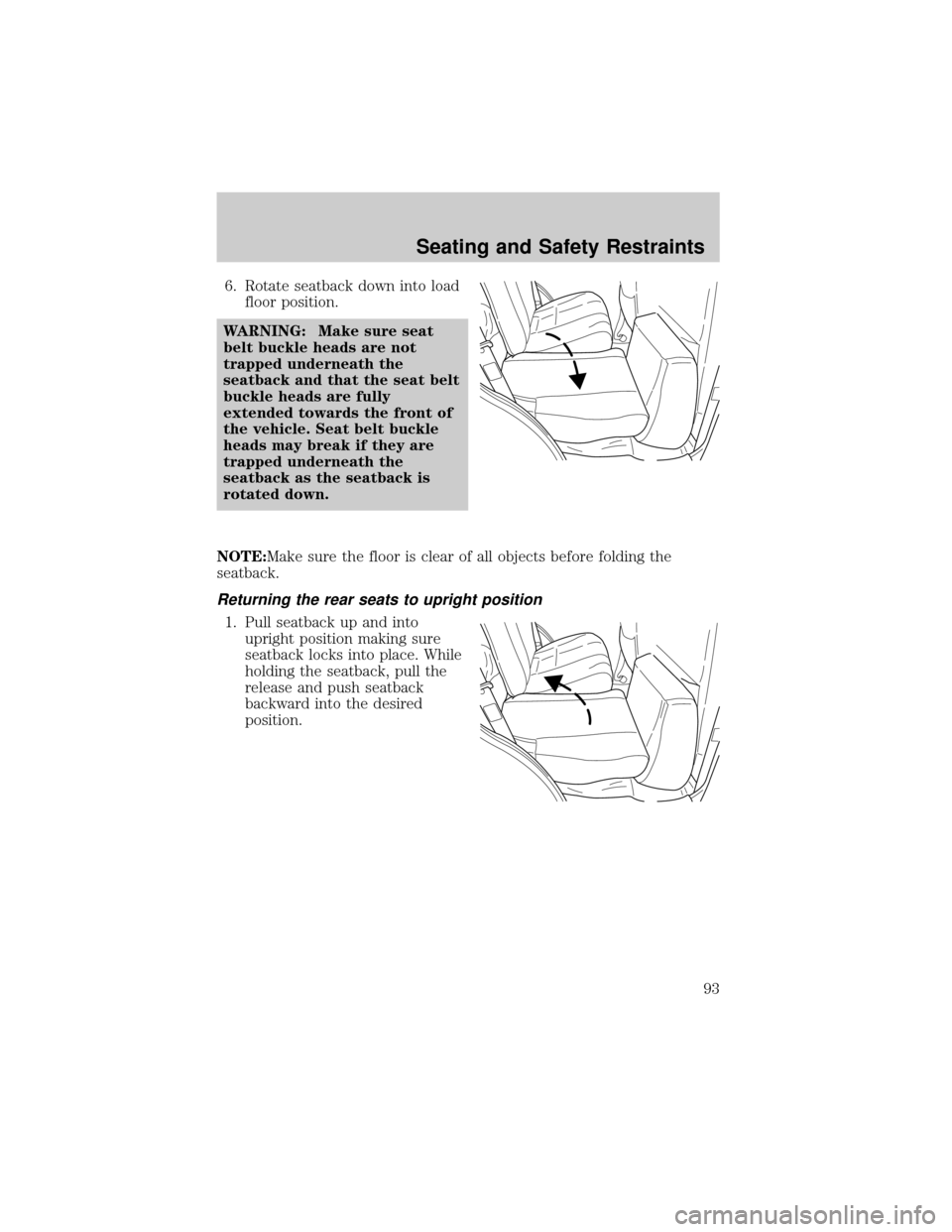
6. Rotate seatback down into load
floor position.
WARNING: Make sure seat
belt buckle heads are not
trapped underneath the
seatback and that the seat belt
buckle heads are fully
extended towards the front of
the vehicle. Seat belt buckle
heads may break if they are
trapped underneath the
seatback as the seatback is
rotated down.
NOTE:Make sure the floor is clear of all objects before folding the
seatback.
Returning the rear seats to upright position
1. Pull seatback up and into
upright position making sure
seatback locks into place. While
holding the seatback, pull the
release and push seatback
backward into the desired
position.
Seating and Safety Restraints
93
Page 96 of 256
3. Pull the seat release control on
each side of the seat to release
the locks.
4. Flip seat forward.
5. Pull the seatback release strap
toward the front seat. Make
sure the seat belt buckle heads
are fully extended towards the
front of the vehicle and are
away from the seatback.
NOTE:When the seatback release
strap is pulled use your other hand
to guide the seatback.
6. Rotate seatback down into load floor position.
WARNING: Make sure seat belt buckle heads are not trapped
underneath the seatback and that the seat belt buckle heads
are fully extended towards the front of the vehicle. Seat belt
buckle heads may break if they are trapped underneath the
seatback as the seatback is rotated down.
NOTE:Make sure the floor is clear of all objects before folding the
seatback.
Seating and Safety Restraints
96
Page 98 of 256

SAFETY RESTRAINTS
Safety restraints precautions
WARNING: Always drive and ride with your seatback upright
and the lap belt snug and low across the hips.
WARNING: To reduce the risk of injury, make sure children sit
where they can be properly restrained.
WARNING: Never let a passenger hold a child on his or her lap
while the vehicle is moving. The passenger cannot protect the
child from injury in a collision.
WARNING: All occupants of the vehicle, including the driver,
should always properly wear their safety belts, even when an
air bag (SRS) is provided.
WARNING: It is extremely dangerous to ride in a cargo area,
inside or outside of a vehicle. In a collision, people riding in
these areas are more likely to be seriously injured or killed. Do
not allow people to ride in any area of your vehicle that is not
equipped with seats and safety belts. Be sure everyone in your
vehicle is in a seat and using a safety belt properly.
WARNING: In a rollover crash, an unbelted person is
significantly more likely to die or be seriously injured than a
person wearing a seat belt.
WARNING: Each seating position in your vehicle has a specific
safety belt assembly which is made up of one buckle and one
tongue that are designed to be used as a pair. 1) Use the
shoulder belt on the outside shoulder only. Never wear the
shoulder belt under the arm. 2) Never swing the safety belt
around your neck over the inside shoulder. 3) Never use a
single belt for more than one person.
Seating and Safety Restraints
98
Page 99 of 256

WARNING: Placing a child, 12 years or younger, in the front
seat is dangerous. The child could be hit by a deploying air bag
and be seriously injured or even killed. A sleeping child is more
likely to lean against the door and be hit by the side air bag in a
moderate collision. Whenever possible, always secure a child, 12
years or younger, in the rear seat, with an appropriate child
restraint system for the child's age and size. Never use a
rear-facing child restraint system in the front seat with an air
bag that could deploy.
Energy Management Feature
²This vehicle has a safety belt system with an energy management
feature at the front seating positions to help further reduce the risk of
injury in the event of a head-on collision.
²This safety belt system has a retractor assembly that is designed to
pay out webbing in a controlled manner. This feature is designed to
help reduce the belt force acting on the occupant's chest.
WARNING: After any vehicle collision, the safety belt system
at all outboard seating positions (except driver, which has no
ªautomatic locking retractorº feature) must be checked by a
qualified technician to verify that the ªautomatic locking
retractorº feature for child seats is still functioning properly. In
addition, all safety belts should be checked for proper function.
Additionally, if the front air bags have deployed, the front
pretensioners have also deployed and the front seat restraint
system must be replaced.
WARNING: BELT AND RETRACTOR ASSEMBLY MUST BE
REPLACED if the safety belt assembly ªautomatic locking
retractorº feature or any other safety belt function is not
operating properly when checked according to the procedures in
Workshop Manual.
WARNING: Failure to replace the Belt and Retractor assembly
could increase the risk of injury in collisions.
Seating and Safety Restraints
99
Page 102 of 256

How to disengage the automatic locking mode
Disconnect the combination lap/shoulder belt and allow it to retract
completely to disengage the automatic locking mode and activate the
vehicle sensitive (emergency) locking mode.
WARNING: After any vehicle collision, the front passenger
outboard seat belt system must be checked by an authorized
Mazda dealership to verify that the ªautomatic locking retractorº
feature for child seats is still functioning properly. In addition, all
seat belts should be checked for proper function. Additionally, if
the front air bags have deployed, the front pretensioners have also
deployed and the front seat restraint system must be replaced.
WARNING: BELT AND RETRACTOR ASSEMBLY MUST BE
REPLACED if the seat belt assembly ªautomatic locking
retractorº feature or any other seat belt function is not
operating properly when checked according to the procedures in
Workshop Manual.
WARNING: Failure to replace the Belt and Retractor assembly
could increase the risk of injury in collisions.
Front safety belt height adjustment
Your vehicle has safety belt height
adjustments for the driver and front
passenger. Adjust the height of the
shoulder belt so the belt rests
across the middle of your shoulder.
To lower the shoulder belt height,
push the button and slide the height
adjuster down. To raise the height
of the shoulder belt, slide the height
adjuster up. Pull down on the height
adjuster to make sure it is locked in
place.
Seating and Safety Restraints
102
Page 103 of 256

WARNING: Position the safety belt height adjusters so that the
belt rests across the middle of your shoulder. Failure to adjust
the safety belt properly could reduce the effectiveness of the
seat belt and increase the risk of injury in a collision.
Safety belt pretensioner
Your vehicle is equipped with safety belt pretensioners at the driver and
front passenger seating positions.
The safety belt pretensioners are designed to activate during certain
frontal or near-frontal collisions with sufficient longitudinal deceleration.
A safety belt pretensioner is a device which tightens the webbing of the
lap and shoulder belts in such a way that they fit more snugly against
the body.
The driver and front outboard passenger safety belt system (including
retractors, buckles and height adjusters) must be replaced if the vehicle
is involved in a collision that results in the activation of the safety belt
pretensioners. Refer to theSafety belt maintenancesection in this
chapter.
WARNING: Failure to replace the safety belt assembly under
the above conditions could result in severe personal injuries in
the event of a collision. The seat belt pretensioners will only
function once. After they are deployed, they will not work again
and must be replaced immediately, even if there was no front
seat occupant seated at the time.
WARNING: Modifying the components or wiring of the
pretensioner system, including the use of electronic testing
devices is dangerous. You could accidentally activate it or make
it inoperable which would prevent it from activating in an
accident. Front occupants could be seriously injured. Never
modify the components or wiring, or use electronic testing
devices on the pretensioner system.
Seating and Safety Restraints
103