Page 28 of 56
COMFORT ADJUSTMENT
100
16G144c
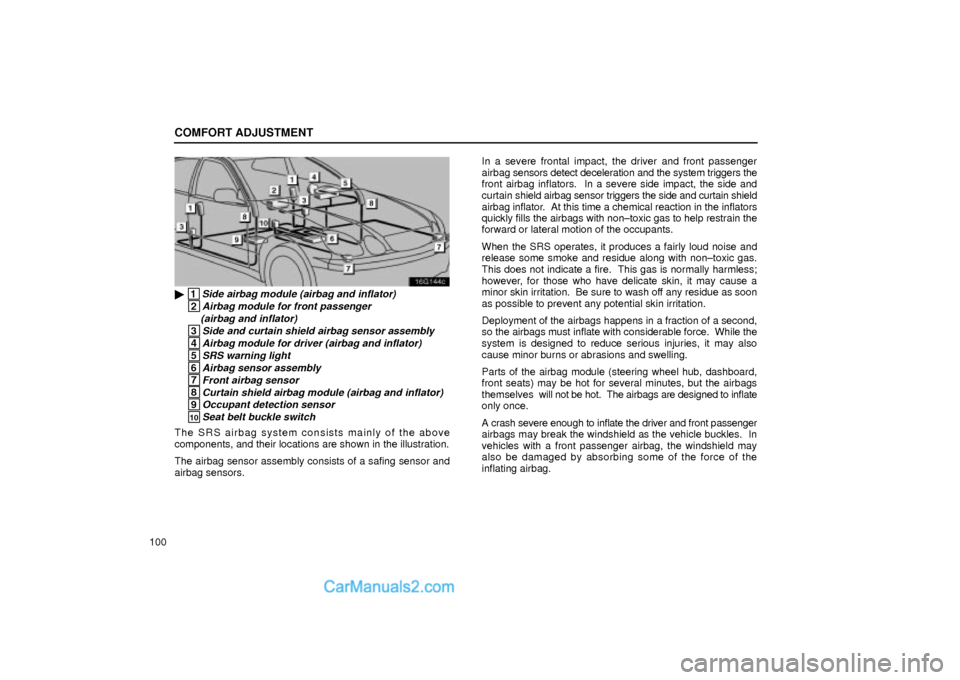
� 1Side airbag module (airbag and inflator)
2Airbag module for front passenger
(airbag and inflator)
3Side and curtain shield airbag sensor assembly
4Airbag module for driver (airbag and inflator)
5SRS warning light
6Airbag sensor assembly
7Front airbag sensor
8Curtain shield airbag module (airbag and inflator)
9Occupant detection sensor
10Seat belt buckle switch
The SRS airbag system consists mainly of the above
components, and their locations are shown in the illustration.
The airbag sensor assembly consists of a safing sensor and
airbag sensors.In a severe frontal impact, the driver and front passenger
airbag sensors detect deceleration and the system triggers the
front airbag inflators. In a severe side impact, the side and
curtain shield airbag sensor triggers the side and curtain shield
airbag inflator. At this time a chemical reaction in the inflators
quickly fills the airbags with non±toxic gas to help restrain the
forward or lateral motion of the occupants.
When the SRS operates, it produces a fairly loud noise and
release some smoke and residue along with non±toxic gas.
This does not indicate a fire. This gas is normally harmless;
however, for those who have delicate skin, it may cause a
minor skin irritation. Be sure to wash off any residue as soon
as possible to prevent any potential skin irritation.
Deployment of the airbags happens in a fraction of a second,
so the airbags must inflate with considerable force. While the
system is designed to reduce serious injuries, it may also
cause minor burns or abrasions and swelling.
Parts of the airbag module (steering wheel hub, dashboard,
front seats) may be hot for several minutes, but the airbags
themselves will not be hot. The airbags are designed to inflate
only once.
A crash severe enough to inflate the driver and front passenger
airbags may break the windshield as the vehicle buckles. In
vehicles with a front passenger airbag, the windshield may
also be damaged by absorbing some of the force of the
inflating airbag.
Page 31 of 56
COMFORT ADJUSTMENT
103
16G030±1
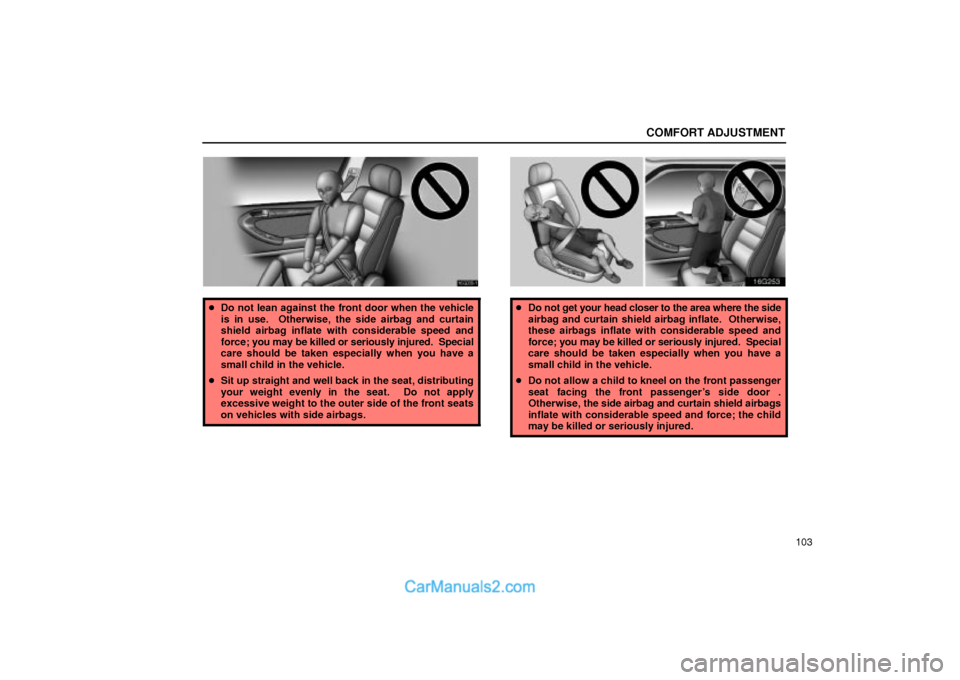
�Do not lean against the front door when the vehicle
is in use. Otherwise, the side airbag and curtain
shield airbag inflate with considerable speed and
force; you may be killed or seriously injured. Special
care should be taken especially when you have a
small child in the vehicle.
�Sit up straight and well back in the seat, distributing
your weight evenly in the seat. Do not apply
excessive weight to the outer side of the front seats
on vehicles with side airbags.
16g253
�Do not get your head closer to the area where the side
airbag and curtain shield airbag inflate. Otherwise,
these airbags inflate with considerable speed and
force; you may be killed or seriously injured. Special
care should be taken especially when you have a
small child in the vehicle.
�Do not allow a child to kneel on the front passenger
seat facing the front passenger's side door .
Otherwise, the side airbag and curtain shield airbags
inflate with considerable speed and force; the child
may be killed or seriously injured.
Page 34 of 56
COMFORT ADJUSTMENT
106
�Do not use seat accessories which cover the parts
where the side airbags inflate. Such accessories may
prevent the side airbags from activating correctly,
causing death or serious injury.
�Do not modify or remove any wiring. Do not modify,
remove, strike or open any components, such as the
steering wheel pad, steering wheel, column cover,
front passenger airbag cover, front seats or airbag
sensor assembly. Doing so may cause sudden SRS
front airbags inflation or disable the system, which
could result in death or serious injury.
�Do not modify or replace the seats or upholstery of
front seats with side airbags. Such changes may
disable the system or cause the side airbags to inflate
accidentally, resulting in death or serious injury.
�Do not disassemble or repair the front pillar and roof
side rail containing the curtain shield airbags. Such
changes may disable the system or cause the curtain
shield airbags to inflate accidentally, resulting in
death or serious injury.
Failure to follow these instructions can result in death
or serious injury. Consult your Lexus dealer about any
repairs and modifications.NOTICE
Do not perform any of the following changes without
consulting your Lexus dealer. Such changes can
interfere with proper operation of the SRS airbag
system in some cases.
�Installation of electronic devices such as a mobile
two±way radio, cassette tape player or compact disc
player.
�Modification of the suspension system.
�Modification of the front end structure and side
structure of the passenger compartment.
�Attachment of a grille guard (bull bar, kangaroo bar,
etc.), snowplow, winches or any other equipment to
the front end.
�Repairs made on or near the front fenders, front end
structure, console, steering column, steering wheel,
dashboard near the front passenger airbag or front
seats.
Page 36 of 56
COMFORT ADJUSTMENT
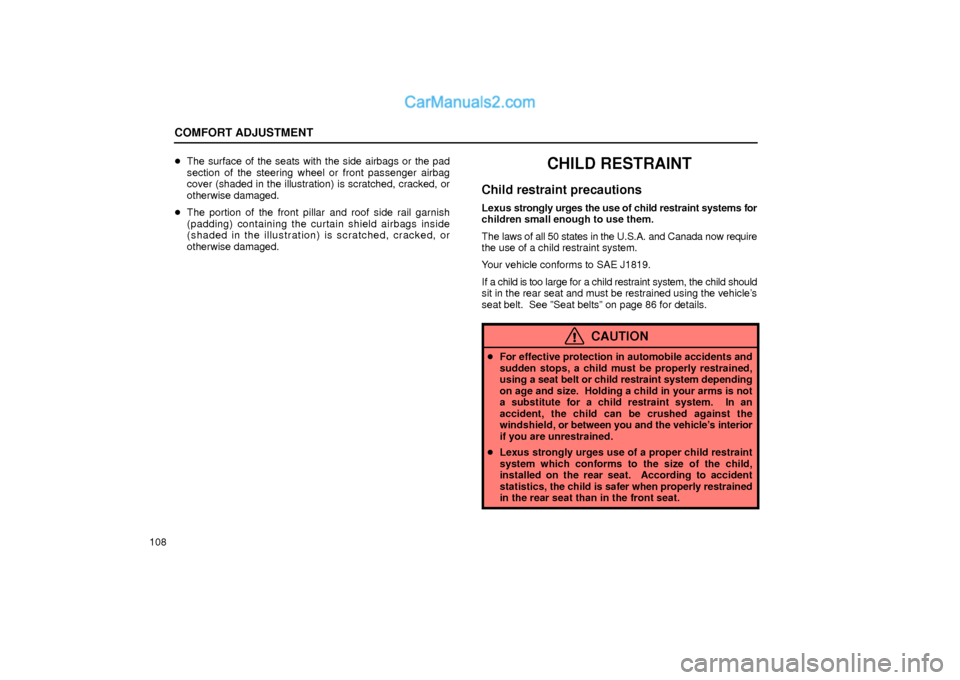
108�The surface of the seats with the side airbags or the pad
section of the steering wheel or front passenger airbag
cover (shaded in the illustration) is scratched, cracked, or
otherwise damaged.
�The portion of the front pillar and roof side rail garnish
(padding) containing the curtain shield airbags inside
(shaded in the illustration) is scratched, cracked, or
otherwise damaged.
CHILD RESTRAINT
Child restraint precautions
Lexus strongly urges the use of child restraint systems for
children small enough to use them.
The laws of all 50 states in the U.S.A. and Canada now require
the use of a child restraint system.
Your vehicle conforms to SAE J1819.
If a child is too large for a child restraint system, the child should
sit in the rear seat and must be restrained using the vehicle's
seat belt. See ºSeat beltsº on page 86 for details.
CAUTION
�For effective protection in automobile accidents and
sudden stops, a child must be properly restrained,
using a seat belt or child restraint system depending
on age and size. Holding a child in your arms is not
a substitute for a child restraint system. In an
accident, the child can be crushed against the
windshield, or between you and the vehicle's interior
if you are unrestrained.
�Lexus strongly urges use of a proper child restraint
system which conforms to the size of the child,
installed on the rear seat. According to accident
statistics, the child is safer when properly restrained
in the rear seat than in the front seat.
Page 52 of 56
COMFORT ADJUSTMENT
124
16G078a
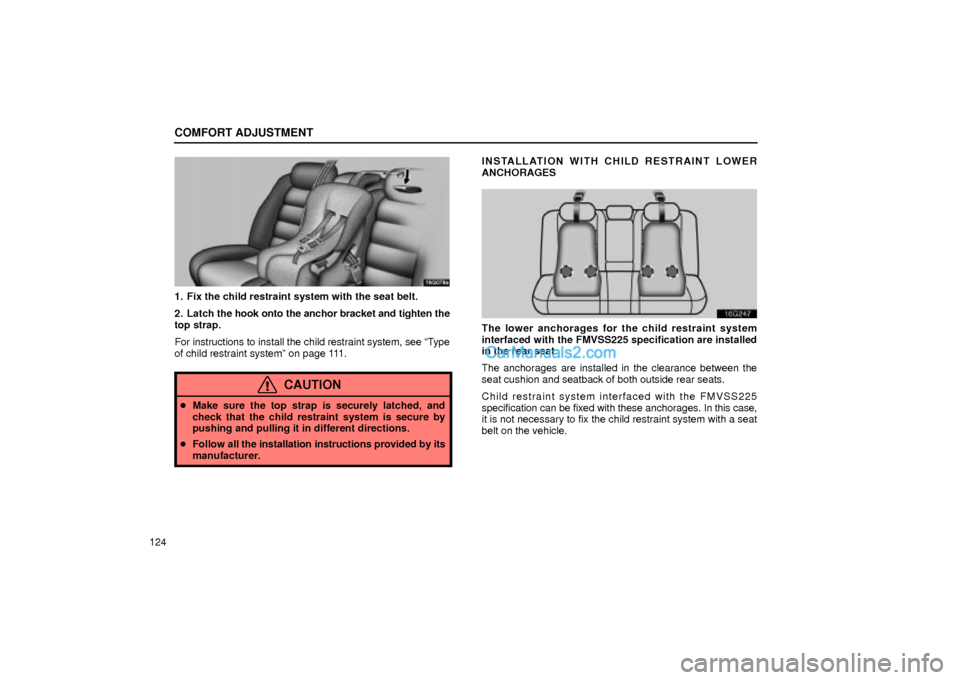
1. Fix the child restraint system with the seat belt.
2. Latch the hook onto the anchor bracket and tighten the
top strap.
For instructions to install the child restraint system, see ªType
of child restraint systemº on page 111.
CAUTION
�Make sure the top strap is securely latched, and
check that the child restraint system is secure by
pushing and pulling it in different directions.
�Follow all the installation instructions provided by its
manufacturer.
INSTALLATION WITH CHILD RESTRAINT LOWER
ANCHORAGES
16g247
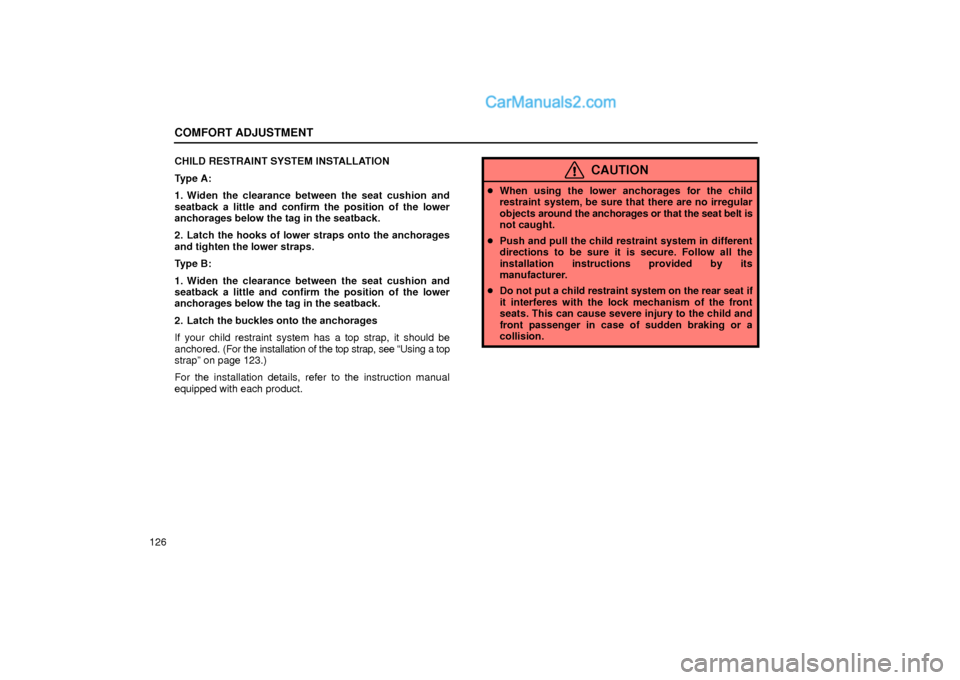
The lower anchorages for the child restraint system
interfaced with the FMVSS225 specification are installed
in the rear seat.
The anchorages are installed in the clearance between the
seat cushion and seatback of both outside rear seats.
Child restraint system interfaced with the FMVSS225
specification can be fixed with these anchorages. In this case,
it is not necessary to fix the child restraint system with a seat
belt on the vehicle.
Page 54 of 56
COMFORT ADJUSTMENT
126CHILD RESTRAINT SYSTEM INSTALLATION
Type A:
1. Widen the clearance between the seat cushion and
seatback a little and confirm the position of the lower
anchorages below the tag in the seatback.
2. Latch the hooks of lower straps onto the anchorages
and tighten the lower straps.
Type B:
1. Widen the clearance between the seat cushion and
seatback a little and confirm the position of the lower
anchorages below the tag in the seatback.
2. Latch the buckles onto the anchorages
If your child restraint system has a top strap, it should be
anchored. (For the installation of the top strap, see ªUsing a top
strapº on page 123.)
For the installation details, refer to the instruction manual
equipped with each product.
CAUTION
�When using the lower anchorages for the child
restraint system, be sure that there are no irregular
objects around the anchorages or that the seat belt is
not caught.
�Push and pull the child restraint system in different
directions to be sure it is secure. Follow all the
installation instructions provided by its
manufacturer.
�Do not put a child restraint system on the rear seat if
it interferes with the lock mechanism of the front
seats. This can cause severe injury to the child and
front passenger in case of sudden braking or a
collision.