2002 LAND ROVER DISCOVERY seats
[x] Cancel search: seatsPage 574 of 1672

FUEL DELIVERY SYSTEM - V8
DESCRIPTION AND OPERATION 19-2-9
Injectors
1'O' ring 2 off
2Electrical connector
3Steel housing
4Filter strainer
5Spring6Valve needle and armature
7Valve seat/spray orifice
8Plastic housing
9Solenoid winding
An injector for each cylinder is mounted externally in the lower inlet manifold on the engine. The injector protrudes
into the inlet manifold tract, where it releases a controlled delivery of fuel into the manifold air inlet.
Each injector is sealed to the fuel rail and the inlet manifold with 'O' rings. Spring clips retain each injector to the fuel
rail and the attachment of the fuel rail clamps the injectors in the lower manifold.
The injector housing is manufactured from plastic which encapsulates a high-alloy steel housing. The steel housing
contains all components which come into contact with fuel. The plastic housing also provides the attachment for the
engine harness connector for the injector. A solenoid is located between the two housings and moves a valve needle
via an armature. The valve needle seats on a valve seat which incorporates a spray orifice plate. A filter strainer is
fitted at the connection with the fuel rail to remove any particulate matter from the fuel before it enters the injector.
When the ECM energises the solenoid, the armature moves lifting the valve needle off its seat. This allows
pressurised fuel from the fuel rail to pass through the injector housing and needle to the spray orifice. The spray orifice
controls the spray shape and fuel metering. When the solenoid is de-energised, the valve needle returns to the valve
seat, aided by a spring, closing off the injection of fuel into the inlet.
Each injector receives a battery supply voltage via a fuse in the engine compartment fusebox. The fuel delivery timing
is controlled by the ECM, which, at a precisely timed interval, provides a ground path for the injector. The completion
of the ground path operates the injector to allow fuel at pump pressure to be delivered from the fuel rail to the injector
nozzle. Each injector sprays a finely atomized spray of fuel into the inlet, where it is mixed with the intake air prior to
combustion.
+ ENGINE MANAGEMENT SYSTEM - V8, DESCRIPTION AND OPERATION, Description - engine
management.
Faults for each injector are stored in the ECM and can be retrieved using TestBook. Each injector can be checked
across the two connector pins. For a correctly functioning injector a resistance of between 13.8 and 15.2 ohms at a
temperature of 20
°C (65°F) should be read across the pins.
Page 578 of 1672

FUEL DELIVERY SYSTEM - V8
REPAIRS 19-2-13
REPAIRS
Switch - inertia - fuel cut-off
$% 19.22.09
Remove
1.Disconnect multiplug from fuel cut-off switch.
2.Remove 2 screws securing fuel cut-off switch to
bulkhead.
3.Remove fuel cut-off switch from bulkhead.
Refit
1.Position fuel cut-off switch to bulkhead and
secure with screws.
2.Connect multiplug to fuel cut-off switch.
3.To set the fuel cut-off switch, depress the top of
the fuel cut-off switch.
Pump - fuel
$% 19.45.08
NOTE: The fuel pump and fuel gauge tank unit are
integral parts of the fuel pump housing and cannot be
renewed separately
Remove
1.Release fixings and remove battery cover.
2.Disconnect battery earth lead.
3. Models with third row seats: Remove RH
third row seat.
+ SEATS, REPAIRS, Seat - third row.
4.Remove 5 trim clips securing lower edge of RH
'D' post trim casing.
5. Models with rear ICE controls: Remove
screw securing remote ICE controls to RH side
trim casing.
6. Models with rear ICE controls: Release ICE
controls from RH side trim casing. Disconnect
multiplug and remove ICE controls.
7.Partially remove tail door aperture seal in the
area of the RH side trim casing.
Page 579 of 1672

FUEL DELIVERY SYSTEM - V8
19-2-14 REPAIRS
8.Remove 2 trim clips securing RH side trim
casing to body.
9.Remove rear lamp access panel from RH side
trim casing.
10.Remove trim clip securing RH side trim casing
to lower 'E' post.
11. Models with third row seats: Remove bolt
securing lower mounting of third row seat belt to
body.
12.Remove RH side trim casing.
13.Pull back loadspace carpet from fuel pump
access panel.
14.Remove 6 screws securing access panel.
15.Remove access panel.
16.Disconnect multiplug and fuel hose from fuel
pump housing.
CAUTION: Always fit plugs to open
connections to prevent contamination.
17. NAS models: Disconnect pressure sensor
pipe from fuel pump housing.
CAUTION: Always fit plugs to open
connections to prevent contamination.18.Use LRT-19-009 to remove locking ring from
fuel pump housing.
19.Remove fuel pump housing.
20.Remove and discard sealing ring from fuel
pump housing.
Refit
1.Clean fuel pump housing and mating face on
fuel tank.
2.Fit new seal to mating face on fuel tank.
3.Fit fuel pump housing to fuel tank and use LRT-
19-009 to fit locking ring.
4.Connect multiplug and fuel hose to fuel pump
housing.
5. NAS models: Connect pressure sensor pipe to
fuel pump housing.
6.Fit access panel and secure with screws.
7.Reposition loadspace carpet.
8.Fit RH side trim casing.
9. Models with third row seats: Fit bolt securing
lower mounting of third row seat belt to body
and tighten to 50 Nm (37 lbf.ft).
10.Fit trim clip securing RH side trim casing to
lower 'E' post.
11.Fit rear lamp access panel to RH side trim
casing.
12.Fit trim clips securing RH side trim casing to
body.
13.Fit tail door aperture seal.
14. Models with rear ICE controls: Connect
multiplug to remote ICE controls.
15. Models with rear ICE controls: Fit ICE
controls to RH side trim casing and secure with
screw.
16.Fit trim clips securing lower edge of RH 'D' post
trim casing to body.
17. Models with third row seats: Fit RH third row
seat.
+ SEATS, REPAIRS, Seat - third row.
18.Connect battery earth lead.
19.Fit battery cover and secure with fixings.
Page 657 of 1672

CLUTCH - TD5
33-1-6 DESCRIPTION AND OPERATION
Description
General
The clutch system is a diaphragm type clutch operated by a hydraulic cylinder. The drive plate is of the rigid centre
type with no integral damping springs. The flywheel is of the dual mass type with damping springs integral with the
flywheel. The clutch requires no adjustment to compensate for wear.
Hydraulic clutch
The hydraulic clutch comprises a master cylinder, slave cylinder and a hydraulic reservoir. The master and slave
cylinders are connected to each other hydraulically by plastic and metal pipes. The plastic section of the pipe allows
ease of pipe routing and also absorbs engine movements and vibrations.
The master cylinder comprises a body with a central bore. Two ports in the body connect the bore to the hydraulic
feed pipe to the slave cylinder and the fluid reservoir. The bore is also connected to a damper which prevents engine
pulses being transferred hydraulically to the clutch pedal. A piston is fitted in the bore and has an external rod which
is attached to the clutch pedal with a pin. Two coil springs on the clutch pedal reduce the effort required to depress
the pedal.
The master cylinder is mounted on the bulkhead and secured with two bolts. The cylinder is connected to the shared
brake/clutch reservoir on the brake servo by a braided connecting hose.
The slave cylinder is located on the left hand side of the gearbox housing and secured with two bolts. A heat shield
is fitted to protect the underside of the slave cylinder from heat generated from the exhaust system. The slave cylinder
comprises a cylinder with a piston and a rod. A port in the cylinder body provides the attachment for the hydraulic feed
pipe from the master cylinder. A second port is fitted witha bleed nipple used for removing air from the hydraulic
system after servicing. The piston rod locates on a clutch release lever located in the gearbox housing. The rod is
positively retained on the release lever with a clip.
Clutch mechanism
The clutch mechanism comprises a flywheel, drive plate, pressure plate, release lever and a release bearing. The
clutch mechanism is fully enclosed at the rear of the engine by the gearbox housing.
A clutch release bearing sleeve is attached in the gearbox housing with two bolts and located on two dowels. A spigot
with a ball end is formed on the release bearing sleeve and provides amounting and pivot point for the clutch release
lever. A dished pivot washer is located on the ball of the spigot. When the release lever is located on the ball, the pivot
washer seats against the rear face of the release lever. A spring clip is located on the lever and the pivot washer and
secures the lever on the spigot. A small bolt retains the spring clip in position.
The release lever is forked at its inner end and locates on the clutch release bearing carrier. The outer end of the
release lever has a nylon seat which locates the slave cylinder piston rod. A second nylon seat, positioned centrally
on the release lever, locates on the ball spigot of the release bearing sleeve and allows the release lever to pivot freely
around the ball.
The clutch release bearing locates on the clutch release lever and release bearing sleeve. The bearing is retained on
a carrier which has two flats to prevent the carrier rotating on the release lever. A clip retains the release lever on the
carrier. The bearing and carrier are not serviceable individually.
Page 673 of 1672

CLUTCH - V8
33-2-6 DESCRIPTION AND OPERATION
Description
General
The clutch system is a conventional diaphragm type clutch operated by a hydraulic cylinder. The clutch requires no
adjustment to compensate for wear.
Hydraulic clutch
The hydraulic clutch comprises a master cylinder, slave cylinder and a hydraulic reservoir, which is also shared with
the braking system. The master and slave cylinders are connected to each other hydraulically by plastic and metal
pipes. The plastic section of the pipe allows ease of pipe routing and also absorbs engine movements and vibrations.
The master cylinder comprises a body with a central bore. Two ports in the body connect the bore to the hydraulic
feed pipe to the slave cylinder and the brake/clutch fluid reservoir. A piston is fitted in the bore and has an external
rod which is attached to the clutch pedal with a pin. Two coiled springs on the clutch pedal reduce the effort required
to depress the pedal.
The master cylinder is mounted on the bulkhead in the engine compartment and secured with two bolts. The cylinder
is connected to the shared brake/clutch reservoir on the brake servo by a braided connecting hose.
The slave cylinder is located on the left hand side of the gearbox housing and secured with two bolts. A heat shield
protects the underside of the cylinder from heat generated from the exhaust system. The slave cylinder comprises a
cylinder with a piston and a rod. A port in the cylinder body provides the attachment for the hydraulic feed pipe from
the master cylinder. A second port is fitted with a bleed nipple for removing air from the hydraulic system after
servicing. The piston rod locates on a clutch release lever located in the gearbox housing. The rod is positively
retained on the release lever with a clip.
Clutch mechanism
The clutch mechanism comprises a flywheel, drive plate, pressure plate, release lever and a release bearing. The
clutch mechanism is fully enclosed at the rear of the engine by the gearbox housing.
A clutch release bearing sleeve is attached in the gearbox housing with two bolts and located on two dowels. A spigot
with a ball end is formed on the release bearing sleeve and provides a mounting and pivot point for the clutch release
lever. A dished pivot washer is located on the ball of the spigot. When the release lever is located on the ball, the pivot
washer seats against the rear face of the release lever. A spring clip is located on the lever and the pivot washer and
secures the lever on the spigot. A small bolt retains the spring clip in position.
The release lever is forked at its inner end and locates on the clutch release bearing carrier. The outer end of the
release lever has a nylon seat which locates the slave cylinder piston rod. A second nylon seat, positioned centrally
on the release lever, locates on the ball spigot of the release bearing sleeve and allows the release lever to pivot freely
around the ball.
The clutch release bearing locates on the clutch release lever and the release bearing sleeve. The bearing is retained
on a carrier which has two flats to prevent the carrier rotating on the release lever. A clip retains the release lever on
the carrier. The bearing and carrier are not serviceable individually.
Page 674 of 1672

CLUTCH - V8
DESCRIPTION AND OPERATION 33-2-7
Flywheel
The flywheel is bolted to a flange on the rear of the crankshaft with six bolts. A dowel on the crankshaft flange ensures
that the flywheel is correctly located. A ring gear is fitted on the outside diameter of the flywheel and seats against a
flange. The ring gear is an interference fit on the flywheel and is installed by heating the ring and cooling the flywheel.
The ring gear is a serviceable item and can be replaced if damaged or worn.
The operating face of the flywheel is machined to provide a smooth surface for the drive plate to engage on. Three
dowels and six threaded holes provide for the location and attachment of the pressure plate. The flywheel is balanced
to ensure that it does not produce vibration when rotating. A machined slot, with a series of holes within the slot, is
located on the engine side of the flywheel. The slot accommodates the tip of the crankshaft position sensor which is
used by the Engine Control Module (ECM) for engine management.
+ ENGINE MANAGEMENT SYSTEM - V8, DESCRIPTION AND OPERATION, Description - engine
management.
Pressure plate
1Leaf spring
2Fulcrum ring
3Fulcrum ring
4Drive plate
5Pressure plate6Diaphragm
7Cover
8Rivet
9Retractor clip
The pressure plate assembly comprises a pressure plate, cover and diaphragm and is mounted on and rotates with
the flywheel.
Page 937 of 1672
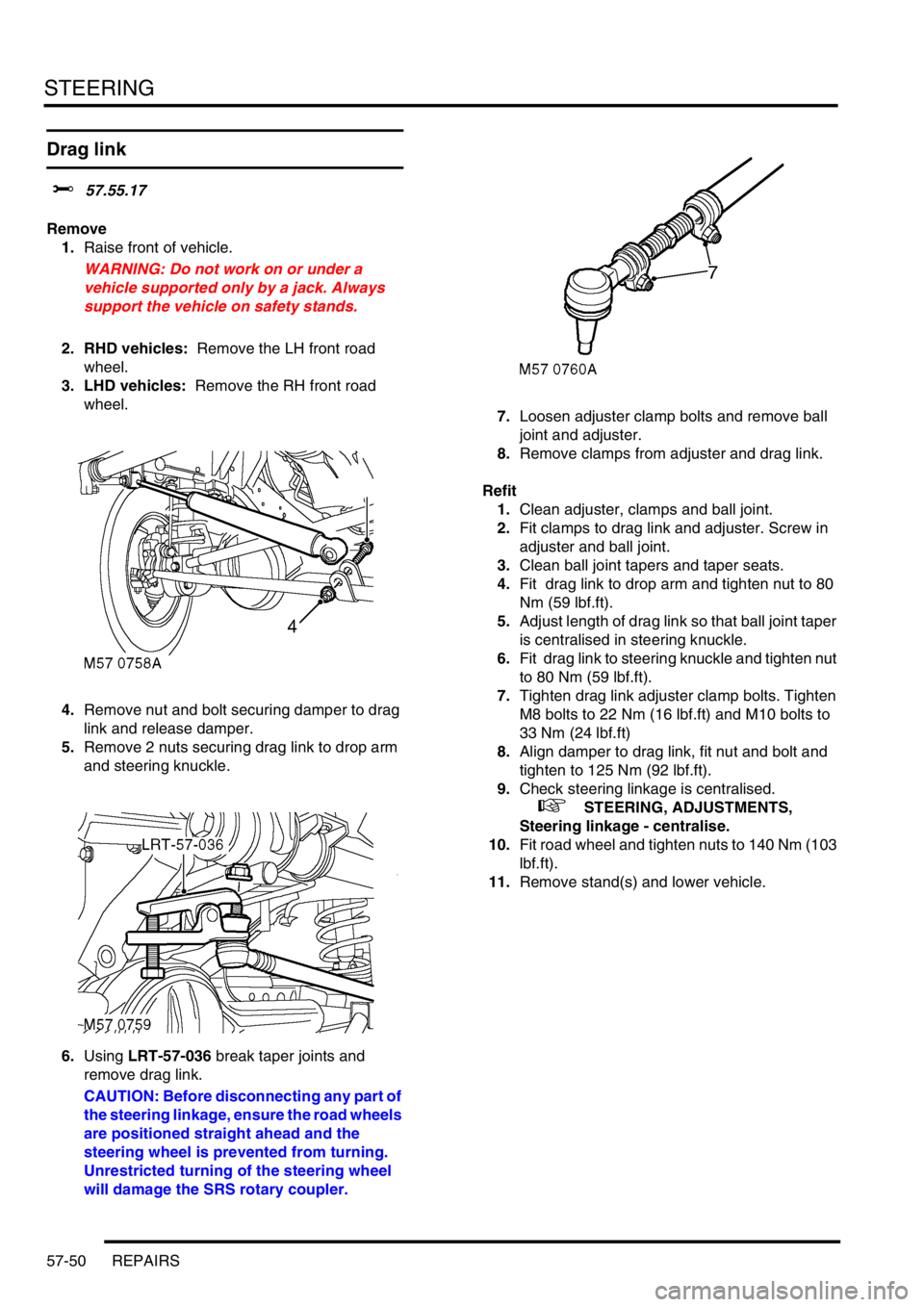
STEERING
57-50 REPAIRS
Drag link
$% 57.55.17
Remove
1.Raise front of vehicle.
WARNING: Do not work on or under a
vehicle supported only by a jack. Always
support the vehicle on safety stands.
2. RHD vehicles: Remove the LH front road
wheel.
3. LHD vehicles: Remove the RH front road
wheel.
4.Remove nut and bolt securing damper to drag
link and release damper.
5.Remove 2 nuts securing drag link to drop arm
and steering knuckle.
6.Using LRT-57-036 break taper joints and
remove drag link.
CAUTION: Before disconnecting any part of
the steering linkage, ensure the road wheels
are positioned straight ahead and the
steering wheel is prevented from turning.
Unrestricted turning of the steering wheel
will damage the SRS rotary coupler.7.Loosen adjuster clamp bolts and remove ball
joint and adjuster.
8.Remove clamps from adjuster and drag link.
Refit
1.Clean adjuster, clamps and ball joint.
2.Fit clamps to drag link and adjuster. Screw in
adjuster and ball joint.
3.Clean ball joint tapers and taper seats.
4.Fit drag link to drop arm and tighten nut to 80
Nm (59 lbf.ft).
5.Adjust length of drag link so that ball joint taper
is centralised in steering knuckle.
6.Fit drag link to steering knuckle and tighten nut
to 80 Nm (59 lbf.ft).
7.Tighten drag link adjuster clamp bolts. Tighten
M8 bolts to 22 Nm (16 lbf.ft) and M10 bolts to
33 Nm (24 lbf.ft)
8.Align damper to drag link, fit nut and bolt and
tighten to 125 Nm (92 lbf.ft).
9.Check steering linkage is centralised.
+ STEERING, ADJUSTMENTS,
Steering linkage - centralise.
10.Fit road wheel and tighten nuts to 140 Nm (103
lbf.ft).
11.Remove stand(s) and lower vehicle.
Page 943 of 1672

FRONT SUSPENSION
60-4 DESCRIPTION AND OPERATION
Description
General
The front suspension comprises two dampers and coil springs, two radius arms, a Panhard rod and an anti-roll bar.
The front axle provides the location points for the dampers, springs, radius arms and the Panhard rod.
The anti-roll bar assembly is an essential part of the front suspension. On vehicles without Active Cornering
Enhancement (ACE) a conventional 'passive' anti-roll bar is fitted. On vehicles fitted with the ACE system, a thicker
diameter anti-roll bar, known as a torsion bar, is used with an actuator at one end.
+ FRONT SUSPENSION, DESCRIPTION AND OPERATION, Description - ACE.
The hydraulic dampers and coil springs provide springing for each front wheel. The long travel dampers, springs and
radius arms provide maximum axle articulation and wheel travel for off-road driving. The front axle is controlled
longitudinally by two forged steel radius arms and transversely by a Panhard rod.
Radius arms
Each radius arm is manufactured from forged steel. Two bushes are pressed into the forward end of the radius arm.
The forward end of the radius arm is located in a fabricated bracket on the axle and secured through the bushes with
two bolts and nuts. A bush is pressed into the rear of the radius arm which is also located in a fabricated bracket on
each chassis longitudinal and secured through the bush with a bolt and nut.
The radius arms prevent longitudinal movement of the front axle and because of their length allow maximum axle
articulation. The stiffness of the bushes in each radius arm also contributes to the vehicle roll stiffness.
Each radius arm has a notch on its lower edge which provides location for the vehicle jack.
Dampers
Two conventional telescopic dampers are used to control body/axle movement. A turret is located on a bracket welded
to the chassis. The upper spring seat has four studs which pass through holes in the bracket and align with
corresponding holes in the turret. Four nuts are screwed onto the studs and secure the turret and upper spring seat
to the chassis.
A fabricated platform is welded to the axle. The platform has two captive nuts which provide for the attachment of the
damper. A lower spring seat is located on the platform. Each spring seat is handed and has a bracket which secures
the ABS sensor harness and the front brake hose.
Each damper is fitted with a bush at its upper end. The bush locates in the top of the turret and is secured with a cross
bolt. The lower attachment point for the damper is also fitted with a bush. This bush has a spindle through its centre
with a hole at each end. The spindle is seated on the lower spring seat and the axle platform and secured with two
bolts. The coil spring is fitted in a compressed state between the upper and lower spring seats and assists the damper
in controlling the body/axle movement. The upper and lower bushes are replaceable items.
Rubber bump stops are fitted to the chassis above each end of the axle. The bump stops are progressive in their
compression and prevent the axle from contacting the chassis in the event of maximum suspension travel being
reached. The bump stops revert to their original shape once the compression load has been removed from them.
The damper functions by restricting the flow of a hydraulic fluid through internal galleries within the damper body. A
chromium plated rod moves axially within the damper. As the rod moves, its movement is limited by the flow of fluid
through the galleries thus providing damping of undulations in the terrain. The damper rod is sealed at its exit point
from the body to maintain fluid within the unit and prevent the ingress of dirt and moisture. The seal also acts as a
wiper to keep the rod outer diameter clean. A plastic shroud protects the rod and slides over the body as the damper
moves. The coil spring aids the damper to extend after being compressed and also aids the damping process.