2002 LAND ROVER DISCOVERY oil type
[x] Cancel search: oil typePage 156 of 1672

ENGINE - TD5
DESCRIPTION AND OPERATION 12-1-17
1Full-flow filter housing
2Thermostat
3Roll-pin
4Port – feed line to turbocharger
5Outlet port from full-flow filter (> 74
° C)
6Inlet port to full-flow filter
7Outlet port from full-flow filter (< 74
° C)
The main filter is a conventional full-flow cartridge-type filter containing a paper element able to trap particles greater
than 15 micron (0.015 mm) in diameter.
The cartridge is screwed to an adaptor casting by way of a hollow brass threaded insert which connects the filter outlet
port to the adaptor casting. A sealing ring seals the union between the oil filter cartridge and the adaptor casting.
Page 158 of 1672

ENGINE - TD5
DESCRIPTION AND OPERATION 12-1-19
Oil Pressure switch
The oil pressure switch is located in a port on the outlet side of the oil cooler housing. It detects when a safe operating
pressure has been reached during engine starting and initiates the illumination of a warning light in the instrument
pack if the pressure drops below a given value.
Crankshaft, sump and oil pump components
The crankshaft, sump and oil pump components are described below:
Sump
The sump is a wet-type, of aluminium construction and is sealed to the engine block by means of a rubber gasket and
twenty fixing bolts. The four bolts at the gearbox end of the sump are longer than the other sixteen bolts.
The sump gasket incorporates compression limiters (integrated metal sleeves) at the bolt holes, which are included
to prevent distortion of the gasket when the sump to cylinder block bolts are being tightened.
The oil drain plug is fitted at the bottom of the oil sump reservoir. An oil return drain pipe is also attached to the oil
sump which returns oil from the centrifugal filter.
Stiffener Plate
The stiffener plate assembly provides lower engine block rigidity and utilises dowels to align it to the bottom of the
cylinder block. A rotary oil pump is integral with the stiffener plate and an oil pick-up and strainer assembly is fitted
to the underside of the stiffener plate. The stiffener and oil pump assembly is secured to the cylinder block by 22 bolts.
Page 159 of 1672

ENGINE - TD5
12-1-20 DESCRIPTION AND OPERATION
Oil pump
1Stiffener plate
2Ring dowel
3Outlet port
4Outer rotor
5Inner rotor6Spring dowel
7Oil pressure relief valve cap
8Oil pressure relief valve spring
9Oil pressure relief valve plunger
10Inlet port
The eccentric rotor oil pump is integrated with the stiffener plate and contains no serviceable parts except for the
pressure relief valve spring. The oil pump drive sprocket is attached to the front of the stiffener plate and is driven
through a chain and sprocket system.
A pressure relief valve is included at the outlet side of the oil pump to restrict oil pressure at high engine speeds by
recirculating oil through the relief valve back around the pump to the inlet. The relief valve and spring is a plunger type.
When oil pressure is great enough to lift the plunger, oil is allowed to escape past the plunger to relieve pressure and
prevent further rise.
Oil is delivered to the pump from the pick-up through a channel in the stiffener plate. The outlet side of the oil pump
delivers pressurised oil flow to the engine block main oil delivery gallery through a port in the stiffener plate.
Piston lubrication jets
Piston lubrication jets are fitted to the cylinder block to provide lubrication to the cylinder walls, and to the piston
underskirt for cooling the pistons and lubricating the gudgeon pins. The input port to each lubrication jet mates with a
port provided in each mounting position tapped at the underside of the cylinder block from the main oil delivery gallery.
When oil pressure is sufficient to supply flow through the jets, oil is squirted to the inside of the cylinder walls to provide
piston to wall lubrication and cooling and to the underside of the piston skirt at the bottom of the piston stroke (gallery
cooled piston). The squirt jets also provide splash feed lubrication supply to the small end bearings of the connecting
rods.
Each lubrication jet is fixed to a mounting position on the underside of the engine block by a single Torx screw.
Chain lubrication jet
A chain lubrication jet is located on the front face of the cylinder block, behind the front engine timing chain cover. The
inlet port to the lubrication jet mates with an oil supply port from the cylinder block main oil delivery gallery. The
lubrication jet is fixed to the front of the engine block by a single screw. Additional chain lubrication is provided by oil
supply through a small aperture tapped from the cylinder head oil delivery gallery.
Page 160 of 1672

ENGINE - TD5
DESCRIPTION AND OPERATION 12-1-21
Crankshaft
1Front end to crankshaft sprocket
2Oil supply cross-drillings
3Main journals
4Big-end journals
5Rear end to flywheel
The crankshaft is constructed from cast iron and is surface-hardened. The areas between the crankshaft journals and
the adjoining webs and balance weights are compressed using the cold roll process to form journal fillets.
Cross-drillings in the crankshaft between adjoining main and big-end bearings are used to divert lubrication oil to the
big-end bearings.
A torsional vibration damper is attached to the crankshaft pulley by three bolts.
The crankshaft is carried in six main bearings, with end-float being controlled by thrust washers positioned on both
sides of No. 3 main bearing.
Main bearings
There are six main bearings used to carry the crankshaft. Each of the bearing caps are of cast iron construction and
are attached to the cylinder block by two bolts.
The bearing shells are of the split cylindrical type. The upper half bearing shells are grooved to facilitate the supply of
lubrication oil to the bearings and fit into a recess in the underside of the cylinder block. The lower half bearing shells
are smooth and fit into the bearing caps.
Steel-backed thrust washers are included at each side of No. 3 main bearing to control crankshaft end-float. One side
of each of the thrust washers is grooved, the grooved side of each of the thrust washers is fitted facing outward from
No. 3 main bearing.
Cylinder head components
The cylinder head components are described below:
Cylinder head
The cylinder head is of aluminium construction. It is not possible to reface the cylinder head if it becomes worn or
damaged. An alloy camshaft carrier is bolted directly to the upper surface of the cylinder head. Two dowels are
included in the cylinder head upper face for correct location of the camshaft carrier.
The EU3 cylinder head has a single internal fuel rail for delivering fuel to the injectors and an external fuel pipe for
returning spill fuel back to the fuel connector block. Therefore, pre EU3 and EU3 model cylinder heads are not
interchangeable.
CAUTION: The cylinder head incorporates drillings for the fuel injection system, any contamination which
enters these drillings could cause engine running problems or injector failure. It is therefore, essential that
absolute cleanliness is maintained when carrying out work on the cylinder head.
Page 164 of 1672

ENGINE - TD5
DESCRIPTION AND OPERATION 12-1-25
Inlet and exhaust valves
The inlet and exhaust valves are mounted directly above the engine block cylinders.
Each valve is a forged and ground solid one-piece head and stem which is hardened by heat treatment. The stems
are chrome-plated then ground for improved heat transfer, wear resistance and smooth operation. It is not possible
to recut the valve's face angle, but the valves can be lapped to their seats using grinding paste.
The valve springs are made from spring steel and are of the parallel single-coil type. The bottom end of the spring
rests on the flange of a spring seal which has a centre bore that locates on a recess ground into the lower valve stem.
The top end of the spring is held in place by a spring retainer which is held in position at the top end of the valve stem
by split taper collets. The taper collets have grooves on the internal bore that locate to grooves ground into the upper
stems of the valves.
The valve seats and valve guides are sintered and are interference fit into the cylinder head. The valve seats and
guides are non-serviceable.
Finger followers and Lash adjusters
1Valve stem
2Finger follower
3Lash adjuster plunger
4Oil supply hole
5Lash adjuster body
The valves are operated through finger followers and lash adjusters, actuated by the camshaft lobes. When the
camshaft lobe presses down on the top of a finger follower roller mechanism, the respective valve is forced down
opening the effected inlet or exhaust port.
The lash adjuster body contains a plunger and two chambers for oil feed and pressurised oil. Pressurised oil is
supplied to the lash adjusters via the oil galleries in the cylinder head and through a hole in the side of the lash adjuster
body. The oil passes into a feed chamber in the lash adjuster then through to a separate pressure chamber via a one
way ball valve. Oil flow from the pressure chamber is determined by the amount of clearance between the lash
adjuster outer body and the centre plunger, oil escapes up the side of the plunger every time the lash adjuster is
operated, the downward pressure on the plunger forcing a corresponding amount of oil in the lash adjuster body to
be displaced. When the downward pressure from the camshaft and finger follower is removed (i.e. after the trailing
flank of the camshaft lobe has passed), oil pressure forces the lash adjuster's plunger up again. This pressure is not
sufficient to affect the valve operation, but eliminates the clearance between the finger follower and top of the valve
stem.
Page 165 of 1672

ENGINE - TD5
12-1-26 DESCRIPTION AND OPERATION
Camshaft cover and engine cover components
The camshaft cover and engine cover components are described below:
Camshaft cover
The camshaft cover is cast from aluminium alloy and is fixed to the camshaft carrier/cylinder head assembly by 13
bolts. The cover has spacers and sealing washers inserted into each of the thirteen bolt holes.
A breather hose is connected to a port at the top of the camshaft cover by means of a hose clip which vents crankcase
gases back to the air intake via a breather valve in the air intake tract, located forward of the turbocharger in the
flexible air intake duct.
A rubber seal is fitted between the camshaft cover.
An oil filler aperture is included in the top of the camshaft cover, which is sealed with a plastic cap with integral rubber
seal.
Camshaft timing chain components
The timing chain cover and timing chain components are described below:
Timing chain cover
The timing chain cover is cast and machined aluminium alloy and is attached to the cylinder head by a bolt at the RH
top of the cover and by a stud and nut at the LH top of the cover. Eight screws are used to attach the timing chain
cover to the front of the engine block. The timing cover is located to the cylinder block front face by two dowels.
A viscous fan is attached to an idler pulley at the front of the engine block. The fan bearing is located on a shaft and
held in place by a circlip and a bearing flange, the inner race of the fan bearing is an interference fit on the shaft. The
fan idler pulley is attached to the bearing hub by three bolts, and the fan itself is secured to the pulley and bearing
shaft by a left hand threaded nut.
+ COOLING SYSTEM - Td5, DESCRIPTION AND OPERATION, Description.
The front of the crankshaft passes through a hole in the lower part of the timing cover. An oil seal is pressed into a
recess in the front of the timing cover to seal the interface between the front of the crankshaft and the timing cover.
A stub pipe is fitted to the front RH side of the timing cover which is used to attach the oil drain pipe from the vacuum
pump by means of a hose and spring clip.
Timing chains
The timing chain between the camshaft and crankshaft sprockets is a duplex type, each chain having 56 links. The
timing chain is contained between a fixed plastic guide and an hydraulically adjustable plastic tensioner arm which
are attached to the front of the engine block.
To cope with higher injection loads of the EU3 engine, the timing drive between the camshaft and crankshaft has been
upgraded. This requires thicker chain links to be used, therefore, the individual pre EU3 and EU3 components are not
interchangeable.
To distinguish between the two timing chains the links are different colours. A pre EU3 chain has blue links and a EU3
chain has bronze links.
The oil pump timing chain is a single type and traverses the oil pump sprocket and the rear crankshaft sprocket.
The timing chains are oil lubricated, with oil being provided by a chain lubrication jet and from oil flow returning back
to the sump from the cylinder head. An oil hole is included at the front left hand side of the cylinder head which supplies
oil from the cylinder head oil galleries.
Page 220 of 1672
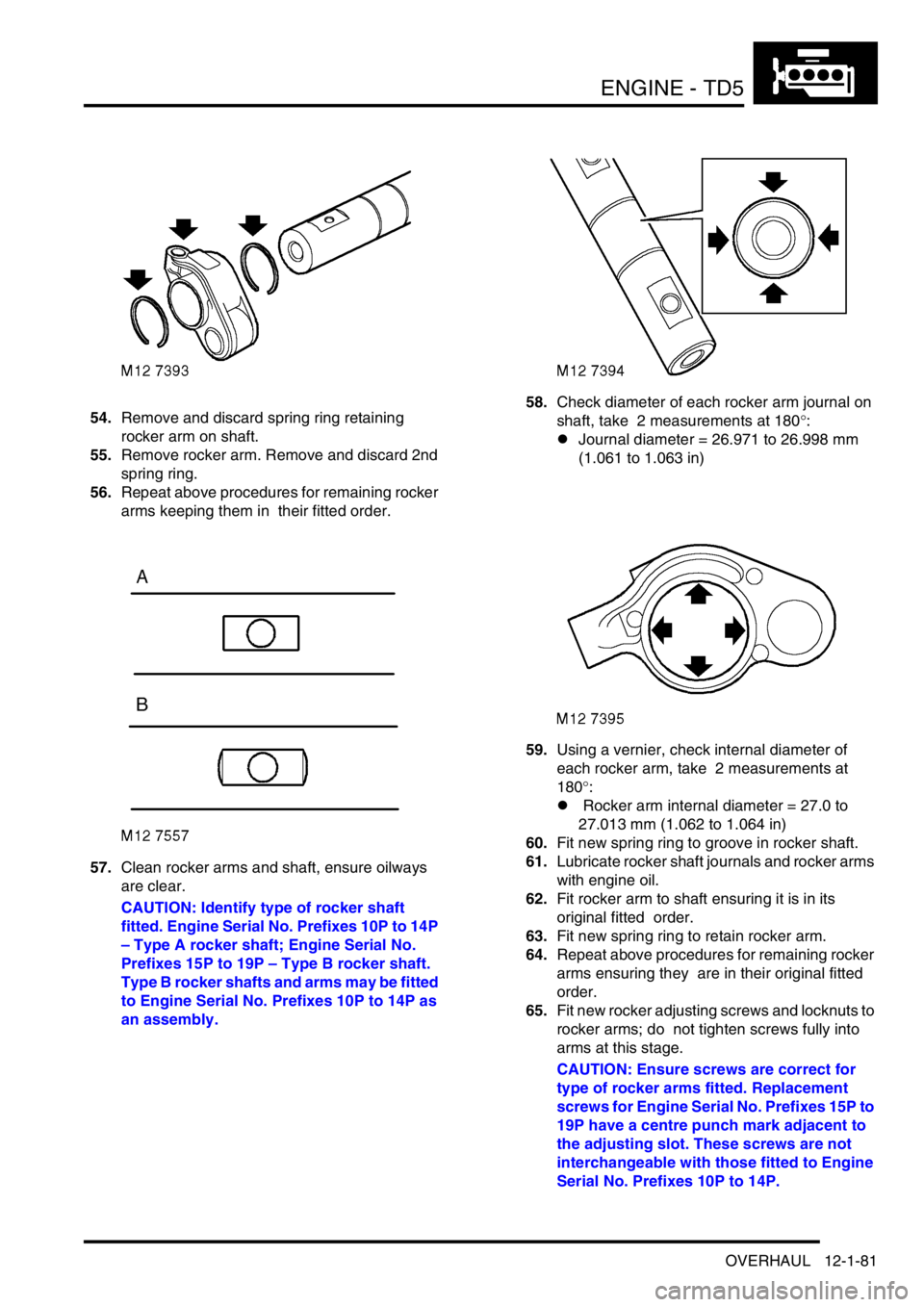
ENGINE - TD5
OVERHAUL 12-1-81
54.Remove and discard spring ring retaining
rocker arm on shaft.
55.Remove rocker arm. Remove and discard 2nd
spring ring.
56.Repeat above procedures for remaining rocker
arms keeping them in their fitted order.
57.Clean rocker arms and shaft, ensure oilways
are clear.
CAUTION: Identify type of rocker shaft
fitted. Engine Serial No. Prefixes 10P to 14P
– Type A rocker shaft; Engine Serial No.
Prefixes 15P to 19P – Type B rocker shaft.
Type B rocker shafts and arms may be fitted
to Engine Serial No. Prefixes 10P to 14P as
an assembly.58.Check diameter of each rocker arm journal on
shaft, take 2 measurements at 180°:
lJournal diameter = 26.971 to 26.998 mm
(1.061 to 1.063 in)
59.Using a vernier, check internal diameter of
each rocker arm, take 2 measurements at
180
°:
l Rocker arm internal diameter = 27.0 to
27.013 mm (1.062 to 1.064 in)
60.Fit new spring ring to groove in rocker shaft.
61.Lubricate rocker shaft journals and rocker arms
with engine oil.
62.Fit rocker arm to shaft ensuring it is in its
original fitted order.
63.Fit new spring ring to retain rocker arm.
64.Repeat above procedures for remaining rocker
arms ensuring they are in their original fitted
order.
65.Fit new rocker adjusting screws and locknuts to
rocker arms; do not tighten screws fully into
arms at this stage.
CAUTION: Ensure screws are correct for
type of rocker arms fitted. Replacement
screws for Engine Serial No. Prefixes 15P to
19P have a centre punch mark adjacent to
the adjusting slot. These screws are not
interchangeable with those fitted to Engine
Serial No. Prefixes 10P to 14P.
Page 236 of 1672

ENGINE - TD5
OVERHAUL 12-1-97
8. Remove and discard big-end bearing shell
from connecting rod.
NOTE: Engine Serial No. Prefixes 10P to 14P:–
The 'sputter type' connecting rod bearing shells
fitted to these engines, identified by them
having a slightly darker colour than the bearing
cap shells should be replaced with the 'plain
type' bearing shells fitted to Engine Serial No.
Prefixes 15P to 19P.
9.Repeat above procedures for remaining big-
end bearings. Keep bearing caps in their
fitted order.
Inspection
1. If crankshaft is to be removed, big-end
bearing journals should be checked when
crankshaft is inspected.
2.Check each big-end bearing journal for scoring,
wear and ovality, make 3 checks at 120
°
intervals in centre of journal:
lBig-end bearing journal diameter = 54.000
±
0.01 mm (2.125
± 0.0004 in)
CAUTION: Big-end journals may not be
ground undersize, only one size of big-end
bearing shell is available and if journals are
found to be scored, oval or worn, crankshaft
must be replaced. Big-end bearing shells
must be replaced whenever they are
removed.
Reassembly
1.Clean connecting rod journals and bearing
shell locations.
2.Lubricate new big-end bearing shells with
engine oil and fit to connecting rods and
bearing caps.
CAUTION: Do not fit the 'sputter type'
bearings fitted to early engines.3.Rotate crankshaft until No.1 big-end bearing
journal is at BDC.
4.Taking care not to damage oil squirt jet or to
displace bearing shell, pull connecting rod on
to crankshaft journal.
5.Check that bearing shell is correctly located in
big-end bearing cap.
6.Fit No.1 big-end bearing cap ensuring that
reference marks are aligned
7.Fit new big-end bearing cap bolts and tighten
to:
lStage 1 - 20 Nm (15 lbf.ft)
lStage 2 - Further 80
°
CAUTION: Do not carry out stages 1 and
2 in one operation.
8.Carefully move connecting rod to one side of
journal and using feeler gauges measure end-
float of connecting rod on journal:
lConnecting rod end-float = 0.2 to 0.5 mm
(0.008 to 0.021 in)
9.Repeat end-float check for remaining
connecting rods.
10. If end-float exceeds limits given, replace
connecting rod and repeat end-float check.
+ ENGINE - Td5, OVERHAUL, Pistons,
connecting rods and cylinder bores.
11.Fit oil pump.
+ ENGINE - Td5, OVERHAUL, Pump -
oil.