2002 JEEP LIBERTY Amp wired
[x] Cancel search: Amp wiredPage 707 of 1803

cycles that occur after the front Wash switch state
changes to open, and to determine the proper inter-
val at which to de-energize the wiper on/off relay to
complete the wipe-after-wash mode cycle.
DIAGNOSIS AND TESTING - FRONT WIPER &
WASHER SYSTEM
FRONT WIPER SYSTEM
If the front wiper motor operates, but the wipers
do not move on the windshield, replace the faulty
front wiper module. If the wipers operate, but chat-
ter, lift, or do not clear the glass, clean and inspect
the front wiper system components as required.
(Refer to 8 - ELECTRICAL/FRONT WIPERS/WASH-
ERS - INSPECTION) and (Refer to 8 - ELECTRI-
CAL/FRONT WIPERS/WASHERS - CLEANING). For
diagnosis and testing of the multi-function switch
(Refer to 8 - ELECTRICAL/LAMPS/LIGHTING -
EXTERIOR/MULTI-FUNCTION SWITCH - DIAG-
NOSIS AND TESTING). Refer to the appropriate
wiring information. The wiring information includes
wiring diagrams, proper wire and connector repair
procedures, details of wire harness routing and
retention, connector pin-out information and location
views for the various wire harness connectors, splices
and grounds.
The hard wired circuits and components of the
front wiper and washer system may be diagnosed
and tested using conventional diagnostic tools and
procedures. However, conventional diagnostic meth-
ods may not prove conclusive in the diagnosis of the
Body Control Module (BCM), or the inputs to or out-
puts from the BCM that control the various front
wiper and washer system operating modes. The most
reliable, efficient, and accurate means to diagnose
the BCM, or the BCM inputs and outputs related to
the various front wiper and washer system operating
modes requires the use of a DRBIIItscan tool. Refer
to the appropriate diagnostic information.
WARNING: ON VEHICLES EQUIPPED WITH AIR-
BAGS, DISABLE THE SUPPLEMENTAL RESTRAINT
SYSTEM BEFORE ATTEMPTING ANY STEERING
WHEEL, STEERING COLUMN, DRIVER AIRBAG,
PASSENGER AIRBAG, SEAT BELT TENSIONER,
SIDE CURTAIN AIRBAG, OR INSTRUMENT PANEL
COMPONENT DIAGNOSIS OR SERVICE. DISCON-
NECT AND ISOLATE THE BATTERY NEGATIVE
(GROUND) CABLE, THEN WAIT TWO MINUTES FOR
THE SYSTEM CAPACITOR TO DISCHARGE BEFORE
PERFORMING FURTHER DIAGNOSIS OR SERVICE.
THIS IS THE ONLY SURE WAY TO DISABLE THE
SUPPLEMENTAL RESTRAINT SYSTEM. FAILURE TO
TAKE THE PROPER PRECAUTIONS COULDRESULT IN ACCIDENTAL AIRBAG DEPLOYMENT
AND POSSIBLE PERSONAL INJURY.
FRONT WASHER SYSTEM
The diagnosis found here addresses an electrically
inoperative front washer system. If the washer
pump/motor operates, but no washer fluid is emitted
from the front washer nozzles, be certain to check
the fluid level in the reservoir. Also inspect the front
washer system components as required. (Refer to 8 -
ELECTRICAL/FRONT WIPERS/WASHERS -
INSPECTION). Refer to the appropriate wiring infor-
mation. The wiring information includes wiring dia-
grams, proper wire and connector repair procedures,
details of wire harness routing and retention, connec-
tor pin-out information and location views for the
various wire harness connectors, splices and grounds.
WARNING: ON VEHICLES EQUIPPED WITH AIR-
BAGS, DISABLE THE SUPPLEMENTAL RESTRAINT
SYSTEM BEFORE ATTEMPTING ANY STEERING
WHEEL, STEERING COLUMN, DRIVER AIRBAG,
PASSENGER AIRBAG, SEAT BELT TENSIONER,
SIDE CURTAIN AIRBAG, OR INSTRUMENT PANEL
COMPONENT DIAGNOSIS OR SERVICE. DISCON-
NECT AND ISOLATE THE BATTERY NEGATIVE
(GROUND) CABLE, THEN WAIT TWO MINUTES FOR
THE SYSTEM CAPACITOR TO DISCHARGE BEFORE
PERFORMING FURTHER DIAGNOSIS OR SERVICE.
THIS IS THE ONLY SURE WAY TO DISABLE THE
SUPPLEMENTAL RESTRAINT SYSTEM. FAILURE TO
TAKE THE PROPER PRECAUTIONS COULD
RESULT IN ACCIDENTAL AIRBAG DEPLOYMENT
AND POSSIBLE PERSONAL INJURY.
(1) Turn the ignition switch to the On position.
Turn the control knob on the right (wiper) control
stalk of the multi-function switch to the On position.
Check whether the front wiper system is operating.
If OK, go to Step 2. If not OK, test and repair the
front wiper system before continuing with these
tests. Refer to FRONT WIPER SYSTEM .
(2) Turn the control ring on the right (wiper) con-
trol stalk of the multi-function switch to the rear
Wash position. Check whether the rear washer sys-
tem is operating. If OK, test the multi-function
switch. (Refer to 8 - ELECTRICAL/LAMPS/LIGHT-
ING - EXTERIOR/MULTI-FUNCTION SWITCH -
DIAGNOSIS AND TESTING). If the multi-function
switch tests OK, go to Step 3. If the multi-function
switch does not test OK, replace the faulty switch.
(3) Turn the ignition switch to the Off position.
Disconnect and isolate the battery negative cable.
Disconnect the headlamp and dash wire harness con-
nector for the washer pump/motor unit from the
pump/motor unit connector receptacle. Check for con-
tinuity between the washer pump driver circuit cav-
8R - 6 FRONT WIPERS/WASHERSKJ
FRONT WIPERS/WASHERS (Continued)
Page 720 of 1803

housing connects the unit to the vehicle electrical
system through a dedicated take out and connector of
the headlamp and dash wire harness. The washer
pump/motor unit cannot be repaired. If faulty or
damaged, the entire washer pump/motor unit must
be replaced.
OPERATION
The washer pump/motor unit features a reversible
electric motor. The direction of the motor is con-
trolled by hard wired outputs from the momentary
front and rear washer switch circuitry contained
within the right (wiper) control stalk of the multi-
function switch. When battery current and ground
are applied to the two pump motor terminals, the
motor rotates in one direction. When the polarity of
these connections is reversed, the motor rotates in
the opposite direction. When the pump motor is ener-
gized, the rotor-type pump pressurizes the washer
fluid and forces it through one of the two pump out-
let nipples, and into the front or rear washer plumb-
ing.Washer fluid is gravity-fed from the washer reser-
voir to the inlet port of the washer pump housing. An
integral shuttle valve is located in a housing on the
outlet port side of the pump housing (Fig. 19). This
shuttle valve controls which washer system plumbing
receives the washer fluid being pressurized by the
pump. When the pump impeller rotates in the coun-
terclockwise direction (viewed from the bottom), pres-
surized washer fluid is pushed out the front washer
system port and biases the shuttle valve to the left,
sealing off the rear washer system outlet nipple.
When the pump impeller rotates in the clockwise
direction (viewed from the bottom), pressurized
washer fluid is pushed out the rear washer system
port and biases the shuttle valve to the right, sealing
off the front washer system outlet nipple.
The washer pump/motor unit can be diagnosed
using conventional diagnostic tools and methods.
REMOVAL
(1) Turn the front wheels full lock to the right.
(2) Disconnect and isolate the battery negative
cable.
(3) Raise and support the vehicle.
(4) Unsnap and lift the cover over the access hole
at the front of the right front wheel house splash
shield.
(5) Place a clean container on the floor beneath the
washer pump/motor location to catch any washer
fluid that is spilled during the following procedure.
(6) Reach through the access hole and firmly grasp
the top of the washer pump/motor housing.
Fig. 18 Washer Pump/Motor
1 - SNAP POST
2 - CONNECTOR RECEPTACLE
3 - MOTOR
4 - PUMP
5 - FRONT WASHER OUTLET NIPPLE
6 - SHUTTLE VALVE
7 - REAR WASHER OUTLET NIPPLE
8 - INLET NIPPLE
9 - FILTER SCREEN
Fig. 19 Washer Pump Fluid Flow
1 - IMPELLER ROTATION (VIEWED FROM BOTTOM)
2 - IMPELLER OUTPUT
3 - REAR WASHER OUTLET NIPPLE
4 - SHUTTLE VALVE
5 - FRONT WASHER OUTLET NIPPLE
KJFRONT WIPERS/WASHERS 8R - 19
WASHER PUMP/MOTOR (Continued)
Page 1391 of 1803

FUEL LEVEL SENDING UNIT /
SENSOR
DESCRIPTION
The fuel gauge sending unit (fuel level sensor) is
attached to the side of the fuel pump module. The
sending unit consists of a float, an arm, and a vari-
able resistor track (card).
OPERATION
The fuel pump module has 4 different circuits
(wires). Two of these circuits are used for the fuel
gauge sending unit for fuel gauge operation, and for
certain OBD II emission requirements. The other 2
wires are used for electric fuel pump operation.
For Fuel Gauge Operation:A constant current
source of approximately 32 milliamps is supplied to
the resistor track on the fuel gauge sending unit.
This is fed directly from the Powertrain Control Mod-
ule (PCM).NOTE: For diagnostic purposes, this
12V power source can only be verified with the
circuit opened (fuel pump module electrical
connector unplugged). With the connectors
plugged, output voltages will vary from about
0.6 volts at FULL, to about 8.6 volts at EMPTY
(about 8.6 volts at EMPTY for Jeep models, and
about 7.0 volts at EMPTY for Dodge Truck mod-
els).The resistor track is used to vary the voltage
(resistance) depending on fuel tank float level. As
fuel level increases, the float and arm move up,
which decreases voltage. As fuel level decreases, the
float and arm move down, which increases voltage.
The varied voltage signal is returned back to the
PCM through the sensor return circuit.
Both of the electrical circuits between the fuel
gauge sending unit and the PCM are hard-wired (not
multi-plexed). After the voltage signal is sent from
the resistor track, and back to the PCM, the PCM
will interpret the resistance (voltage) data and send
a message across the multi-plex bus circuits to the
instrument panel cluster. Here it is translated into
the appropriate fuel gauge level reading. Refer to
Instrument Panel for additional information.
For OBD II Emission Monitor Requirements:
The PCM will monitor the voltage output sent from
the resistor track on the sending unit to indicate fuel
level. The purpose of this feature is to prevent the
OBD II system from recording/setting false misfire
and fuel system monitor diagnostic trouble codes.
The feature is activated if the fuel level in the tank
is less than approximately 15 percent of its rated
capacity. If equipped with a Leak Detection Pump
(EVAP system monitor), this feature will also be acti-
vated if the fuel level in the tank is more than
approximately 85 percent of its rated capacity.
DIAGNOSIS AND TESTING - FUEL LEVEL
SENDING UNIT
The fuel level sending unit contains a variable
resistor (track). As the float moves up or down, elec-
trical resistance will change. Refer to Instrument
Panel and Gauges for Fuel Gauge testing. To test the
gauge sending unit only, it must be removed from
vehicle. The unit is a separate part of the lower fuel
pump module section. Refer to Fuel Pump Module
Removal/Installation for procedures (remove only the
upper section of the fuel pump module). Measure the
resistance across the sending unit terminals. With
float in up position, resistance should be 20 ohms (+/-
5%). With float in down position, resistance should be
270 ohms (+/- 5%).
REMOVAL
The fuel level sending unit (fuel level sensor) and
float assembly is located on the side of the lower sec-
tion of the fuel pump module. The lower section of
the fuel pump module is located within the fuel tank.
(1) Remove lower section of fuel pump module
from fuel tank. Refer to Fuel Pump Module Removal/
Installation.
(2) To remove sending unit from pump module, lift
on plastic locking tab (Fig. 8) while sliding sending
unit upwards.
(3) Disconnect 4±wire electrical connector (Fig. 9)
from bottom of upper section of fuel pump module.
Separate necessary sending unit wiring.
Fig. 8 FUEL LEVEL SENDING UNIT
1 - LIFT TAB HERE FOR REMOVAL
2 - FUEL LEVEL SENDING UNIT
3 - LOWER SECTION OF PUMP MODULE
KJFUEL DELIVERY 14 - 9
Page 1661 of 1803
(5) Connect the test set hose or probe to the open
end of the leaking circuit. The test set gauge should
return to the 27 kPa (8 in. Hg.) setting shortly after
each connection is made. If OK, replace the faulty
disconnected component. If not OK, go to Step 6.
(6)
To locate a leak in a vacuum line, leave one end
of the line plugged and connect the test set hose or
probe to the other end of the line. Run your fingers
slowly along the line while watching the test set gauge.
The vacuum reading will fluctuate when your fingers
contact the source of the leak. To repair the vacuum
line, cut out the leaking section of the line. Then, insert
the loose ends of the line into a suitable length of 3 mil-
limeter (0.125 inch) inside diameter rubber hose.
STANDARD PROCEDURE - DIODE
REPLACEMENT
(1) Disconnect the battery negative cable and iso-
late it.
(2) Locate the diode in the harness, and remove
the protective covering.
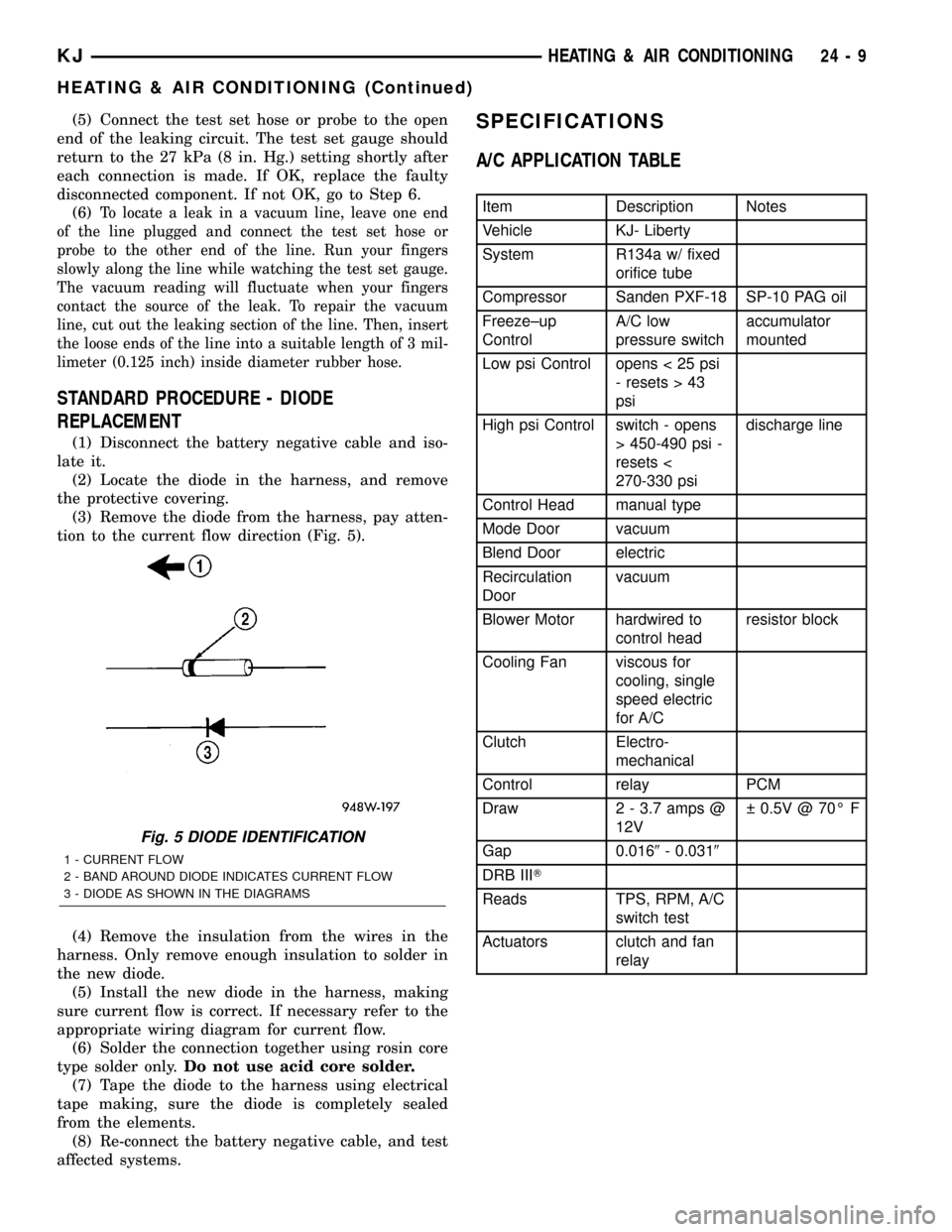
(3) Remove the diode from the harness, pay atten-
tion to the current flow direction (Fig. 5).
(4) Remove the insulation from the wires in the
harness. Only remove enough insulation to solder in
the new diode.
(5) Install the new diode in the harness, making
sure current flow is correct. If necessary refer to the
appropriate wiring diagram for current flow.
(6) Solder the connection together using rosin core
type solder only.Do not use acid core solder.
(7) Tape the diode to the harness using electrical
tape making, sure the diode is completely sealed
from the elements.
(8) Re-connect the battery negative cable, and test
affected systems.
SPECIFICATIONS
A/C APPLICATION TABLE
Item Description Notes
Vehicle KJ- Liberty
System R134a w/ fixed
orifice tube
Compressor Sanden PXF-18 SP-10 PAG oil
Freeze±up
ControlA/C low
pressure switchaccumulator
mounted
Low psi Control opens < 25 psi
- resets > 43
psi
High psi Control switch - opens
> 450-490 psi -
resets <
270-330 psidischarge line
Control Head manual type
Mode Door vacuum
Blend Door electric
Recirculation
Doorvacuum
Blower Motor hardwired to
control headresistor block
Cooling Fan viscous for
cooling, single
speed electric
for A/C
Clutch Electro-
mechanical
Control relay PCM
Draw 2 - 3.7 amps @
12V 0.5V @ 70É F
Gap 0.0169- 0.0319
DRB IIIT
Reads TPS, RPM, A/C
switch test
Actuators clutch and fan
relay
Fig. 5 DIODE IDENTIFICATION
1 - CURRENT FLOW
2 - BAND AROUND DIODE INDICATES CURRENT FLOW
3 - DIODE AS SHOWN IN THE DIAGRAMS
KJHEATING & AIR CONDITIONING 24 - 9
HEATING & AIR CONDITIONING (Continued)