2002 JEEP LIBERTY reverse
[x] Cancel search: reversePage 530 of 1803

²Trailer Tow Adapter- Vehicles equipped with
a factory-installed trailer towing package have an
adapter provided that adapts the factory-installed
heavy duty 7-way trailer tow connector to a conven-
tional 4-way light duty connector.
²Trailer Tow Connector- Vehicles equipped
with a factory-installed trailer towing package have a
heavy duty 7-way trailer tow connector installed in a
bracket on the trailer hitch receiver.
²Trailer Tow Relays- Vehicles equipped with a
factory-installed trailer towing package have a con-
nector bank containing four relays located behind the
right quarter trim panel and over the right rear
wheel housing. The four relays are used to supply
fused ignition switch output (run), brake lamps, right
turn signal, and left turn signal outputs to a trailer
through the trailer tow wiring and connectors.
Hard wired circuitry connects the exterior lighting
system components to the electrical system of the
vehicle. These hard wired circuits are integral to sev-
eral wire harnesses, which are routed throughout the
vehicle and retained by many different methods.
These circuits may be connected to each other, to the
vehicle electrical system and to the exterior lighting
system components through the use of a combination
of soldered splices, splice block connectors, and many
different types of wire harness terminal connectors
and insulators. Refer to the appropriate wiring infor-
mation. The wiring information includes wiring dia-
grams, proper wire and connector repair procedures,
further details on wire harness routing and reten-
tion, as well as pin-out and location views for the
various wire harness connectors, splices and grounds.
OPERATION
Following are paragraphs that briefly describe the
operation of each of the major exterior lighting sys-
tems. The hard wired circuits and components of the
exterior lighting systems may be diagnosed and
tested using conventional diagnostic tools and proce-
dures. However, conventional diagnostic methods
may not prove conclusive in the diagnosis of the Body
Control Module (BCM), the ElectroMechanical
Instrument Cluster (EMIC), the Powertrain Control
Module (PCM), or the Programmable Communica-
tions Interface (PCI) data bus network. The most
reliable, efficient, and accurate means to diagnose
the BCM, the EMIC, the PCM, and the PCI data bus
network inputs and outputs related to the various
exterior lighting systems requires the use of a
DRBIIItscan tool. Refer to the appropriate diagnos-
tic information.BACKUP LAMPS
The backup (or reverse) lamps have a path to
ground at all times through their connection to the
rear lighting wire harness from a take out of the rear
body wire harness with an eyelet terminal connector
that is secured by a ground screw to the base of the
right D-pillar behind the quarter trim panel. The
backup lamps receive battery current from a fused
ignition switch output (run) fuse in the Junction
Block (JB) on the back-up lamp feed circuit only
when the backup lamp switch (manual transmission),
or backup lamp switch circuit of the Transmission
Range Sensor (TRS - electronic automatic transmis-
sion) is closed by the gearshift mechanism within the
transmission.
BRAKE LAMPS
The brake (or stop) lamps have a path to ground at
all times through their connection to the rear light-
ing wire harness from a take out of the rear body
wire harness with an eyelet terminal connector that
is secured by a screw to the base of the right D-pillar
behind the quarter trim panel. The Center High
Mounted Stop Lamp (CHMSL) has a path to ground
at all times through its connection to the rear body
wire harness from a take out of the rear body wire
harness with an eyelet terminal connector that is
secured by a ground screw to the driver side D-pillar
(left side D-pillar for left-hand drive, right side D-pil-
lar for right-hand drive) behind the quarter trim
panel. The brake lamps and CHMSL receive battery
current from a fused B(+) fuse in the Junction Block
(JB) on the brake lamp switch output circuit only
when the brake lamp switch circuit of the brake
lamp switch is closed by the brake pedal arm.
DAYTIME RUNNING LAMPS
Vehicles manufactured for sale in Canada illumi-
nate the high beam filament at a reduced intensity
when the engine is running and the exterior lamps
are turned off. This feature is enabled by the Body
Control Module (BCM) and a solid state Daytime
Running Lamps (DRL) relay, which is installed in the
Junction Block (JB) and the high beam relay is omit-
ted. When the BCM monitors an engine speed signal
of greater than 450 RPM and the status of the exte-
rior lighting switch input from the multi-function
switch is Off, the BCM duty cycles the DRL relay to
produce illumination of the headlamp high beam fil-
aments at a reduced intensity. The BCM also pro-
vides normal headlamp high beam operation through
the DRL relay on vehicles so equipped. When the
DRL relay is energized, it provides battery current
from a fused B(+) fuse in the JB to the headlamp
high beam filament through the DRL relay output
circuit.
KJLAMPS8Ls-5
LAMPS/LIGHTING - EXTERIOR (Continued)
Page 540 of 1803
SPECIFICATIONS - LAMPS/LIGHTING -
EXTERIOR
BULB SPECIFICATIONS
LAMP BULB
Backup 3157 P27/7W
Brake 3157 P27/7W
Center High Mounted
Stop921/W16W
Front Fog 9145
Front Park 3157 P27/7W
Front Position W5W
Front Side Marker 168
Front Turn 3157 P27/7W
Headlamp (North
America)9007QL
Headlamp (Rest-Of-
World)H-4 W0W6
License Plate (North
America)168
License Plate (Rest-Of-
World)W5W
Rear Fog 3157 P27/7W
Rear Park/Tail 3157 P27/7W
Rear Turn 3157 P27/7W
Side Repeater W5W
BACKUP LAMP SWITCH
DESCRIPTION
Vehicles equipped with a manual transmission
have a normally open, spring-loaded plunger type
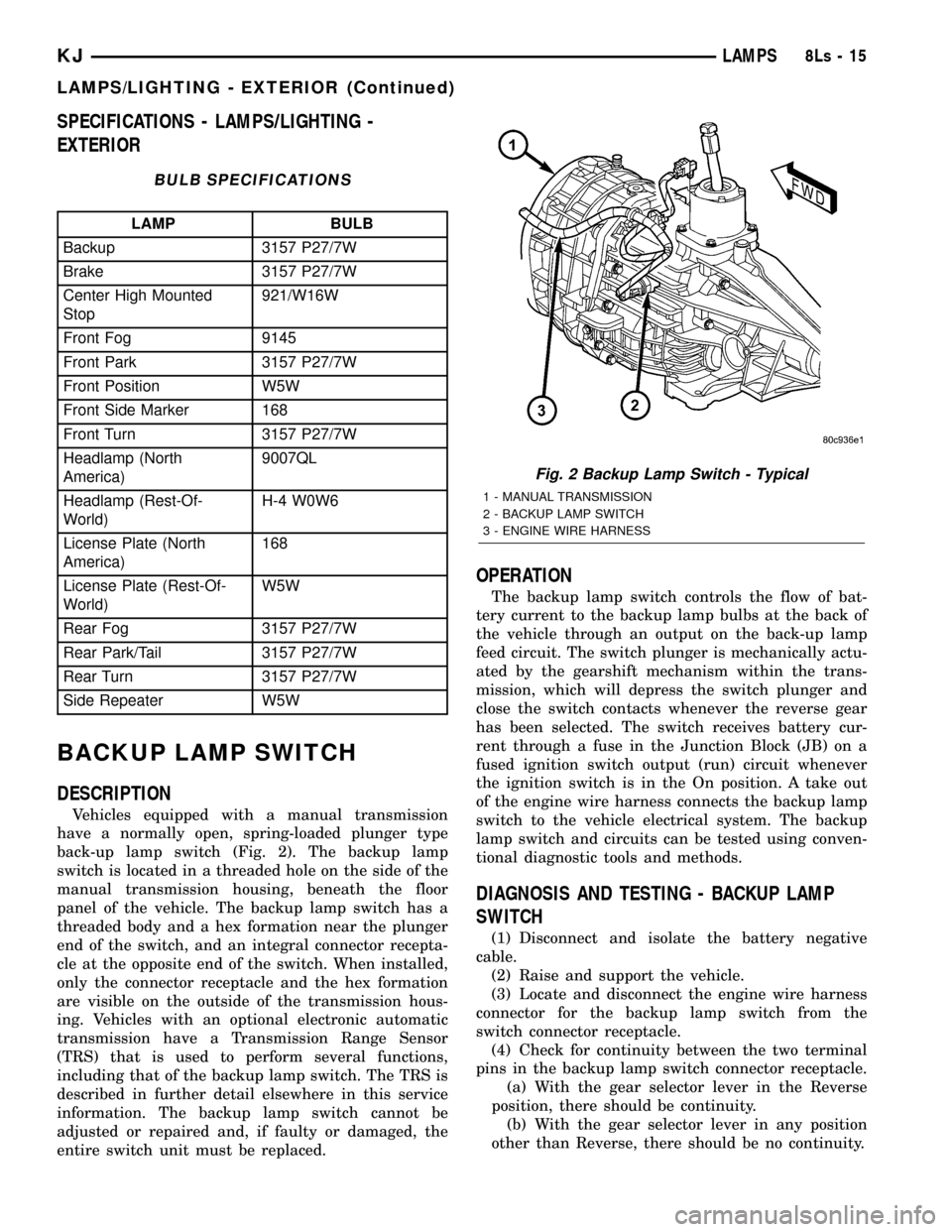
back-up lamp switch (Fig. 2). The backup lamp
switch is located in a threaded hole on the side of the
manual transmission housing, beneath the floor
panel of the vehicle. The backup lamp switch has a
threaded body and a hex formation near the plunger
end of the switch, and an integral connector recepta-
cle at the opposite end of the switch. When installed,
only the connector receptacle and the hex formation
are visible on the outside of the transmission hous-
ing. Vehicles with an optional electronic automatic
transmission have a Transmission Range Sensor
(TRS) that is used to perform several functions,
including that of the backup lamp switch. The TRS is
described in further detail elsewhere in this service
information. The backup lamp switch cannot be
adjusted or repaired and, if faulty or damaged, the
entire switch unit must be replaced.
OPERATION
The backup lamp switch controls the flow of bat-
tery current to the backup lamp bulbs at the back of
the vehicle through an output on the back-up lamp
feed circuit. The switch plunger is mechanically actu-
ated by the gearshift mechanism within the trans-
mission, which will depress the switch plunger and
close the switch contacts whenever the reverse gear
has been selected. The switch receives battery cur-
rent through a fuse in the Junction Block (JB) on a
fused ignition switch output (run) circuit whenever
the ignition switch is in the On position. A take out
of the engine wire harness connects the backup lamp
switch to the vehicle electrical system. The backup
lamp switch and circuits can be tested using conven-
tional diagnostic tools and methods.
DIAGNOSIS AND TESTING - BACKUP LAMP
SWITCH
(1) Disconnect and isolate the battery negative
cable.
(2) Raise and support the vehicle.
(3) Locate and disconnect the engine wire harness
connector for the backup lamp switch from the
switch connector receptacle.
(4) Check for continuity between the two terminal
pins in the backup lamp switch connector receptacle.
(a) With the gear selector lever in the Reverse
position, there should be continuity.
(b) With the gear selector lever in any position
other than Reverse, there should be no continuity.
Fig. 2 Backup Lamp Switch - Typical
1 - MANUAL TRANSMISSION
2 - BACKUP LAMP SWITCH
3 - ENGINE WIRE HARNESS
KJLAMPS8Ls-15
LAMPS/LIGHTING - EXTERIOR (Continued)
Page 618 of 1803

OPERATION
The power seat system receives battery current
through a fuse in the Power Distribution Center
(PDC) and a circuit breaker in the Junction Block,
regardless of the ignition switch position.
When a power seat switch control knob or knobs
are actuated, a battery feed and a ground path are
applied through the switch contacts to the appropri-
ate power seat track adjuster motor. The selected
adjuster motor operates to move the seat track
through its drive unit in the selected direction until
the switch is released, or until the travel limit of the
seat track is reached. When the switch is moved in
the opposite direction, the battery feed and ground
path to the motor are reversed through the switch
contacts. This causes the adjuster motor to run in the
opposite direction.
Refer to the owner's manual in the vehicle glove
box for more information on the features, use and
operation of the power seat system.
DIAGNOSIS AND TESTING - POWER SEATS
Before any testing of the power seat system is
attempted, the battery should be fully-charged and
all wire harness connections and pins cleaned and
tightened to ensure proper continuity and grounds.
Refer to the appropriate wiring information. The wir-
ing information includes wiring diagrams, proper
wire and connector repair procedures, further details
on wire harness routing and retention, as well as
pin-out and joint connector location views for the var-
ious wire harness connectors, splices and grounds.
(1) If all power seats are inoperative, check the
automatic resetting circuit breaker in the Junction
Block. (Refer to 8 - ELECTRICAL/POWER DISTRI-
BUTION/CIRCUIT BREAKER - DIAGNOSIS AND
TESTING).
(2) With the dome lamp on, apply the power seat
switch in the direction of the failure.
(3) If the dome lamp dims, the seat or the power
seat track may be jammed. Check under and behind
the seat for binding or obstructions.
(4) If the dome lamp does not dim, proceed with
testing of the individual power seat system compo-
nents and circuits.
SEAT TRACK
DESCRIPTION
The six-way power seat option includes a power
seat track assembly located under each front seat
(Fig. 2). The power seat track assembly replaces the
standard manually operated seat tracks. The lower
half of the power seat track is secured at the frontwith two bolts to the floor panel seat cross member,
and at the rear with one bolt and one nut to the floor
panel. Four bolts secure the bottom of the seat cush-
ion frame to the upper half of the power seat track
unit.
The power seat track assembly cannot be repaired,
and is serviced only as a complete assembly. If any
component in this assembly is faulty or damaged, the
entire power seat track must be replaced.
OPERATION
The power seat track unit includes three reversible
electric motors that are secured to the upper half of
the track unit. Each motor moves the seat adjuster
through a combination of worm-drive gearboxes and
screw-type drive units. Each of the three driver side
power seat track motors also has a position potenti-
ometer integral to the motor assembly, which elec-
tronically monitors the motor position.
The front and rear of the seat are operated by two
separate vertical adjustment motors. These motors
can be operated independently of each other, tilting
the entire seat assembly forward or rearward; or,
they can be operated in unison by selecting the
proper power seat switch functions, which will raise
or lower the entire seat assembly. The third motor is
the horizontal adjustment motor, which moves the
seat track in the forward and rearward directions.
Fig. 2 Power Seat Track - Typical
1 - POWER SEAT ADJUSTER AND MOTORS
2 - SEAT CUSHION FRAME
3 - POWER SEAT TRACK ASSEMBLY
KJPOWER SEATS 8N - 15
POWER SEATS (Continued)
Page 620 of 1803

The individual switches internal to the power seat
switch cannot be repaired. If one switch is damaged
or faulty, the entire power seat switch unit must be
replaced.
OPERATION
The power seat tracks can be adjusted in six differ-
ent ways using the power seat switches. See the own-
er's manual in the vehicle glove box for more
information on the power seat switch functions and
the seat adjusting procedures.
When a power seat switch control knob or knobs
are actuated, a battery feed and a ground path are
applied through the switch contacts to the power seat
track adjuster motor. The selected adjuster motor
operates to move the seat track through its drive
unit in the selected direction until the switch is
released, or until the travel limit of the seat track is
reached. When the switch is moved in the opposite
direction, the battery feed and ground path to the
motor are reversed through the switch contacts. This
causes the adjuster motor to run in the opposite
direction.
No power seat switch should be held applied in any
direction after the seat track has reached its travel
limit. The power seat adjuster motors each contain a
self-resetting circuit breaker to protect them from
overload. However, consecutive or frequent resetting
of the circuit breaker must not be allowed to con-
tinue, or the motor may be damaged.
DIAGNOSIS AND TESTING - LEFT POWER
SEAT SWITCH
For complete circuit diagrams, refer toPower
Seatin Wiring Diagrams.
(1) Disconnect and isolate the battery negative
cable.
(2) Remove the power seat switch from the out-
board seat cushion side shield.
(3) Use an ohmmeter to test the continuity of the
power seat switch in each switch position. See the
Power Seat Switch Continuity chart (Fig. 5) and
switch (Fig. 6) below. If OK, refer toDiagnosis and
Testing the Power Seat Trackin this section. If
not OK, replace the faulty power seat switch unit.
Fig. 5 SIX-WAY POWER SEAT SWITCH CONTINUITY
Fig. 6 DIAGNOSING POWER SEAT SWITCH
1-UP
2 - REARWARD
3 - DOWN
4 - FORWARD
5 - FRONT RISER SWITCH
6 - CENTER SEAT SWITCH
7 - REAR RISER SWITCH
KJPOWER SEATS 8N - 17
LEFT POWER SEAT SWITCH (Continued)
Page 622 of 1803

RIGHT POWER SEAT SWITCH
DESCRIPTION
Vehicles equipped with the power seat option uti-
lize a six-way power seat switch. This six-way power
seat switch features one seat cushion shaped knob,
visible on the outboard seat cushion side shield.
The switch is secured to the back of the seat cush-
ion side shield with two screws. However, the control
knob must be removed before the seat switch can be
removed from the side shield.
The individual switches internal to the power seat
switch cannot be repaired. If one switch is damaged
or faulty, the entire power seat switch unit must be
replaced.
OPERATION
The power seat tracks can be adjusted in six differ-
ent ways using the power seat switches. See the own-
er's manual in the vehicle glove box for more
information on the power seat switch functions and
the seat adjusting procedures.
When a power seat switch control knob or knobs
are actuated, a battery feed and a ground path are
applied through the switch contacts to the power seat
track adjuster motor. The selected adjuster motor
operates to move the seat track through its drive
unit in the selected direction until the switch is
released, or until the travel limit of the seat track is
reached. When the switch is moved in the opposite
direction, the battery feed and ground path to the
motor are reversed through the switch contacts. This
causes the adjuster motor to run in the opposite
direction.
No power seat switch should be held applied in any
direction after the seat track has reached its travel
limit. The power seat adjuster motors each contain a
self-resetting circuit breaker to protect them from
overload. However, consecutive or frequent resetting
of the circuit breaker must not be allowed to con-
tinue, or the motor may be damaged.
DIAGNOSIS AND TESTING - RIGHT POWER
SEAT SWITCH
For complete circuit diagrams, refer toPower
Seatin Wiring Diagrams.
(1) Disconnect and isolate the battery negative
cable.
(2) Remove the power seat switch from the out-
board seat cushion side shield.(3) Use an ohmmeter to test the continuity of the
power seat switch in each switch position. See the
Power Seat Switch Continuity chart (Fig. 8) and
switch (Fig. 9) below. If OK, refer toDiagnosis and
Testing the Power Seat Trackin this section. If
not OK, replace the faulty power seat switch unit.
Fig. 8 SIX-WAY POWER SEAT SWITCH CONTINUITY
Fig. 9 DIAGNOSING POWER SEAT SWITCH
1-UP
2 - REARWARD
3 - DOWN
4 - FORWARD
5 - FRONT RISER SWITCH
6 - CENTER SEAT SWITCH
7 - REAR RISER SWITCH
KJPOWER SEATS 8N - 19
Page 625 of 1803

(Refer to 23 - BODY/DOOR - FRONT/TRIM PANEL -
REMOVAL).
(2) Disconnect power window motor wire connector
from door harness.
(3) Using two jumper wires, connect one to a bat-
tery (+) source and the other to a good ground (-).
(4) Connect the Negative (-) jumper probe to one of
the motor connector terminals.
(5) Momentarily touch the Positive (+) jumper
probe to the other motor connector terminal.
When positive probe is connected the motor should
rotate in one direction to either move window up or
down. If window is all the way up or down the motor
will grunt and the inner door panel will flex when
actuated in that one direction.
(6) Reverse jumper probes at the motor connector
terminals and window should now move in opposite
direction. If window does not move or grunt, replace
the motor.
If window moved completely up or down, reverse
the jumper probes and cycle window to the opposite
position to verify full operation.
If motor grunts and does not move, verify that reg-
ulator is not binding.
WINDOW MOTOR
REMOVAL
The window motor is incorporated into the window
regulator assembly. If the window motor requires
replacement, the window regulator must be replaced.
(Refer to 23 - BODY/DOOR - FRONT/WINDOW
REGULATOR - REMOVAL) or (Refer to 23 - BODY/
DOORS - REAR/WINDOW REGULATOR - REMOV-
AL).
WINDOW SWITCH
DIAGNOSIS AND TESTING - WINDOW SWITCH
(1) Remove the switch to be tested (Refer to 8 -
ELECTRICAL/POWER WINDOWS/POWER WIN-
DOW SWITCH - REMOVAL).
(2) Using an ohmmeter, Test front switch for con-
tinuity (Fig. 1).
POWER WINDOW FRONT SWITCH TEST
SWITCH POSITION CONTINUITY BETWEEN
OFF 14 AND 4
14 AND 5
14 AND 6
14 AND 7
14 AND 9
14 AND 11
14 AND 12
14 AND 13
LEFT FRONT UP 10 AND 11
LEFT FRONT DOWN 10 AND 9
RIGHT FRONT UP 10 AND 12
RIGHT FRONT DOWN 10 AND 13
LEFT REAR UP 10 AND 5
LEFT REAR DOWN 10 AND 4
RIGHT REAR UP 10 AND 7
RIGHT REAR DOWN 10 AND 6
LOCKOUT (LOCKED) NO CONTINUITY
BETWEEN 10 AND 2
LOCKOUT (UNLOCKED) 10 AND 2
(3) If the proper results are not obtained, replace
the front window switch.
(4) Test rear switch for continuity (Fig. 2).
Fig. 1 FRONT WINDOW SWITCH
Fig. 2 REAR WINDOW SWITCH
8N - 22 POWER WINDOWSKJ
POWER WINDOWS (Continued)
Page 720 of 1803

housing connects the unit to the vehicle electrical
system through a dedicated take out and connector of
the headlamp and dash wire harness. The washer
pump/motor unit cannot be repaired. If faulty or
damaged, the entire washer pump/motor unit must
be replaced.
OPERATION
The washer pump/motor unit features a reversible
electric motor. The direction of the motor is con-
trolled by hard wired outputs from the momentary
front and rear washer switch circuitry contained
within the right (wiper) control stalk of the multi-
function switch. When battery current and ground
are applied to the two pump motor terminals, the
motor rotates in one direction. When the polarity of
these connections is reversed, the motor rotates in
the opposite direction. When the pump motor is ener-
gized, the rotor-type pump pressurizes the washer
fluid and forces it through one of the two pump out-
let nipples, and into the front or rear washer plumb-
ing.Washer fluid is gravity-fed from the washer reser-
voir to the inlet port of the washer pump housing. An
integral shuttle valve is located in a housing on the
outlet port side of the pump housing (Fig. 19). This
shuttle valve controls which washer system plumbing
receives the washer fluid being pressurized by the
pump. When the pump impeller rotates in the coun-
terclockwise direction (viewed from the bottom), pres-
surized washer fluid is pushed out the front washer
system port and biases the shuttle valve to the left,
sealing off the rear washer system outlet nipple.
When the pump impeller rotates in the clockwise
direction (viewed from the bottom), pressurized
washer fluid is pushed out the rear washer system
port and biases the shuttle valve to the right, sealing
off the front washer system outlet nipple.
The washer pump/motor unit can be diagnosed
using conventional diagnostic tools and methods.
REMOVAL
(1) Turn the front wheels full lock to the right.
(2) Disconnect and isolate the battery negative
cable.
(3) Raise and support the vehicle.
(4) Unsnap and lift the cover over the access hole
at the front of the right front wheel house splash
shield.
(5) Place a clean container on the floor beneath the
washer pump/motor location to catch any washer
fluid that is spilled during the following procedure.
(6) Reach through the access hole and firmly grasp
the top of the washer pump/motor housing.
Fig. 18 Washer Pump/Motor
1 - SNAP POST
2 - CONNECTOR RECEPTACLE
3 - MOTOR
4 - PUMP
5 - FRONT WASHER OUTLET NIPPLE
6 - SHUTTLE VALVE
7 - REAR WASHER OUTLET NIPPLE
8 - INLET NIPPLE
9 - FILTER SCREEN
Fig. 19 Washer Pump Fluid Flow
1 - IMPELLER ROTATION (VIEWED FROM BOTTOM)
2 - IMPELLER OUTPUT
3 - REAR WASHER OUTLET NIPPLE
4 - SHUTTLE VALVE
5 - FRONT WASHER OUTLET NIPPLE
KJFRONT WIPERS/WASHERS 8R - 19
WASHER PUMP/MOTOR (Continued)
Page 1153 of 1803
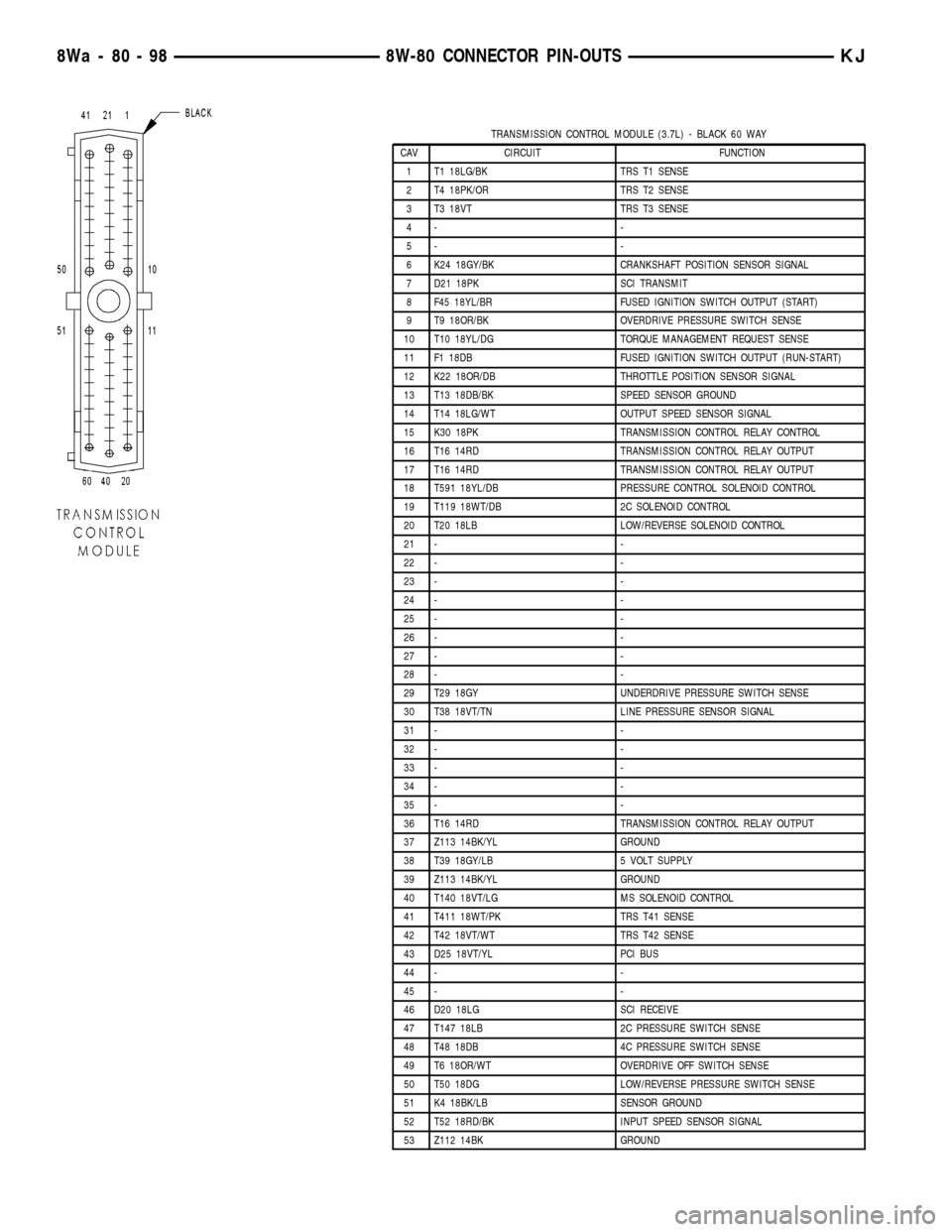
TRANSMISSION CONTROL MODULE (3.7L) - BLACK 60 WAY
CAV CIRCUIT FUNCTION
1 T1 18LG/BK TRS T1 SENSE
2 T4 18PK/OR TRS T2 SENSE
3 T3 18VT TRS T3 SENSE
4- -
5- -
6 K24 18GY/BK CRANKSHAFT POSITION SENSOR SIGNAL
7 D21 18PK SCI TRANSMIT
8 F45 18YL/BR FUSED IGNITION SWITCH OUTPUT (START)
9 T9 18OR/BK OVERDRIVE PRESSURE SWITCH SENSE
10 T10 18YL/DG TORQUE MANAGEMENT REQUEST SENSE
11 F1 18DB FUSED IGNITION SWITCH OUTPUT (RUN-START)
12 K22 18OR/DB THROTTLE POSITION SENSOR SIGNAL
13 T13 18DB/BK SPEED SENSOR GROUND
14 T14 18LG/WT OUTPUT SPEED SENSOR SIGNAL
15 K30 18PK TRANSMISSION CONTROL RELAY CONTROL
16 T16 14RD TRANSMISSION CONTROL RELAY OUTPUT
17 T16 14RD TRANSMISSION CONTROL RELAY OUTPUT
18 T591 18YL/DB PRESSURE CONTROL SOLENOID CONTROL
19 T119 18WT/DB 2C SOLENOID CONTROL
20 T20 18LB LOW/REVERSE SOLENOID CONTROL
21 - -
22 - -
23 - -
24 - -
25 - -
26 - -
27 - -
28 - -
29 T29 18GY UNDERDRIVE PRESSURE SWITCH SENSE
30 T38 18VT/TN LINE PRESSURE SENSOR SIGNAL
31 - -
32 - -
33 - -
34 - -
35 - -
36 T16 14RD TRANSMISSION CONTROL RELAY OUTPUT
37 Z113 14BK/YL GROUND
38 T39 18GY/LB 5 VOLT SUPPLY
39 Z113 14BK/YL GROUND
40 T140 18VT/LG MS SOLENOID CONTROL
41 T411 18WT/PK TRS T41 SENSE
42 T42 18VT/WT TRS T42 SENSE
43 D25 18VT/YL PCI BUS
44 - -
45 - -
46 D20 18LG SCI RECEIVE
47 T147 18LB 2C PRESSURE SWITCH SENSE
48 T48 18DB 4C PRESSURE SWITCH SENSE
49 T6 18OR/WT OVERDRIVE OFF SWITCH SENSE
50 T50 18DG LOW/REVERSE PRESSURE SWITCH SENSE
51 K4 18BK/LB SENSOR GROUND
52 T52 18RD/BK INPUT SPEED SENSOR SIGNAL
53 Z112 14BK GROUND
8Wa - 80 - 98 8W-80 CONNECTOR PIN-OUTSKJ