2002 JEEP LIBERTY Transmission control unit
[x] Cancel search: Transmission control unitPage 523 of 1803

TAILGATE AJAR SWITCH
DESCRIPTION
A tailgate ajar switch is standard equipment in
this vehicle. This switch is concealed within and inte-
gral to the tailgate latch unit. The switch is a
momentary leaf contact-type unit that is actuated by
the tailgate latch mechanism. A pigtail wire harness
and connector on the tailgate latch unit connects the
tailgate ajar switch to the vehicle electrical system
through the tailgate wire harness. The tailgate ajar
switch cannot be adjusted or repaired and, if faulty
or damaged, the tailgate latch unit must be replaced.
(Refer to 23 - BODY/SWING GATE/LATCH -
REMOVAL).
OPERATION
The tailgate switch is actuated by the tailgate
latch mechanism. When the tailgate is closed and
properly latched, the tailgate ajar switch is an open
circuit. When the tailgate is open or only partially
latched, the tailgate ajar switch is a closed circuit.
The tailgate ajar switch is hard wired between a
body ground and the Body Control Module (BCM).
The output of the switch is connected to the BCM
through a tailgate ajar switch sense circuit. The
BCM reads the tailgate ajar switch status through
an internal pull-up, then uses this input to control
many electronic functions and features of the vehicle.
The tailgate ajar switch can be diagnosed using con-
ventional diagnostic tools and methods; however, for
proper diagnosis of the BCM, and both the hard
wired and electronic BCM outputs affected by the
tailgate ajar switch input, a DRBIIItscan tool is
required. Refer to the appropriate diagnostic infor-
mation.
TRANSMISSION RANGE
INDICATOR ILLUMINATION
BULB
REMOVAL
WARNING: ON VEHICLES EQUIPPED WITH AIR-
BAGS, DISABLE THE SUPPLEMENTAL RESTRAINT
SYSTEM BEFORE ATTEMPTING ANY STEERING
WHEEL, STEERING COLUMN, DRIVER AIRBAG,
PASSENGER AIRBAG, SEAT BELT TENSIONER,
FRONT IMPACT SENSORS, SIDE CURTAIN AIRBAG,
OR INSTRUMENT PANEL COMPONENT DIAGNOSIS
OR SERVICE. DISCONNECT AND ISOLATE THE
BATTERY NEGATIVE (GROUND) CABLE, THEN
WAIT TWO MINUTES FOR THE SYSTEM CAPACI-
TOR TO DISCHARGE BEFORE PERFORMING FUR-
THER DIAGNOSIS OR SERVICE. THIS IS THE ONLY
SURE WAY TO DISABLE THE SUPPLEMENTAL
RESTRAINT SYSTEM. FAILURE TO TAKE THE
PROPER PRECAUTIONS COULD RESULT IN ACCI-
DENTAL AIRBAG DEPLOYMENT AND POSSIBLE
PERSONAL INJURY.
(1) Disconnect and isolate the battery negative
cable.
(2) Remove the center console from the floor panel
transmission tunnel. (Refer to 23 - BODY/INTERI-
OR/FLOOR CONSOLE - REMOVAL).
(3) From the left side of the vehicle, reach between
transmission range indicator and the floor panel
transmission tunnel to grasp the illumination lamp
socket (Fig. 15).
Fig. 15 Transmission Range Indicator Illumination
Bulb Remove/Install
1 - AUTOMATIC TRANSMISSION SHIFT MECHANISM
2 - ILLUMINATION LAMP SOCKET
8L - 82 LAMPS/LIGHTING - INTERIORKJ
Page 529 of 1803

mounted to the back of the quarter panel on each
side of the tailgate at the rear of the vehicle. The
park lamps include a license plate lamp or lamps,
depending upon the requirements of the market for
which the vehicle is manufactured. Vehicles with a
license plate tub located near the left end of the rear
bumper fascia have a single lamp, while vehicles
with a license plate module located on the spare tire
carrier have two license plate lamps. In certain mar-
kets where required, a front position lamp that is
integral to each headlamp unit is illuminated instead
of the front park lamps and front side marker lamps
in the park lamps circuit; and, a rectangular, red
reflector is located on the rear bumper fascia just
inboard and below each rear lamp unit.
²Rear Fog Lamps- Rear fog lamps are avail-
able only in certain markets where they are required
equipment. The rear fog lamps are integral to the
rear lamp units mounted to the back of the quarter
panel on each side of the tailgate at the rear of the
vehicle.
²Turn Signal Lamps- The turn signal lamps
include the front turn signal and front side marker
lamps that are integral to the front lamp units
mounted at each end of the bumper fascia at the
front of the vehicle, as well as rear turn signal lamps
that are integral to the rear lamp units mounted to
the back of the quarter panel on each side of the tail-
gate at the rear of the vehicle. In certain markets
where required, a repeater lamp unit mounted to
each front fender just behind the front wheel opening
is illuminated instead of the front side marker lamp
in each turn signal lamp circuit.
Other components of the exterior lighting system
for this model include:
²Combination Flasher- An electronic combina-
tion flasher is integral to the hazard warning switch
in the center of the instrument panel.
²Backup Lamp Switch- Vehicles equipped with
a manual transmission have a plunger-type backup
lamp switch located on the transmission housing. A
Transmission Range Sensor (TRS) integral to the
solenoid pack on the valve body of the optional elec-
tronic automatic transmission performs the backup
lamp switch function on models that are so equipped.
²Brake Lamp Switch- A plunger-type brake
lamp switch is located on the steering column sup-
port bracket under the instrument panel and actu-
ated by the brake pedal arm.²Body Control Module- The Body Control
Module (BCM) is located on the Junction Block (JB)
under the driver side outboard end of the instrument
panel. (Refer to 8 - ELECTRICAL/ELECTRONIC
CONTROL MODULES/BODY CONTROL MODULE
- DESCRIPTION).
²Daytime Running Lamp Relay- Vehicles
manufactured for sale in Canada use a solid state
Daytime Running Lamps (DRL) relay installed in the
Junction Block (JB) instead of the conventional high
beam relay.
²Front Fog Lamp Relay- Vehicles equipped
with the optional front fog lamps have a front fog
lamp relay located in the Junction Block (JB).
²Hazard Switch- The hazard switch is located
near the center of the instrument panel and includes
the integral electronic combination flasher circuitry
for the hazard warning system and the turn signal
system.
²Headlamp Leveling Motor- A headlamp lev-
eling actuator motor is located on the back of each
headlamp housing of vehicles manufactured for cer-
tain markets where this equipment is required.
²Headlamp Leveling Switch- A thumbwheel
actuated headlamp leveling switch is mounted in the
driver side inboard instrument panel trim bezel of
vehicles manufactured for certain markets where this
equipment is required.
²High Beam Relay- A high beam relay is
located in the Junction Block (JB) of all vehicles
except those that are manufactured for sale in Can-
ada. Canadian vehicles have a solid state Daytime
Running Lamps (DRL) relay in the JB instead of the
high beam relay.
²Low Beam Relay- A low beam relay is located
in the Junction Block (JB) of all vehicles.
²Multi-Function Switch- The multi-function
switch is located on the top of the steering column,
just below the steering wheel. The multi-function
switch includes a left (lighting) control stalk and a
right (wiper) control stalk. The left control stalk is
dedicated to providing almost all of the driver con-
trols for both the exterior and interior lighting sys-
tems.
²Park Lamp Relay- A park lamp relay is
located in the Junction Block (JB) of all vehicles.
²Rear Fog Lamp Relay- Vehicles manufac-
tured for certain markets where rear fog lamps are
required equipment have a rear fog lamp relay
located in the Junction Block (JB).
1 - HEADLAMP UNIT (2)
2 - REPEATER LAMP UNIT (2)
3 - FRONT POSITION LAMP (2)
4 - FRONT LAMP UNIT (2)5 - FRONT FOG LAMP (2)
6 - CENTER HIGH MOUNTED STOP LAMP UNIT
7 - REAR LAMP UNIT
8 - LICENSE PLATE LAMP UNIT
8Ls - 4 LAMPSKJ
LAMPS/LIGHTING - EXTERIOR (Continued)
Page 540 of 1803
SPECIFICATIONS - LAMPS/LIGHTING -
EXTERIOR
BULB SPECIFICATIONS
LAMP BULB
Backup 3157 P27/7W
Brake 3157 P27/7W
Center High Mounted
Stop921/W16W
Front Fog 9145
Front Park 3157 P27/7W
Front Position W5W
Front Side Marker 168
Front Turn 3157 P27/7W
Headlamp (North
America)9007QL
Headlamp (Rest-Of-
World)H-4 W0W6
License Plate (North
America)168
License Plate (Rest-Of-
World)W5W
Rear Fog 3157 P27/7W
Rear Park/Tail 3157 P27/7W
Rear Turn 3157 P27/7W
Side Repeater W5W
BACKUP LAMP SWITCH
DESCRIPTION
Vehicles equipped with a manual transmission
have a normally open, spring-loaded plunger type
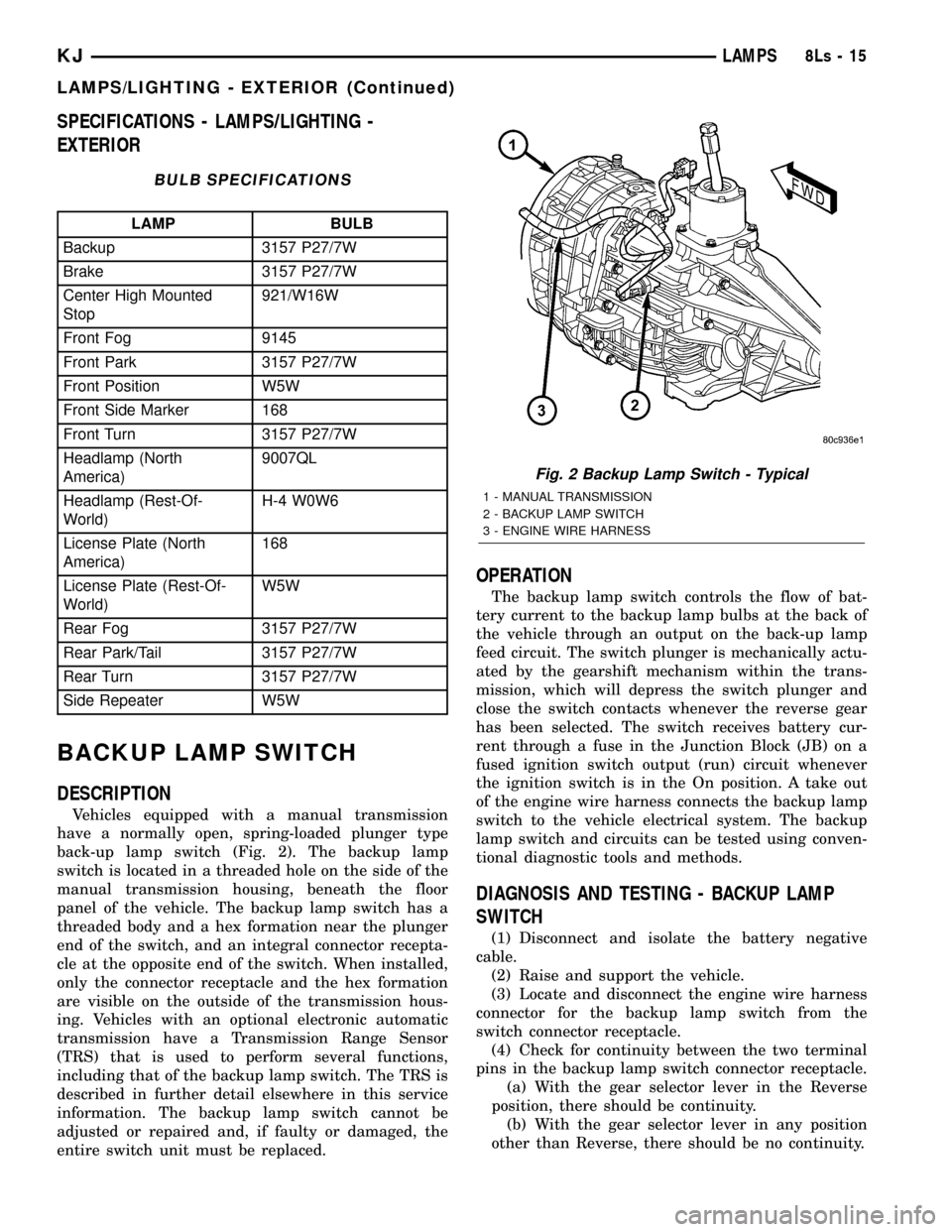
back-up lamp switch (Fig. 2). The backup lamp
switch is located in a threaded hole on the side of the
manual transmission housing, beneath the floor
panel of the vehicle. The backup lamp switch has a
threaded body and a hex formation near the plunger
end of the switch, and an integral connector recepta-
cle at the opposite end of the switch. When installed,
only the connector receptacle and the hex formation
are visible on the outside of the transmission hous-
ing. Vehicles with an optional electronic automatic
transmission have a Transmission Range Sensor
(TRS) that is used to perform several functions,
including that of the backup lamp switch. The TRS is
described in further detail elsewhere in this service
information. The backup lamp switch cannot be
adjusted or repaired and, if faulty or damaged, the
entire switch unit must be replaced.
OPERATION
The backup lamp switch controls the flow of bat-
tery current to the backup lamp bulbs at the back of
the vehicle through an output on the back-up lamp
feed circuit. The switch plunger is mechanically actu-
ated by the gearshift mechanism within the trans-
mission, which will depress the switch plunger and
close the switch contacts whenever the reverse gear
has been selected. The switch receives battery cur-
rent through a fuse in the Junction Block (JB) on a
fused ignition switch output (run) circuit whenever
the ignition switch is in the On position. A take out
of the engine wire harness connects the backup lamp
switch to the vehicle electrical system. The backup
lamp switch and circuits can be tested using conven-
tional diagnostic tools and methods.
DIAGNOSIS AND TESTING - BACKUP LAMP
SWITCH
(1) Disconnect and isolate the battery negative
cable.
(2) Raise and support the vehicle.
(3) Locate and disconnect the engine wire harness
connector for the backup lamp switch from the
switch connector receptacle.
(4) Check for continuity between the two terminal
pins in the backup lamp switch connector receptacle.
(a) With the gear selector lever in the Reverse
position, there should be continuity.
(b) With the gear selector lever in any position
other than Reverse, there should be no continuity.
Fig. 2 Backup Lamp Switch - Typical
1 - MANUAL TRANSMISSION
2 - BACKUP LAMP SWITCH
3 - ENGINE WIRE HARNESS
KJLAMPS8Ls-15
LAMPS/LIGHTING - EXTERIOR (Continued)
Page 560 of 1803

INSTALLATION
WARNING: ON VEHICLES EQUIPPED WITH AIR-
BAGS, DISABLE THE SUPPLEMENTAL RESTRAINT
SYSTEM BEFORE ATTEMPTING ANY STEERING
WHEEL, STEERING COLUMN, DRIVER AIRBAG,
PASSENGER AIRBAG, SEAT BELT TENSIONER,
FRONT IMPACT SENSORS, SIDE CURTAIN AIRBAG,
OR INSTRUMENT PANEL COMPONENT DIAGNOSIS
OR SERVICE. DISCONNECT AND ISOLATE THE
BATTERY NEGATIVE (GROUND) CABLE, THEN
WAIT TWO MINUTES FOR THE SYSTEM CAPACI-
TOR TO DISCHARGE BEFORE PERFORMING FUR-
THER DIAGNOSIS OR SERVICE. THIS IS THE ONLY
SURE WAY TO DISABLE THE SUPPLEMENTAL
RESTRAINT SYSTEM. FAILURE TO TAKE THE
PROPER PRECAUTIONS COULD RESULT IN ACCI-
DENTAL AIRBAG DEPLOYMENT AND POSSIBLE
PERSONAL INJURY.
(1) Position the headlamp high beam relay to the
proper receptacle in the Junction Block (JB) (Fig. 30).
(2) Align the headlamp high beam relay terminals
with the terminal cavities in the JB receptacle.
(3) Push firmly and evenly on the top of the head-
lamp high beam relay until the terminals are fully
seated in the terminal cavities in the JB receptacle.
(4) Reinstall the end cap onto the driver side out-
board end of the instrument panel. (Refer to 23 -
BODY/INSTRUMENT PANEL/INSTRUMENT
PANEL END CAP - INSTALLATION).
(5) Reconnect the battery negative cable.
HEADLAMP LEVELING MOTOR
DESCRIPTION
The headlamp leveling motor is located on the rear
inboard side of each headlamp unit on models
equipped with the headlamp leveling system, which
is available only in certain markets where required
(Fig. 31). The motor is encased within a molded plas-
tic housing and is secured by an integral wedge-type
mounting boss on its forward surface to a flanged
receptacle on the back of the headlamp unit housing.
A rubber seal around the circumference of the
mounting boss is compressed and seals the motor to
the headlamp unit when the boss is properly
installed in the flanged receptacle. The outside of the
motor housing features an integral molded connector
receptacle on its rearward surface, a hex-headed
adjusting screw extends from the top of the housing,
and a plastic pushrod with a ball formation on its
free end extends from the center of the mounting
boss at the front. Within the motor housing is a
12-volt Direct Current (DC) servo motor, an elec-
tronic controller board that includes the motor logic
circuits, and an integral screw-drive transmission.
The headlamp leveling motor is connected to the
vehicle electrical system through a dedicated take
out and connector of the front fascia wire harness.
The headlamp leveling motor cannot be repaired
and, if faulty or damaged, the unit must be replaced.
Fig. 30 Junction Block - Outboard Side (RHD Shown
- Rotate 180É for LHD)
1 - JB/BCM CONNECTOR
2 - HIGH BEAM RELAY
3 - DRL RELAY
Fig. 31 Headlamp Unit - With Leveling
1 - LEVELING MOTOR (IF EQUIPPED)
2 - BOOT SEAL
3 - ADJUSTING SCREW
4 - LOCATOR TAB
5 - HOUSING
6 - FRONT POSITION LAMP SOCKET & BULB
7 - HEADLAMP BULB
8 - MOUNTING TAB (2)
KJLAMPS8Ls-35
HEADLAMP HIGH BEAM RELAY (Continued)
Page 561 of 1803

OPERATION
The controller board and logic circuitry of the
headlamp leveling motor will energize the motor and
extend or retract the motor pushrod through the
integral screw-drive transmission based upon the
voltage signal input received from the resistor multi-
plexed headlamp leveling switch. The ball formation
on the end of the headlamp leveling motor pushrod is
snapped into a socket formation on the back of the
movable reflector within the headlamp unit housing.
The headlamp leveling motors and switch have a
path to ground at all times. The headlamp leveling
components operate on battery current received
through the fused park lamp relay output circuit so
that the system will only operate when the exterior
lighting is turned On.
Because of active electronic elements within the
headlamp leveling motor, it cannot be tested with
conventional automotive electrical test equipment. If
the headlamp leveling motor is believed to be faulty,
replace the motor with a known good unit to confirm
system operation.
REMOVAL
The headlamp leveling motors are integral to the
headlamp units on vehicles manufactured for certain
markets where headlamp leveling is required.
(1) Disconnect and isolate the battery negative
cable.
(2) Remove the headlamp bulb from the headlamp
unit housing. (Refer to 8 - ELECTRICAL/LAMPS/
LIGHTING - EXTERIOR/HEADLAMP BULB -
REMOVAL).
(3) Rotate the headlamp leveling motor on the
back of the headlamp unit housing counterclockwise
about 30 degrees (Fig. 32).
(4) Firmly grasp the motor with one hand while
stabilizing the headlamp unit housing with the other
hand.
(5) Firmly, steadily, and forcefully pull the head-
lamp leveling motor straight away from the back of
the headlamp unit housing to unsnap the ball forma-
tion on the end of the motor pushrod from the socket
on the headlamp unit reflector (Fig. 33).
(6) Remove the headlamp leveling motor and push-
rod from the back of the headlamp unit housing.
INSTALLATION
The headlamp leveling motors are integral to the
headlamp units on vehicles manufactured for certain
markets where headlamp leveling is required.
(1) Position the headlamp leveling motor and
pushrod from to the mounting hole on the back of the
headlamp unit housing.
(2) Insert two fingers through the bulb mounting
hole in the center of the headlamp reflector and pullthe reflector upwards toward the headlamp leveling
motor.
(3) Align the ball formation on the end of the lev-
eling motor pushrod with the socket on the headlamp
unit reflector (Fig. 33).
(4) While continuing to pulling the reflector
toward the motor, firmly, steadily, and forcefully push
the headlamp leveling motor straight into the back of
the headlamp unit housing to snap the ball formation
on the end of the motor pushrod into the socket on
the headlamp unit reflector.
(5) After the pushrod is engaged to the reflector,
remove your fingers from the bulb mounting hole in
Fig. 32 Headlamp Leveling Motor Remove/Install
1 - LEVELING MOTOR
2 - HEADLAMP HOUSING
3 - PUSHROD
Fig. 33 Leveling Motor Pushrod - Typical
1 - REFLECTOR PUSHROD SOCKET
2 - PUSHROD
3 - LEVELING MOTOR
4 - HEADLAMP HOUSING
8Ls - 36 LAMPSKJ
HEADLAMP LEVELING MOTOR (Continued)
Page 630 of 1803

An occupant restraint system is standard factory-
installed safety equipment on this model. Available
occupant restraints for this model include both active
and passive types. Active restraints are those which
require the vehicle occupants to take some action to
employ, such as fastening a seat belt; while passive
restraints require no action by the vehicle occupants
to be employed (Fig. 1).
ACTIVE RESTRAINTS The active restraints for
this model include:
²Front Seat Belts- Both front seating positions
are equipped with three-point seat belt systems
employing a lower B-pillar mounted inertia latch-
type retractor, height-adjustable upper B-pillar
mounted turning loops, a traveling lower seat belt
anchor secured to the outboard side of the seat
frame, and a traveling end-release seat belt buckle
secured to the inboard side of the seat frame. Both
front seat belt buckles include an integral Hall-effect
seat belt switch that detects whether its respective
seat belt has been fastened.
²Rear Seat Belts- All three rear seating posi-
tions are equipped with three-point seat belt sys-
tems. The outboard seating position belts employ a
lower C-pillar mounted inertia latch-type retractor, a
fixed position upper C-pillar mounted turning loop,
and a fixed lower seat belt anchor secured to the
floor panel. The rear seat center seating position belt
has an inertia latch-type retractor that is integral to
the rear seat back panel, and a cable from the seat
back latch locks the center belt retractor spool unless
the seat back is fully latched. The rear seat center
seating position belt lower anchor is secured to the
floor panel. All three rear seat belts have fixed end-
release seat belt buckles secured to the floor panel, a
single buckle unit on the right side and a double
buckle unit on the left side.
²Child Seat Tether Anchors- All vehicles are
equipped with three, fixed-position, child seat tether
anchors. Two anchors are integral to the back of the
right rear seat back panel, and one is integral to the
left rear seat back panel.
PASSIVE RESTRAINTS The passive restraints
available for this model include the following:
²Dual Front Airbags- Multistage driver and
front passenger airbags are available for this model.
This airbag system is a passive, inflatable, Supple-
mental Restraint System (SRS) and vehicles with
this equipment can be readily identified by the ªSRS
- AIRBAGº logo molded into the driver airbag trim
cover in the center of the steering wheel and also
into the passenger airbag door on the instrument
panel above the glove box (Fig. 2). Vehicles with the
airbag system can also be identified by the airbag
indicator, which will illuminate in the instrument
cluster for about seven seconds as a bulb test eachtime the ignition switch is turned to the On position.
A pyrotechnic-type seat belt tensioner is integral to
the driver side front seat belt retractor mounted on
the lower B-pillar of all models equipped with dual
front airbags.
²Side Curtain Airbags- Optional side curtain
airbags are available for this model when it is also
equipped with dual front airbags. This airbag system
is a passive, inflatable, Supplemental Restraint Sys-
tem (SRS) and vehicles with this equipment can be
readily identified by a molded identification trim but-
ton with the ªSRS - AIRBAGº logo located on the
headliner above each B-pillar (Fig. 2).
The supplemental restraint system includes the
following major components, which are described in
further detail elsewhere in this service information:
²Airbag Control Module- The Airbag Control
Module (ACM) is also sometimes referred to as the
Occupant Restraint Controller (ORC). The ACM is
located on a mount on the floor panel transmission
tunnel, below the center of the instrument panel.
²Airbag Indicator- The airbag indicator is inte-
gral to the ElectroMechanical Instrument Cluster
(EMIC), which is located on the instrument panel in
front of the driver.
²Clockspring- The clockspring is located near
the top of the steering column, directly beneath the
steering wheel.
²Driver Airbag- The driver airbag is located in
the center of the steering wheel, beneath the driver
airbag trim cover.
²Driver Knee Blocker- The driver knee blocker
is a structural unit secured to the back side of and
integral to the instrument panel steering column
opening cover.
²Front Impact Sensor- Two front impact sen-
sors are used on vehicles equipped with dual front
airbags, one left side and one right side. One sensor
Fig. 2 SRS Logo
KJRESTRAINTS 8O - 3
RESTRAINTS (Continued)
Page 637 of 1803

The ACM housing also has an integral ground lug
with a tapped hole that protrudes from the lower left
rear corner of the unit. This lug provides a case
ground to the ACM when a ground screw is installed
through the left side of the mounting bracket. Two
molded plastic electrical connector receptacles exit
the right side of the ACM housing. The smaller of the
two receptacles contains twelve terminal pins, while
the larger one contains twenty-three. These terminal
pins connect the ACM to the vehicle electrical system
through two dedicated take outs and connectors of
the instrument panel wire harness.
A molded rubber protective cover is installed
loosely over the ACM to protect the unit from con-
densation or coolant leaking from a damaged or
faulty heater-air conditioner unit housing. An inte-
gral flange on the left side of the cover is secured to
the floor panel transmission tunnel with a short
piece of double-faced tape as an assembly aid during
the manufacturing process, but this tape does not
require replacement following service removal.
The impact sensor and safing sensor internal to
the ACM are calibrated for the specific vehicle, and
are only serviced as a unit with the ACM. The ACM
cannot be repaired or adjusted and, if damaged or
faulty, it must be replaced. The ACM cover is avail-
able for separate service replacement.
OPERATION
The microprocessor in the Airbag Control Module
(ACM) contains the front supplemental restraint sys-
tem logic circuits and controls all of the front supple-
mental restraint system components. The ACM uses
On-Board Diagnostics (OBD) and can communicate
with other electronic modules in the vehicle as well
as with the DRBIIItscan tool using the Programma-
ble Communications Interface (PCI) data bus net-
work. This method of communication is used for
control of the airbag indicator in the ElectroMechani-
cal Instrument Cluster (EMIC) and for supplemental
restraint system diagnosis and testing through the
16-way data link connector located on the driver side
lower edge of the instrument panel. (Refer to 8 -
ELECTRICAL/INSTRUMENT CLUSTER/AIRBAG
INDICATOR - OPERATION).
The ACM microprocessor continuously monitors all
of the front supplemental restraint system electrical
circuits to determine the system readiness. If the
ACM detects a monitored system fault, it sets an
active and stored Diagnostic Trouble Code (DTC) and
sends electronic messages to the EMIC over the PCI
data bus to turn on the airbag indicator. An active
fault only remains for the duration of the fault or in
some cases the duration of the current ignition
switch cycle, while a stored fault causes a DTC to be
stored in memory by the ACM. For some DTCs, if afault does not recur for a number of ignition cycles,
the ACM will automatically erase the stored DTC.
For other internal faults, the stored DTC is latched
forever.
On models equipped with optional side curtain air-
bags, the ACM communicates with both the left and
right Side Impact Airbag Control Modules (SIACM)
over the PCI data bus. The SIACM notifies the ACM
when it has detected a monitored system fault and
stored a DTC in memory for its respective side cur-
tain airbag system, and the ACM sets a DTC and
controls the airbag indicator operation accordingly.
The ACM also monitors a Hall effect-type seat belt
switch located in the buckle of each front seat belt to
determine whether the seatbelts are buckled, and
provides an input to the EMIC over the PCI data bus
to control the seatbelt indicator operation based upon
the status of the driver side front seat belt switch.
The ACM receives battery current through two cir-
cuits; a fused ignition switch output (run) circuit
through a fuse in the Junction Block (JB), and a
fused ignition switch output (run-start) circuit
through a second fuse in the JB. The ACM has a case
ground through a lug on the bottom of the ACM
housing that is secured with a ground screw to the
left side of the ACM mounting bracket. The ACM
also receives a power ground through a ground cir-
cuit and take out of the instrument panel wire har-
ness. This take out has a single eyelet terminal
connector that is secured by a second ground screw
to the left side of the ACM mounting bracket. These
connections allow the ACM to be operational when-
ever the ignition switch is in the Start or On posi-
tions. The ACM also contains an energy-storage
capacitor. When the ignition switch is in the Start or
On positions, this capacitor is continually being
charged with enough electrical energy to deploy the
airbags for up to one second following a battery dis-
connect or failure. The purpose of the capacitor is to
provide backup supplemental restraint system pro-
tection in case there is a loss of battery current sup-
ply to the ACM during an impact.
Two sensors are contained within the ACM, an
electronic impact sensor and a safing sensor. The
ACM also monitors inputs from two remote front
impact sensors located on the back of the right and
left vertical members of the radiator support near
the front of the vehicle. The electronic impact sensors
are accelerometers that sense the rate of vehicle
deceleration, which provides verification of the direc-
tion and severity of an impact. The safing sensor is
an electromechanical sensor within the ACM that
provides an additional logic input to the ACM micro-
processor. The safing sensor is a normally open
switch that is used to verify the need for an airbag
deployment by detecting impact energy of a lesser
8O - 10 RESTRAINTSKJ
AIRBAG CONTROL MODULE (Continued)
Page 638 of 1803

magnitude than that of the electronic impact sensors,
and must be closed in order for the airbags/seat belt
tensioner to deploy. A pre-programmed decision algo-
rithm in the ACM microprocessor determines when
the deceleration rate as signaled by the impact sen-
sors and the safing sensor indicate an impact that is
severe enough to require front supplemental
restraint system protection and, based upon the sta-
tus of the seatbelt switch inputs and the severity of
the monitored impact, determines what combination
of driver seat belt tensioner and/or front airbag
deployment is required for each front seating posi-
tion. When the programmed conditions are met, the
ACM sends the proper electrical signals to deploy the
driver seat belt tensioner and/or the multistage dual
front airbags at the programmed force levels.
The hard wired inputs and outputs for the ACM
may be diagnosed and tested using conventional
diagnostic tools and procedures. However, conven-
tional diagnostic methods will not prove conclusive in
the diagnosis of the ACM, the PCI data bus network,
or the electronic message inputs to and outputs from
the ACM. The most reliable, efficient, and accurate
means to diagnose the ACM, the PCI data bus net-
work, and the electronic message inputs to and out-
puts from the ACM requires the use of a DRBIIIt
scan tool. Refer to the appropriate diagnostic infor-
mation.
REMOVAL
WARNING: ON VEHICLES EQUIPPED WITH AIR-
BAGS, DISABLE THE SUPPLEMENTAL RESTRAINT
SYSTEM BEFORE ATTEMPTING ANY STEERING
WHEEL, STEERING COLUMN, DRIVER AIRBAG,
PASSENGER AIRBAG, SEAT BELT TENSIONER,
FRONT IMPACT SENSORS, SIDE CURTAIN AIRBAG,
OR INSTRUMENT PANEL COMPONENT DIAGNOSIS
OR SERVICE. DISCONNECT AND ISOLATE THE
BATTERY NEGATIVE (GROUND) CABLE, THEN
WAIT TWO MINUTES FOR THE SYSTEM CAPACI-
TOR TO DISCHARGE BEFORE PERFORMING FUR-
THER DIAGNOSIS OR SERVICE. THIS IS THE ONLY
SURE WAY TO DISABLE THE SUPPLEMENTAL
RESTRAINT SYSTEM. FAILURE TO TAKE THE
PROPER PRECAUTIONS COULD RESULT IN ACCI-
DENTAL AIRBAG DEPLOYMENT AND POSSIBLE
PERSONAL INJURY.
WARNING: THE AIRBAG CONTROL MODULE CON-
TAINS THE IMPACT SENSOR, WHICH ENABLES
THE SYSTEM TO DEPLOY THE FRONT SUPPLE-
MENTAL RESTRAINTS. NEVER STRIKE OR DROP
THE AIRBAG CONTROL MODULE, AS IT CAN DAM-
AGE THE IMPACT SENSOR OR AFFECT ITS CALI-
BRATION. IF AN AIRBAG CONTROL MODULE ISACCIDENTALLY DROPPED DURING SERVICE, THE
MODULE MUST BE SCRAPPED AND REPLACED
WITH A NEW UNIT. FAILURE TO OBSERVE THIS
WARNING COULD RESULT IN ACCIDENTAL,
INCOMPLETE, OR IMPROPER FRONT SUPPLEMEN-
TAL RESTRAINT DEPLOYMENT AND POSSIBLE
OCCUPANT INJURIES.
(1) Disconnect and isolate the battery negative
cable. Wait two minutes for the system capacitor to
discharge before further service.
(2) Remove the center console from the top of the
floor panel transmission tunnel. (Refer to 23 - BODY/
INTERIOR/FLOOR CONSOLE - REMOVAL).
(3) From the left side of the floor panel transmis-
sion tunnel, remove the Airbag Control Module
(ACM) cover from the ACM (Fig. 7). The cover flange
is secured to the silencer pad on the floor panel
transmission tunnel with double-faced tape.
(4) Remove the ground screw that secures the
ground lug on the left rear corner of the ACM hous-
ing to the ACM bracket on the floor panel transmis-
sion tunnel.
Fig. 7 ACM Cover Remove/Install
1 - FLANGE
2 - COVER
3 - TAPE
4 - SCREW
5 - BRACKET
6 - AIRBAG CONTROL MODULE
7 - FLOOR PANEL TRANSMISSION TUNNEL
KJRESTRAINTS 8O - 11
AIRBAG CONTROL MODULE (Continued)