2002 JEEP LIBERTY oil dipstick
[x] Cancel search: oil dipstickPage 1284 of 1803

(11) Bleed fuel system. Refer to FUEL SYSTEM.
(12) Remove fuel rail.
(13) Remove throttle body assembly and mounting
bracket.
(14) Drain cooling system below coolant tempera-
ture level. Refer to COOLING SYSTEM.
(15) Remove the heater hoses from the engine
front cover and the heater core.
(16) Unclip and remove heater hoses and tubes
from intake manifold.
(17) Remove coolant temperature sensor. Refer to
FUEL SYSTEM.
(18) Remove intake manifold retaining fasteners in
reverse order of tightening sequence.
(19) Remove intake manifold.
INSTALLATION
(1) Install intake manifold gaskets.
(2) Install intake manifold.
(3) Install intake manifold retaining bolts and
tighten in sequence shown in to 12 N´m (105 in. lbs.).
(4) Install left and right radio suppressor straps.
(5) Install throttle body assembly.
(6) Install throttle cable bracket.
(7) Connect throttle cable and speed control cable
to throttle body.
(8) Install fuel rail.
(9) Install ignition coil towers.
(10) Position and install heater hoses and tubes
onto intake manifold.
(11) Install the heater hoses to the heater core and
engine front cover.
(12) Connect electrical connectors for the following
components:
²Manifold Absolute Pressure (MAP) Sensor
²Intake Air Temperature (IAT) Sensor
²Throttle Position (TPS) Sensor
²Coolant Temperature (CTS) Sensor
²Idle Air Control (IAC) Motor
²Ignition coil towers
²Fuel injectors
(13) Install top oil dipstick tube retaining bolt and
ground strap.
(14) Connect generator electrical connections.
(15) Connect Vapor purge hose, Brake booster
hose, Speed control servo hose, Positive crankcase
ventilation (PCV) hose.
(16) Fill cooling system.
(17) Install resonator assembly and air inlet hose.
(18) Connect negative cable to battery.
EXHAUST MANIFOLD
DESCRIPTION
The exhaust manifolds (Fig. 87) are log style with
a patented flow enhancing design to maximize perfor-
mance. The exhaust manifolds are made of high sili-
con molybdenum cast iron. A perforated core graphite
exhaust manifold gasket is used to improve sealing
to the cylinder head. The exhaust manifolds are cov-
ered by a three layer laminated heat shield for ther-
mal protection and noise reduction. The heat shields
(Fig. 88) are fastened with a torque prevailing nut
that is backed off slightly to allow for the thermal
expansion of the exhaust manifold.
REMOVAL
RIGHT EXHAUST MANIFOLD
(1) Disconnect the negative cable from the battery.
(2) Raise and support the vehicle.
(3) Remove the bolts and nuts attaching the
exhaust pipe to the engine exhaust manifold.
(4) Lower the vehicle.
(5) Remove the exhaust heat shield (Fig. 89).
(6) Remove bolts, nuts and washers attaching
manifold to cylinder head.
(7) Remove manifold and gasket from the cylinder
head.
Fig. 87 EXHAUST MANIFOLDS
1 - LEFT SIDE EXHAUST MANIFOLD
2 - RIGHT SIDE EXHAUST MANIFOLD
KJENGINE - 3.7L 9 - 69
INTAKE MANIFOLD (Continued)
Page 1301 of 1803

(7) Crank engine until maximum pressure is
reached on gage. Record this pressure as #1 cylinder
pressure.
(8) Repeat the previous step for all remaining cyl-
inders.
(9) Compression should not be less than 689 kPa
(100 psi) and not vary more than 25 percent from cyl-
inder to cylinder.
(10) If one or more cylinders have abnormally low
compression pressures, repeat the compression test.
(11) If the same cylinder or cylinders repeat an
abnormally low reading on the second compression
test, it could indicate the existence of a problem in
the cylinder in question.The recommended com-
pression pressures are to be used only as a
guide to diagnosing engine problems. An engine
should not be disassembled to determine the
cause of low compression unless some malfunc-
tion is present.
DIAGNOSIS AND TESTING - ENGINE OIL LEAK
INSPECTION
Begin with a thorough visual inspection of the
engine, particularly at the area of the suspected leak.
If an oil leak source is not readily identifiable, the
following steps should be followed:
(1) Do not clean or degrease the engine at this
time because some solvents may cause rubber to
swell, temporarily stopping the leak.
(2) Add an oil soluble dye (use as recommended by
manufacturer). Start the engine and let idle for
approximately 15 minutes. Check the oil dipstick to
make sure the dye is thoroughly mixed as indicated
with a bright yellow color under a black light.
(3) Using a black light, inspect the entire engine
for fluorescent dye, particularly at the suspected area
of oil leak. If the oil leak is found and identified,
repair as necessary.
(4) If dye is not observed, drive the vehicle at var-
ious speeds for approximately 24 km (15 miles), and
repeat inspection.
(5)If the oil leak source is not positively
identified at this time, proceed with the air leak
detection test method as follows:
²Disconnect the fresh air hose (make-up air) at
the cylinder head cover and plug or cap the nipple on
the cover.
²Remove the PCV valve hose from the cylinder
head cover. Cap or plug the PCV valve nipple on the
cover.
²Attach an air hose with pressure gauge and reg-
ulator to the dipstick tube.
CAUTION: Do not subject the engine assembly to
more than 20.6 kpa (3 PSI) of test pressure.²Gradually apply air pressure from 1 psi to 2.5
psi maximum while applying soapy water at the sus-
pected source. Adjust the regulator to the suitable
test pressure that provides the best bubbles which
will pinpoint the leak source. If the oil leak is
detected and identified, repair per service manual
procedures.
²If the leakage occurs at the crankshaft rear oil
seal area, refer to the section, Inspection for Rear
Seal Area Leak.
(6) If no leaks are detected, turn off the air supply.
Remove the air hose, all plugs, and caps. Install the
PCV valve and fresh air hose (make-up air). Proceed
to next step.
(7) Clean the oil off the suspect oil leak area using
a suitable solvent. Drive the vehicle at various
speeds approximately 24 km (15 miles). Inspect the
engine for signs of an oil leak by using a black light.
NOTE: If oil leakage is observed at the dipstick tube
to block location; remove the tube, clean and reseal
using MoparTStud & Bearing Mount (press fit tube
applications only), and for O-ring style tubes,
remove tube and replace the O-ring seal.
INSPECTION FOR REAR SEAL AREA LEAKS
Since it is sometimes difficult to determine the
source of an oil leak in the rear seal area of the
engine, a more involved inspection is necessary. The
following steps should be followed to help pinpoint
the source of the leak.
If the leakage occurs at the crankshaft rear oil seal
area:
(1) Disconnect the battery.
(2) Raise the vehicle.
(3) Remove torque converter or clutch housing
cover and inspect rear of block for evidence of oil.
Use a black light to check for the oil leak. If a leak is
present in this area, remove transmission for further
inspection.
(a) Circular spray pattern generally indicates
seal leakage or crankshaft damage.
(b) Where leakage tends to run straight down,
possible causes are a porous block, oil gallery cup
plug, bedplate to cylinder block mating surfaces
and seal bore. See proper repair procedures for
these items.
(4) If no leaks are detected, pressurize the crank-
case as previously described.
CAUTION: Do not exceed 20.6 kPa (3 psi).
(5) If the leak is not detected, very slowly turn the
crankshaft and watch for leakage. If a leak is
detected between the crankshaft and seal while
slowly turning the crankshaft, it is possible the
9s - 4 ENGINEKJ
ENGINE - 2.4L (Continued)
Page 1344 of 1803

(6) Install oil pressure switch and connector. (Refer
to 9 - ENGINE/LUBRICATION/OIL PRESSURE
SENSOR/SWITCH - INSTALLATION)
OIL
STANDARD PROCEDURE
ENGINE OIL LEVEL CHECK
The best time to check engine oil level is after it
has sat overnight, or if the engine has been running,
allow the engine to be shut off for at least 5 minutes
before checking oil level.
Checking the oil while the vehicle is on level
ground will improve the accuracy of the oil level
reading. Remove dipstick and observe oil level. Add
oil only when the level is at or below the ADD mark
(Fig. 78).
STANDARD PROCEDURE - ENGINE OIL AND
FILTER CHANGE
Change engine oil at mileage and time intervals
described in the Maintenance Schedule. (Refer to
LUBRICATION & MAINTENANCE/MAINTE-
NANCE SCHEDULES - DESCRIPTION)
WARNING: NEW OR USED ENGINE OIL CAN BE
IRRITATING TO THE SKIN. AVOID PROLONGED OR
REPEATED SKIN CONTACT WITH ENGINE OIL.
CONTAMINANTS IN USED ENGINE OIL, CAUSED BY
INTERNAL COMBUSTION, CAN BE HAZARDOUS TO
YOUR HEALTH. THOROUGHLY WASH EXPOSED
SKIN WITH SOAP AND WATER. DO NOT WASH
SKIN WITH GASOLINE, DIESEL FUEL, THINNER, OR
SOLVENTS, HEALTH PROBLEMS CAN RESULT. DO
NOT POLLUTE, DISPOSE OF USED ENGINE OIL
PROPERLY. CONTACT YOUR DEALER OR GOVERN-
MENT AGENCY FOR LOCATION OF COLLECTION
CENTER IN YOUR AREA.
Run engine until achieving normal operating tem-
perature.
(1) Position the vehicle on a level surface and turn
engine off.(2) Hoist and support vehicle on safety stands.
Refer to Hoisting and Jacking Recommendations.
(Refer to LUBRICATION & MAINTENANCE/HOIST-
ING - STANDARD PROCEDURE)
(3) Remove oil fill cap.
(4) Place a suitable drain pan under crankcase
drain.
(5) Remove drain plug from crankcase and allow
oil to drain into pan. Inspect drain plug threads for
stretching or other damage. Replace drain plug and
gasket if damaged.
(6) Remove oil filter. (Refer to 9 - ENGINE/LUBRI-
CATION/OIL FILTER - REMOVAL)
(7) Install and tighten drain plug in crankcase.
(8) Install new oil filter. (Refer to 9 - ENGINE/LU-
BRICATION/OIL FILTER - INSTALLATION)
(9) Lower vehicle and fill crankcase with specified
type and amount of engine oil. (Refer to LUBRICA-
TION & MAINTENANCE/FLUID TYPES -
DESCRIPTION)
(10) Install oil fill cap.
(11) Start engine and inspect for leaks.
(12) Stop engine and inspect oil level.
NOTE: Care should be exercised when disposing
used engine oil after it has been drained from a
vehicle engine. Refer to the WARNING listed above.
OIL FILTER
DESCRIPTION
The engine oil filter is a high quality full-flow, dis-
posable type. Replace the oil filter with a Mopartor
the equivalent.
REMOVAL
(1) Raise vehicle on hoist.
(2) Position an oil collecting container under oil fil-
ter location.
CAUTION: When servicing the oil filter avoid
deforming the filter can by installing the remove/in-
stall tool band strap against the can to base lock
seam. The lock seam joining the can to the base is
reinforced by the base plate.
(3) Using a suitable filter wrench, turn oil filter
counterclockwise to remove (Fig. 79).
INSTALLATION
(1) Clean and check filter mounting surface. The
surface must be smooth, flat and free of debris or
pieces of gasket.
(2) Lubricate new oil filter gasket with clean
engine oil.
Fig. 78 Oil Level
1 - ENGINE OIL LEVEL DIPSTICK
KJENGINE9s-47
LUBRICATION (Continued)
Page 1782 of 1803
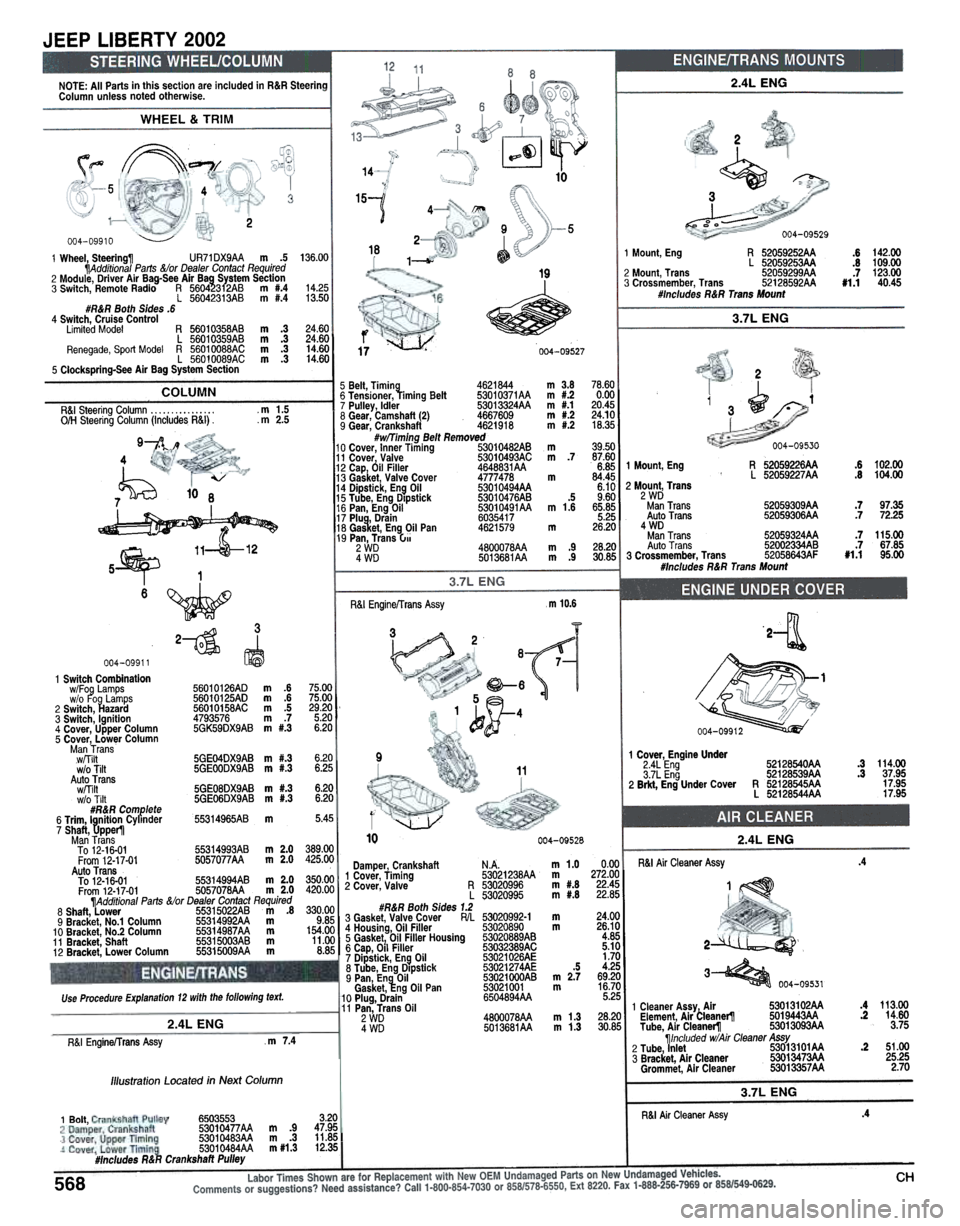
JEEP LIBERTY 2002
2.4L ENGNOTE: All Parts in this section are included in R&R SteerinaColumn unless noted otherwise.
WHEEL & TRIM
2
~fI::;~~ ~/\1f'R14
151
r-54
4~3
~~29
~
5004-09529
1 Mount, Eng R 52059252AAL 52059253AA2 Mount, Trans 52059299AA3 Crossmember, Trans 52128592AA#/ncludes R&R Trans Mount
2
1~18.6 142.00.8 109.00.7 123.00'1.1 40.4519,.
004-09527
004-09910 ~
1 Wheel, Steeringll UR71 DX9AA m .5 136.00llAdditional Parts &lor Dealer Contact Required2 Module, Driver Air Bag-See Air Bag System Section3 Switch, Remote Radio R 560423f2AB m #.4 14.25L 56042313AB m #.4 13.50#R&R Both Sides .64 Switch, Cruise ControlLimited Mode! R 56010358AB m .3 24.60L 56010359AB m .3 24.60IRenegade, Sport Model R 56010088AC m .3 14.60L 56010089AC m .3 14.605 Clockspring-See Air Bag System Section
3.7L ENG
f17~
COLUMN
2
3~m 1.5m 2.5R&I Steering Column O/H Steering Column (Includes R&I)
9-AA
5 Belt, Timing 4621844 m 3.8 78.606 Tensioner, Timing Belt 53010371AA m #.2 0.001I 7 Pulley, Idler 53013324AA m #.1 20.458 Gear, Camshaft (2) 4667609 m #.2 24.109 Gear, Crankshaft 4621918 m #.2 18.35#W/Timing Belt Removed10 Cover, Inner Timing 53010482AB m 39.50 004-0953011 Cover Valve 53010493AC m .7 87.6012 Cap, Oil Filler 4648831AA 6.85 1 Mount, Eng R 52059226AA13 Gasket, Valve Cover 4777478 m 84.45 L 52059227AA14 Dipstick, Eng Oil 53010494AA 6.10 2 Mount, Trans15 Tube, Eng Dipstick 53010476AB .5 9.6Q 2 WD16 Pan, Eng Oil 53010491AA m 1.6 65.85 Man Trans 52059309AA17 Plug, Drain 6035417 5.25 Auto Trans 52059306AA18 Gasket, Eng Oil Pan 4621579 m 26.20 4 WD19 Pan, Trans vii Man Trans 52059324AA2 WD 4800078AA m.9 28.20 Auto Trans 52002334AB4 WD 5013681AA m.9 30.85 3 Crossmember, Trans 52058643AF#Includes R&R Trans Mount
.6 102.00.8 104.00
.7.7
.7.7'1.1
4 '
7~ 10 8-'-/
~J=::~~~$=l=~~::~
~ 114-12
5-"'1 1
6*
2~ ~
m 10.6R&I Enginefrrans Assy
32S
Q>--E
1 b~4
~A56010126AD
m .6 75.00I56010125AD m .6 75.0056010158AC m .5 29.204793576 m.7 5.205GK59DX9AB m #.3 6.20
96.206.25
6.206.20
5.45
.2-{
.
.3 114.00.3 37.9517.9517.95
11
~
004-09911
1 Switch Combinationw/Fog Lampsw/o Fog LamRs2 Switch, Hazard3 Switch, Ignition4 Cover, Upper Column5 Cover, Lower ColumnMan TranswfTilt 5GE04DX9AB m #.3w/o Tilt 5GEOODX9AB m #.3Auto Transwmlt 5GE08DX9AB m #.3w/o Tilt 5GE06DX9AB m #.3#R&R Complete6 Trim, Ignition Cylinder 55314965AB m7 Shaft, Upper1jMan Trans 10To 12-16-01 55314993AB m 2.0 389.00 004-09528
From 12-17-01 5057077AA m 2.0 425.00Auto Trans Damper, Crankshaft N.A. m 1.0 0.00To 12-16-01 55314994AB m 2.0 350.00 1 Cover, Timing 53021238AA m 272.00From 12-17-01 5057078AA m 2.0 420.00 2 Cover, Valve R 53020996 m #.8 22.45l1Additional Parts &/or Dealer Contact Required L 53020995 m #.8 22.858 Shaft, Lower 55315022AB m .8 330.00 #R&R Both Sides 1.29 Bracket, No.1 Column 55314992AA m 9.85'3 Gasket, Valve Cover AiL 53020992-1 m 24.0010 Bracket, No.2 Column 55314987AA m 154.00 4 Housing, Oil Filler 53020890 m 26.1011 Bracket, Shaft 55315003AB m 11.00 5 Gasket, Oil Filler Housing 53020889AB 4.8512 Bracket, Lower Column 55315009AA m 8.85 6 Cap, 011 Filler 53032389AC 5.107 Dipstick, En~ Oil 53021026AE 1.70I8 Tube, Eng I?lpstick 53021274AE .5 4.259 Pan, Eng 011 53021000AB m 2.7 69.20Gasket, Eng Oil Pan 53021001 m 16.7010 Plug, Drain 6504894AA 5.25111 Pan, Trans Oil2 WD 4800078AA m 1.3 28.204 WD 5013681AA m 1.3 30.85
2.4L ENG
R&I Air Cleaner Assy.4
1~
2~-l1.b-!6it
3~~ 004-0953,
1 Cleaner Assy.. Air 53013102AAElement, Air "Ieane~ 5019443AATube, Air Cleane~ 53013093AA1llncluded w/Air Cleaner Assy2 Tube, Inlet 53013101AA3 Bracket, Air Cleaner 53013473AAGrommet, Air Cleaner 53013357AA
Use Procedure Explanation 12 with the following text..4 113.00.2 14.603.75
.2 51.0025.252.70
2.4L ENG
m 7.4R&I Engine/Trans Assy
Illustration Located in Next Column3.7L ENG
.4R&I Air Cleaner Assy6503553 3.2053010477AA m .9 47.9553010483AA m .3 11.85153010484AA m #1.3 12.35"nc'udes R&R Crankshaft Pulley
1 Boll,
CH568
~~~10/;1
97.3572.25
115.0067.8595.00:v