2002 JEEP LIBERTY low beams
[x] Cancel search: low beamsPage 531 of 1803

FRONT FOG LAMPS
Vehicles equipped with optional front fog lamps
have a premium Body Control Module (BCM), a front
fog lamp relay installed in the Junction Block (JB),
and a front fog lamp switch integral to the left (light-
ing) control stalk of the multi-function switch. The
front fog lamps have a path to ground at all times
through their connection to the front fascia wire har-
ness from two take outs of the headlamp and dash
wire harness with eyelet terminal connectors that
are secured by ground screws to the left inner fender
shield in the engine compartment. The BCM controls
front fog lamp operation by monitoring the exterior
lighting switch input from the multi-function switch,
then energizing or de-energizing the front fog lamp
relay control coil; and, by sending the appropriate
electronic message to the instrument cluster over the
Programmable Communications Interface (PCI) data
bus to turn the front fog lamp indicator on or off.
When the front fog lamp relay is energized, it pro-
vides battery current from a fused B(+) fuse in the
JB to the front fog lamps through the front fog lamp
relay output circuit. The BCM provides a battery
saver (load shedding) feature for the front fog lamps,
which will turn these lamps off if they are left on for
more than about eight minutes with the ignition
switch in the Off position. In certain markets where
required, the front fog lamps are also turned off by
the BCM whenever the headlamp high beams are
selected. Each front fog lamp includes an integral
adjustment screw to be used for static aiming the fog
lamp beams.
HAZARD WARNING LAMPS
With the hazard switch in the On position, the
hazard warning system is activated causing the haz-
ard switch button illumination lamp, the right and
left turn signal indicators, and the right and left turn
signal lamps to flash on and off. When the hazard
warning system is activated, the circuitry within the
hazard switch and electronic combination flasher
unit will repeatedly energize and de-energize two
internal relays that switch battery current from a
fused B(+) fuse in the Junction Block (JB) to the
right side and left side turn signal indicators, and
turn signal lamps through the right and left turn sig-
nal circuits. The flashing of the hazard switch button
illumination lamp is performed internally by the haz-
ard switch and combination flasher unit circuit
board. The hazard warning lamps can also be ener-
gized by the Body Control Module (BCM) through a
hazard lamp control circuit input to the hazard
switch and combination flasher unit.HEADLAMPS
The headlamp system includes the Body Control
Module (BCM), a low beam relay installed in the
Junction Block (JB), a high beam relay installed in
the JB (except Canada), a solid state Daytime Run-
ning Lamps (DRL) relay installed in the JB (Canada
only), and the exterior lighting (headlamp and dim-
mer) switches integral to the left (lighting) control
stalk of the multi-function switch. The headlamp
bulbs have a path to ground at all times through
their connection to the grille opening reinforcement
wire harness from two take outs of the headlamp and
dash wire harness with eyelet terminal connectors
that are secured by ground screws to the left inner
fender shield in the engine compartment. The BCM
controls the headlamp operation by monitoring the
exterior lighting switch inputs from the multi-func-
tion switch, then energizing or de-energizing the con-
trol coils of the low beam relay, the high beam relay,
or the solid state circuitry of the DRL relay; and, by
sending the appropriate electronic message to the
instrument cluster over the Programmable Commu-
nications Interface (PCI) data bus to turn the high
beam indicator on or off. When each respective relay
is energized, it provides battery current from a fused
B(+) fuse in the Power Distribution Center (PDC)
through a relay (low beam, high beam, or DRL) out-
put circuit and four separate fuses in the JB through
individual fused right and left, low and high beam
output circuits to the appropriate headlamp bulb fil-
aments. The BCM provides a battery saver (load
shedding) feature for the headlamps, which will turn
these lamps off if they are left on for more than
about eight minutes with the ignition switch in the
Off position; and, a headlamp delay feature with a
DRBIIItscan tool programmable delay interval.
Each headlamp includes an integral adjustment
screw to be used for static aiming of the headlamp
beams.
HEADLAMP LEVELING
In certain markets where required, a headlamp
leveling system is provided on the vehicle. The head-
lamp leveling system includes unique headlamp units
equipped with a headlamp leveling actuator motor,
and a rotary thumbwheel actuated headlamp leveling
switch on the instrument panel. The headlamp level-
ing system allows the headlamp beams to be
adjusted to one of four vertical positions to compen-
sate for changes in inclination caused by the loading
of the vehicle suspension. The actuator motors are
mechanically connected through an integral pushrod
to an adjustable headlamp reflector. The headlamp
leveling switch is a resistor multiplexed unit that
provides one of four voltage outputs to the headlamp
leveling motors. The headlamp leveling motors will
8Ls - 6 LAMPSKJ
LAMPS/LIGHTING - EXTERIOR (Continued)
Page 534 of 1803

BRAKE LAMPS
CONDITION POSSIBLE CAUSES CORRECTION
BRAKE LAMP DOES NOT
ILLUMINATE1. Faulty or missing fuse. 1. Test and replace brake lamp fuse as
required.
2. Faulty or missing bulb. 2. Test and replace brake lamp bulb as
required.
3. Faulty switch. 3. Test and replace brake lamp switch as
required.
4. Faulty ground circuit. 4. Test and repair brake lamp ground circuit
as required.
5. Faulty feed circuit. 5. Test and repair open brake lamp switch
output circuit as required.
BRAKE LAMP DOES NOT
EXTINGUISH1. Faulty switch. 1. Test and replace brake lamp switch as
required.
2. Faulty feed circuit. 2. Test and repair shorted brake lamp
switch output circuit as required.
DAYTIME RUNNING LAMPS
Before performing the following tests, determine
whether the headlamp low and high beams operate.If the headlamp high and low beams are also inoper-
ative, diagnose and repair that problem before
attempting to repair the Daytime Running Lamps.
CONDITION POSSIBLE CAUSES CORRECTION
DAYTIME RUNNING
LAMPS WILL NOT
ILLUMINATE1. High beam relay installed. 1. Remove high beam relay as required.
2. Faulty or missing DRL relay. 2. Replace DRL relay with a known good
unit and check operation. Replace DRL
relay as required.
3. Incorrect BCM programming. 3. Use a DRBIIITscan tool to check and
program correct country code into BCM as
required.
4. Faulty BCM inputs or outputs. 4. Use a DRBIIITscan tool to test the BCM
inputs or outputs. Refer to the appropriate
diagnostic information.
KJLAMPS8Ls-9
LAMPS/LIGHTING - EXTERIOR (Continued)
Page 537 of 1803
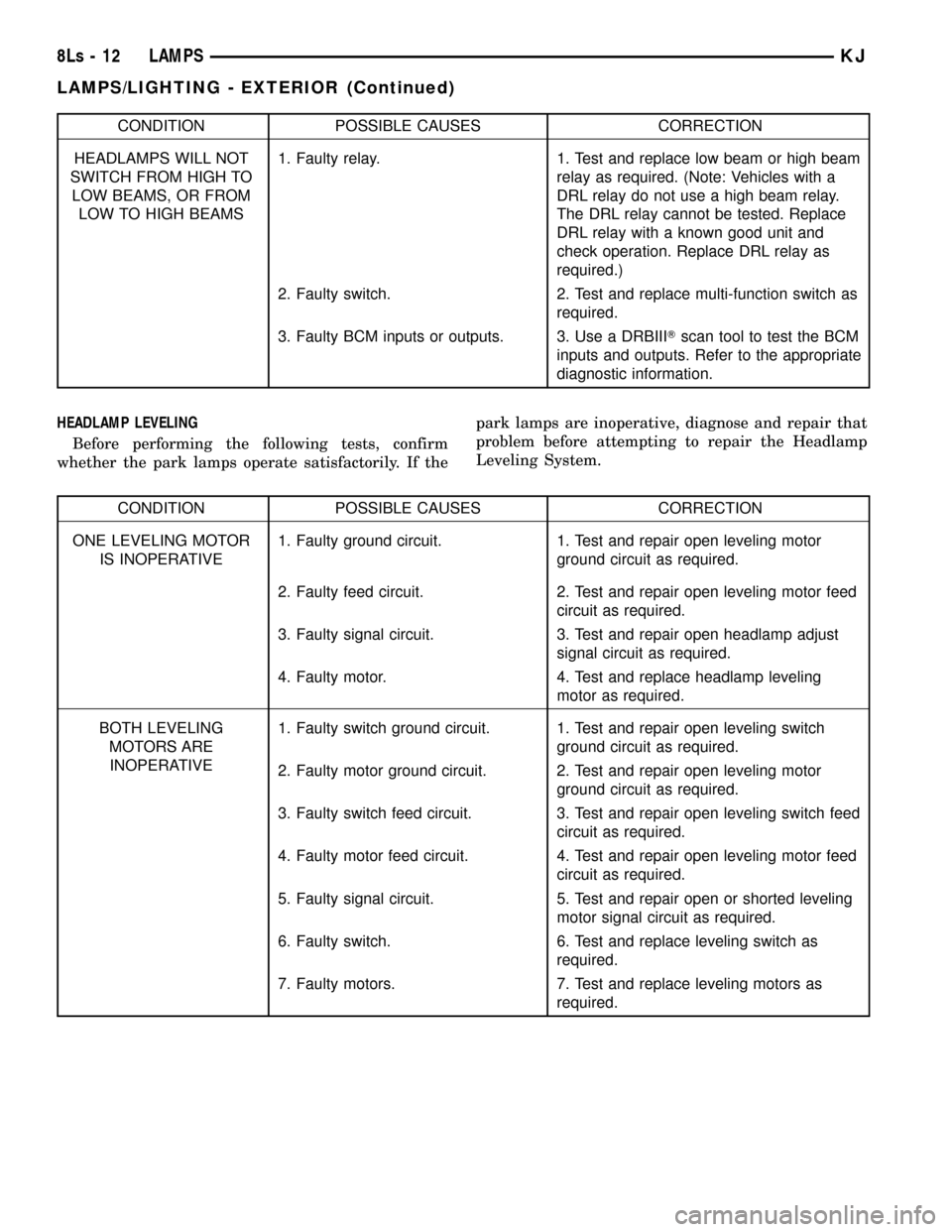
CONDITION POSSIBLE CAUSES CORRECTION
HEADLAMPS WILL NOT
SWITCH FROM HIGH TO
LOW BEAMS, OR FROM
LOW TO HIGH BEAMS1. Faulty relay. 1. Test and replace low beam or high beam
relay as required. (Note: Vehicles with a
DRL relay do not use a high beam relay.
The DRL relay cannot be tested. Replace
DRL relay with a known good unit and
check operation. Replace DRL relay as
required.)
2. Faulty switch. 2. Test and replace multi-function switch as
required.
3. Faulty BCM inputs or outputs. 3. Use a DRBIIITscan tool to test the BCM
inputs and outputs. Refer to the appropriate
diagnostic information.
HEADLAMP LEVELING
Before performing the following tests, confirm
whether the park lamps operate satisfactorily. If thepark lamps are inoperative, diagnose and repair that
problem before attempting to repair the Headlamp
Leveling System.
CONDITION POSSIBLE CAUSES CORRECTION
ONE LEVELING MOTOR
IS INOPERATIVE1. Faulty ground circuit. 1. Test and repair open leveling motor
ground circuit as required.
2. Faulty feed circuit. 2. Test and repair open leveling motor feed
circuit as required.
3. Faulty signal circuit. 3. Test and repair open headlamp adjust
signal circuit as required.
4. Faulty motor. 4. Test and replace headlamp leveling
motor as required.
BOTH LEVELING
MOTORS ARE
INOPERATIVE1. Faulty switch ground circuit. 1. Test and repair open leveling switch
ground circuit as required.
2. Faulty motor ground circuit. 2. Test and repair open leveling motor
ground circuit as required.
3. Faulty switch feed circuit. 3. Test and repair open leveling switch feed
circuit as required.
4. Faulty motor feed circuit. 4. Test and repair open leveling motor feed
circuit as required.
5. Faulty signal circuit. 5. Test and repair open or shorted leveling
motor signal circuit as required.
6. Faulty switch. 6. Test and replace leveling switch as
required.
7. Faulty motors. 7. Test and replace leveling motors as
required.
8Ls - 12 LAMPSKJ
LAMPS/LIGHTING - EXTERIOR (Continued)
Page 558 of 1803

(5) Position the outer circumference of the boot
seal over the flange on the back of the headlamp unit
housing and pull it downward until the seal is fully
engaged over the flange.
(6) Reinstall the headlamp unit onto the grille
opening reinforcement. (Refer to 8 - ELECTRICAL/
LAMPS/LIGHTING - EXTERIOR/HEADLAMP UNIT
- INSTALLATION).
(7) Reconnect the battery negative cable.
(8) Confirm proper headlamp unit alignment.
(Refer to 8 - ELECTRICAL/LAMPS/LIGHTING -
EXTERIOR/HEADLAMP UNIT - ADJUSTMENTS).
HEADLAMP HIGH BEAM
RELAY
DESCRIPTION
The headlamp high beam relay is located in the
Junction Block (JB) on the driver side outboard end
of the instrument panel in the passenger compart-
ment of the vehicle. The headlamp high beam relay
is omitted from vehicles manufactured for sale in
Canada, which have a Daytime Running Lamp (DRL)
solid state relay installed in the JB that also per-
forms the function of the headlamp high beam relay.
The headlamp high beam relay is a conventional
International Standards Organization (ISO) micro
relay (Fig. 28). Relays conforming to the ISO specifi-
cations have common physical dimensions, current
capacities, terminal patterns, and terminal functions.
The relay is contained within a small, rectangular,molded plastic housing and is connected to all of the
required inputs and outputs by five integral male
spade-type terminals that extend from the bottom of
the relay base.
The headlamp high beam relay cannot be adjusted
or repaired and, if faulty or damaged, the unit must
be replaced.
OPERATION
The headlamp high beam relay is an electrome-
chanical switch that uses a low current input from
the Body Control Module (BCM) to control a high
current output to the headlamp high beam filaments.
The movable common feed contact point is held
against the fixed normally closed contact point by
spring pressure. When the relay coil is energized, an
electromagnetic field is produced by the coil wind-
ings. This electromagnetic field draws the movable
relay contact point away from the fixed normally
closed contact point, and holds it against the fixed
normally open contact point. When the relay coil is
de-energized, spring pressure returns the movable
contact point back against the fixed normally closed
contact point. A resistor is connected in parallel with
the relay coil in the relay, and helps to dissipate volt-
age spikes and electromagnetic interference that can
be generated as the electromagnetic field of the relay
coil collapses.
The headlamp high beam relay terminals are con-
nected to the vehicle electrical system through a con-
nector receptacle in the Junction Block (JB). The
inputs and outputs of the headlamp high beam relay
include:
²Common Feed Terminal- The common feed
terminal (30) receives battery current at all times
from a fuse in the Power Distribution Center (PDC)
through a fused B(+) circuit.
²Coil Ground Terminal- The coil ground termi-
nal (85) is connected to a control output of the Body
Control Module (BCM) through a head lamp relay
control circuit. The BCM controls head lamp opera-
tion by controlling a ground path through this circuit
²Coil Battery Terminal- The coil battery ter-
minal (86) is connected to a control output of the
Body Control Module (BCM) and to the momentary
optical horn (flash-to-pass) output of the multi-func-
tion switch through a high beam relay control circuit.
The BCM and/or the multi-function switch controls
headlamp high beam operation by controlling a
ground path through this circuit.
²Normally Open Terminal- The normally open
terminal (87) is connected to the headlamp high
beam filaments through the high beam relay output
circuit and provides battery current to the headlamp
high beams whenever the relay is energized.
Fig. 28 ISO Micro Relay
30 - COMMON FEED
85 - COIL GROUND
86 - COIL BATTERY
87 - NORMALLY OPEN
87A - NORMALLY CLOSED
KJLAMPS8Ls-33
HEADLAMP BULB (Continued)
Page 565 of 1803

²Coil Battery Terminal- The coil battery ter-
minal (86) is connected to a control output of the
Body Control Module (BCM) through a low beam
relay control circuit. The BCM controls headlamp low
beam operation by controlling a ground path through
this circuit.
²Normally Open Terminal- The normally open
terminal (87) is connected to the headlamp low beam
filaments through the low beam relay output circuit
and provides battery current to the headlamp low
beams whenever the relay is energized.
²Normally Closed Terminal- The normally
closed terminal (87A) is not connected in this appli-
cation.
The headlamp low beam relay can be diagnosed
using conventional diagnostic tools and methods.
DIAGNOSIS AND TESTING - HEADLAMP LOW
BEAM RELAY
The headlamp low beam relay (Fig. 38) is located
in the Junction Block (JB) under the driver side out-
board end of the instrument panel. Refer to the
appropriate wiring information. The wiring informa-
tion includes wiring diagrams, proper wire and con-
nector repair procedures, details of wire harness
routing and retention, connector pin-out information
and location views for the various wire harness con-
nectors, splices and grounds.
WARNING: ON VEHICLES EQUIPPED WITH AIR-
BAGS, DISABLE THE SUPPLEMENTAL RESTRAINT
SYSTEM BEFORE ATTEMPTING ANY STEERING
WHEEL, STEERING COLUMN, DRIVER AIRBAG,
PASSENGER AIRBAG, SEAT BELT TENSIONER,
FRONT IMPACT SENSORS, SIDE CURTAIN AIRBAG,
OR INSTRUMENT PANEL COMPONENT DIAGNOSIS
OR SERVICE. DISCONNECT AND ISOLATE THE
BATTERY NEGATIVE (GROUND) CABLE, THEN
WAIT TWO MINUTES FOR THE SYSTEM CAPACI-
TOR TO DISCHARGE BEFORE PERFORMING FUR-
THER DIAGNOSIS OR SERVICE. THIS IS THE ONLY
SURE WAY TO DISABLE THE SUPPLEMENTAL
RESTRAINT SYSTEM. FAILURE TO TAKE THE
PROPER PRECAUTIONS COULD RESULT IN ACCI-
DENTAL AIRBAG DEPLOYMENT AND POSSIBLE
PERSONAL INJURY.
(1) Remove the headlamp low beam relay from the
JB. (Refer to 8 - ELECTRICAL/LAMPS/LIGHTING -
EXTERIOR/HEADLAMP LOW BEAM RELAY -
REMOVAL).
(2) A relay in the de-energized position should
have continuity between terminals 87A and 30, and
no continuity between terminals 87 and 30. If OK, go
to Step 3. If not OK, replace the faulty relay.(3) Resistance between terminals 85 and 86 (elec-
tromagnet) should be 75 8 ohms. If OK, go to Step
4. If not OK, replace the faulty relay.
(4) Connect a battery to terminals 85 and 86.
There should now be continuity between terminals
30 and 87, and no continuity between terminals 87A
and 30. If OK, reinstall the relay and use a DRBIIIt
scan tool to perform further testing. Refer to the
appropriate diagnostic information.
REMOVAL
WARNING: ON VEHICLES EQUIPPED WITH AIR-
BAGS, DISABLE THE SUPPLEMENTAL RESTRAINT
SYSTEM BEFORE ATTEMPTING ANY STEERING
WHEEL, STEERING COLUMN, DRIVER AIRBAG,
PASSENGER AIRBAG, SEAT BELT TENSIONER,
FRONT IMPACT SENSORS, SIDE CURTAIN AIRBAG,
OR INSTRUMENT PANEL COMPONENT DIAGNOSIS
OR SERVICE. DISCONNECT AND ISOLATE THE
BATTERY NEGATIVE (GROUND) CABLE, THEN
WAIT TWO MINUTES FOR THE SYSTEM CAPACI-
TOR TO DISCHARGE BEFORE PERFORMING FUR-
THER DIAGNOSIS OR SERVICE. THIS IS THE ONLY
SURE WAY TO DISABLE THE SUPPLEMENTAL
RESTRAINT SYSTEM. FAILURE TO TAKE THE
PROPER PRECAUTIONS COULD RESULT IN ACCI-
DENTAL AIRBAG DEPLOYMENT AND POSSIBLE
PERSONAL INJURY.
(1) Disconnect and isolate the battery negative
cable.
Fig. 38 ISO Micro Relay
30 - COMMON FEED
85 - COIL GROUND
86 - COIL BATTERY
87 - NORMALLY OPEN
87A - NORMALLY CLOSED
8Ls - 40 LAMPSKJ
HEADLAMP LOW BEAM RELAY (Continued)
Page 568 of 1803

HEADLAMP ALIGNMENT SCREEN PREPARATION
Prepare an alignment screen as illustrated.
(1) Position the vehicle on a level surface perpen-
dicular to a flat wall 7.62 meters (25 feet) away from
the front of the headlamp lens for North American
vehicles, or 10.0 meters (32.81 feet) away from the
front of the headlamp lens for Rest-Of-World vehicles
(Fig. 43). If necessary, tape a line on the floor at the
appropriate distance away from and parallel to the
wall.
(2) Measure up on the wall 1.27 meters (5 feet)
from the floor and tape a vertical line on the align-
ment screen at the centerline of the vehicle. Sight
along the centerline of the vehicle (from the rear of
the vehicle forward) to verify the accuracy of the cen-
terline placement.
(3) Rock the vehicle from side-to-side three times
to allow the suspension to stabilize, then jounce the
front suspension three times by pushing downward
on the front bumper and releasing. Measure the dis-
tance from the center of the headlamp lens to the
floor. Transfer this measurement to the alignment
screen and tape a horizontal line on the wall at this
mark. This line will be used for up-and-down adjust-
ment reference.(4) Measure the distance from the centerline of the
vehicle to the center of each headlamp being aligned.
Transfer these measurements to the alignment
screen and tape a vertical line this distance to each
side of the vehicle centerline. These lines will be used
for left/right reference.
HEADLAMP ADJUSTMENT
A properly aligned headlamp will project a pattern
on the alignment screen from just below horizontal to
75 millimeters (3 inches) below the headlamp center-
line for vehicles in North America, or from just below
horizontal to 125 millimeters (5 inches) below the
headlamp horizontal centerline for vehicles in Rest-
Of-World.
(1) Vehicles for all markets except Japan should
have the headlamp low beams selected with the dim-
mer (multi-function) switch during the adjustment
procedure. Vehicles for the Japanese market should
have the headlamp high beams selected.
(2) Cover the lens of the headlamp that is not
being adjusted.
(3) Turn the adjusting screw (Fig. 44) until the top
edge of the beam intensity pattern is positioned from
just below horizontal to 75 millimeters (3 inches)
Fig. 43 Headlamp Alignment Screen - Typical
1 - CENTER OF VEHICLE TO CENTER OF HEADLAMP LENS
2 - FLOOR TO CENTER OF HEADLAMP LENS
3 - 7.62 METERS (25 FEET) NORTH AMERICA/10.0 METERS
(32.81 FEET) REST-OF-WORLD4 - FRONT OF HEADLAMP
5 - VEHICLE CENTERLINE
KJLAMPS8Ls-43
HEADLAMP UNIT (Continued)
Page 572 of 1803

knob on its end with a flattened face to allow it to be
easily rotated. On vehicles equipped with optional
front fog lamps, the knob on the end of left control
stalk can also be pulled outward to select those
lamps. Each control stalk also features a knurled
control ring located just below the control knob. The
left control stalk is dedicated to providing driver con-
trols for the interior and exterior lighting systems,
while the right control stalk is dedicated to providing
driver controls for the front and rear wiper systems.
Two integral connector receptacles on the forward
facing surface of the multi-function switch housing
connect the switch two the vehicle electrical system
through two take outs and connectors of the instru-
ment panel wire harness. The left connector recepta-
cle contains nine terminal pins for the lighting
control circuits of the switch, while the right connec-
tor receptacle contains six terminal pins for the
wiper control circuits of the switch. The multi-func-
tion switch cannot be adjusted or repaired and, if
faulty or damaged, it must be replaced.
LEFT CONTROL STALK The left (lighting) control
stalk of the multi-function switch supports the fol-
lowing functions and features:
²Front Fog Lamps- For vehicles so equipped,
the internal circuitry and hardware of the multi-
function switch left (lighting) control stalk provide
detent switching for the optional front fog lamps.
²Headlamps- The internal circuitry and hard-
ware of the multi-function switch left (lighting) con-trol stalk provide detent switching for the
headlamps.
²Headlamp Beam Selection- The internal cir-
cuitry and hardware of the multi-function switch left
(lighting) control stalk provide detent switching for
selection of the headlamp high or low beams.
²Headlamp Optical Horn- The internal cir-
cuitry and hardware of the multi-function switch left
(lighting) control stalk includes momentary switching
of the headlamp high beam circuits to provide an
optical horn feature (sometimes referred to as flash-
to-pass), which allows the vehicle operator to momen-
tarily flash the headlamp high beams as an optical
signalling device.
²Interior Lamps Defeat- The internal circuitry
and hardware of the multi-function switch left (light-
ing) control stalk provide detent switching to defeat
the illumination of all interior courtesy lamps when a
door, the rear flip-up glass, or the tailgate are
opened.
²Interior Lamps On- The internal circuitry and
hardware of the multi-function switch left (lighting)
control stalk provide detent switching to simulta-
neously illuminate all interior courtesy lamps.
²Panel Lamps Dimming- The internal cir-
cuitry and hardware of the multi-function switch left
(lighting) control stalk provide simultaneous adjust-
able control of the illumination intensity of all instru-
ment panel lighting at one of six available
illumination intensity levels.
Fig. 50 Multi-Function Switch
1 - MULTI-FUNCTION SWITCH
2 - RIGHT (WIPER) CONTROL STALK
3 - LEFT (LIGHTING) CONTROL STALK
4 - TURN SIGNAL CANCEL ACTUATOR5 - RIGHT (WIPER) CONTROL KNOB
6 - RIGHT (WIPER) CONTROL RING
7 - LEFT (LIGHTING) CONTROL RING
8 - LEFT (LIGHTING) CONTROL KNOB
KJLAMPS8Ls-47
MULTI-FUNCTION SWITCH (Continued)
Page 577 of 1803

MULTI-FUNCTION SWITCH TESTS
EXTERIOR LIGHTING FUNCTIONS
SWITCH POSITION CONNECTOR C-1 PINS RESISTANCE (OHMS) 10%
Off 4 & 5 3781
Park Lamps On 4 & 5 911
Headlamp Low Beams On 4 & 5 349
Rear Fog Lamps On 4 & 5 75
Headlamp High Beams On 8 & 9 0 - 1
Front Fog Lamps On 2 & 4 0 - 1
Optical Horn (Flash-to-Pass) On 7 & 8 0 - 1
Turn Signal Neutral 6 & 8,8&10Infinite (Open)
Turn Signal Left 6 & 8 0 - 1
Turn Signal Right 8 & 10 0 - 1
INTERIOR LIGHTING FUNCTIONS
SWITCH POSITION CONNECTOR C-1 PINS RESISTANCE (OHMS) 10%
Off (Courtesy Disable) 1 & 4 63
Dimming 1 1 & 4 200
Dimming 2 1 & 4 557
Dimming 3 1 & 4 914
Dimming 4 1 & 4 1271
Dimming 5 1 & 4 1628
Dimming 6 1 & 4 1985
Parade Mode On 1 & 4 3565
Courtesy On 1 & 4 7885
FRONT WIPER FUNCTIONS
SWITCH POSITIONCONNECTOR C-1 & C-2
PINSRESISTANCE (OHMS) 10%
Front Wiper Off C-1 Pin 4 & C-2 Pin 4 4587
Delay 1 C-1 Pin 4 & C-2 Pin 4 1267
Delay 2 C-1 Pin 4 & C-2 Pin 4 792
Delay 3 C-1 Pin 4 & C-2 Pin 4 531
Delay 4 C-1 Pin 4 & C-2 Pin 4 369
Delay 5 C-1 Pin 4 & C-2 Pin 4 262
Front Wiper Low C-1 Pin 4 & C-2 Pin 4 125
Front Wiper High C-1 Pin 4 & C-2 Pin 4 38
Front Wiper Mist C-1 Pin 4 & C-2 Pin 4 125
Front Washer On C-2 Pins5&7 0-1
REAR WIPER FUNCTIONS
SWITCH POSITION CONNECTOR C-2 PINS RESISTANCE (OHMS) 10%
Rear Wiper Off 1 & 5,2&5Infinite (Open)
Rear Wiper Intermittent 2 & 5 0 - 1
Rear Wiper On 1 & 5 0 - 1
Rear Washer On 2 & 5,3&5 0-1
8Ls - 52 LAMPSKJ
MULTI-FUNCTION SWITCH (Continued)