2002 JEEP LIBERTY Rear axle
[x] Cancel search: Rear axlePage 298 of 1803

ever occurs first. The overspeed warning feature is
only enabled on a BCM that has been programmed
with a Middle East Gulf Coast Country (GCC) coun-
try code.
²No Airbag Indicator Message Warning- The
EMIC chime tone generator will generate one, short,
ªbong-likeº chime tone and turn on the ªAirbagº indi-
cator when the ignition switch is in the On position,
and a PCI data bus ªAirbagº indicator on or off mes-
sage is not received from the ACM for six consecutive
seconds.
²No Antilock Brake Indicator Message Warn-
ing- The EMIC chime tone generator will generate
one, short, ªbong-likeº chime tone and turn on the
ªABSº indicator when the ignition switch is in the On
position, and a PCI data bus ªABSº indicator on or
off message is not received from the CAB for six con-
secutive seconds.
²No Fuel Level Message Warning- The EMIC
chime tone generator will generate one, short, ªbong-
likeº chime tone and turn on the ªLow Fuelº indica-
tor when the ignition switch is in the On position,
and a PCI data bus fuel level message is not received
from the PCM for twelve consecutive seconds.
²Remote Keyless Entry Transmitter Pro-
gramming- On vehicles so equipped, the EMIC
chime tone generator will generate a single ªbong-
likeº chime tone when an electronic message is
received over the PCI data bus from the BCM indi-
cating that a Remote Keyless Entry (RKE) transmit-
ter has been successfully programmed by the
customer into the RKE module memory.
²Sentry Key Immobilizer System Transpon-
der Programming- On vehicles so equipped, the
EMIC chime tone generator will generate a single
ªbong-likeº chime tone when an electronic message is
received over PCI data bus message from the Sentry
Key Immobilizer Module (SKIM) indicating that the
Sentry Key Immobilizer System (SKIS) has been
placed in the ªCustomer Learnº programming mode,
and again each time a new SKIS transponder has
been successfully programmed by the customer.
²Turn Signal Cancel Warning- The EMIC
chime tone generator will generate repetitive ªbong-
likeº chime tones at a slow rate when the vehicle is
driven for a distance of about 3.2 kilometers (about
two miles) with a turn signal indicator flashing. The
EMIC uses an electronic message received over the
PCI data bus from the PCM, and a hard wired input
from the turn signal switch circuitry of the multi-
function switch to determine when to sound the turn
signal cancel warning. The PCM uses internal pro-
gramming and distance pulse information received
over a hard wired vehicle speed pulse input from the
BCM to determine the proper vehicle speed messages
to send to the EMIC. The BCM uses an internallyprogrammed electronic pinion factor and a hard
wired input from the rear wheel speed sensor to cal-
culate the proper distance pulse information to send
to the PCM. The electronic pinion factor represents
the proper tire size and axle ratio information for the
vehicle. These chimes will continue to sound until
the turn signal is turned Off, until the hazard warn-
ing system is turned On, or until the ignition switch
is turned to the Off position, whichever occurs first.
²Water-In-Fuel Warning- On vehicles equipped
with a diesel engine, each time the ignition switch is
turned to the On position, the EMIC chime tone gen-
erator will generate a single ªbong-likeº chime tone
the first time an electronic message is received over
the PCI data bus from the PCM requesting ªWater-
in-Fuelº indicator illumination. The PCM uses inter-
nal programming and a hard wired input from the
water-in-fuel sensor to determine the proper water-
in-fuel messages to send to the EMIC. This warning
will only occur once during an ignition cycle.
The EMIC provides chime service for all available
features in the chime warning system. The EMIC
relies upon its internal programming and hard wired
inputs from the turn signal (multi-function) switch,
the washer fluid level switch, and the engine coolant
level sensor (diesel engine only) to provide chime ser-
vice for the turn signal cancel warning, the low
washer fluid warning, and the low coolant warning
respectively. The EMIC relies upon electronic mes-
sage inputs received from other electronic modules
over the PCI data bus network to provide chime ser-
vice for all of the remaining chime warning system
features. Upon receiving the proper inputs, the EMIC
activates the integral chime tone generator to pro-
vide the audible chime warning to the vehicle opera-
tor. The internal programming of the EMIC
determines the priority of each chime request input
that is received, as well as the rate and duration of
each chime tone that is to be generated. See the own-
er's manual in the vehicle glove box for more infor-
mation on the features provided by the chime
warning system.
The hard wired chime warning system inputs to
the EMIC, as well as other hard wired circuits for
this system may be diagnosed and tested using con-
ventional diagnostic tools and procedures. However,
conventional diagnostic methods may not prove con-
clusive in the diagnosis of the EMIC, the PCI data
bus network, or the electronic message inputs used
by the EMIC to provide chime warning system ser-
vice. The most reliable, efficient, and accurate means
to diagnose the EMIC, the PCI data bus network,
and the electronic message inputs for the chime
warning system requires the use of a DRBIIItscan
tool. Refer to the appropriate diagnostic information.
KJCHIME/BUZZER 8B - 5
CHIME WARNING SYSTEM (Continued)
Page 303 of 1803

²Fog Lamp Control- The premium BCM pro-
vides fog lamp control for front fog lamps (optional),
and rear fog lamps (in required markets only).
²Front Wiper System Status- The BCM moni-
tors the status of the front wiper motor park switch.
²Fuel Economy and Distance to Empty Cal-
culations- The BCM calculates and transmits the
fuel economy and Distance To Empty (DTE) data.
²Headlamp Time Delay- The BCM provides a
headlamp time delay feature with the ignition switch
in the Off position.
²Heated Rear Glass Control- The BCM pro-
vides control and timer functions for the heated rear
glass feature and transmits the system status.
²Ignition On/Off Timer- The BCM monitors
and transmits the elapsed ignition On timer data
and monitors the ignition Off time.
²Ignition Switch Position Status- The BCM
monitors and transmits the status of the ignition
switch.
²Instrument Panel Dimming- The BCM mon-
itors and transmits the selected illumination inten-
sity level of the panel lamps dimmer switch.
²Interior Lamp Load Shedding- The BCM
provides a battery saver feature which will automat-
ically turn off all interior lamps that remain on after
a timed interval.
²Interior Lighting Control- The BCM moni-
tors inputs from the interior lighting switch, the door
ajar switches, the flip-up glass ajar switch, the tail-
gate ajar switch, the cargo lamp switch, the reading
lamp switches, and the Remote Keyless Entry (RKE)
module to provide courtesy lamp control. This
includes support for timed illuminated entry with
theater-style fade-to-off and courtesy illumination
defeat features.
²Intermittent Wipe and Front Wiper System
Control- The BCM monitors inputs from the front
wiper and washer switch and the front wiper motor
park switch to provide front wiper system control
through the wiper on/off and high/low relays. This
includes support for adjustable intermittent wipe,
mist wipe (also known as pulse wipe), and wipe-after-
wash features.
²Key-In-Ignition Switch Status- The BCM
monitors and transmits the status of the key-in-igni-
tion switch.
²Panic Mode- The BCM provides support for
the Remote Keyless Entry (RKE) system panic mode
feature.
²Parade Mode- The BCM provides a parade
mode (also known as funeral mode) that allows the
interior Vacuum Fluorescent Displays (VFD) to be
illuminated at full intensity while driving in daylight
with the exterior lamps On.²Power Locks- The BCM monitors inputs from
the power lock switches and the Remote Keyless
Entry (RKE) module (optional) to provide control of
the power lock motors through outputs to the lock,
unlock, and driver unlock (RKE only) relays. This
includes support for rolling door locks (also known as
automatic door locks) and a door lock inhibit mode.
²Programmable Features- The BCM provides
support for several standard and optional program-
mable features, including: rolling door locks, head-
lamp time delay interval, Remote Keyless Entry
(RKE) driver-door-only or unlock-all-doors, RKE opti-
cal chirp, and RKE audible chirp.
²Remote Keyless Entry- The premium BCM
provides the optional Remote Keyless Entry (RKE)
system features, including support for the RKE Lock,
Unlock (with optional driver-door-only unlock, and
unlock-all-doors), rear flip-up glass control, Panic,
audible chirp, optical chirp, and illuminated entry
modes, as well as the ability to be programmed to
recognize up to four RKE transmitters.
²Rolling Door Locks- The BCM provides sup-
port for the power lock system rolling door locks fea-
ture (also known as automatic door locks).
²Tailgate and Flip-Up Glass Ajar Status- The
BCM monitors and transmits the status of the tail-
gate and rear flip-up glass ajar switches.
²Remote Radio Switch Interface- The pre-
mium BCM monitors and transmits the status of the
optional remote radio switches.
²Self-Diagnostics- The BCM provides support
for diagnostics through communication with the
DRBIIItscan tool over the PCI data bus network.
Each analog and digital input can be verified, and
each output can be actuated through the use of this
diagnostic protocol. The BCM also stores Diagnostic
Trouble Codes (DTCs) to assist in troubleshooting
this unit.
²Vacuum Fluorescent Display Synchroniza-
tion- The BCM transmits panel lamp intensity data
which allows modules with Vacuum Fluorescent Dis-
plays (VFD) to coordinate their illumination inten-
sity.
²Vehicle Speed System- The BCM monitors a
vehicle speed input from the vehicle speed sensor
(without Antilock Brake System [ABS]) or from the
Controller Antilock Brake (CAB)(with ABS), calcu-
lates the vehicle speed based upon a programmed
axle ratio/tire size (electronic pinion factor), and
transmits the vehicle speed information to the Pow-
ertrain Control Module (PCM) on a hard wired out-
put circuit.
²Vehicle Theft Security System- The pre-
mium BCM monitors inputs from the door cylinder
lock switches, the tailgate cylinder lock switch, the
door ajar switches, the tailgate ajar switch, the
8E - 4 ELECTRONIC CONTROL MODULESKJ
BODY CONTROL MODULE (Continued)
Page 752 of 1803

TERMINOLOGY
This is a list of terms and definitions used in the
wiring diagrams.
LHD .................Left Hand Drive Vehicles
RHD................Right Hand Drive Vehicles
ATX . . Automatic Transmissions-Front Wheel Drive
MTX....Manual Transmissions-Front Wheel Drive
AT ....Automatic Transmissions-Rear Wheel Drive
MT .....Manual Transmissions-Rear Wheel Drive
SOHC...........Single Over Head Cam Engine
DOHC..........Double Over Head Cam Engine
Built-Up-Export........ Vehicles Built For Sale In
Markets Other Than North America
Except-Built-Up-Export . . Vehicles Built For Sale In
North America
DESCRIPTION - CIRCUIT INFORMATION
Each wire shown in the diagrams contains a code
which identifies the main circuit, part of the main
circuit, gage of wire, and color (Fig. 4).
WIRE COLOR CODE CHART
COLOR CODE COLOR
BL BLUE
BK BLACK
BR BROWN
DB DARK BLUE
DG DARK GREEN
GY GRAY
LB LIGHT BLUE
LG LIGHT GREEN
COLOR CODE COLOR
OR ORANGE
PK PINK
RD RED
TN TAN
VT VIOLET
WT WHITE
YL YELLOW
* WITH TRACER
DESCRIPTION - CIRCUIT FUNCTIONS
All circuits in the diagrams use an alpha/numeric
code to identify the wire and it's function. To identify
which circuit code applies to a system, refer to the
Circuit Identification Code Chart. This chart shows
the main circuits only and does not show the second-
ary codes that may apply to some models.
CIRCUIT IDENTIFICATION CODE CHART
CIRCUIT FUNCTION
A BATTERY FEED
B BRAKE CONTROLS
C CLIMATE CONTROLS
D DIAGNOSTIC CIRCUITS
E DIMMING ILLUMINATION
CIRCUITS
F FUSED CIRCUITS
G MONITORING CIRCUITS
(GAUGES)
H OPEN
I NOT USED
J OPEN
K POWERTRAIN CONTROL
MODULE
L EXTERIOR LIGHTING
M INTERIOR LIGHTING
N NOT USED
O NOT USED
P POWER OPTION (BATTERY
FEED)
Q POWER OPTIONS (IGNITION
FEED)
R PASSIVE RESTRAINT
S SUSPENSION/STEERING
T TRANSMISSION/TRANSAXLE/
TRANSFER CASE
Fig. 4 WIRE CODE IDENTIFICATION
1 - COLOR OF WIRE (LIGHT BLUE WITH YELLOW TRACER
2 - GAGE OF WIRE (18 GAGE)
3 - PART OF MAIN CIRCUIT (VARIES DEPENDING ON
EQUIPMENT)
4 - MAIN CIRCUIT IDENTIFICATION
KJ8W-01 WIRING DIAGRAM INFORMATION8Wa-01-5
WIRING DIAGRAM INFORMATION (Continued)
Page 1162 of 1803

CONNECTOR NAME/NUMBER COLOR LOCATION FIG.
Output Speed Sensor BK Left Side of Transmission 5
Overhead Map/Courtesy Lamp BK Overhead Console N/S
Oxygen Sensor 1/1 Upstream (2.4L) BK Right Side of Engine 12
Oxygen Sensor 1/1 Upstream (3.7L) BK Lower Left Side of Engine 3
Oxygen Sensor 1/2 Downstream
(2.4L)NAT Right Side of Transmission 11, 12
Oxygen Sensor 1/2 Downstream
(3.7L)NAT Left Side of Transmission 5, 7
Oxygen Sensor 2/1 Upstream (3.7L) BK Lower Right Side of Engine 4
Oxygen Sensor 2/2 Downstream
(3.7L)NAT Right Side of Transmission 6
Park Brake Switch BK Center Console 36, 40
Passenger Airbag YL Right Side Instrument Panel N/S
Passenger Seat Belt Switch LG At Passenger Seat N/S
Power Mirror Switch WT In Left Front Door 41
Power Outlet RD Center of Instrument Panel N/S
Power Steering Pressure Switch BK Left Front Side of Engine 3, 15
Power Window Master Switch LG Center Console 36, 40
Powertrain Control Module C1 (2.4L) BK At Powertrain Control Module 13, 14
Powertrain Control Module C1 (3.7L) BK At Powertrain Control Module 8, 9, 10
Powertrain Control Module C2 WT At Powertrain Control Module 8, 9, 10, 13, 14
Powertrain Control Module C3 GY At Powertrain Control Module 31
Radiator Fan Motor BK Right Front Side of Engine
Compartment28
Radiator Fan Relay BK Left Front Side of Engine
Compartment29
Radio C1 GY Rear of Radio N/S
Radio C2 Rear of Radio N/S
Radio C3 Rear of Radio N/S
Radio Choke GY Center of Instrument Panel N/S
Rear Map/Reading Lamp BK Overhead Console N/S
Rear Power Outlet RD Right Rear Quarter Panel 44, 45, 48
Rear Power Window Switch WT Center Console 36, 40
Rear Wheel Speed Sensor BK On Rear Axle N/S
Rear Window Defogger BK At Rear Window 46
Rear Wiper Motor BK In Tailgate 46
Red Brake Warning Indicator Switch
(LHD)GY Left Rear Side of Engine
Compartment31
Red Brake Warning Indicator Switch
(RHD)GY Right Rear Side of Engine
Compartment26
Right Curtain Airbag YL Right Mid B-Pillar 34, 39
Right Cylinder Lock Switch (Except
Base)LG In Right Front Door 41
KJ8W-91 CONNECTOR/GROUND/SPLICE LOCATION8Wa-91-7
CONNECTOR/GROUND/SPLICE LOCATION (Continued)
Page 1379 of 1803
SPECIFICATIONS - TORQUE
DESCRIPTION N´m Ft. Lbs. In. Lbs.
ENGINE CRADLE CROSSMEMBER INNER RAIL BOLTS 47 35 Ð
ENGINE CRADLE CROSSMEMBER MOUNTING BOLTS 122 90 Ð
ENGINE MOUNT THROUGH BOLTS/NUTS 88 65 Ð
FRONT SKID PLATE BOLTS 61 45 Ð
FRONT TOW HOOK NUTS/BOLT 61 45 Ð
FUEL TANK SKID PLATE 88 65 Ð
REAR CROSSMEMBER BOLTS 47 35 Ð
REAR TOW HOOK BOLTS 88 65 Ð
TRAILER HITCH BOLTS 88 65 Ð
TRANSFER CASE SKID PLATE BOLTS 34 25 Ð
TRANSMISSION MOUNT THROUGH BOLT/NUT 88 65 Ð
FRONT SKID PLATE
REMOVAL
(1) Raise and support the vehicle.
(2) Remove the skid plate bolts and remove the
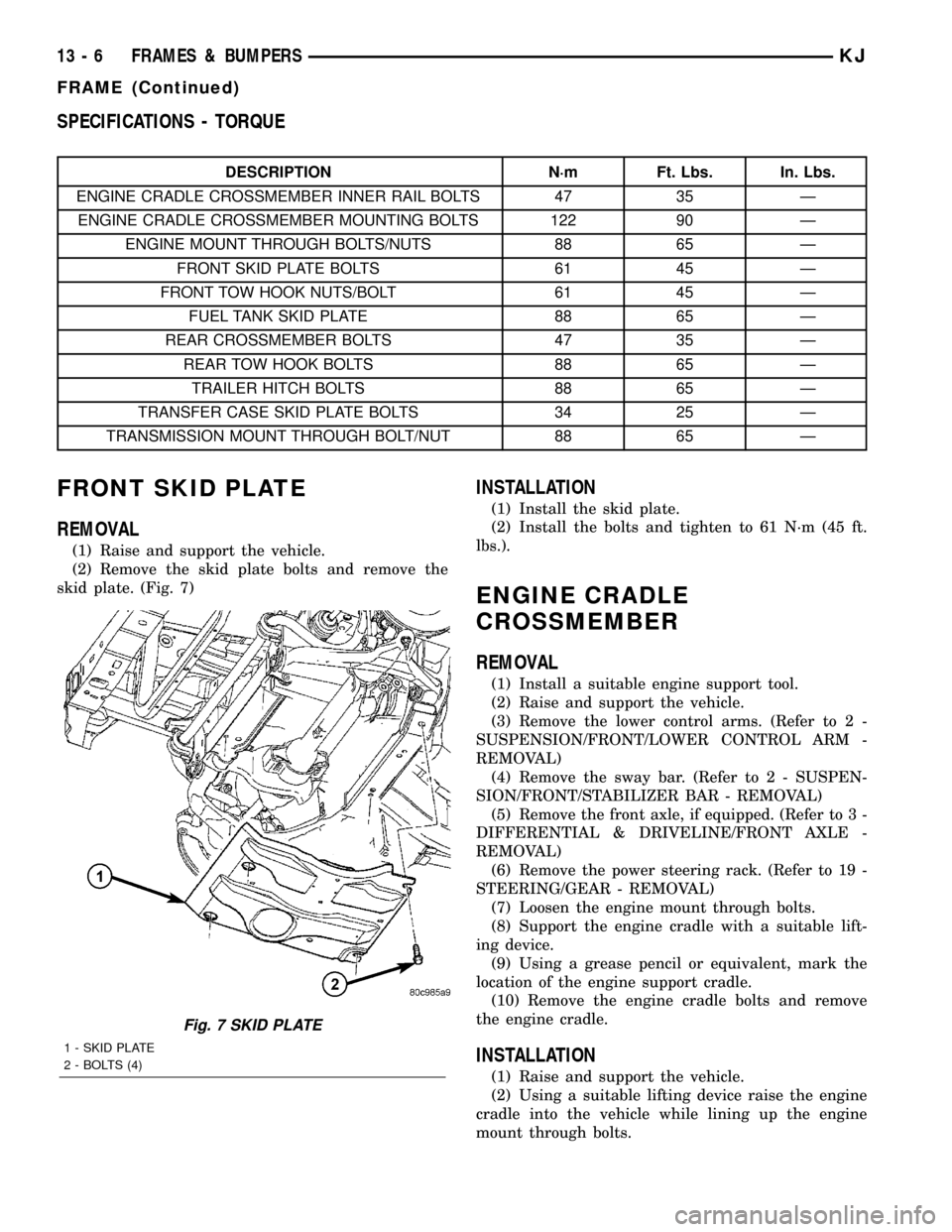
skid plate. (Fig. 7)
INSTALLATION
(1) Install the skid plate.
(2) Install the bolts and tighten to 61 N´m (45 ft.
lbs.).
ENGINE CRADLE
CROSSMEMBER
REMOVAL
(1) Install a suitable engine support tool.
(2) Raise and support the vehicle.
(3) Remove the lower control arms. (Refer to 2 -
SUSPENSION/FRONT/LOWER CONTROL ARM -
REMOVAL)
(4) Remove the sway bar. (Refer to 2 - SUSPEN-
SION/FRONT/STABILIZER BAR - REMOVAL)
(5) Remove the front axle, if equipped. (Refer to 3 -
DIFFERENTIAL & DRIVELINE/FRONT AXLE -
REMOVAL)
(6) Remove the power steering rack. (Refer to 19 -
STEERING/GEAR - REMOVAL)
(7) Loosen the engine mount through bolts.
(8) Support the engine cradle with a suitable lift-
ing device.
(9) Using a grease pencil or equivalent, mark the
location of the engine support cradle.
(10) Remove the engine cradle bolts and remove
the engine cradle.
INSTALLATION
(1) Raise and support the vehicle.
(2) Using a suitable lifting device raise the engine
cradle into the vehicle while lining up the engine
mount through bolts.
Fig. 7 SKID PLATE
1 - SKID PLATE
2 - BOLTS (4)
13 - 6 FRAMES & BUMPERSKJ
FRAME (Continued)
Page 1380 of 1803

(3) Align the engine cradle to the marks made dur-
ing removal and install the mounting and inner rail
bolts.
(4) Tighten the mounting bolts to 122 N´m (90 ft.
lbs.).
(5) Tighten the inner rail bolts to 47 N´m (35 ft.
lbs.).
(6) Tighten the engine mount through bolts to 88
N´m (65 ft. lbs.).
(7) Install the power steering rack. (Refer to 19 -
STEERING/GEAR - INSTALLATION)
(8) Install the front axle, if equipped. (Refer to 3 -
DIFFERENTIAL & DRIVELINE/FRONT AXLE -
INSTALLATION)
(9) Install the stabilizer bar. (Refer to 2 - SUS-
PENSION/FRONT/STABILIZER BAR - INSTALLA-
TION)
(10) Install the lower control arms. (Refer to 2 -
SUSPENSION/FRONT/LOWER CONTROL ARM -
INSTALLATION)
(11) Lower the vehicle and remove the engine sup-
port tool.
TRANSFER CASE SKID PLATE
REMOVAL
(1) Remove the bolts and remove the skid plate.
(Fig. 8)
INSTALLATION
(1) Install the skid plate.
(2) Install the bolts and tighten to 34 N´m (25 ft.
lbs.).
REAR CROSSMEMBER
REMOVAL
(1) Raise and support the vehicle.
(2) Support the transmission with a suitable lifting
device.
(3) Remove the transmission mount through bolt.
(4) Remove the crossmember bolts and remove the
crossmember. (Fig. 9)
INSTALLATION
(1) Install the crossmember and install the bolts.
(2) Tighten the bolts to 47 N´m (35 ft. lbs.)
(3) Install transmission mount through bolt and
tighten to 88 N´m (65 ft. lbs.).
Fig. 8 SKID PLATE
1 - SKID PLATE
2 - BOLTS
Fig. 9 CROSS MEMBER
1 - CROSSMEMBER
2 - BOLTS
KJFRAMES & BUMPERS 13 - 7
ENGINE CRADLE CROSSMEMBER (Continued)
Page 1621 of 1803

INTERIOR
TABLE OF CONTENTS
page page
4WD FLOOR SHIFT BOOT
REMOVAL............................156
INSTALLATION........................156
A-PILLAR TRIM AND GRAB HANDLE
REMOVAL............................156
INSTALLATION........................156
COWL TRIM COVER
REMOVAL............................157
INSTALLATION........................157
DOOR SILL SCUFF PLATE
REMOVAL............................157
INSTALLATION........................157
ASSIST HANDLE
REMOVAL............................157
INSTALLATION........................157
B-PILLAR LOWER TRIM
REMOVAL............................157
INSTALLATION........................157
B-PILLAR UPPER TRIM
REMOVAL............................157
INSTALLATION........................158
CARPETS AND FLOOR MATS
REMOVAL............................158
INSTALLATION........................158
SHIFT BEZEL
REMOVAL............................158
INSTALLATION........................158FLOOR CONSOLE
REMOVAL............................158
INSTALLATION........................158
FLOOR CONSOLE LID LATCH
REMOVAL............................158
INSTALLATION........................158
HEADLINER
REMOVAL............................159
INSTALLATION........................159
QUARTER TRIM PANEL
REMOVAL............................159
INSTALLATION........................159
REAR DOOR SCUFF PLATE
REMOVAL............................160
INSTALLATION........................160
SUN VISOR
REMOVAL............................160
INSTALLATION........................160
SUN VISOR SUPPORT
REMOVAL............................160
INSTALLATION........................160
REAR VIEW MIRROR
REMOVAL............................161
INSTALLATION
INSTALLATION......................161
INSTALLATION - REARVIEW MIRROR
SUPPORT BRACKET..................161
4WD FLOOR SHIFT BOOT
REMOVAL
(1) Remove the shift lever and remove the boot
from the lever. (Refer to 21 - TRANSMISSION/
TRANSAXLE/TRANSFER CASE/SHIFT LEVER -
REMOVAL)
INSTALLATION
(1) Install the shift boot onto the shift lever and
install the lever. (Refer to 21 - TRANSMISSION/
TRANSAXLE/TRANSFER CASE/SHIFT LEVER -
INSTALLATION)
A-PILLAR TRIM AND GRAB
HANDLE
REMOVAL
(1) Using a small pry tool or equivalent, remove
the grab handle trim plugs.
(2) Remove the two grab handle screws.
(3) Remove the grab handle and a-pillar trim from
the a-pillar.
INSTALLATION
(1) Snap a-pillar trim and grab handle into the
a-pillar.
(2) Install the two screws and install the grab han-
dle trim plugs.
23 - 156 INTERIORKJ
Page 1740 of 1803

ABS - DESCRIPTION, BRAKES...........5-32
ABS - OPERATION, BRAKES.............5-32
ABS - SPECIFICATIONS, BRAKES.........5-33
ABS BRAKE BLEEDING - STANDARD
PROCEDURE.........................5-33
ABS INDICATOR - DESCRIPTION.........8J-11
ABS INDICATOR - OPERATION..........8J-11
A/C APPLICATION TABLE,
SPECIFICATIONS......................24-9
A/C COMPRESSOR CLUTCH -
INSPECTION........................24-14
A/C COMPRESSOR CLUTCH -
INSTALLATION.......................24-14
A/C COMPRESSOR CLUTCH - REMOVAL . . 24-13
A/C COMPRESSOR CLUTCH BREAK-IN -
STANDARD PROCEDURE...............24-12
A/C COMPRESSOR CLUTCH COIL -
DIAGNOSIS AND TESTING.............24-12
A/C COMPRESSOR CLUTCH RELAY -
DESCRIPTION.......................24-15
A/C COMPRESSOR CLUTCH RELAY -
INSTALLATION.......................24-16
A/C COMPRESSOR CLUTCH RELAY -
OPERATION.........................24-15
A/C COMPRESSOR CLUTCH RELAY -
REMOVAL..........................24-16
A/C COMPRESSOR NOISE - DIAGNOSIS
AND TESTING.......................24-42
A/C CONDENSER - DESCRIPTION........24-45
A/C CONDENSER - INSTALLATION.......24-46
A/C CONDENSER - OPERATION...........24-45
A/C CONDENSER - REMOVAL...........24-45
A/C DISCHARGE LINE - INSTALLATION . . . 24-47
A/C DISCHARGE LINE - REMOVAL.......24-46
A/C EVAPORATOR - DESCRIPTION.......24-49
A/C EVAPORATOR - INSTALLATION......24-49
A/C EVAPORATOR - OPERATION.........24-49
A/C EVAPORATOR - REMOVAL..........24-49
A/C HEATER CONTROL - DESCRIPTION . . . 24-16
A/C HEATER CONTROL - INSTALLATION . . . 24-17
A/C HEATER CONTROL - REMOVAL......24-17
A/C HIGH PRESSURE SWITCH -
DESCRIPTION.......................24-17
A/C HIGH PRESSURE SWITCH -
DIAGNOSIS AND TESTING.............24-18
A/C HIGH PRESSURE SWITCH -
INSTALLATION.......................24-18
A/C HIGH PRESSURE SWITCH -
OPERATION.........................24-18
A/C HIGH PRESSURE SWITCH -
REMOVAL..........................24-18
A/C LIQUID LINE - INSTALLATION.......24-47
A/C LIQUID LINE - REMOVAL...........24-47
A/C LOW PRESSURE SWITCH -
DESCRIPTION.......................24-18
A/C LOW PRESSURE SWITCH -
DIAGNOSIS AND TESTING.............24-19
A/C LOW PRESSURE SWITCH -
INSTALLATION.......................24-19
A/C LOW PRESSURE SWITCH -
OPERATION.........................24-18
A/C LOW PRESSURE SWITCH -
REMOVAL..........................24-19
A/C ORIFICE TUBE - DESCRIPTION.......24-50
A/C ORIFICE TUBE - INSTALLATION......24-50
A/C ORIFICE TUBE - OPERATION........24-50
A/C ORIFICE TUBE - REMOVAL..........24-50
A/C PERFORMANCE - DIAGNOSIS AND
TESTING............................24-2
A/C SUCTION LINE - INSTALLATION......24-49
A/C SUCTION LINE - REMOVAL.........24-48
ACCELERATOR PEDAL - INSTALLATION . . . 14-30
ACCELERATOR PEDAL - REMOVAL.......14-29
ACCESS PANEL - DESCRIPTION, LATCH . . 23-139
ACCESS PANEL - INSTALLATION, LATCH . 23-139
ACCESS PANEL - REMOVAL, LATCH.....23-139
ACCUMULATOR - DESCRIPTION.........24-51
ACCUMULATOR - INSTALLATION........24-51
ACCUMULATOR - OPERATION..........24-51
ACCUMULATOR - REMOVAL
............24-51
ACTUATION TEST MODE - DESCRIPTION,
CIRCUIT
.............................25-2
ACTUATOR - INSTALLATION, BLEND
DOOR
.............................24-20
ACTUATOR - INSTALLATION, FLOOR -
DEFROST DOOR
.....................24-25
ACTUATOR - INSTALLATION, PANEL
DOOR
.............................24-25ACTUATOR - INSTALLATION,
RECIRCULATION DOOR................24-26
ACTUATOR - REMOVAL, BLEND DOOR....24-20
ACTUATOR - REMOVAL, FLOOR -
DEFROST DOOR.....................24-24
ACTUATOR - REMOVAL, PANEL DOOR....24-24
ACTUATOR - REMOVAL, RECIRCULATION
DOOR.............................24-26
ADAPTER - INSTALLATION, DISC BRAKE
CALIPER............................5-18
ADAPTER - REMOVAL, DISC BRAKE
CALIPER............................5-18
ADAPTER HOUSING SEAL -
INSTALLATION......................21-124
ADAPTER HOUSING SEAL - REMOVAL . . . 21-124
ADAPTOR - REMOVAL, DEFROST
DUCT/DEMISTER.....................24-32
ADHESIVE LOCATIONS -
SPECIFICATIONS, WELD AND
STRUCTURAL........................23-9
ADJUSTER - DIAGNOSIS AND TESTING,
HYDRAULIC LASH.................9-19,9-30
ADJUSTER - INSTALLATION, SEAT BELT
TURNING LOOP.....................8O-38
ADJUSTER - REMOVAL, SEAT BELT
TURNING LOOP.....................8O-37
ADJUSTMENT - STANDARD
PROCEDURE, CAMBER AND CASTER.......2-5
ADJUSTMENT - STANDARD
PROCEDURE, CAMBER, CASTER AND
TOE .................................2-5
ADJUSTMENT - STANDARD
PROCEDURE, COMPASS VARIATION......8M-3
ADJUSTMENT - STANDARD
PROCEDURE, TOE......................2-5
ADJUSTMENT, ADJUSTMENTS . . . 23-119,23-124,
23-131
ADJUSTMENT, ADJUSTMENTS...........3-55
ADJUSTMENT, ADJUSTMENTS -
SUNROOF GLASS PANEL.............23-178
ADJUSTMENT, FRONT FOG LAMP UNIT . . . 8L-25
ADJUSTMENT, HEADLAMP UNIT.........8L-42
ADJUSTMENT, LOCK OUT...............5-30
ADJUSTMENT, REAR DRUM BRAKE.......5-12
ADJUSTMENTS - ADJUSTMENT . . 23-119,23-124,
23-131
ADJUSTMENTS - ADJUSTMENT..........3-55
ADJUSTMENTS - SUNROOF GLASS
PANEL ADJUSTMENT................23-178
ADJUSTMENTS, FRONT AXLE - 186FIA....3-25
ADJUSTMENTS, GEARSHIFT CABLE.....21-130
ADJUSTMENTS, PARK-INTERLOCK
CABLE............................21-154
ADJUSTMENTS, REAR AXLE - 8 1/4 .......3-92
AFTER A SUPPLEMENTAL RESTRAINT
DEPLOYMENT - STANDARD
PROCEDURE, SERVICE.................8O-6
AIR CHECKING TRANSMISSION CLUTCH
OPERATION - DIAGNOSIS AND
TESTING...........................21-80
AIR CONDITIONER - DESCRIPTION,
HEATER .............................24-1
AIR CONDITIONER - OPERATION,
HEATER .............................24-2
AIR CONTROL MOTOR - DESCRIPTION,
IDLE...............................14-35
AIR CONTROL MOTOR - INSTALLATION,
IDLE...............................14-36
AIR CONTROL MOTOR - OPERATION,
IDLE...............................14-35
AIR CONTROL MOTOR - REMOVAL, IDLE . . 14-36
AIR TEMPERATURE SENSOR -
DESCRIPTION, INTAKE................14-36
AIR TEMPERATURE SENSOR -
INSTALLATION, INTAKE................14-38
AIR TEMPERATURE SENSOR -
OPERATION, INTAKE..................14-36
AIR TEMPERATURE SENSOR -
REMOVAL, INTAKE...................14-37
AIRBAG - DESCRIPTION, DRIVER........8O-17
AIRBAG - DESCRIPTION, PASSENGER....8O-27
AIRBAG - DESCRIPTION, SIDE CURTAIN . . 8O-38
AIRBAG - INSTALLATION, DRIVER.......8O-20
AIRBAG - INSTALLATION, PASSENGER
. . . 8O-29
AIRBAG - INSTALLATION, SIDE CURTAIN
. . 8O-41
AIRBAG - OPERATION, DRIVER
.........8O-18
AIRBAG - OPERATION, PASSENGER
......8O-27
AIRBAG - OPERATION, SIDE CURTAIN
....8O-39AIRBAG - REMOVAL, DRIVER...........8O-19
AIRBAG - REMOVAL, PASSENGER.......8O-28
AIRBAG - REMOVAL, SIDE CURTAIN.....8O-40
AIRBAG CONTROL MODULE -
DESCRIPTION........................8O-9
AIRBAG CONTROL MODULE -
DESCRIPTION, SIDE IMPACT...........8O-43
AIRBAG CONTROL MODULE -
INSTALLATION......................8O-12
AIRBAG CONTROL MODULE -
INSTALLATION, SIDE IMPACT...........8O-45
AIRBAG CONTROL MODULE -
OPERATION.........................8O-10
AIRBAG CONTROL MODULE -
OPERATION, SIDE IMPACT.............8O-43
AIRBAG CONTROL MODULE - REMOVAL . . 8O-11
AIRBAG CONTROL MODULE - REMOVAL,
SIDE IMPACT.......................8O-44
AIRBAG DOOR - INSTALLATION,
PASSENGER........................8O-30
AIRBAG DOOR - REMOVAL, PASSENGER . . 8O-29
AIRBAG INDICATOR - DESCRIPTION......8J-12
AIRBAG INDICATOR - OPERATION.......8J-12
AIRBAG MOUNTING BRACKET -
INSTALLATION, PASSENGER...........8O-31
AIRBAG MOUNTING BRACKET -
REMOVAL, PASSENGER...............8O-31
AJAR INDICATOR - DESCRIPTION, DOOR . . 8J-17
AJAR INDICATOR - DESCRIPTION, GATE . . 8J-20
AJAR INDICATOR - DESCRIPTION,
GLASS..............................8J-21
AJAR INDICATOR - OPERATION, DOOR . . . 8J-17
AJAR INDICATOR - OPERATION, GATE....8J-20
AJAR INDICATOR - OPERATION, GLASS . . . 8J-21
AJAR SWITCH - DESCRIPTION, DOOR....8L-77
AJAR SWITCH - DESCRIPTION, FLIP-UP
GLASS.............................8L-77
AJAR SWITCH - DESCRIPTION, HOOD....8Q-11
AJAR SWITCH - DESCRIPTION,
TAILGATE...........................8L-82
AJAR SWITCH - DIAGNOSIS AND
TESTING, HOOD.....................8Q-12
AJAR SWITCH - INSTALLATION, HOOD . . . 8Q-12
AJAR SWITCH - OPERATION, DOOR......8L-77
AJAR SWITCH - OPERATION, FLIP-UP
GLASS.............................8L-77
AJAR SWITCH - OPERATION, HOOD.....8Q-12
AJAR SWITCH - OPERATION, TAILGATE . . . 8L-82
AJAR SWITCH - REMOVAL, HOOD.......8Q-12
AJAR SWITCH BRACKET -
INSTALLATION, HOOD.................8Q-13
AJAR SWITCH BRACKET - REMOVAL,
HOOD.............................8Q-13
AJAR SWITCH STRIKER -
INSTALLATION, HOOD.................8Q-14
AJAR SWITCH STRIKER - REMOVAL,
HOOD.............................8Q-13
ALIGNMENT - DESCRIPTION, WHEEL.......2-3
ALIGNMENT - OPERATION, WHEEL........2-3
ALIGNMENT, SPECIFICATIONS............2-6
ALUMINUM THREAD REPAIR -
STANDARD PROCEDURE...............21-81
AMBIENT TEMP SENSOR - DESCRIPTION . . 8M-9
AMBIENT TEMP SENSOR - OPERATION . . . 8M-9
AMBIENT TEMPERATURE SENSOR -
DIAGNOSIS AND TESTING..............8M-9
AMBIENT TEMPERATURE SENSOR
CIRCUIT - DIAGNOSIS AND TESTING.....8M-9
AMPERAGE TEST - DIAGNOSIS AND
TESTING, FUEL PUMP.................14-16
AMPLIFIER CHOKE AND RELAY -
DESCRIPTION........................8A-3
AMPLIFIER CHOKE AND RELAY -
DIAGNOSIS AND TESTING..............8A-4
AMPLIFIER CHOKE AND RELAY -
INSTALLATION.......................8A-4
AMPLIFIER CHOKE AND RELAY -
OPERATION..........................8A-3
AMPLIFIER CHOKE AND RELAY -
REMOVAL...........................8A-4
ANCHOR - DESCRIPTION, CHILD TETHER
. 8O-13
ANCHOR - OPERATION, CHILD TETHER
. . . 8O-13
ANGLE - STANDARD PROCEDURES,
PROPELLER SHAFT
.....................3-3
ANTENNA BODY & CABLE -
DESCRIPTION
........................8A-4
ANTENNA BODY & CABLE -
INSTALLATION
.......................8A-6
KJINDEX 1
Description Group-Page Description Group-Page Description Group-Page