2002 Hyundai Getz lock
[x] Cancel search: lockPage 355 of 428
WHAT TO DO IN AN EMERGENCY 3- 9
SD070H1-E 6. Changing Wheels
HTB157
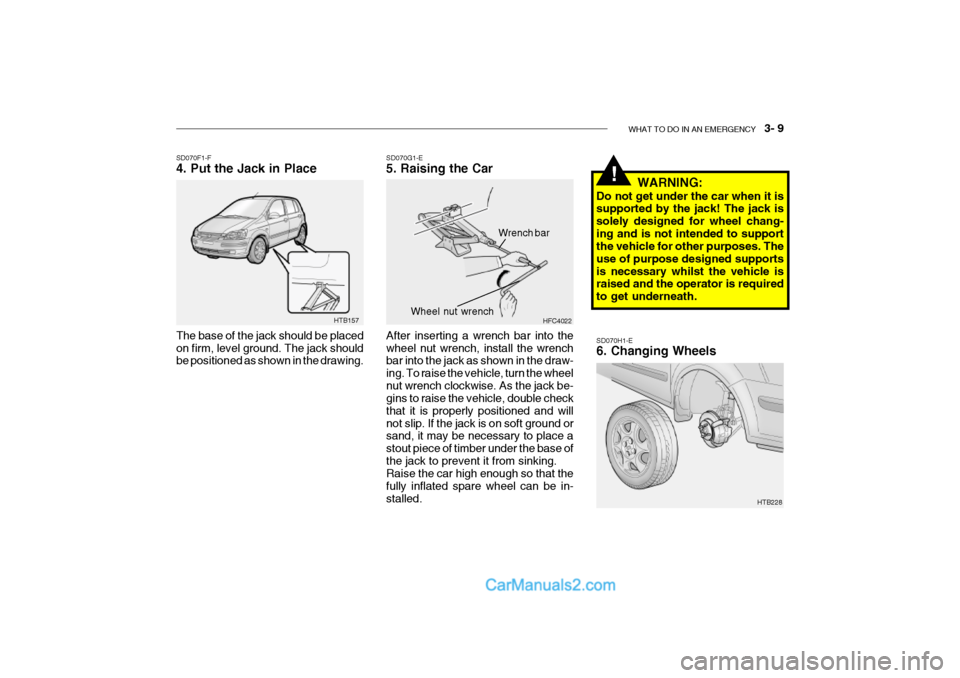
SD070F1-F 4. Put the Jack in Place The base of the jack should be placed on firm, level ground. The jack should be positioned as shown in the drawing.
SD070G1-E 5. Raising the Car After inserting a wrench bar into the wheel nut wrench, install the wrench bar into the jack as shown in the draw- ing. To raise the vehicle, turn the wheelnut wrench clockwise. As the jack be- gins to raise the vehicle, double check that it is properly positioned and willnot slip. If the jack is on soft ground or sand, it may be necessary to place a stout piece of timber under the base ofthe jack to prevent it from sinking. Raise the car high enough so that the fully inflated spare wheel can be in-stalled. HFC4022
Wrench bar
Wheel nut wrench
WARNING:
Do not get under the car when it is supported by the jack! The jack is solely designed for wheel chang-ing and is not intended to support the vehicle for other purposes. The use of purpose designed supportsis necessary whilst the vehicle is raised and the operator is required to get underneath.!
HTB228
Page 356 of 428
3- 10 WHAT TO DO IN AN EMERGENCY
HTB150
SD070J1-E 8. Lower Vehicle and Tighten
Nuts
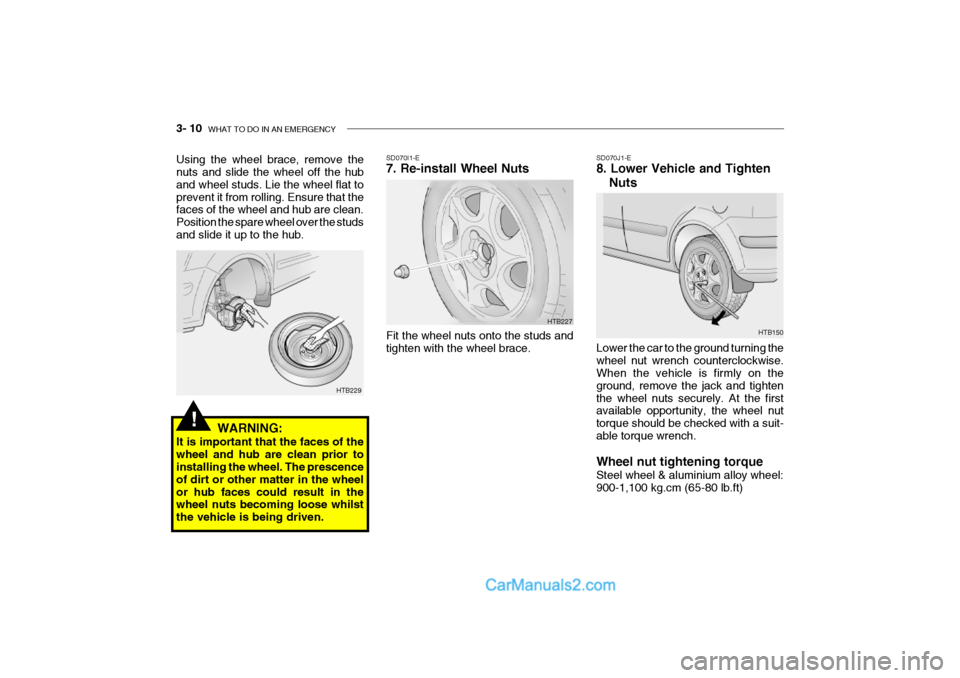
Lower the car to the ground turning the wheel nut wrench counterclockwise. When the vehicle is firmly on the ground, remove the jack and tightenthe wheel nuts securely. At the first available opportunity, the wheel nut torque should be checked with a suit-able torque wrench. Wheel nut tightening torque Steel wheel & aluminium alloy wheel: 900-1,100 kg.cm (65-80 lb.ft)
SD070I1-E 7. Re-install Wheel NutsFit the wheel nuts onto the studs and tighten with the wheel brace.
HTB227
Using the wheel brace, remove the nuts and slide the wheel off the hub and wheel studs. Lie the wheel flat toprevent it from rolling. Ensure that the faces of the wheel and hub are clean. Position the spare wheel over the studsand slide it up to the hub.
!
HTB229
WARNING:
It is important that the faces of the wheel and hub are clean prior to installing the wheel. The prescence of dirt or other matter in the wheelor hub faces could result in the wheel nuts becoming loose whilst the vehicle is being driven.
Page 358 of 428
3- 12 WHAT TO DO IN AN EMERGENCY
!
CAUTION:
The following restriction must be observed in order to avoid seriousdamage to the transaxle . The vehicle must never be towed from the rear with the front wheelson the ground. The vehicle must not be towed until transaxle fluid has been added tobring the level up to the "HOT" marking on the dipstick. (The level will need to be reduced again aftertowing). The vehicle must not be towed at speeds faster than 25 mph. or dis-tances greater than fifty miles. The general points regarding the steer- ing lock etc. described in the pre-ceding section (Manual transaxle vehicle) should be observed.
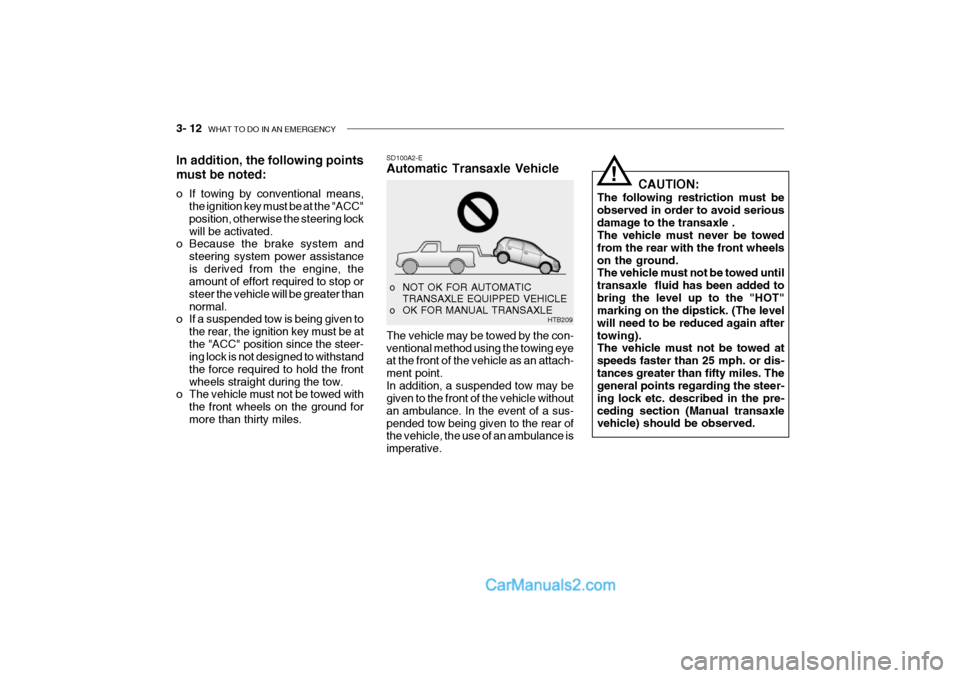
SD100A2-E Automatic Transaxle Vehicle The vehicle may be towed by the con- ventional method using the towing eye at the front of the vehicle as an attach- ment point.In addition, a suspended tow may be given to the front of the vehicle without an ambulance. In the event of a sus-pended tow being given to the rear of the vehicle, the use of an ambulance is imperative.
o NOT OK FOR AUTOMATIC
TRANSAXLE EQUIPPED VEHICLE
o OK FOR MANUAL TRANSAXLE HTB209
In addition, the following points must be noted:
o If towing by conventional means,
the ignition key must be at the "ACC" position, otherwise the steering lockwill be activated.
o Because the brake system and
steering system power assistanceis derived from the engine, the amount of effort required to stop or steer the vehicle will be greater thannormal.
o If a suspended tow is being given to
the rear, the ignition key must be atthe "ACC" position since the steer- ing lock is not designed to withstand the force required to hold the frontwheels straight during the tow.
o The vehicle must not be towed with
the front wheels on the ground formore than thirty miles.
Page 359 of 428
WHAT TO DO IN AN EMERGENCY 3- 13
D120A01A-EAT IF YOU LOSE YOUR KEYS Information about the key of immobi- lizer system will be found on page 1-4.CAUTION:
If the car is being towed with allfour wheels on the ground, it can be towed only from the front. Besure that the transaxle is in neu- tral. Do not tow at speeds greater
than 30 mph (50 km/h) and for more
than 15 miles(25 km). Be sure the steering is unlocked by placing the key in the "ACC" posi- tion. A driver must be in the towed vehicle to operate the steering andbrakes.
!
(3)Attach a tow cable, chain or strap to
one of the tie-down hooks under the front of your car.
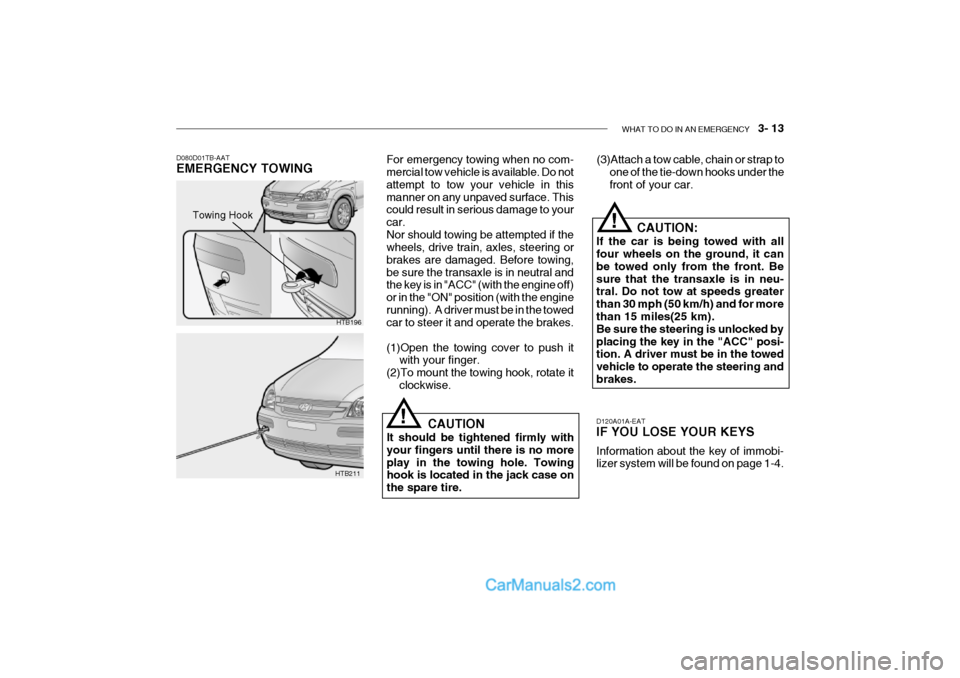
D080D01TB-AAT EMERGENCY TOWING For emergency towing when no com- mercial tow vehicle is available. Do not attempt to tow your vehicle in thismanner on any unpaved surface. This could result in serious damage to your car.Nor should towing be attempted if the wheels, drive train, axles, steering or brakes are damaged. Before towing,be sure the transaxle is in neutral and the key is in "ACC" (with the engine off) or in the "ON" position (with the enginerunning). A driver must be in the towed car to steer it and operate the brakes. (1)Open the towing cover to push it
with your finger.
(2)To mount the towing hook, rotate it clockwise.
HTB196
HTB211 CAUTION
It should be tightened firmly with your fingers until there is no moreplay in the towing hole. Towing hook is located in the jack case on the spare tire.
!
Towing Hook
Page 369 of 428
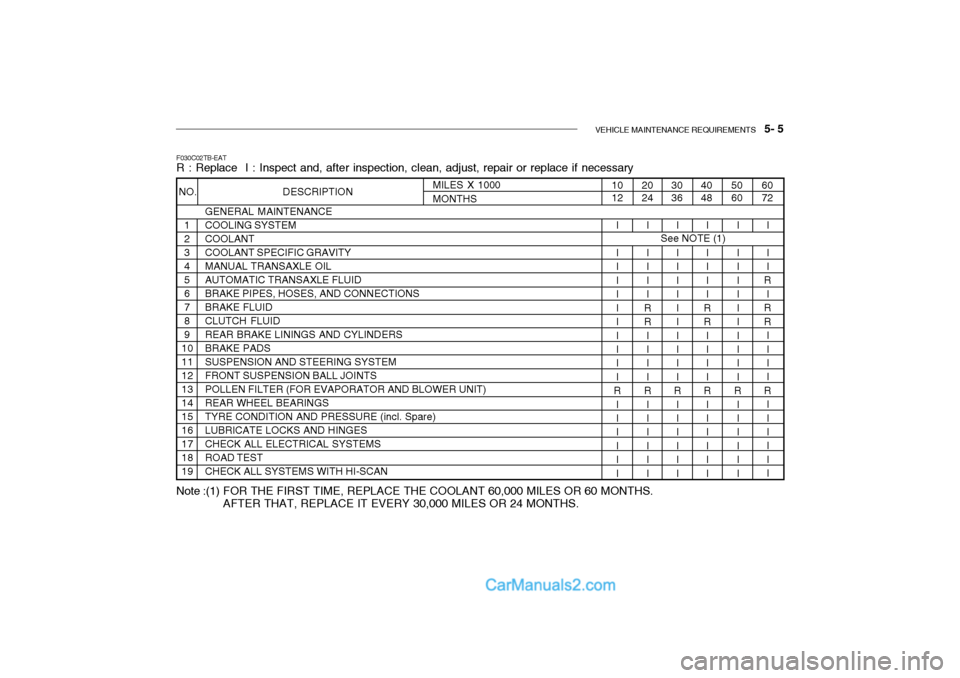
VEHICLE MAINTENANCE REQUIREMENTS 5- 5
F030C02TB-EAT R : Replace I : Inspect and, after inspection, clean, adjust, repair or replace if necessary
GENERAL MAINTENANCE COOLING SYSTEMCOOLANTCOOLANT SPECIFIC GRAVITYMANUAL TRANSAXLE OILAUTOMATIC TRANSAXLE FLUIDBRAKE PIPES, HOSES, AND CONNECTIONSBRAKE FLUIDCLUTCH FLUIDREAR BRAKE LININGS AND CYLINDERSBRAKE PADSSUSPENSION AND STEERING SYSTEMFRONT SUSPENSION BALL JOINTSPOLLEN FILTER (FOR EVAPORATOR AND BLOWER UNIT)REAR WHEEL BEARINGSTYRE CONDITION AND PRESSURE (incl. Spare)LUBRICATE LOCKS AND HINGESCHECK ALL ELECTRICAL SYSTEMSROAD TESTCHECK ALL SYSTEMS WITH HI-SCAN
60 72
5060
4048
I I I
R
I
RR II I I
R III I II
I I I IIIII I II
R II I III
I I I II
RR I I II
R II I III
30 36
2024
I I I IIIII I II
R II I III
I I I II
RR I I II
R II I III
10 12
I I I IIIII I II
R II I III
MILES X 1000MONTHS
NO. DESCRIPTION
1 23456789
10111213141516171819
See NOTE (1)
Note :(1) FOR THE FIRST TIME, REPLACE THE COOLANT 60,000 MILES OR 60 MONTHS. AFTER THAT, REPLACE IT EVERY 30,000 MILES OR 24 MONTHS.
Page 382 of 428

6- 8 DO-IT-YOURSELF MAINTENANCE
Petrol engine
HTB169
HTB169A
Diesel engine
G030D01TB-EAT ENGINE OIL REPLENISHMENT
If the indicated oil level is at or below the lower mark of the dipstick, oil should be added until the level is at or below the upper mark.To add oil to the engine, remove the filler cap by rotating in an counterclock- wise direction and pour engine oil intothe engine. Before checking the level again, allow several minutes for the oil to drain into the sump. Replace the oilfiller cap rotating it in a clockwise direc- tion until tight. The quantity of oil required to raise thelevel from the minimum to maximum level is approximately 1.2 litre.ZG030E1-A ENGINE OIL CONSUMPTION Function of engine oil Engine oil has the primary function of lubricating and cooling the inside of the engine. Engine oil consumption It is normal that an engine should con- sume some engine oil while normal driving. The cause of oil consumption in a normal engine are as follows;
o Engine oil is used to lubricate pis-
tons, piston rings and cylinders. A thin film of oil is left on the cylinder wall when a piston moves down- wards in the cylinder. High negativepressure generated during engine operation sucks some of the oil into the combustion chamber.This oil with some oil of the cylinder wall is burned by the high tempera- ture combustion gases during thecombustion process.
o The engine oil consumption is strongly
effected by the viscosity and qualityof oil, engine rpm and driving condi- tion etc.
Page 384 of 428

6- 10 DO-IT-YOURSELF MAINTENANCE
HTB170
Petrol engine SG050A1-E ENGINE COOLANT CHECKING AND REPLACING
SG050B1-E Coolant recommendations WARNING:
Do not remove the radiator cap when the engine is hot, since the system is pressurized and coolant may beejected from the radiator resulting in scalding.
!
!
3. Prepare a suitable receptacle to col- lect the displaced oil and remove the drain plug from the sump.
4. When the oil has drained from the sump, replace the drain plug using anew washer ensuring that the plug is not over tightened. Tightening torque is: 3.5 ~ 4.5 kgf.m
5. Remove the oil filter by rotating coun- terclockwise, using a proprietary oil filter removal tool if necessary. Notethat the oil filter will contain approxi- mately 0.5 litres of oil and this should be collected in a suitable receptacle.
6. Install a new oil filter having smeared the sealing ring with clean oil androtating clockwise until the filter con-tacts the mounting and then a further one half turn. Do not over-tighten CAUTION:
The oil being drained from the en- gine will be hot. Care should beexercised to prevent scalding.
! Tightening torque: Petrol -
1.2 ~ 1.6 kgf.m
Diesel(RHD) - 2.3 ~ 2.5 kgf.m
7. Pour the specified quantity of the recommended oil into the engine and replace the filler cap. Start the en- gine and ensure that no oil leaks exist. Turn off the engine and after acouple minutes, recheck the oil level.
WARNING:
Prolonged and repeated contact with used engine oils may result in seri- ous skin disorders including derma-titis and cancer. Avoid contact with skin as far as possible and always wash thoroughly after any contact.Keep used oils out of reach of chil- dren. It is illegal to pollute drains, water courses and soil. Use onlyauthorized waste collection facili- ties including civic amenity sites and garages for the disposal of usedoil and oil filters. If in doubt, contact the local authority for disposal in- structions.
Page 387 of 428

DO-IT-YOURSELF MAINTENANCE 6- 13
SG060A1-E SPARKING PLUG REPLACE- MENT
G060A01L
0.039 ~ 0.043 in. (1.0 ~ 1.1 mm )
This operation should only be performed when the engine is cold.
1. Remove the centre cover from the engine rocker cover.
2. Remove plug lead from the sparking plug to be replaced, pulling the lead by the rubber cap. (Pulling the lead may damage the carbon conductor).
3. Clean around the base of the plug to be removed, and install the plugsocket ensuring that the ceramicinsulator does not become damaged. Turn the socket counterclockwise to remove the plug. CAUTION:
Sparking plugs must only be cleaned using purpose designed equipment. Wire brushing may damage the cen-tre electrodein-sulator causing mis- firing to occur. Only the correct grade of sparking plug should be used.Use of an incorrect grade may result in serious engine damage. Prior to installing a sparking plug, the gap between the centre and outer elec- trodes must be checked and adjusted as necessary. Adjustment is facilitated by bending the outer electrode towards or away fromthe centre electrode. Under no circum- stances should attempts be made to adjust the position of the centre elec-trode.
4. Insert the sparking plug into the cyl- inder head and screw by the wrench and until the plug contacts the seat- ing area. Tighten the plug with the socket by a further 1/2 to 3/4 of a turnonly. 5. Replace the plug lead ensuring that
the cap is pushed firmly into place.Confirm that the cap is correctlyseated by lightly pulling upon it.
NOTE: When replacing the spark plug, al- ways use the genuine parts recom- mended. Recommended Spark Plugs
CHAMPION NGK RC10YCBKR5ES
Unleaded
engine Leaded
engine
RC10YC4 BKR5ES-11
!