2002 Hyundai Getz engine
[x] Cancel search: enginePage 240 of 428
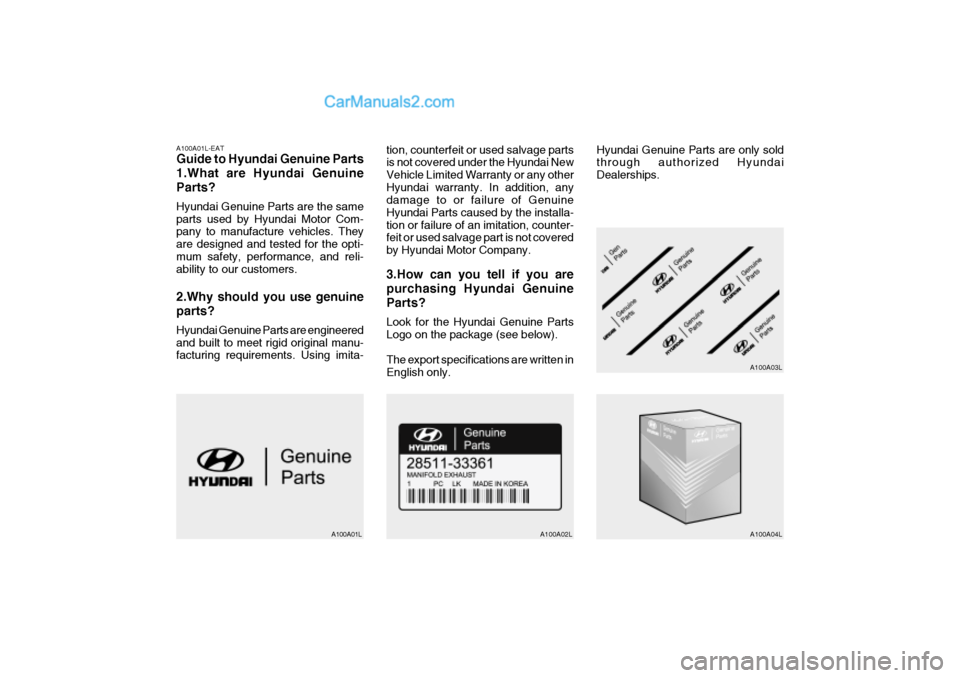
A100A01L-EAT Guide to Hyundai Genuine Parts 1.What are Hyundai GenuineParts? Hyundai Genuine Parts are the same parts used by Hyundai Motor Com- pany to manufacture vehicles. They are designed and tested for the opti-mum safety, performance, and reli- ability to our customers. 2.Why should you use genuine parts? Hyundai Genuine Parts are engineered and built to meet rigid original manu- facturing requirements. Using imita-A100A01Ltion, counterfeit or used salvage partsis not covered under the Hyundai New Vehicle Limited Warranty or any otherHyundai warranty. In addition, any damage to or failure of Genuine Hyundai Parts caused by the installa-tion or failure of an imitation, counter- feit or used salvage part is not covered by Hyundai Motor Company. 3.How can you tell if you are purchasing Hyundai GenuineParts? Look for the Hyundai Genuine Parts Logo on the package (see below). The export specifications are written in English only.
A100A02L A100A04L
A100A03L
Hyundai Genuine Parts are only sold through authorized Hyundai Dealerships.
Page 246 of 428

1- 2 FEATURES OF YOUR HYUNDAI
B010A02O-EAT FUEL RECOMMENDATIONS Petrol Engines THIS VEHICLE MUST ONLY BE OP- ERATED WITH UNLEADED FUEL.SERIOUS DAMAGE WILL RESULTFROM THE USE OF LEADED FUEL. The use of leaded fuel in this vehicle willresult in irreversible pollution of thecatalyst element. Such pollution willprevent correct operation of the cata-lyst and give rise to increased operating temperatures leading to the catalyst element melting and restricting the ex-haust flow along with an increase inexhaust emission levels.
Unleaded fuel with a Research OctaneNumber (RON) of 91 or higher must beused in this vehicle.To prevent accidental filling of the fueltank with leaded fuel, a small diameterfiller neck along with a restrictor flap are fitted to ensure that only unleaded fuel pump nozzles may enter the filler neck.However, care must be exercised whenfilling the vehicle tank from jerry cans orby means of a funnel that the fuel beingused is unleaded. HTB187
!
CAUTION:
The vehicle warranty will not extend to damage arising from the use of incorrect fuels. Diesel Engines Diesel fuel of 52 to 54 cetane is used in Hyundai vehicle. If two types of diesel fuel are available, use summer or winter fuel properly according to the followingtemperature conditions.
o Above 23°F (-5°C) ... Summer type diesel fuel.
o Below 23°F (-5°C) ... Winter type
diesel fuel.
! Watch the fuel level in the tank very carefully : If the engine stops due to fuelfailure, the circuits must be completelypurged to permit restarting.
CAUTION:
Do not let any petrol or water enter the tank. This would make it neces- sary to drain it out and bleed thelines to avoid jamming the injectionpump and damaging the engine. Overseas Operation: When the vehicle is to be operated overseas, the vehicle operator shouldestablish that a suitable fuel for satis-factory operation of the vehicle is avail-able. SB010E1-A PETROLS FOR CLEANER AIR To help contribute to cleaner air, Hyundai recommends that you use fuels treated with detergent additives, which help to prevent deposit formation in the engine.These fuels will help the engines runcleaner and the Emission Control Sys-tem performance.
Page 247 of 428
FEATURES OF YOUR HYUNDAI 1- 3
B020A01FC-EAT RUNNING IN (Petrol Engine) The longevity and performance of the vehicle are greatly affected by the careexercised during the first 1,000 miles ofmotoring. Because of modern manu-facturing techniques, rigid guidelines regarding maximum road speeds have become unnecessary. However, cer-tain precautions should be observed inorder to obtain the best possible perfor-mance and useful life from the vehicle.
1) Do not race the engine without a load
(i.e revving the engine in neutral).
2) During the first 500 miles the maxi- mum engine speed should be re- stricted to 3,000 rpm and graduallyincreased thereafter.
3) Avoid prolonged constant speed op-
eration. The internal components ofthe engine will become more quicklyrun in if the operation speed is variedduring the running in period.
4) Never allow the engine to labour. Use the gearbox freely and avoid largethrottle open-ings when the enginespeed is below 1,500 rpm.
5) Avoid rapid acceleration and maxi- mum throttle openings. 6) Avoid harsh braking during the first
100 miles of urban motoring or 1,000miles of motorway driving to allowthe friction facings of the brake padsand shoes to bed against the discs and drums properly.
7) Avoid trailer towing during the run- ning in period.
B020B01FC-EATRUNNING IN (Diesel Engine) The longevity and performance of the vehicle are greatly affected by the care exercised during the first 1,000 miles of motoring. Because of modern manu-facturing techniques, rigid guidelinesregarding maximum road speeds havebecome unnecessary. However, cer-tain precautions should be observed in order to obtain the best possible perfor- mance and useful life from the vehicle. 1) Do not race the engine without a load
(i.e revving the engine in neutral).
2) During the first 600 miles the maxi- mum engine speed should be re-stricted to 3,000 rpm and gradually increased thereafter. And while driv- ing, keep under three quarters ofmaximum vehicle speed.
3) Avoid prolonged constant speed op- eration. The internal components ofthe engine will become more quickly run in if the operation speed is varied during the running in period.
4) Never allow the engine to labour. Use
the gearbox freely and avoid largethrottle openings when the enginespeed is below 1,500 rpm.
5) Avoid rapid acceleration and maxi-
mum throttle openings.
6) Avoid harsh braking during the first
100 miles of urban motoring or 1,000miles of motorway driving to allowthe friction facings of the brake pads and shoes to bed against the discs and drums properly.
7) Avoid trailer towing during the run-
ning in period.
Page 248 of 428
1- 4 FEATURES OF YOUR HYUNDAI
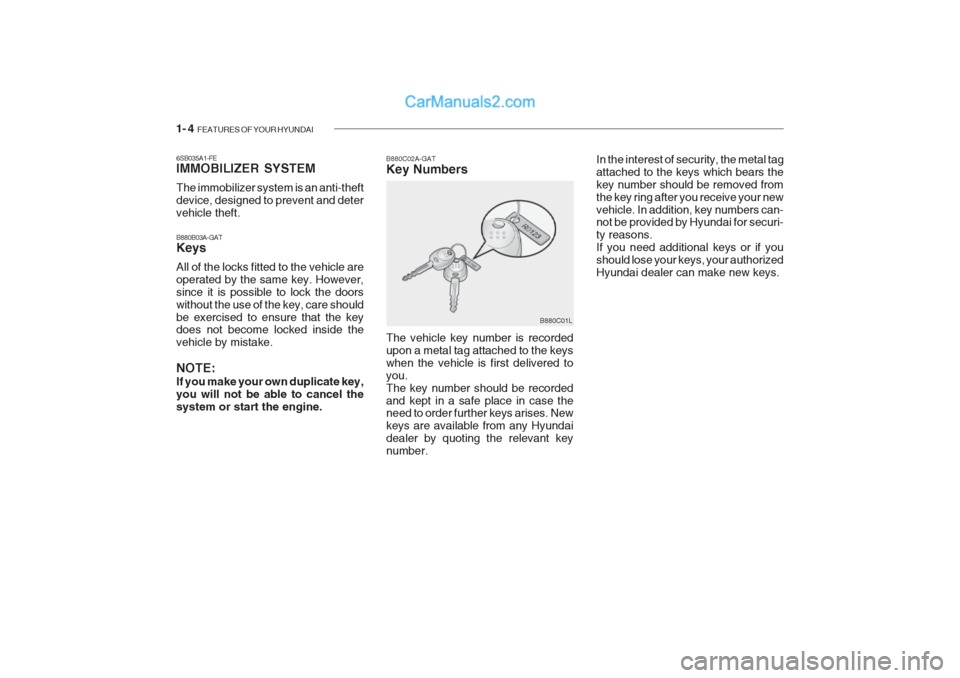
6SB035A1-FE IMMOBILIZER SYSTEM The immobilizer system is an anti-theft device, designed to prevent and detervehicle theft. B880B03A-GAT Keys All of the locks fitted to the vehicle are operated by the same key. However,since it is possible to lock the doorswithout the use of the key, care shouldbe exercised to ensure that the key does not become locked inside the vehicle by mistake. NOTE: If you make your own duplicate key, you will not be able to cancel thesystem or start the engine. B880C02A-GAT Key Numbers The vehicle key number is recorded upon a metal tag attached to the keyswhen the vehicle is first delivered toyou.The key number should be recordedand kept in a safe place in case the need to order further keys arises. New keys are available from any Hyundaidealer by quoting the relevant keynumber.
B880C01L
In the interest of security, the metal tag attached to the keys which bears thekey number should be removed fromthe key ring after you receive your newvehicle. In addition, key numbers can- not be provided by Hyundai for securi- ty reasons.If you need additional keys or if youshould lose your keys, your authorizedHyundai dealer can make new keys.
Page 251 of 428
FEATURES OF YOUR HYUNDAI 1- 7
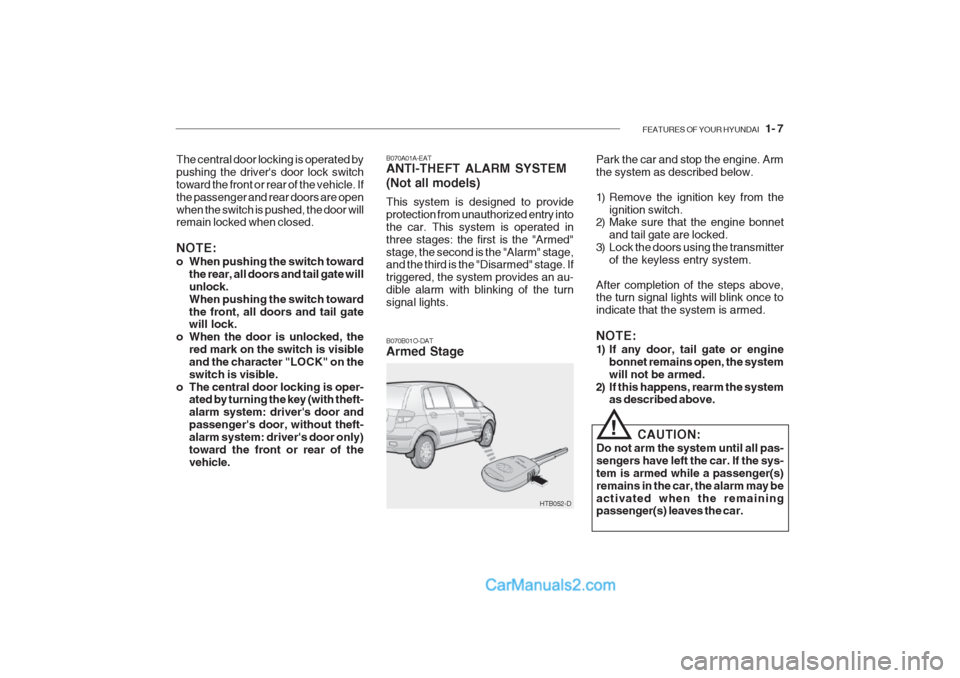
B070A01A-EAT ANTI-THEFT ALARM SYSTEM (Not all models) This system is designed to provide protection from unauthorized entry intothe car. This system is operated inthree stages: the first is the "Armed"stage, the second is the "Alarm" stage, and the third is the "Disarmed" stage. If triggered, the system provides an au-dible alarm with blinking of the turnsignal lights.
The central door locking is operated bypushing the driver's door lock switchtoward the front or rear of the vehicle. Ifthe passenger and rear doors are openwhen the switch is pushed, the door will remain locked when closed. NOTE:
o When pushing the switch toward
the rear, all doors and tail gate will unlock.When pushing the switch towardthe front, all doors and tail gate will lock.
o When the door is unlocked, the red mark on the switch is visible and the character "LOCK" on theswitch is visible.
o The central door locking is oper- ated by turning the key (with theft-alarm system: driver's door andpassenger's door, without theft-alarm system: driver's door only)toward the front or rear of thevehicle. Park the car and stop the engine. Armthe system as described below.
1) Remove the ignition key from the
ignition switch.
2) Make sure that the engine bonnet
and tail gate are locked.
3) Lock the doors using the transmitter
of the keyless entry system.
After completion of the steps above, the turn signal lights will blink once to indicate that the system is armed. NOTE:
1) If any door, tail gate or engine bonnet remains open, the system will not be armed.
2) If this happens, rearm the system as described above.
CAUTION:
Do not arm the system until all pas-sengers have left the car. If the sys-tem is armed while a passenger(s)remains in the car, the alarm may beactivated when the remaining passenger(s) leaves the car.
!
HTB052-D
B070B01O-DAT Armed Stage
Page 252 of 428
1- 8 FEATURES OF YOUR HYUNDAI
HTB202
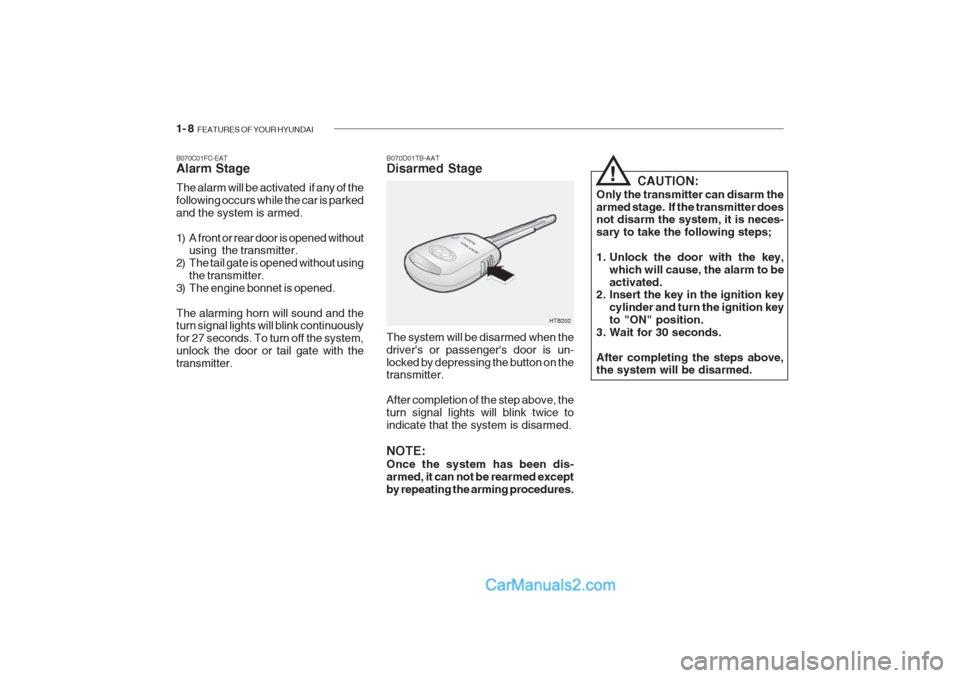
B070D01TB-AAT Disarmed Stage
B070C01FC-EATAlarm Stage The alarm will be activated if any of the following occurs while the car is parkedand the system is armed.
1) A front or rear door is opened without
using the transmitter.
2) The tail gate is opened without using the transmitter.
3) The engine bonnet is opened.The alarming horn will sound and the turn signal lights will blink continuously for 27 seconds. To turn off the system,unlock the door or tail gate with thetransmitter. The system will be disarmed when thedriver's or passenger's door is un-locked by depressing the button on the transmitter. After completion of the step above, the turn signal lights will blink twice toindicate that the system is disarmed. NOTE: Once the system has been dis- armed, it can not be rearmed exceptby repeating the arming procedures. CAUTION:
Only the transmitter can disarm thearmed stage. If the transmitter does not disarm the system, it is neces- sary to take the following steps;
1. Unlock the door with the key, which will cause, the alarm to be activated.
2. Insert the key in the ignition key
cylinder and turn the ignition keyto "ON" position.
3. Wait for 30 seconds. After completing the steps above, the system will be disarmed.
!
Page 274 of 428

1- 30 FEATURES OF YOUR HYUNDAI
o For maximum safety protection in
all types of crashes, all occupants including the driver should alwayswear their seat belts whether ornot an airbag is also provided attheir seating position to minimize the risk of severe injury or death in the event of a crash. Do not sit orlean unnecessarily close to theairbag while the vehicle is in mo-tion.
o The SRS airbag system must de- ploy very rapidly to provide pro-tection in a crash. If an occupant isout of position because of notwearing a seat belt, the airbag mayforcefully contact the occupantcausing serious or fatal injuries.
The SRS consists of the following com- ponents:
- Driver's Airbag Module
- Passenger's Airbag Module
- SRS Service Reminder Indicator
(SRI)
- SRS Control Module (SRSCM) The SRSCM continually monitors all elements while the ignition is "ON" todetermine if a frontal or near-frontalimpact is severe enough to requireairbag deployment.
B240B03A-DAT SRS Components and Functions
The SRS service reminder indicator (SRI) on the instrument panel will blink for about 6 seconds after the ignitionkey is turned to the "ON" position orafter the engine is started, after whichthe SRI should go out.
B240B01L-D
B240B02L-D
Page 276 of 428
1- 32 FEATURES OF YOUR HYUNDAI
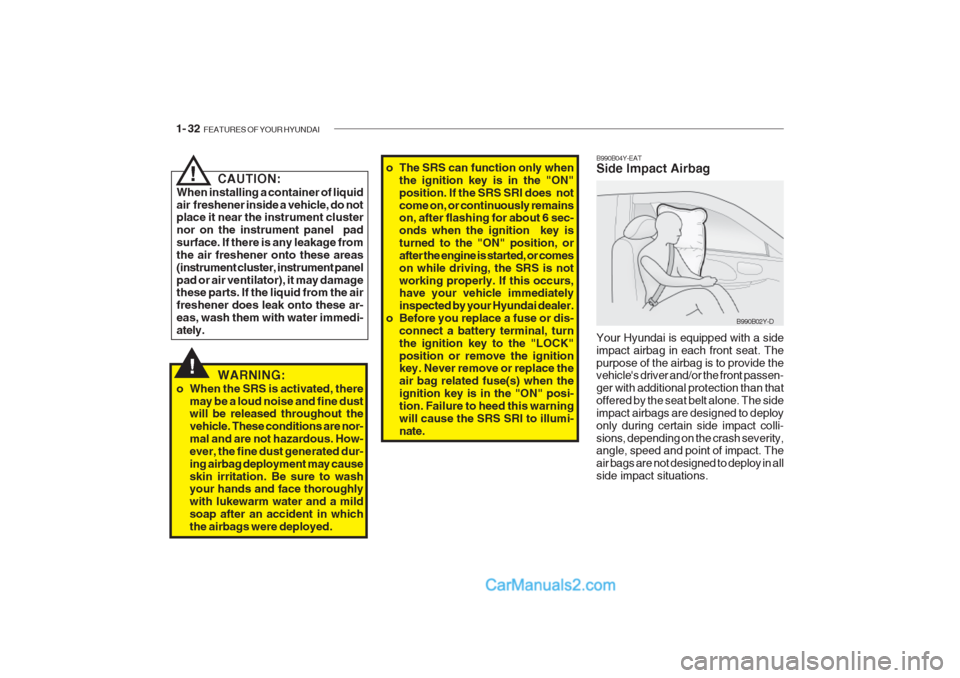
B990B04Y-EAT Side Impact Airbag Your Hyundai is equipped with a side impact airbag in each front seat. Thepurpose of the airbag is to provide the vehicle's driver and/or the front passen- ger with additional protection than thatoffered by the seat belt alone. The sideimpact airbags are designed to deployonly during certain side impact colli-sions, depending on the crash severity, angle, speed and point of impact. The air bags are not designed to deploy in allside impact situations.
B990B02Y-D
!
!
CAUTION:
When installing a container of liquid air freshener inside a vehicle, do not place it near the instrument cluster nor on the instrument panel padsurface. If there is any leakage fromthe air freshener onto these areas(instrument cluster, instrument panelpad or air ventilator), it may damage these parts. If the liquid from the air freshener does leak onto these ar-eas, wash them with water immedi-ately.
WARNING:
o When the SRS is activated, there may be a loud noise and fine dust will be released throughout the vehicle. These conditions are nor-mal and are not hazardous. How-ever, the fine dust generated dur-ing airbag deployment may causeskin irritation. Be sure to wash your hands and face thoroughly with lukewarm water and a mildsoap after an accident in whichthe airbags were deployed. o The SRS can function only when
the ignition key is in the "ON"position. If the SRS SRI does notcome on, or continuously remains on, after flashing for about 6 sec- onds when the ignition key isturned to the "ON" position, orafter the engine is started, or comeson while driving, the SRS is notworking properly. If this occurs, have your vehicle immediately inspected by your Hyundai dealer.
o Before you replace a fuse or dis- connect a battery terminal, turnthe ignition key to the "LOCK"position or remove the ignition key. Never remove or replace the air bag related fuse(s) when theignition key is in the "ON" posi-tion. Failure to heed this warningwill cause the SRS SRI to illumi-nate.