Page 8 of 294
POWER DOOR
LOCKSAIRBAGS
SEAT BELTS
SAFETY CAGE
COLLAPSIBLE
STEERING
COLUMN
CRUSH
ZONES
5Driver and Passenger SafetyYour vehicle is equipped with
many features that work together
to protect you and your
passengers during a crash.
Some safety features do not
require any action on your part.
These include a strong steel
framework that forms a safety
cage around the passenger
compartment; front and rear crush
zones that are designed to
crumple and absorb energy during
a crash; and a collapsible steering
column.
These safety features are designed
to reduce the severity of injuries
in a crash. However, you and your
passengers can
’t take full
advantage of these safety features
unless you remain sitting in a
proper position and always wear
your seat belts properly. In fact,
Your Vehicle ’s Safety Features
Page 56 of 294
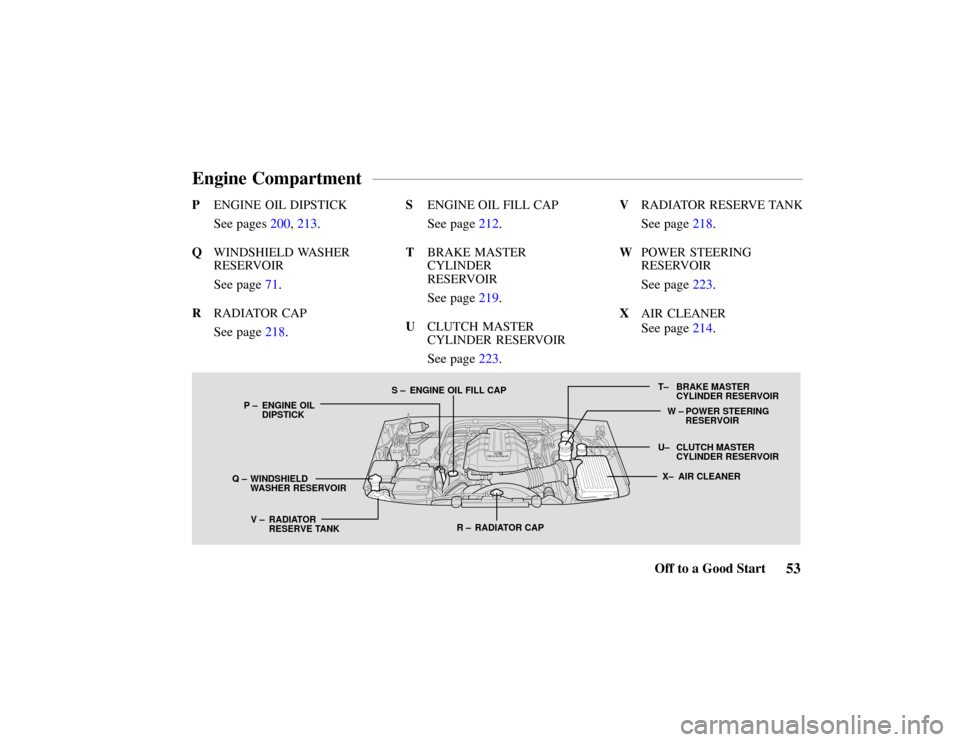
S – ENGINE OIL FILL CAP
Q – WINDSHIELD
WASHER RESERVOIR
R – RADIATOR CAP T–
BRAKE MASTER
CYLINDER RESERVOIR
V – RADIATOR
RESERVE TANK W
– POWER STEERING
RESERVOIR
X– AIR CLEANER
P –
ENGINE OIL
DIPSTICK
U– CLUTCH MASTER
CYLINDER RESERVOIR
53Off to a Good Start
P ENGINE OIL DIPSTICK
See pages 200, 213.
Q WINDSHIELD WASHER
RESERVOIR
See page 71.
R RADIATOR CAP
See page 218.
S ENGINE OIL FILL CAP
See page 212.
T BRAKE MASTER
CYLINDER
RESERVOIR
See page 219.
U CLUTCH MASTER
CYLINDER RESERVOIR
See page 223.
V RADIATOR RESERVE TANK
See page 218.
WPOWER STEERING
RESERVOIR
See page 223.
X
AIR CLEANER
See page 214.
Engine Compartment
Page 102 of 294

99Interior Features
Keys and Ignition
100
. . . . . . . . .
Steering Column Lock/
Ignition Switch101 . . . . . . .
LOCK101
. . . . . . . . . . . . .
ACC101
. . . . . . . . . . . . . . .
ON101
. . . . . . . . . . . . . . . .
START101
. . . . . . . . . . . . .
Key Removal102 . . . . . . . . . .
Key Reminder102 . . . . . . . . .
Guard Against Theft102 . . . .
Locks103 . . . . . . . . . . . . . . . . . .
Power Door Locks104 . . . . . .
Child-Safe Door Locks105 . .
Mirrors105 . . . . . . . . . . . . . . . . .
Interior Mirror105 . . . . . . . . .
Power Mirrors105 . . . . . . . . .
Vanity Mirrors106 . . . . . . . . . Power Windows107
. . . . . . . . . .
Checking the Circuit
Breaker108 . . . . . . . . . . . . .
Tailgate 108 . . . . . . . . . . . . . . . .
Operation108 . . . . . . . . . . . . .
Hood Release109 . . . . . . . . . . . .
Interior Lights110 . . . . . . . . . . .
Luggage Light110 . . . . . . . . .
Dome Light111 . . . . . . . . . . .
Courtesy Lights112 . . . . . . . .
Map Lights112 . . . . . . . . . . . .
Moonroof112 . . . . . . . . . . . . . . . Conveniences113
. . . . . . . . . . . .
Beverage Holder 113 . . . . . . .
Sun Visor114 . . . . . . . . . . . . .
Glove Box114 . . . . . . . . . . . .
Assist Grip115 . . . . . . . . . . . .
Horn Button115 . . . . . . . . . . .
Tilt Steering Wheel 115 . . . . .
Cigarette Lighter116 . . . . . . .
Ashtrays116 . . . . . . . . . . . . . .
Accessory Power Outlets117 .
Interior Features
Page 164 of 294

161Driving Tips
If anything goes wrong, the
ABS
indicator on the instrument panel
comes on (see page 67). This
means the anti-lock function of
the braking system has shut down.
The brakes still work like a
conventional system without
anti-lock, providing normal
stopping ability. You should have
the dealer inspect your vehicle as
soon as possible if this light stays
on after you start the engine, or
comes on while driving.
Driving With Wet Brakes
Driving through deep water may
get the brakes wet and reduce
their effectiveness. As a result, the
vehicle may not slow down
normally or may pull in one
direction or the other.
If you drive through deep water,
apply the brakes lightly to see if
the water has affected them. To
dry the brakes quickly, press
lightly on the brake pedal while
maintaining the same speed with
the accelerator pedal. Continue
this until the brakes operate
normally.
Power Brakes
The braking system uses engine
vacuum to provide power assist. If
the power assist fails because of a
stalled engine or other reason, the
reserve vacuum in the system will
usually allow you to apply the
brakes at least one time.
The reserve vacuum is partly used
up each time the brake pedal is
applied and released. Do not
pump the brakes when the power
assist has been lost, except when
needed to maintain steering
control on slippery surfaces.
You can still stop the vehicle
without the power assist by pushing
harder on the brake pedal.
However, the stopping distance
may be longer, even though the
brakes themselves remain fully
operational.
Page 181 of 294

178Driving Tips
Your Honda vehicle is designed
for passenger and cargo
transportation. With the proper
equipment installed, your vehicle
can also tow a trailer under certain
conditions, as detailed in this
section. Be sure to read this entire
section and follow all
requirements.
Towing a trailer will have an
effect on handling, performance,
braking, durability and fuel
consumption.
Improperly loading your
vehicle and trailer can
seriously affect the steering
and braking performance,
causing a crash in which you
can be seriously injured.
Check the loading of your
vehicle and trailer carefully
before starting to drive.
Honda recommends that you do
not tow a trailer with a new
Honda vehicle or one with a new
powertrain component (engine,
transmission, differential) for the
first 500 miles.
For your safety and the safety
of others, use equipment
specifically designed for your
vehicle. Improper towing
equipment and improper
installation of same can cause
damage to your vehicle and may
also result in personal injury.
Additional care and cautious
driving habits are essential to
trailer towing.
Do not exceed 45 mph or the
posted towing speed limit,
whichever is lower. Higher speed
may cause loss of vehicle control.
Trailer Towing
Page 194 of 294

191In Case of Emergency
find a leak, it must be repaired
before you can continue
driving. (See Towing on page
191.)
•If you don’
t find an obvious
leak, check the coolant level in
the radiator reserve tank. If the
level is below the
MIN mark, add
coolant to halfway between the
MIN and MAX marks.
•If there was no coolant in the
reserve tank, you may also
have to add coolant to the
radiator.
Let the engine cool down until
the pointer reaches the middle
of the temperature gauge, or
lower, before checking the
radiator.
Removing the radiator cap
while the engine is hot can
cause the coolant to spray
out, seriously scalding you.
Always let the engine and
radiator cool down before
removing the radiator cap.
•
If needed, add coolant to the
radiator to bring the level up to
the filler neck, and to the
reservoir up to the level
indicated on the reservoir tank. Proper equipment must be used to
prevent damage to vehicles during
any towing. State and local laws
that apply to vehicles in tow must
be followed. Get detailed towing
instructions from your Honda
dealer.
Should it become necessary to
tow your vehicle, follow these
directions.Precautions
•Before towing, make sure that
the power train, axle,
transmission, wheels and
steering system are in good
condition.
If any of these items are
damaged, a flatbed trailer must
be used.
Towing
Page 199 of 294

196Care and Maintenance
Front (4
WD Only) and
Rear Propeller Shaft 222
. . .
Exhaust System 222
. . . . . . .
Fuel Line and Fuel
Tank/Cap 222
. . . . . . . . . . . .
Drive Belt 222
. . . . . . . . . . . .
Timing Belt 222
. . . . . . . . . . .
Valve Clearance 222
. . . . . . . .
Spark Plugs 223
. . . . . . . . . . .
Clutch 223
. . . . . . . . . . . . . . .
Fluid or Lubricant Levels 223
Power Steering 223
. . . . . . . .
Wheel Alignment 224
. . . . . .
Exterior 224 . . . . . . . . . . . . . . . .
Washing Your Vehicle 224
. .
Polishing and Waxing
Your Vehicle 224
. . . . . . . . .
Protection of Exterior
Bright Metal Parts 224
. . . .
Care of Aluminum Wheels 224Foreign Material Deposits
224
Finish Damage 225
. . . . . . . .
Corrosion Protection 225
. . . .
Sheet Metal Damage 225
. . . .
Underbody Maintenance 225
Interior 226 . . . . . . . . . . . . . . . .
Basic Steps
Before Cleaning 226
. . . . . .
Cleaning Fabric 227
. . . . . . . .
Cleaning General Soilage
or Water Spots From
Fabric Trim 227
. . . . . . . .
Spot Cleaning Fabric
With Solvent Cleaner 227
Removal of
Specific Stains 228
. . . . . .
Cleaning Vinyl
or Leather Trim 229
. . . . . . .
Seat Belt Care 229
. . . . . . . . .
Cleaning Glass Surfaces 230
.
Page 200 of 294
197Care and Maintenance
Fuel Fill Cap
To remove the fuel fill cap, turn it
counterclockwise. To close the fill
cap, turn it clockwise until you
hear it click at least three times.
Put the fuel fill cap in the cap
holder while refueling.
If you need a replacement, use only
a genuine Honda fuel fill cap. An
improper fuel fill cap can affect the
fuel system, the emissions system,
and allow fuel spillage.
Component Locations
WINDSHIELD
WASHER
RESERVOIRBATTERY RADIATOR CAP
ENGINE OIL
FILLER CAP
AIR CLEANER
ENGINE
OIL DIPSTICK
BRAKE MASTER
CYLINDER
RESERVOIRPOWER
STEERING
RESERVOIR
RADIATOR
RESERVE
TANK
CLUTCH MASTER
CYLINDER
RESERVOIR
Service Station Information