Page 200 of 294
197Care and Maintenance
Fuel Fill Cap
To remove the fuel fill cap, turn it
counterclockwise. To close the fill
cap, turn it clockwise until you
hear it click at least three times.
Put the fuel fill cap in the cap
holder while refueling.
If you need a replacement, use only
a genuine Honda fuel fill cap. An
improper fuel fill cap can affect the
fuel system, the emissions system,
and allow fuel spillage.
Component Locations
WINDSHIELD
WASHER
RESERVOIRBATTERY RADIATOR CAP
ENGINE OIL
FILLER CAP
AIR CLEANER
ENGINE
OIL DIPSTICK
BRAKE MASTER
CYLINDER
RESERVOIRPOWER
STEERING
RESERVOIR
RADIATOR
RESERVE
TANK
CLUTCH MASTER
CYLINDER
RESERVOIR
Service Station Information
Page 201 of 294
198Care and Maintenance
Fuel Recommendation
Use only unleaded gasoline. For
additional information see “Fuel
Requirements” in this section.
Fuel Tank Capacity
19.5 U.S. gallons (75 liters)
Engine Oil Recommendation
Use only SJ quality oil.
The chart shown under “Engine
Oil and Filter” in this section will
serve as a guide for choosing the
proper viscosity oil.
Windshield Washer
Check the reservoir fluid level
regularly. Use a commercially
available windshield washer fluid.
The windshield washer reservoir
is located on the front right side of
the engine compartment.
Tire Inflation Pressures
Check at least monthly, including
the spare. Keep inflated to the
pressure shown on the tire placard
on the driver’s doorjamb.
LABEL
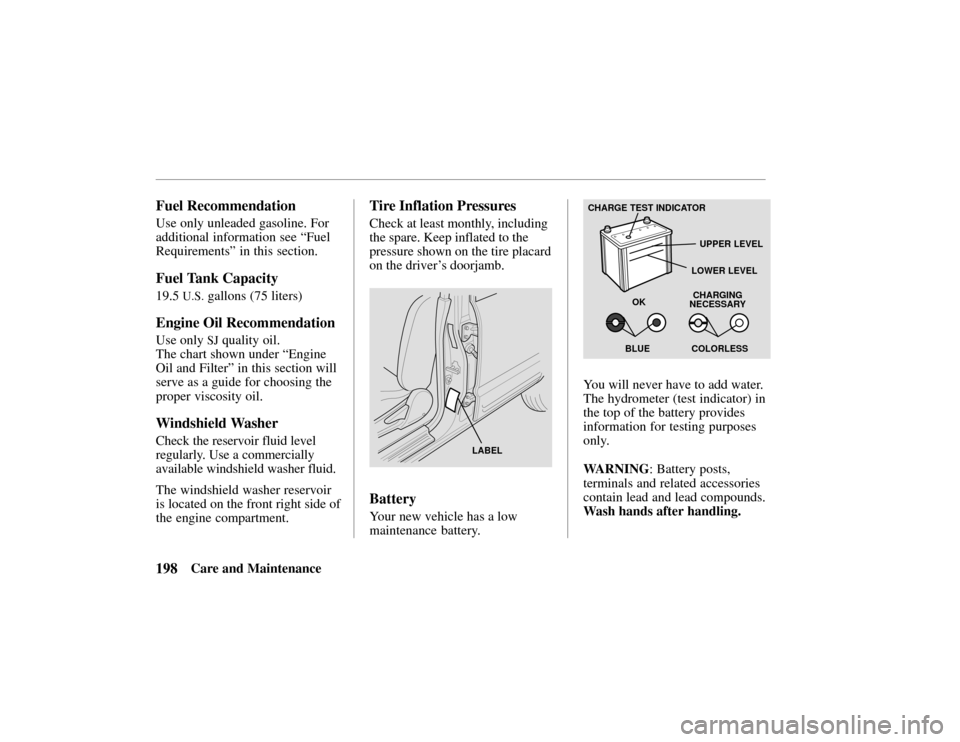
Battery
Your new vehicle has a low
maintenance battery.
CHARGE TEST INDICATOR
UPPER LEVEL
LOWER LEVEL CHARGING
NECESSARY
OK
BLUE COLORLESS
You will never have to add water.
The hydrometer (test indicator) in
the top of the battery provides
information for testing purposes
only.
WARNING : Battery posts,
terminals and related accessories
contain lead and lead compounds.
Wash hands after handling.
Page 203 of 294

200 Care and Maintenance
To Close
1.
Lift the hood slightly to remove
tension from the support rod.
2. Place the support rod in its
retaining clip and lower the
hood.
Always make sure the hood is
securely latched before you begin
driving.
Engine Oil Dipstick
Check the oil level when the
engine is off and the oil is warm,
such as during a fuel stop. See
page 213. Your Honda operates most
effectively on unleaded gasoline
with a pump octane number of 86
or higher. Use of a lower octane
gasoline can cause a persistent,
heavy metallic rapping noise in
the engine that can lead to
mechanical damage.
We recommend gasolines containing
detergent additives that help prevent
fuel system and engine deposits.
Using gasoline containing lead will
damage your vehicle
’s emission
controls. This contributes to air
pollution and can void certain parts
of your warranty.
Oxygenated Fuels
Some conventional gasolines are
being blended with alcohol or an
ether compound. These gasolines
are collectively referred to as
oxygenated fuels. To meet clean air
Fuel Requirements
Page 205 of 294

202Care and Maintenance
This section includes instructions
for simple maintenance tasks,
such as checking and adding oil.
Any service items not detailed in
this section should be performed
by a Honda technician or other
qualified mechanic.
Some of the most important safety
precautions are given below.
However, we cannot warn you of
every conceivable hazard that can
arise in performing maintenance.
Only you can decide whether or
not you should perform a given
task.
Failure to properly follow
maintenance instructions and
precautions can cause you to
be seriously hurt or killed.
Always follow the procedures
and precautions in this owner
’s
manual.
Important Safety Precautions
Before you begin any
maintenance, make sure your
vehicle is parked on level ground
and that the parking brake is on.
Also, be sure the engine is off.
This will help to eliminate several
potential hazards:
•Carbon monoxide poisoning
from engine exhaust.
Be sure
there is adequate ventilation
whenever you operate the engine.
•Burns from hot parts. Let the
engine and exhaust system cool
before touching any parts.
•Injury from moving parts. Do
not run the engine unless
instructed to do so.
Read the instructions before you
begin, and make sure you have
the tools and skills required.
To reduce the possibility of fire or
explosion, be careful when
working around gasoline or
batteries. Use a commercially
available degreaser or parts
cleaner, not gasoline, to clean
parts. Keep cigarettes, sparks, and
flames away from the battery and
all fuel-related parts.
You should wear eye protection
and protective clothing when
working near the battery or when
using compressed air.
Page 207 of 294

•
* 1
* 2Under severe driving conditions, service these items more often. –These fluids: brake, clutch, P/S, battery, ATF,
Using SAE 10W-40 oil, or any viscosity other than those recommended, may reduce engin\
e life and affect the warranty. windshield washer
This service is recommended only. – Tire pressure
204 Care and Maintenance
R – Replace L – Lube I – Inspect After inspection, clean, adjust, repair or replace if necessary.Service at the interval listed x1 000 il ( k ) ft th tx 1,000 miles7.51522.53037.54552.56067.57582.59097.5105Service at the interval listed x1,000 miles (or km) or after thatnumber of months whicheverx 1,000 km1224364860728496108120132144156168number of months, whichever
comes first.months612182430364248546066727884
Engine and TransmissionAir cleaner elementRRR
Fuel tank, cap, pipes, hoses and connectionsI
Spark plugsR
•Engine oil and oil filter * 1RRRRRRRRRRRRRREngine drive beltIII
Cooling system, heater hoses, and connectionsIIIIIII•Engine coolantRRR
Timing beltR*
2
Exhaust systemIIIIIIIIIIIIII
Starter safety switchIIIIIIIIIIIIII
Auto cruise control linkage and hoseIIIIIII
Radiator core and A/C condenserI
Manual transmission oil and transfer case oilRRRRAutomatic transmissionSee page 216.
Shift-on-the-fly systemIIIIValve clearanceAdjust only if noisy.
Check oil and coolant level at each fuel stop.Inspect monthly:
Maintenance Schedule
Page 208 of 294

•
•Repeated short trips in cold weather
• Driving in dusty areas •
Frequent idling and/or frequent low-speed operation
• Towing a trailer Change engine oil and filter
–Every 3,750 miles (6,000 km)
or 3 months
Change rear axle oil –Every 15,000 miles (24,000 km)
205Care and Maintenance
R – Replace L – Lube I – Inspect After inspection, clean, adjust, repair or replace if necessary.
Service at the interval listed x1 000 il ( k ) ft th tx 1,000 miles7.51522.53037.54552.56067.57582.59097.5105Service at the interval listed x1,000 miles (or km) or after thatnumber of months whicheverx 1,000 km1224364860728496108120132144156168number of months, whichever
comes first.months612182430364248546066727884
Steering and suspension, miscellaneousFront and rear axle oilRRRRPropeller shaft flange torqueIIIIIII
Front and rear propeller shaftsLLLLLLLLLL
Body and chassisLLLLLLLLLLLLLL
Front wheel bearingsRepack bearings when replacing front brake pads.Power steering fluidRRR
Tires (inspect and rotate)IIIIIIIIIIIIII
Suspension and steeringIIIIIIIIIIIIIIBrakes/ClutchBrake discs; calipers and padsIIIIIII
Brake drums, wheel cylinders and liningsIIIIIIIBrake lines and hosesIIIIIIIIIIIIIIParking brakeIIIIIIIBrake pedal playIIIIIIIClutch pedal playIIIIIIIClutch pedal spring, bushing and clevis pinLLLLLLL
Clutch lines and hosesIII
Check oil and coolant level at each fuel stop.
Under severe driving conditions, service these items more often. These c\
onditions are: Service for severe driving conditions
Page 214 of 294

211Care and Maintenance
Underbody — Corrosive
materials used for road-ice, snow
removal and dust control can
collect on the underbody. If these
materials are not removed,
accelerated corrosion (rust) can
occur on underbody parts such as
the fuel line, frame, floor pan and
exhaust system. At least once a
year, in the spring, flush these
materials from the underbody
with plain water.
Take care to thoroughly clean any
areas where mud and other debris
can collect. Sediment trapped in
closed areas of the frame should
be loosened before being flushed.Proper Quality Oil
Engine oils are labeled on the
containers with various API
(American Petroleum Institute)
designations of quality.
Use Only SJ Quality Oil
Additional designations of quality
may also be present, but
SJ must
be included.
The “
SJ” designation may be
shown alone, or in combination
with other designations, such as
“
SJ/CC,” “SJ/CD,” or “SJ, CC”
etc.
As long as the letters “
SJ” appear
somewhere in the designation of
oil quality indicated on the
container, the oil is of suitable
quality.
Change Interval
The oil and filter change intervals
for your engine are based on the
use of the recommended oil
quality and viscosity, as well as
high-quality filters. Using oils
other than recommended, or
extending oil change intervals
longer than those recommended,
could reduce engine life.
Your engine was filled with a
high-quality engine oil when it
left the factory. You do not have
to change this oil before the
suggested change period.
If your normal driving does not
include one or more of the “severe
driving” conditions listed below,
change the oil every 7,500 miles
(12,000 kilometers) or 6 months,
whichever comes first.
Engine Oil and Filter
Page 215 of 294

212Care and Maintenance
Change the oil and oil filter every
3,750 miles (6,000 kilometers) or
every three months if you drive
under one or more of these
“severe driving” conditions:
•Driving in dusty areas
•Towing a trailer
•Frequent idling or idling for
long periods
•Frequent short trips (4 miles [6
kilometers] or less) in cold or
freezing weather, where the
engine does not thoroughly
warm up.
•Change the oil and oil filter as
soon as possible after driving in
a dust storm.
Oil Change
Changing the oil and filter requires
special tools and access from
underneath the vehicle. The vehicle
should be raised on a service
station-type hydraulic lift for this
service. Unless you have the
knowledge and proper equipment,
you should have this maintenance
done by a skilled mechanic.
1. Warm up the engine. This
makes the oil drain faster and
more thoroughly.
2. Remove the oil filler cap.
3. Remove the drain plug and drain oil fully.
4. Install the drain plug, with a new gasket, and tighten it.
5. Fill the engine with the proper amount of new oil (see
“Specifications”). Oil Filter Installation
1. Remove the old oil filter with
the filter wrench.
2. Apply a light coat of engine oil to the oil filter gasket.
3. Hand-tighten the filter until the gasket contacts the sealing
face.
4. Using the filter wrench, tighten the filter one full turn.
5. Run the engine and inspect for leaks.
6. Shut off the engine. After a couple of minutes, check the
oil level. If necessary, add oil
to bring it to the
FULL mark.
An improperly installed oil filter
can result in severe engine
damage.
