2002 HONDA ODYSSEY interior
[x] Cancel search: interiorPage 22 of 399

Adjust the steering wheel, if needed,
so that the wheel points toward your
chest, not toward your f ace.
Pointing the steering wheel toward
your chest provides optimal
protection f rom the airbag.
See page f or how to adjust the
steering wheel.Sitting improperly can increase the
chance of injury during a crash. For
example, if an occupant slouches,
lies down, turns sideways, sits
forward, leans forward or sideways,
or puts one or both f eet up, the
chance of injury during a crash is
greatly increased. After all occupants have adjusted
their seats and put on seat belts, it is
very important that they continue to
sit upright, well back in their seats,
with their feet on the floor, until the
vehicle is parked and the engine is
off.
In addition, an occupant who is out of
position in the f ront seat can be
seriously or f atally injured by
striking interior parts of the vehicle,
or by being struck by an inf lating
f ront airbag. Being struck by an
inf lating side airbag can result inpossibly serious injuries.
Remember, to get the best
protection f rom your vehicle’s
airbags and other safety features,
you must sit properly and wear your
seat belt properly.
78
Adjust the Steering Wheel
Maintain a Proper Sitting
Position
6.
7.
Protecting Adults
Driver and Passenger Saf ety19
Sitting improperly or out of
position can result in serious
injury or death in a crash.
Always sit upright, well back in
the seat, with your feet on the
floor.
Page 26 of 399

According to accident statistics,
children of all ages and sizes are
saf er when they are restrained in the
back seat, not the f ront seat. The
National Highway Traf f ic Saf ety
Administration and Transport
Canada recommend that all children
ages 12 and under be properly
restrained in a back seat.
In a back seat, children are less
likely to be injured by striking hard
interior parts during a collision or
hard braking. Also, children cannot
be injured by an inf lating airbag
when they ride in the back.
During a
crash, the belt could press deep
into the child and cause very
serious injuries. If you are not wearing a
seat belt in a crash, you could be
thrown f orward into the
dashboard and crush the child.
If youarewearingaseatbelt,the
child can be torn f rom your arms
during a crash. For example, if
your vehicle crashes into a parked
vehicleat30mph(48km/h),a
20-lb (9 kg) inf ant will become a
600-lb (275 kg) f orce, and you will
not be able to hold on.
Protecting Children
Driver and Passenger Saf ety
Children Should Sit in the Back
Seat
Never put a seat belt over yourself
and an inf ant or child.
A ddit ional Precaut ions t o Parent s
Neverholdaninfantorchildonyour lap.
23
Page 62 of 399

Your vehicle’s exhaust contains
carbon monoxide gas. You should
have no problem with carbon
monoxide entering the vehicle in
normal driving if you maintain your
vehicle properly.
Have the exhaust system inspected
f or leaks whenever:The vehicle is raised f or an oil
change.
You notice a change in the sound
of the exhaust.
The vehicle was in an accident
that may have damaged the under-
side. High levels of carbon monoxide can
collect rapidly in enclosed areas,
such as a garage. Do not run the
engine with the garage door closed.
Even with the door open, run the
engine only long enough to move the
vehicle out of the garage. With the tailgate open, air flow can
pull exhaust gas into your vehicle’s
interior and create a hazardous
condition. If you must drive with the
tailgate open, open all the windows
and set the heating and cooling
system/climate control system as
shown below.
Select the Fresh Air mode.
Select the mode.
Turn the f an on high speed.
Set the temperature control to a
comfortable setting.
If you must sit in your parked vehicle,
even in an unconf ined area, with the
engine running, adjust the heating
and cooling system/climate control
system as f ollows:
1.
2.
3.
4.
Carbon Monoxide Hazard
Driver and Passenger Saf ety59
Carbon monoxide gas is toxic.
Breathing it can cause
unconsciousness and even kill
you.
Avoid any enclosed areas or
activities that expose you to
carbon monoxide.
Page 64 of 399

This section gives inf ormation about
the controls and displays that
contribute to the daily operation of
your Honda. All the essential
controls are within easy reach............................
Control Locations .62
...............................
Indicator Lights .63
.............................................
Gauges .68
Controls Near the Steering .......................................
Wheel .71
...................................
Headlights .72
Automatic Lighting Off .....................................
Feature .73
............
Daytime Running Lights . 73
....
Instrument Panel Brightness . 73
................................
Turn Signals .74 .....................
Windshield Wipers .74
..................
Windshield Washers . 76
Rear Window Wiper and .....................................
Washer .76
..........................
Hazard Warning .77
.............
Rear Window Def ogger . 77
......
Steering Wheel Adjustment . 78
...............................
Keys and Locks .79
..............................................
Keys .79
....................
Immobilizer System . 80
............................
Ignition Switch .81
......................
Power Door Locks .82
...................
Remote Transmitter . 84
..............
Childproof Door Locks . 88
........................................
Tailgate .88
....................................
Glove Box .90
.....................
Manual Sliding Doors .91
.......................
Power Sliding Doors .92
.................................................
Seats .98
......................
Passenger Seating .98
........................
Seat Adjustments .99
Driver’s Seat Manual Height ............................
Adjustment .101
Driver’s Seat Power ..........................
Adjustments .102
.........
Driver’s Lumbar Support . 103....................................
Armrests .104
........................
Head Restraints .104
.....................
Third Seat Access .105
Moving the Second Row ...........................
Bucket Seat .106
Removing the Bucket Seats ................
in the Second Row . 108
Folding the Third Row .........................
‘‘Magic Seat’’ .109
..................................
Seat Heaters .112
............................
Power Windows .113
...........................................
Mirrors .116
...............................
Parking Brake .117
..................................
Digital Clock .118
..................................
Center Table .118
...........................
Beverage Holder .120
........................
Sunglasses Holder .122
........................................
Sun Visor .123
................................
Vanity Mirror .123
.......................
Rear Compartment .124
...............................
Center Pocket .124
...................................
Coin Holder .124
...................................
Storage Box .125
......................................
Coat Hook .125
............
Accessory Power Sockets . 126
...............................
Interior Lights .127
Instruments and Controls
Inst rument s and Cont rols61
Page 92 of 399
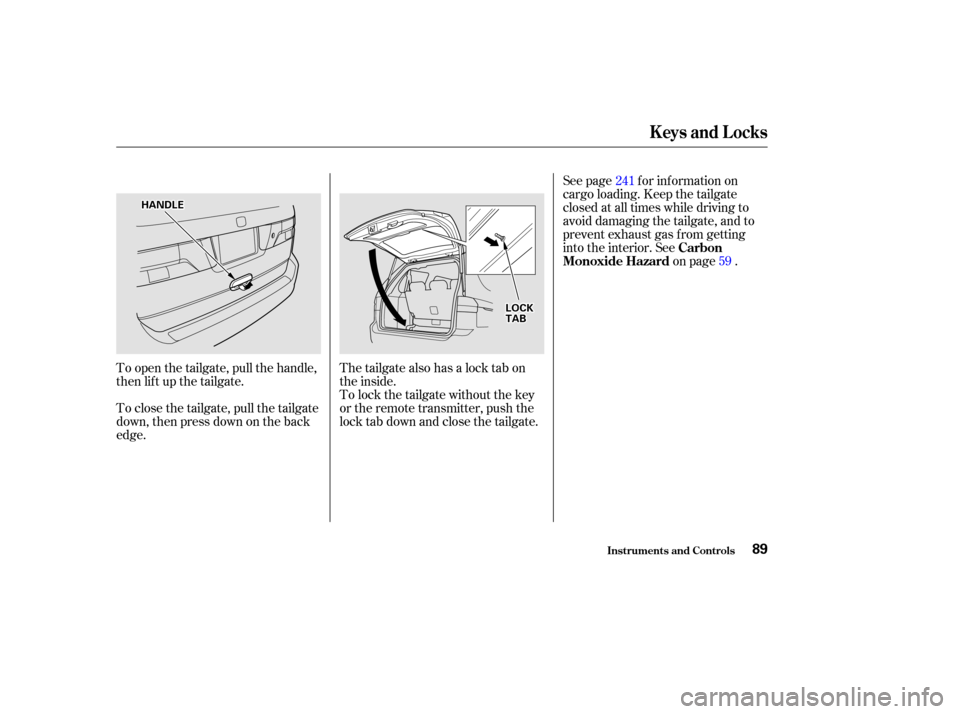
To open the tailgate, pull the handle,
then lif t up the tailgate.
To close the tailgate, pull the tailgate
down, then press down on the back
edge.The tailgate also has a lock tab on
the inside.
To lock the tailgate without the key
or the remote transmitter, push the
lock tab down and close the tailgate.See page for information on
cargo loading. Keep the tailgate
closed at all times while driving to
avoid damaging the tailgate, and to
prevent exhaust gas f rom getting
into the interior. See
on page .
241
59
Carbon
Monoxide Hazard
Keys and Locks
Inst rument s and Cont rols89
H H A
AN
ND DL
LEE
L
LOOC CKK
T
T A
A B
B
Page 124 of 399
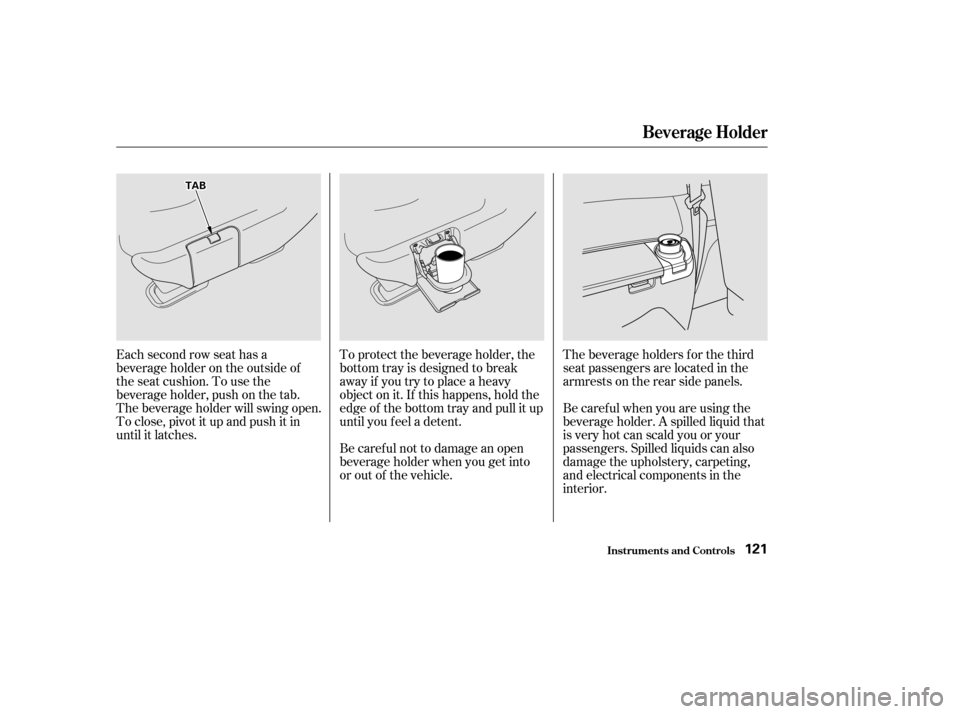
Each second row seat has a
beverage holder on the outside of
the seat cushion. To use the
beverage holder, push on the tab.
The beverage holder will swing open.
To close, pivot it up and push it in
until it latches.The beverage holders f or the third
seat passengers are located in the
armrests on the rear side panels.
Be caref ul when you are using the
beverage holder. A spilled liquid that
is very hot can scald you or your
passengers. Spilled liquids can also
damage the upholstery, carpeting,
and electrical components in the
interior.
To protect the beverage holder, the
bottom tray is designed to break
away if you try to place a heavy
object on it. If this happens, hold the
edge of the bottom tray and pull it up
until you f eel a detent.
Be caref ul not to damage an open
beverage holder when you get into
or out of the vehicle.
Inst rument s and Cont rols
Beverage Holder
121
T T
A
A B
B
Page 130 of 399
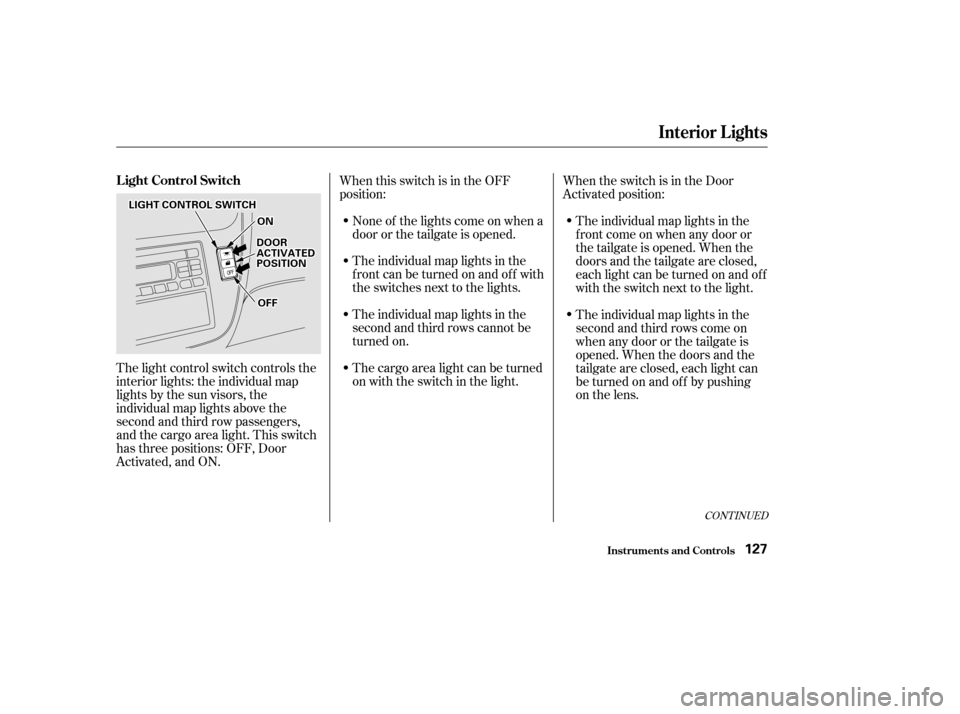
The light control switch controls the
interior lights: the individual map
lights by the sun visors, the
individual map lights above the
second and third row passengers,
and the cargo area light. This switch
has three positions: OFF, Door
Activated, and ON.When this switch is in the OFF
position:
None of the lights come on when a
door or the tailgate is opened.
The individual map lights in the
f ront can be turned on and of f with
the switches next to the lights.
The individual map lights in the
second and third rows cannot be
turned on.
The cargo area light can be turned
on with the switch in the light. The individual map lights in the
f ront come on when any door or
thetailgateisopened.Whenthe
doors and the tailgate are closed,
eachlightcanbeturnedonandoff
with the switch next to the light.
The individual map lights in the
second and third rows come on
when any door or the tailgate is
opened. When the doors and the
tailgate are closed, each light can
be turned on and of f by pushing
on the lens.
When the switch is in the Door
Activated position:
CONT INUED
Inst rument s and Cont rols
Interior Lights
L ight Control Switch
127
L LI
IGGH HT
T C
COON NTTR
RO OL L S
SWWI ITT C
CH H
O
ONN
D
D O
OO ORR
A
A C
CTTI
IVV A
AT
TE
ED
D
P
P O
OS SIITT I
IOON N
O
OF FFF
Page 131 of 399

The cargo area light comes on
whenanydoororthetailgateis
opened if the switch in the light is
in the door activated (center)
position. When the doors and the
tailgate are closed, it can be turned
on with the switch in the light.When the switch is in the ON
position:
All the individual map lights come
onandstayonaslongasthe
switch remains in the ON position.
The cargo area light comes on and
stays on if the switch in the light is
in the door activated (center)
position. The lights go out about six seconds
after all the doors and the tailgate
are closed.
With the light control switch in the
Door Activated position, all the
individual map lights and the cargo
area light (with the switch in the
center position) come on when you
unlock the door with the remote
transmitter (see page ).
Withanydoororthetailgateleft
open, the lights stay on about three
minutes, then go out.
84On EX and EX-L models
Interior Lights
Inst rument s and Cont rols128