Page 293 of 399
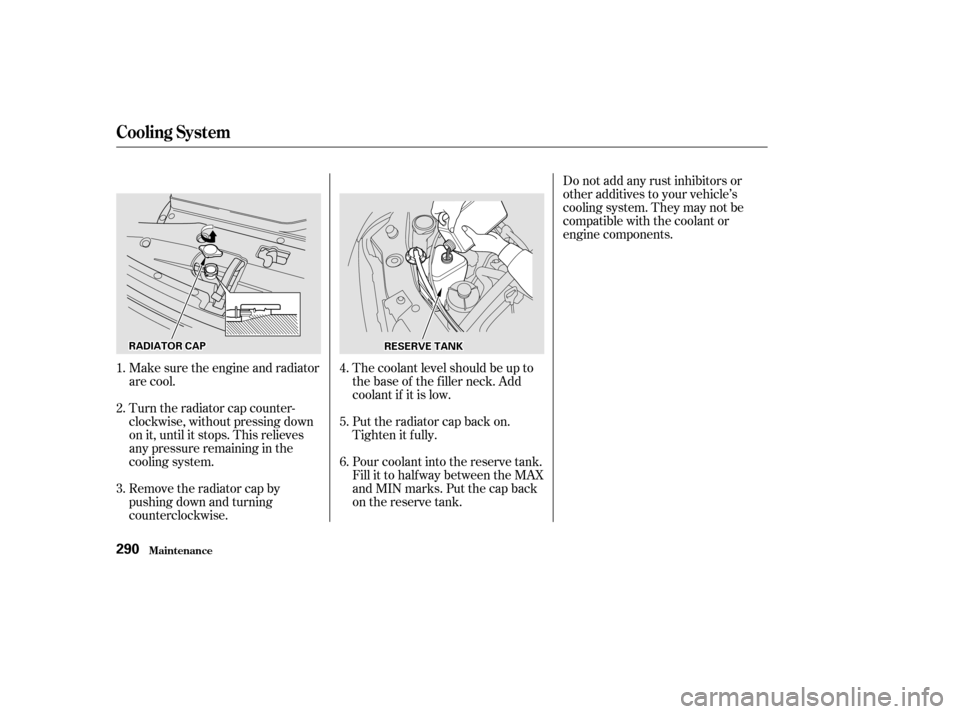
Make sure the engine and radiator
are cool.
Turn the radiator cap counter-
clockwise, without pressing down
on it, until it stops. This relieves
any pressure remaining in the
cooling system.
Remove the radiator cap by
pushing down and turning
counterclockwise.The coolant level should be up to
the base of the f iller neck. Add
coolant if it is low.
Put the radiator cap back on.
Tighten it f ully.
Pour coolant into the reserve tank.
Fill it to half way between the MAX
and MIN marks. Put the cap back
on the reserve tank.Do not add any rust inhibitors or
other additives to your vehicle’s
cooling system. They may not be
compatible with the coolant or
engine components.
3. 4.
5.
6.
1.
2.
Cooling Syst em
Maint enance290
R RA
A D
DI
IAA T
TO
OR R C
CAA P
P
R
REES
SE ER
RV V E
E T
TA
A N
NK K
Page 294 of 399
CONT INUED
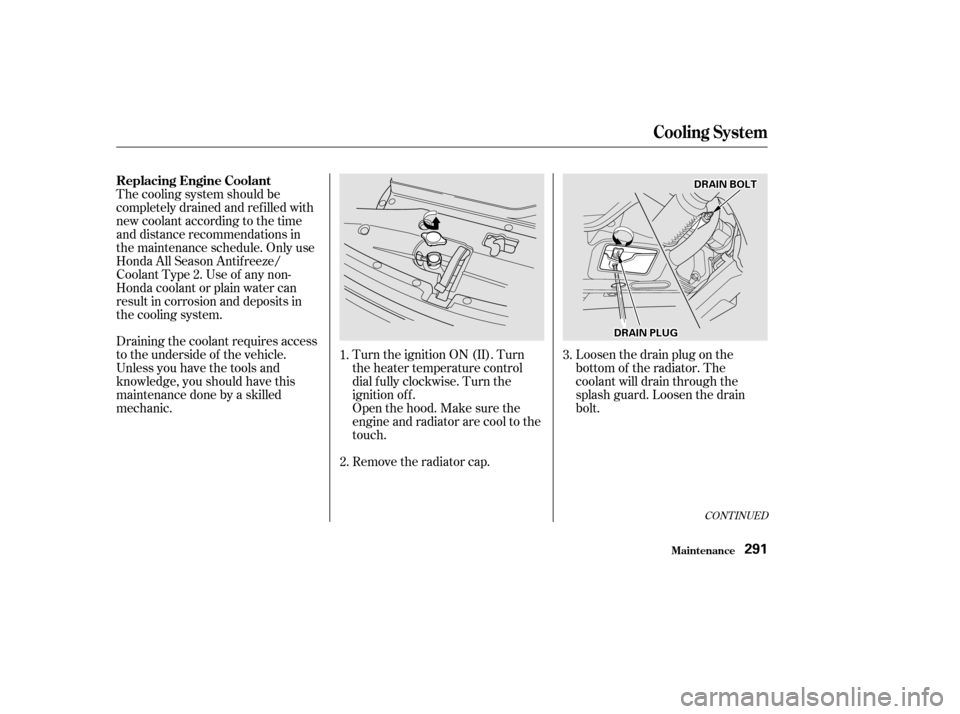
Loosen the drain plug on the
bottom of the radiator. The
coolant will drain through the
splash guard. Loosen the drain
bolt.
Turn the ignition ON (II). Turn
the heater temperature control
dial f ully clockwise. Turn the
ignition of f .
Openthehood.Makesurethe
engine and radiator are cool to the
touch.
Remove the radiator cap.
Draining the coolant requires access
to the underside of the vehicle.
Unless you have the tools and
knowledge, you should have this
maintenance done by a skilled
mechanic. Thecoolingsystemshouldbe
completely drained and ref illed with
new coolant according to the time
and distance recommendations in
the maintenance schedule. Only use
Honda All Season Antif reeze/
Coolant Type 2. Use of any non-
Honda coolant or plain water can
result in corrosion and deposits in
the cooling system.
1.3.
2.
Replacing Engine Coolant
Cooling Syst em
Maint enance291
D D
R
RAA I
INN B
BOOL LTT
D
D R
RAA I
INN P
PL
LUUG G
Page 295 of 399
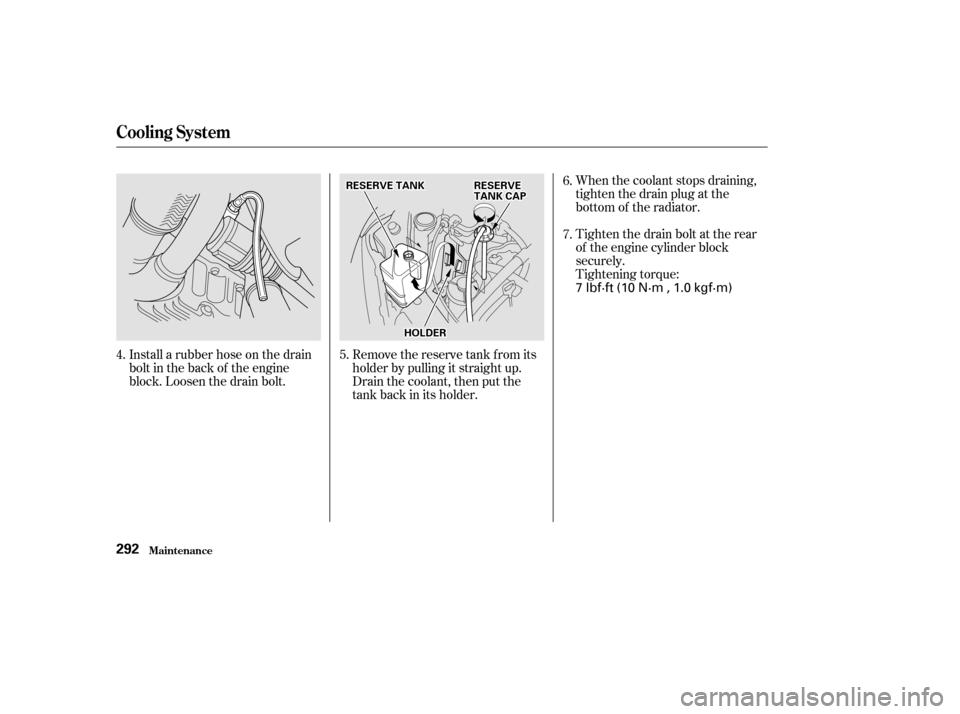
When the coolant stops draining,
tightenthedrainplugatthe
bottom of the radiator.
Tighten the drain bolt at the rear
of the engine cylinder block
securely.
Tightening torque:
Remove the reserve tank f rom its
holder by pulling it straight up.
Drain the coolant, then put the
tank back in its holder.
Install a rubber hose on the drain
bolt in the back of the engine
block. Loosen the drain bolt. 6.
4. 5. 7.
Cooling Syst em
Maint enance292
R RE
ES
SE ER
RV V E
E T
TA
A N
NK K R
REES
SE ER
RV V E
E
T
T A
A N
NK K C
CAA P
P
H
H O
OL LDD E
ER
R
7 lbf·ft (10 N·m , 1.0 kgf·m)
Page 296 of 399
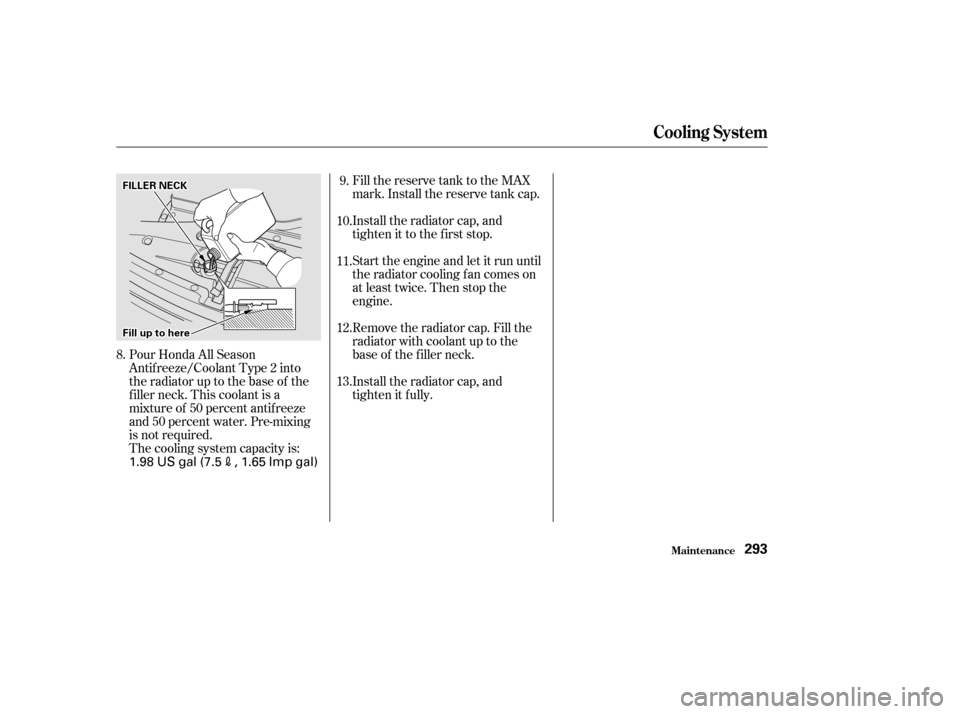
Fill the reserve tank to the MAX
mark. Install the reserve tank cap.
Install the radiator cap, and
tighten it to the first stop.
Start the engine and let it run until
the radiator cooling f an comes on
at least twice. Then stop the
engine.
Remove the radiator cap. Fill the
radiator with coolant up to the
base of the f iller neck.
Install the radiator cap, and
tighten it fully.
Pour Honda All Season
Antif reeze/Coolant Type 2 into
the radiator up to the base of the
f iller neck. This coolant is a
mixture of 50 percent antif reeze
and 50 percent water. Pre-mixing
is not required.
The cooling system capacity is:
8. 10.
11.
12.
13.9.
Cooling Syst em
Maint enance293
F FI
ILLL LEE R
R N
NEEC
CK K
F
Fi illll u
u p
p t
too h
he
erree
1.98 US gal (7.5, 1.65 Imp gal)
Page 310 of 399
Run the air conditioning at least once
a week during the cold weather
months. Run it f or at least ten
minutes while you are driving at a
steady speed with the engine at
normal operating temperature. This
circulates the lubricating oil con-
tained in the ref rigerant.If the air conditioning does not get as
cold as before, have your dealer
check the system. Recharge the
system with Ref rigerant HFC-134a
(R-134a). (See Specif ications on page
.)
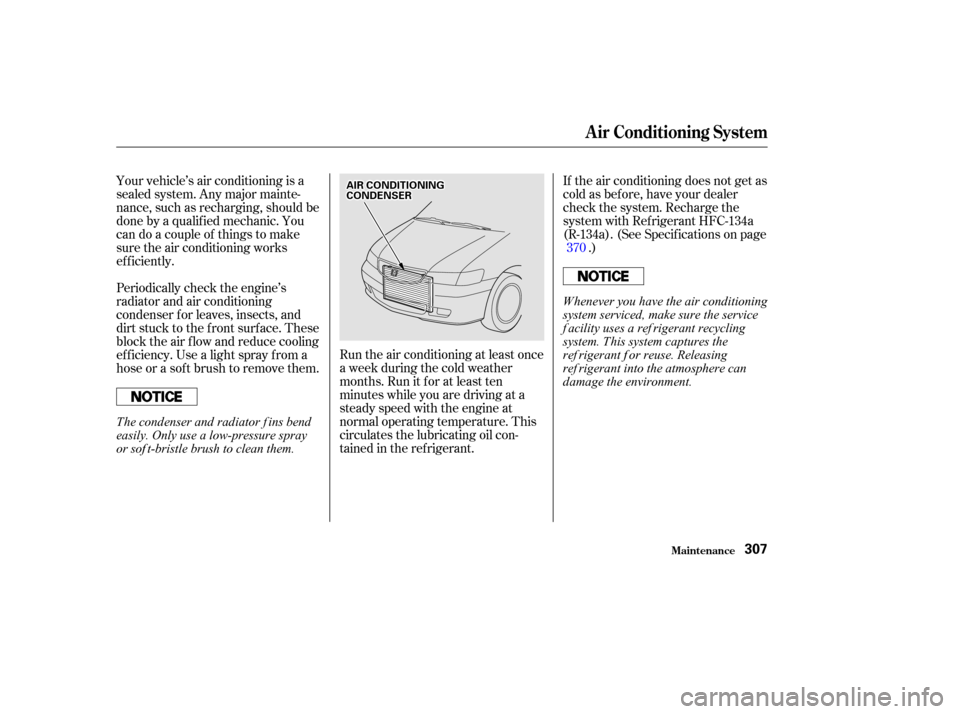
Your vehicle’s air conditioning is a
sealed system. Any major mainte-
nance, such as recharging, should be
done by a qualif ied mechanic. You
can do a couple of things to make
sure the air conditioning works
ef f iciently.
Periodically check the engine’s
radiator and air conditioning
condenser f or leaves, insects, and
dirt stuck to the f ront surf ace. These
block the air f low and reduce cooling
ef f iciency. Use a light spray f rom a
hose or a sof t brush to remove them. 370
Maint enance
A ir Condit ioning Syst em
307
A A
I
IRR C
COON NDDI
ITT I
IOON NIINNG G
C
CO ON NDDE
EN
NS SEER
R
Whenever you have the air conditioning
system serviced, make sure the service
f acility uses a ref rigerant recycling
system. This system captures the
ref rigerant f or reuse. Releasing
ref rigerant into the atmosphere can
damage the environment.
The condenser and radiator f ins bend
easily. Only use a low-pressure spray
or sof t-bristle brush to clean them.
Page 311 of 399
�µ�µ
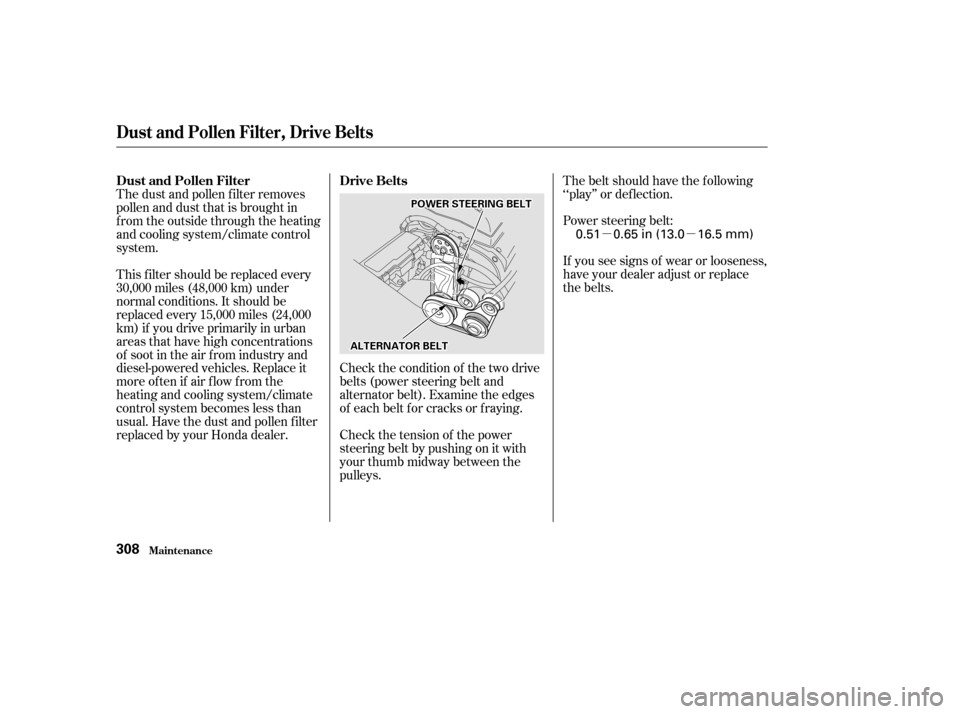
Check the condition of the two drive
belts (power steering belt and
alternator belt). Examine the edges
of each belt f or cracks or f raying. If you see signs of wear or looseness,
have your dealer adjust or replace
the belts. Power steering belt: Thebeltshouldhavethefollowing
‘‘play’’ or def lection.
Check the tension of the power
steering belt by pushing on it with
your thumb midway between the
pulleys.
The dust and pollen f ilter removes
pollen and dust that is brought in
f rom the outside through the heating
and cooling system/climate control
system.
This f ilter should be replaced every
30,000 miles (48,000 km) under
normal conditions. It should be
replaced every 15,000 miles (24,000
km) if you drive primarily in urban
areas that have high concentrations
of soot in the air f rom industry and
diesel-powered vehicles. Replace it
more of ten if air f low f rom the
heating and cooling system/climate
control system becomes less than
usual. Have the dust and pollen f ilter
replaced by your Honda dealer.
Drive Belts
Dust and Pollen Filter
Maint enance
Dust and Pollen Filter, Drive Belts
308
P P O
OW WE ER
R S
STTE
EE
ER
RI INNG G B
BEEL
LTT
A
A L
LTT E
ER
RN NA AT
TO
OR R B
BEEL
LTT
0.51 0.65 in (13.0 16.5 mm)
Page 355 of 399

Saf ely pull to the side of the road.
Put the transmission in Neutral or
Park and set the parking brake.
Turn of f the heating and cooling/
climate control system and all
otheraccessories.Turnonthe
hazard warning indicators.
If you see steam and/or spray
coming f rom under the hood, turn
of f the engine.If you do not see steam or spray,
leave the engine running and
watch the temperature gauge. If
the high heat is due to overloading
(climbing a long, steep hill on a
hot day with the A/C running, f or
example), the engine should start
to cool down almost immediately.
If it does, wait until the tempera-
ture gauge comes down to the mid-
point then continue driving.
If the temperature gauge stays at
the red mark, turn of f the engine.
Wait until you see no more signs
of steam or spray, then open the
hood.Look f or any obvious coolant leaks,
such as a split radiator hose.
Everything is still extremely hot,
so use caution. If you f ind a leak, it
must be repaired bef ore you
continue driving (see
on page ).
If you don’t f ind an obvious leak,
check the coolant level in the
radiator reserve tank (see page ). If the level is below the
MIN mark, add coolant to halfway
between the MIN and MAX marks.
1.
2.
3.
7. 6.
5. 4. 237365
If Your Engine Overheats
T aking Care of t he Unexpect ed
Emergency
Towing
352
Page 356 of 399

If there was no coolant in the
reserve tank, you may also have to
add coolant to the radiator. Let the
engine cool down until the pointer
reaches the middle of the tempera-
ture gauge, or lower, bef ore check-
ing the radiator.Using gloves or a large heavy
cloth, turn the radiator cap
counterclockwise, without pushing
down, to the f irst stop. This
releases any remaining pressure in
the cooling system. After the
pressure releases, push down on
the cap and turn it until it comes
off.
Start the engine and set the
temperature control dial to
maximum (climate control to
FULL AUTO at 90°F/32°C). Add
coolant to the radiator up to the
base of the f iller neck. If you do
not have the proper coolant
mixture available, you can add
plain water. Remember to have
the cooling system drained and
ref illed with the proper mixture as
soon as you can.Put the radiator cap back on
tightly. Run the engine and watch
the temperature gauge. If it goes
back to the red mark, the engine
needs repair. (See
on page .)
If the temperature stays normal,
check the coolant level in the
radiator reserve tank. If it has
gone down, add coolant to the
MAX mark. Put the cap back on
tightly.
8.
9.
10. 12. 11.
365Emergency
Towing
If Your Engine Overheats
T aking Care of t he Unexpect ed353
Removing the radiator cap
while the engine is hot can
cause the coolant to spray out,
seriously scalding you.
Always let the engine and
radiator cool down before
removing the radiator cap.