Page 135 of 372

CONT INUED
Turn the temperature control dial
all the way to the lef t.
Make sure the A/C is of f .
Select and Fresh Air mode.
Set the f an to the desired speed.
The outside air intakes f or the
heating and cooling system are at
the base of the windshield. Keep
these clear of leaves and other
debris.
It is best to leave the system in Fresh
Air mode under almost all conditions.
Keeping the system in Recirculation
mode, particularly with the A/C of f ,
can cause the windows to fog up.
Switch to Recirculation mode when
you are driving through smoky or
dusty conditions, then switch back to
Fresh Air mode when the condition
clears. This section covers how to set up the
system controls f or ventilation,
heating, cooling, dehumidif ying, and
def rosting.
The engine must be running f or the
heater and air conditioning to
generate hot and cold air. The heater
uses engine coolant to warm the air.
If the engine is cold, it will be several
minutes bef ore you f eel warm air
coming from the system.
The air conditioning does not rely on
engine temperature.
The f low-through ventilation system
draws in outside air, circulates it
through the interior, then exhausts it
through vents near the tailgate.1.
2.
3.
Heating and Cooling
Comf ort and Convenience Feat ures
Vent ilat ion
How to Use the System
131
M M
O
ODDE
E C
COON NTTR
RO OL L
D
D I
IAA L
L
T
T
E
EM
M P
PE
ER
RA A T
TU
UR REE
C
CO ON NTTR
RO OL L D
DI
IAA L
L
F
FA
A N
N C
COON NTTR
RO OL L
D
D I
IAA L
L
A
AI
IRR C
COON NDDI
ITT I
IOON NIINNG G
B
BU UT TT
TO
ON N
R
RE
EC
CI IRRC CUUL LAA T
TI
IOON N
B
BU UT TT
TO
ON N
Page 199 of 372

Distribute cargo evenly on the
f loor of the cargo area, placing the
heaviest items on the bottom and
as far forward as possible. Tie
down items that could be thrown
about the vehicle during a crash or
sudden stop.
If you carry large items that
prevent you f rom closing the
tailgate or the hatch glass, exhaust
gas can enter the passenger area.
To avoid the possibility of, f ollow the
instructions on page . If you can carry any items on a
roof rack,besurethetotalweight
of the rack and the items does not
exceed the maximum allowable
weight. Please contact your Honda
dealer f or f urther inf ormation.
If you use an accessory roof rack,
the roof rack weight limit may be
lower. Ref er to the inf ormation that
came with your roof rack.
To secure cargo, use the f our f loor
hooks in the cargo area. Make sure
all stored items are secured before
driving.
60
CONT INUED
Carrying Cargo in the Cargo A rea
or on a Roof Rack
carbon
monoxide poisoning
Carrying Cargo
Bef ore Driving195
H H O
OO OKKSS
Page 200 of 372
Store only small, lightweight items in
the pockets on the back of the
tailgate.
Carrying Cargo
Bef ore Driving
T ailgat e Pocket s
196
T TA
A I
ILLG GA AT
TE
E P
PO
OC CKKEET
TS
S
Page 203 of 372

Youshoulddothefollowingchecks
and adjustments every day bef ore
you drive your vehicle.Make sure all windows, mirrors,
and outside lights are clean and
unobstructed. Remove f rost, snow,
or ice. Check the adjustment of the seat
(see page ).
Check the adjustment of the
inside and outside mirrors (see
page ).
Check the adjustment of the
steering wheel (see page ).
Fasten your seat belt. Check that
your passengers have f astened
their seat belts (see page ).Turn the ignition switch ON (II).
Check the indicator lights in the
instrument panel.
Start the engine (see page ).
Check the gauges and indicator
lights in the instrument panel (see
page ).
Visually check the tires. If a tire
looks low, use a gauge to check its
pressure.
Check that any items you may be
carrying with you inside are stored
properly or f astened down
securely. Make sure the doors are securely
closed and locked.
Check that the hood, tailgate and
hatch glass are f ully closed.
1.
2.
3.
4. 5.
6.
7.
8.
9.
10.
11.
12.
97
114 83
17 200
65
Driving
Preparing to Drive
199
Page 214 of 372

�µ
Always use the parking brake when
you park your vehicle. The indicator
on the instrument panel shows that
the parking brake is not f ully
released; it does not indicate that the
parking brake is f irmly set. Make
sure the parking brake is set f irmly
or your vehicle may roll if it is
parked on an incline.
If your vehicle has an automatic
transmission, set the parking brake
bef ore you put the transmission in
Park. This keeps the vehicle f rom
moving and putting pressure on the
parking mechanism in the
transmission making it easier to
move the shift lever out of Park
when you want to drive away. If the vehicle is f acing uphill, turn
the f ront wheels away f rom the curb.
If you have a manual transmission,
putitinfirstgear.
If the vehicle is f acing downhill, turn
the f ront wheels toward the curb. If
you have a manual transmission, put
it in reverse gear.
Make sure the parking brake is f ully
released bef ore driving away.
Driving with the parking brake
partially set can overheat or damage
the rear brakes.
Make sure the moonroof and the
windows are closed.
Lock the doors and the tailgate
with the key or the remote
transmitter.
Make sure the hatch glass is
closed securely. Place any packages, valuables, etc.,
in the cargo area or take them
with you. Turn of f the lights.
Never park over dry leaves, tall
grass, or other f lammable
materials. The three way catalytic
converter gets very hot, and could
cause these materials to catch on
fire.
Parking T ips
Driving
Parking
210
Page 294 of 372
Open the tailgate. Place a cloth on
the edge of the cover. Remove the
covers by caref ully prying on the
edge with a small f lat-tipped
screwdriver.Use a Phillips-head screwdriver to
remove the taillight assembly
mounting screw under each cover.
Determine which of the f our bulbs
is burned out: stop/taillight, back-
up light, turn signal, or side
marker.
Remove the socket by turning it
one-quarter turn counterclockwise.
Pull the taillight assembly out of
the rear pillar.
1.
2.
3.4.
5.
Lights
Maint enance
Replacing Rear Bulbs
290
C CO
OV VE
ER
R
S
SCCRREEW
W
Page 296 of 372
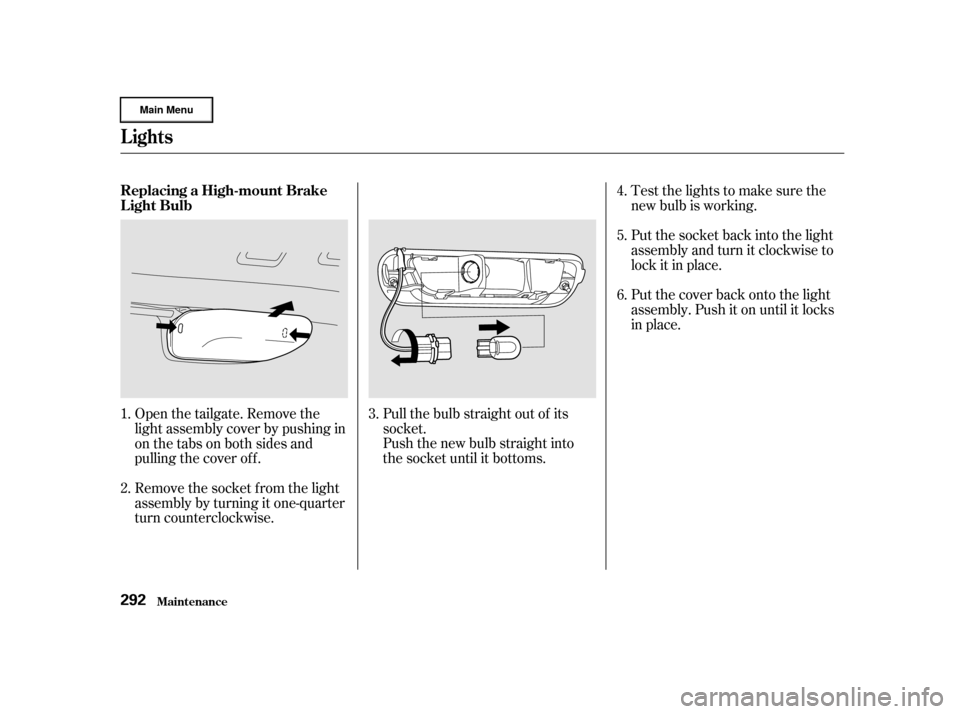
Pull the bulb straight out of its
socket.
Push the new bulb straight into
the socket until it bottoms.Testthelightstomakesurethe
new bulb is working.
Put the socket back into the light
assembly and turn it clockwise to
lock it in place.
Put the cover back onto the light
assembly. Push it on until it locks
in place.
Open the tailgate. Remove the
light assembly cover by pushing in
on the tabs on both sides and
pulling the cover of f .
Remove the socket f rom the light
assembly by turning it one-quarter
turn counterclockwise.
1.
2.
3.4.
5.
6.
Replacing a High-mount Brake
Light Bulb
Lights
Maint enance292
Page 299 of 372

If you need to park your vehicle f or
an extended period (more than one
month), there are several things you
should do to prepare it f or storage.
Proper preparation helps prevent
deterioration and makes it easier to
get your vehicle back on the road. If
possible, store your vehicle indoors.Block the rear wheels.
If the vehicle is to be stored f or a
longer period, it should be
supported on jackstands so the
tires are of f the ground.
Leave one window open slightly (if
the vehicle is being stored
indoors).Cover the vehicle with a
‘‘breathable’’ cover, one made
f rom a porous material such as
cotton. Nonporous materials, such
as plastic sheeting, trap moisture,
which can damage the paint.
Fill the f uel tank.
Change the engine oil and f ilter
(see page ).
Wash and dry the exterior
completely.
Cleantheinterior.Makesurethe
carpeting, floor mats, etc. are
completely dry. To minimize sticking, apply a
silicone spray lubricant to all door
and tailgate seals. Also, apply a
vehiclebodywaxtothepainted
surfaces that mate with the door
and tailgate seals. Support the f ront and rear wiper
blade arms with a f olded towel or
ragsotheydonottouchthe
windshield. Disconnect the battery.
Leave the parking brake off. Put
the transmission in Reverse
(5-speed manual) or Park
(automatic). If possible, run the engine f or a
while periodically (pref erably once
amonth).
If you store your vehicle f or 12
months or longer, have your Honda
dealer perf orm the inspections called
f or in the 24 months maintenance
schedule (Normal Conditions) as
soon as you take it out of storage
(see page ). The replacements
called f or in the maintenance
schedule are not needed unless the
vehicle has actually reached that
time or mileage.
249
238
Maint enance
St oring Your Vehicle
295