Page 278 of 372

Your vehicle’s air conditioning is a
sealed system. Any major mainte-
nance, such as recharging, should be
done by a qualif ied mechanic. You
can do a couple of things to make
sure the air conditioning works
ef f iciently.Run the air conditioning at least once
a week during the cold weather
months. Run it f or at least ten
minutes while you are driving at a
steady speed with the engine at
normal operating temperature. This
circulates the lubricating oil con-
tained in the ref rigerant.If the air conditioning does not get as
cold as before, have your dealer
check the system. Recharge the
system with Ref rigerant HFC-134a
(R-134a). (See Specif ications on page
.)
Periodically check the engine’s
radiator and air conditioning
condenser f or leaves, insects, and
dirt stuck to the f ront surf ace. These
block the air f low and reduce cooling
ef f iciency. Use a light spray f rom a
hose or a sof t brush to remove them. 343
A ir Condit ioning Syst em
Maint enance274
A A
I
IRR C
COON NDDI
ITT I
IOON NIINNG G C
COON NDDE
EN
NS SEER
R
Whenever you have the air conditioning
system serviced, make sure the service
f acility uses a ref rigerant recycling
system. This system captures the
ref rigerant f or reuse. Releasing
ref rigerant into the atmosphere can
damage the environment.
The condenser and radiator f ins bend
easily. Only use a low-pressure spray
or sof t-bristle brush to clean them.
Page 279 of 372
To replace it: The dust and pollen f ilter is located
behind the glove box.Remove the dust and pollen f ilter
cover by pushing in on the lock tab,
then pulling the cover toward you.
The dust and pollen f ilter removes
pollen and dust that is brought in
f rom the outside through the heating
andcoolingsystem.
This f ilter should be replaced every
30,000 miles (48,000 km) under
normal conditions. It should be
replaced every 15,000 miles (24,000
km) if you drive primarily in urban
areas that have high concentrations
of soot in the air f rom industry and
diesel-powered vehicles. Replace it
more of ten if air f low f rom the
heating and cooling system becomes
less than usual.
Open the glove box. Remove the
hooks on the side panels by
pushingontheendof eachhook
fromtheinsideof theglovebox.
Pivot the glove box out of the way.
1. 2.
CONT INUED
Maint enance
Dust and Pollen Filter
Replacement
275
C CO
OV VE
ER
R
H
H O
OO OKKSS
T
TA
A B
B
Page 280 of 372
Remove the f irst f ilter by pulling it
straight out of the air conditioning
unit. Remove the second f ilter by
sliding it to the lef t, then pulling it
out.Remove the old f ilter f rom the
f ilter case.
Install the new f ilter in the case.
Make sure the ‘‘AIR FLOW’’
arrows on the f ilter and the f ilter
case f ace the same direction.Install the dust and pollen f ilters
into the air conditioning unit.
Make sure the ‘‘AIR FLOW’’
arrows on the f ilter point
downward.
Reinstall the dust and pollen f ilter
cover.
Pivot the glove box up into
position. Reinstall the hooks into
thesidepanelof theglovebox.
Close the glove box.
If you are not sure how to replace
the dust and pollen filters, have them
replaced by your Honda dealer.
3.
4.
5.6.
7.
8.
Maint enance
Dust and Pollen Filter
276
D D
U
US STT A
AN
ND D P
PO
OL LLLEE N
N F
FIILLT T E
ER
RS S
Page 282 of 372

To saf ely operate your vehicle, your
tires must be the proper type and
size, in good condition with adequate
tread, and correctly inf lated. The
f ollowing pages give more detailed
informationonhowandwhento
check air pressure, how to inspect
your tires f or damage and wear, and
what to do when your tires need to
be replaced.Keeping the tires properly inf lated
provides the best combination of
handling, tread lif e and riding
comf ort. Underinf lated tires wear
unevenly, adversely af f ect handling
and f uel economy, and are more
likely to f ail f rom being overheated.
Overinf lated tires can make your
vehicleridemoreharshly,aremore
prone to damage from road hazards,
and wear unevenly.
We recommend that you visually
check your tires every day. If you
think a tire might be low, check it
immediately with a tire gauge.Use a gauge to measure the air
pressure at least once a month. Even
tires that are in good condition may
lose one to two psi (10 to 20 kPa, 0.1
to 0.2 kgf /cm ) per month.
Remember to check the spare tire at
thesametimeyoucheckallthe
other tires.
Check the pressure in the tires when
they are cold. This means the vehicle
has been parked f or at least three
hours. If you have to drive the
vehicle bef ore checking the tire
pressure, the tires can still be
considered ‘‘cold’’ if you drive less
than 1 mile (1.6 km).
Inf lation
Tires
Maint enance278
Using tires that are excessively
worn or improperly inflated can
cause a crash in which you can
be seriously hurt or killed.
Follow all instructions in this
owner’s manual regarding tire
inflation and maintenance.
Page 283 of 372

If you check the pressure when the
tires are hot (the vehicle has been
driven several miles), you will see
readings 4 to 6 psi (30 to 40 kPa, 0.3
to 0.4 kgf/cm ) higher than the cold
reading. This is normal. Do not let
air out to match the specified cold
pressure. The tire will be
underinf lated.
Youshouldgetyourowntire
pressure gauge and use it whenever
you check your tire pressures. This
will make it easier f or you to tell if a
pressure loss is due to a tire problem
and not due to a variation between
gauges.The following chart shows the
recommended cold tire pressures f or
most normal driving conditions and
speeds.
These pressures are also given on
thetireinformationlabelonthe
driver’s doorjamb.
Tubeless tires have some ability to
self -seal if they are punctured.
However, because leakage is of ten
very slow, you should look closely
for punctures if a tire starts losing
pressure.Honda strongly recommends that
you not drive f aster than posted
speed limits and conditions allow. If
you decide it is safe to drive at high
speeds, be sure to adjust the cold tire
pressuresasshownbelow.If youdo
not adjust the tire pressure, exces-
sive heat can build up and cause
sudden tire f ailure.
When you return to normal speed
driving, be sure to readjust the tire
pressure f or normal driving. You
should wait until the tires are cold
bef ore adjusting the tire pressure.
Tire Size Cold Tire Pressure
for Normal Driving
Tire Size Cold Tire Pressurefor Speed over 100
mph (160 km/h)
Front/Rear:
Tires
Recommended T ire Pressures f or
Normal Driving T ire Pressure A djust ment f or High
Speed Driving
Maint enance279
P205/70R15 95S
P205/70R15 95S
26 psi (180 kPa ,
1.8 kgf/cm
)
35 psi (240 kPa ,2.4 kgf/cm
)
Page 284 of 372

Every time you check inf lation, you
should also examine the tires f or
damage, f oreign objects, and wear.
Youshouldlookfor:Bumps or bulges in the tread or
side of the tire. Replace the tire if
youfindeitherof theseconditions.
Excessive tread wear. In addition to proper inf lation,
correct wheel alignment helps to
decrease tire wear. If you f ind a tire
is worn unevenly, have your dealer
check the wheel alignment.
Cuts, splits, or cracks in the side
of the tire. Replace the tire if you
can see f abric or cord. Your vehicle’s tires have wear indica-
tors molded into the tread. When the
tread wears down to that point, you
will see a 1/2 inch (12.7 mm) wide
band running across the tread. This
shows there is less than 1/16 inch
(1.6 mm) of tread lef t on the tire. A
tire that is this worn gives very little
traction on wet roads. You should
replace the tire if you can see the
tread wear indicator in three or more
places around the tire. The tires were properly balanced by
the factory. They may need to be
rebalanced at some time bef ore they
are worn out. Have your dealer
check the tires if you f eel a consis-
tent vibration while driving. A tire
should always be rebalanced if it is
removed f rom the wheel f or repair.
Inspection
Maintenance
Tires
Maint enance280
I INND DI
ICCA A T
TO
OR R L
LOOC CAA T
TI
IOON N M
MA
AR
RKKSS
T
T R
RE EA
A D
D W
WE EA
A R
R I
INND DI
ICCA A T
TO
OR RSS
Page 333 of 372
�Î
�Î�Î
�Î
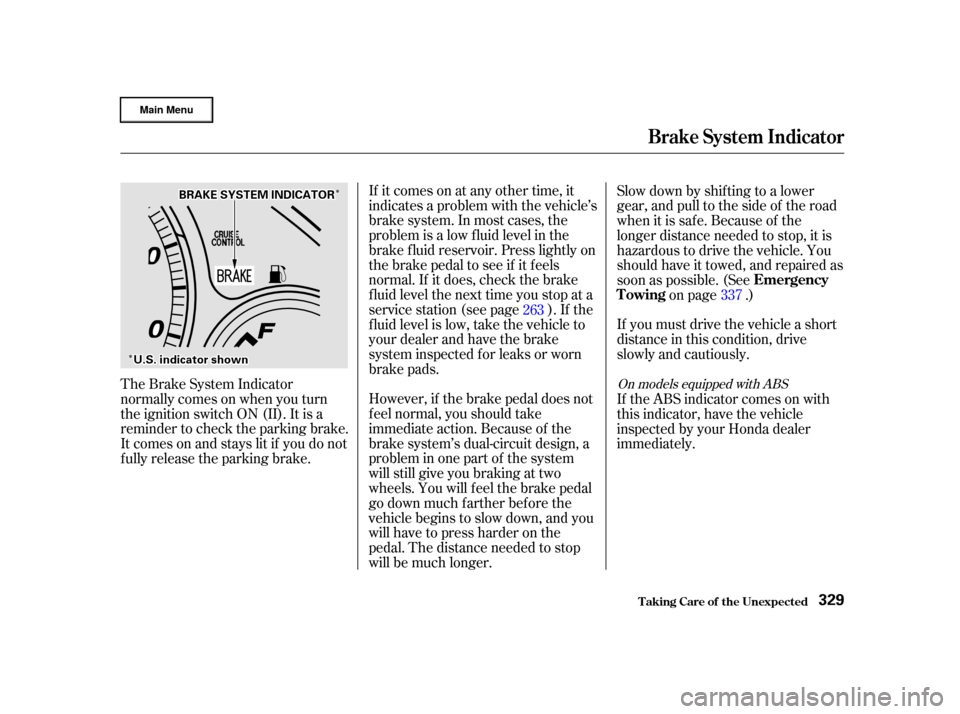
If you must drive the vehicle a short
distance in this condition, drive
slowly and cautiously.
If it comes on at any other time, it
indicates a problem with the vehicle’s
brake system. In most cases, the
problem is a low f luid level in the
brake f luid reservoir. Press lightly on
the brake pedal to see if it f eels
normal. If it does, check the brake
f luid level the next time you stop at a
service station (see page ). If the
f luid level is low, take the vehicle to
your dealer and have the brake
system inspected f or leaks or worn
brake pads.
However, if the brake pedal does not
f eel normal, you should take
immediate action. Because of the
brake system’s dual-circuit design, a
problem in one part of the system
will still give you braking at two
wheels. You will f eel the brake pedal
go down much f arther bef ore the
vehicle begins to slow down, and you
will have to press harder on the
pedal. The distance needed to stop
will be much longer. Slow down by shif ting to a lower
gear, and pull to the side of the road
when it is saf e. Because of the
longer distance needed to stop, it is
hazardous to drive the vehicle. You
should have it towed, and repaired as
soon as possible. (See
on page .)
The Brake System Indicator
normallycomesonwhenyouturn
the ignition switch ON (II). It is a
reminder to check the parking brake.
It comes on and stays lit if you do not
f ully release the parking brake. If the ABS indicator comes on with
this indicator, have the vehicle
inspected by your Honda dealer
immediately.
263
337
On models equipped with ABS
Emergency
Towing
Brake System Indicator
T aking Care of t he Unexpect ed329
U U. .SS. .i
inn d
di
icca at too r
r s
shh o
ow
wn n
B
BR
RAA K
KEE S
SYYSSTTE
EM
M I
INND DI
ICCA A T
TO
OR R
Page 347 of 372

�µ�µ�µ
�µ
�µ
�µ
�µ
�µ
�µ
�µ
�µ
�µ
�µ
�µ
�µ
�µ
�µ
Specif ications
T echnical Inf ormation343
Air Conditioning
Battery
Tires Alignment Fuses
Lights HFC-134a (R-134a)
17.0 18.7 oz (480 530 g) SP-10
12 V
12 V 60/55 W
21/5 W
36 AH/5 HR
12 V 12 V
12 V
12 V
12 V
12 V
12 V
12 V
12 V
21 W
3CP
8W
4CP
8W
5W
21 W
21/5 W
21 W
12 V 3 CP
Refrigerant type
Charge quantity
Lubricant type
Capacity
12 V See page
335or the fuse label
attached to the inside of the fuse
box door under the steering
column.
45 AH/20 HR
12 V 26 psi (180 kPa , 1.8 kgf/cm
)
26 psi (180 kPa , 1.8 kgf/cm)
P205/70R15 95S
Size
Pressure Toe-in
Camber
Caster 1°45’1°
0°
0.08 in (2.0 mm) 0.0in(0mm)
See page
336or the fuse box
cover.
Interior
Under-hood
Headlights
Front turn signal/side marker
lights
Parking lights
Rear turn signal lights
Stop/Taillights
Back-up lights
License plate light
Ceiling light
Spotlights
Cargo area Light
Rear side marker lights
High-mount brake light Front
Rear
Front
Rear
Front
Front/Rear
Front
Rear
(H4/HB2)

