Page 307 of 372

Dirt build-up in the loops of the seat
belt anchors can cause the belts to
retract slowly. Wipe the insides of
the loops with a clean cloth
dampened in mild soap and warm
water or isopropyl alcohol.Clean the windows, inside and out,
with a commercially-available glass
cleaner. You can also use a mixture
of one part white vinegar to ten parts
water. This will remove the haze that
builds up on the inside of the
windows. Use a sof t cloth or paper
towels to clean all glass and clear
plastic surf aces.If you want to use an air f reshener/
deodorizer in the interior of your
vehicle, it is best to use a solid type.
Some liquid air f resheners contain
chemicals that may cause parts of
the interior trim and f abric to crack
or discolor.
If you use a liquid air f reshener,
make sure you f asten it securely so it
does not spill as you drive.
Interior Care
Appearance Care
Windows
A ir Fresheners
303
The rear window def ogger wires are
bonded to the inside of the glass.
Wiping vigorously up-and-down can
dislodge and break the def ogger wires.
When cleaning the rear window, use
gentle pressure and wipe side-to-side.
Page 312 of 372
If you have a f lat tire while driving,
stop in a saf e place to change it.
Stopping in traf f ic or on the shoulder
of a busy road is dangerous. Drive
slowly along the shoulder until you
gettoanexitoranareatostopthat
is far away from the traffic lanes.Park the vehicle on f irm, level and
non-slippery ground away f rom
traf f ic. Put the transmission in
Park (automatic) or Reverse
(manual). Apply the parking brake.
Turn on the hazard warning lights
and turn the ignition switch to
LOCK (0). Have all the
passengers get out of the vehicle
while you change the tire. If you are towing a trailer, unhitch
the trailer.Open the tailgate.
1.
2. 3.
T aking Care of t he Unexpect ed
Changing a Flat T ire
308
S SP
PA
A R
REE T
TI
IRRE E
J
JA A C
CKK
The vehicle can easily roll off
the jack, seriously injuring
anyone underneath.
Follow the directions for
changing a tire exactly, and
never get under the vehicle
when it is supported only by the
jack.
Page 330 of 372
This indicator should come on when
the ignition switch is ON (II), and go
out af ter the engine starts. If it
comes on brightly when the engine
is running, it indicates that the
charging system has stopped
charging the battery.Immediately turn of f all electrical
accessories: radio, heater, A/C, rear
def ogger, cruise control, etc. Try not
to use other electrically-operated
controls such as the power windows.
Keep the engine running and take
extra care not to stall it. Starting the
engine will discharge the battery
rapidly.
By eliminating as much of the
electrical load as possible, you can
drive several miles (kilometers)
before the battery is too discharged
to keep the engine running. Drive to
a service station or garage where
you can get technical assistance.
Charging System Indicator
T aking Care of t he Unexpect ed326
C CH
H A
AR
RGGI INNG G S
SYYSSTTE
EM
M I
INND DI
ICCA A T
TO
OR R
Page 331 of 372

This indicator should light when the
ignition switch is ON (II), and go out
af ter the engine starts. If it comes on
at any other time, it indicates one of
the engine’s emissions control
systems may have a problem. Even
though you may f eel no dif f erence in
your vehicle’s perf ormance, it can
reduce your f uel economy and cause
your vehicle to put out excessive
emissions. Continued operation may
cause serious damage.If you have recently ref ueled your
vehicle, the cause of this indicator
coming on could be a loose or
missing f uel f ill cap. Check the cap
and tighten it until it clicks several
times. Replace the fuel fill cap if it is
missing. Tightening the cap will not
make the indicator turn of f
immediately; it takes one driving trip.
If the indicator remains on past one
driving trip, or the f uel cap was not
loose or missing, have the vehicle
checked by the dealer as soon as
possible. Drive moderately until the
dealer has inspected the problem.
Avoid full-throttle acceleration and
driving at high speed.
Youshouldalsohavethedealer
inspect your vehicle if this indicator
comes on repeatedly, even though it
may turn of f as you continue driving.
This indicator may also come on
along with the ‘‘D’’ indicator.
Malf unction Indicator L amp
T aking Care of t he Unexpect ed327
M M
A
AL
LFFUUN NCCTTI
IOON N I
INND DI
ICCA A T
TO
OR R L
LAA M
M P
P
If you keep driving with the
malf unction indicator lamp on, you can
damage your vehicle’s emissions
controls and engine. Those repairs may
not be covered by your vehicle’s
warranties.
Page 333 of 372
�Î
�Î�Î
�Î
If you must drive the vehicle a short
distance in this condition, drive
slowly and cautiously.
If it comes on at any other time, it
indicates a problem with the vehicle’s
brake system. In most cases, the
problem is a low f luid level in the
brake f luid reservoir. Press lightly on
the brake pedal to see if it f eels
normal. If it does, check the brake
f luid level the next time you stop at a
service station (see page ). If the
f luid level is low, take the vehicle to
your dealer and have the brake
system inspected f or leaks or worn
brake pads.
However, if the brake pedal does not
f eel normal, you should take
immediate action. Because of the
brake system’s dual-circuit design, a
problem in one part of the system
will still give you braking at two
wheels. You will f eel the brake pedal
go down much f arther bef ore the
vehicle begins to slow down, and you
will have to press harder on the
pedal. The distance needed to stop
will be much longer. Slow down by shif ting to a lower
gear, and pull to the side of the road
when it is saf e. Because of the
longer distance needed to stop, it is
hazardous to drive the vehicle. You
should have it towed, and repaired as
soon as possible. (See
on page .)
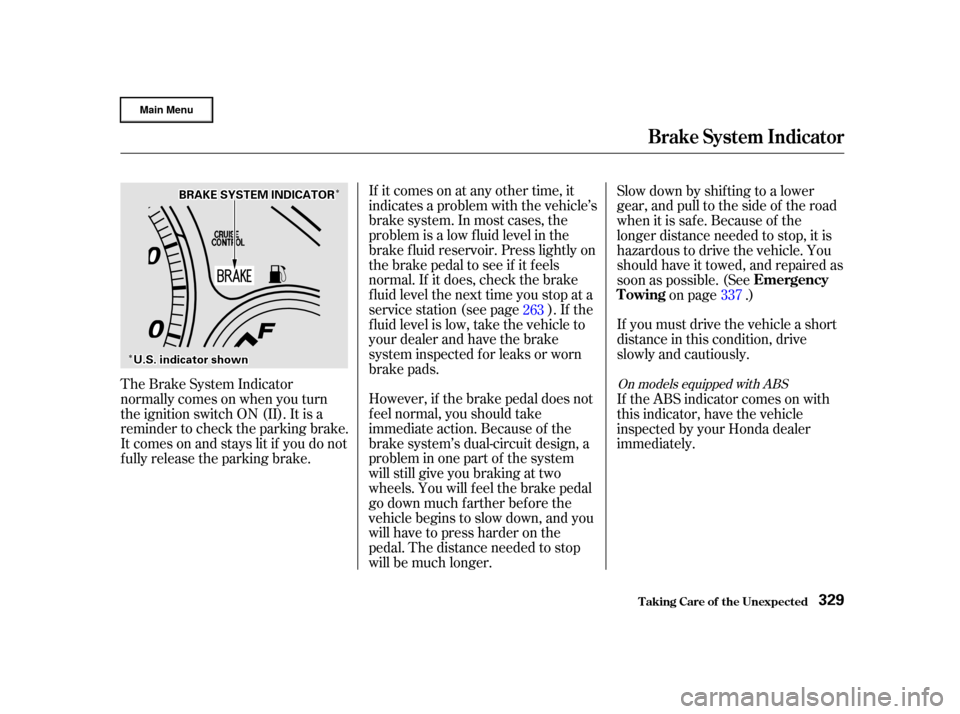
The Brake System Indicator
normallycomesonwhenyouturn
the ignition switch ON (II). It is a
reminder to check the parking brake.
It comes on and stays lit if you do not
f ully release the parking brake. If the ABS indicator comes on with
this indicator, have the vehicle
inspected by your Honda dealer
immediately.
263
337
On models equipped with ABS
Emergency
Towing
Brake System Indicator
T aking Care of t he Unexpect ed329
U U. .SS. .i
inn d
di
icca at too r
r s
shh o
ow
wn n
B
BR
RAA K
KEE S
SYYSSTTE
EM
M I
INND DI
ICCA A T
TO
OR R
Page 334 of 372
If the electric motor will not close
the moonroof , do the f ollowing:Check the f use f or the moonroof
motor (see page ). If the f use
is blown, replace it with one of the
same or lower rating.
Try closing the moonroof . If the
new f use blows immediately or the
moonroof motor still does not
operate, you can close the
moonroof manually. Insert the moonroof wrench into
the socket behind this plug. Turn
the wrench until the moonroof is
f ully closed.
Remove the wrench. Reinstall the
round plug.
To remove the round plug in the
center of the headliner, turn the
plug by using a screwdriver or
coin, then pry it out. Make sure to
align the tabs on the round plug to
the notches on the ceilling as
shown in the illustration.
Get the moonroof wrench out of
the tool kit under the cargo area
f loor.
1.
2.
3.
4.
5.
6.
331
Closing t he Moonroof
T aking Care of t he Unexpect ed330
R RO
OU UNNDD P
PL
LUUG G
T
T
A
A B
B N
NOOTTC
CH H S
SOOC CKKEET
T
Page 335 of 372
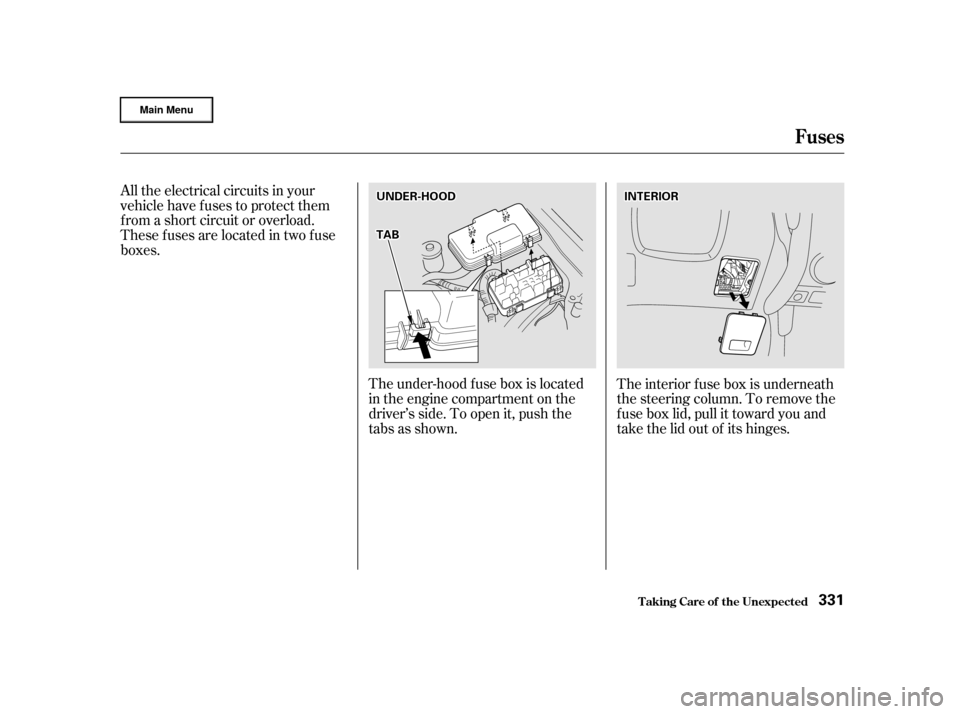
All the electrical circuits in your
vehicle have fuses to protect them
f rom a short circuit or overload.
These f uses are located in two f use
boxes.The under-hood f use box is located
in the engine compartment on the
driver’s side. To open it, push the
tabs as shown.The interior f use box is underneath
the steering column. To remove the
f use box lid, pull it toward you and
take the lid out of its hinges.
Fuses
T aking Care of t he Unexpect ed331
T T
A
A B
B I
IN
NT TE
ER
RI IOOR R
U
UN NDDE
ER
R- -H
H O
OO ODD
Page 336 of 372
If something electrical in your
vehicle stops working, the first thing
youshouldcheckforisablownfuse.
Determine f rom the chart on pagesand , or the diagram on the
fuse box lid, which fuse or fuses
control that component. Check those
f uses f irst, but check all the f uses
bef ore deciding that a blown f use is
not the cause. Replace any blown
f uses and check the component’s
operation. Check each of the large f uses in
the under-hood f use box by
looking through the top at the wire
inside. Removing these f uses
requires a Phillips-head screw-
driver.
Remove the cover f rom the f use
box. Turn the ignition switch to LOCK
(0). Make sure the headlights and
all other accessories are off.
3.
1.
2.
335 336
Checking and Replacing Fuses
Fuses
T aking Care of t he Unexpect ed332
B BL
LOOW WN N
F
FU
US SEE