Page 246 of 321
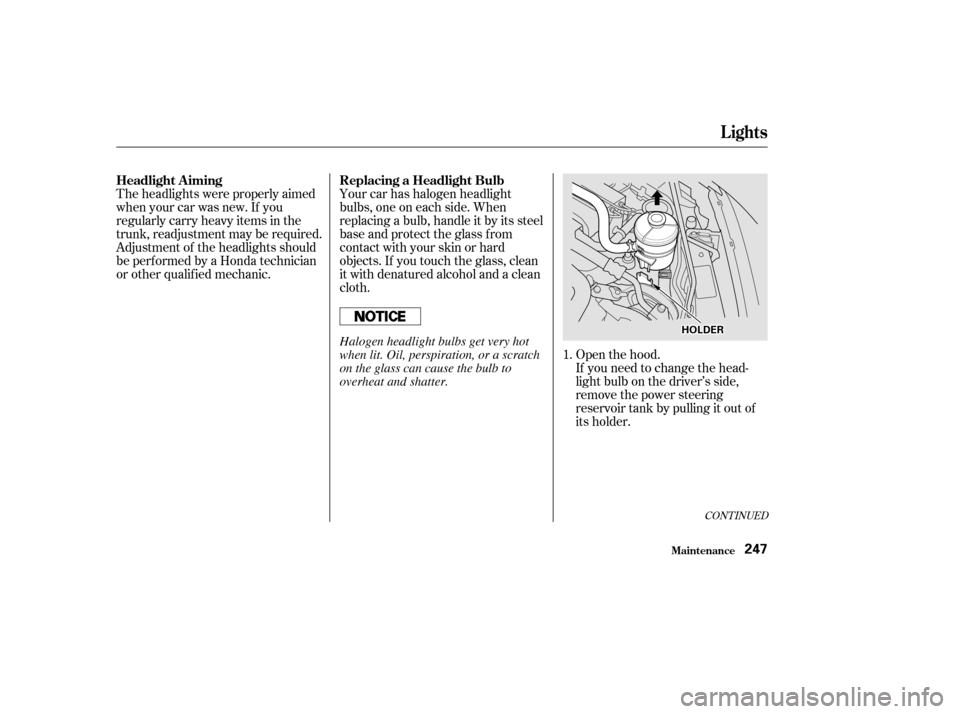
Open the hood.
If you need to change the head-
light bulb on the driver’s side,
remove the power steering
reservoir tank by pulling it out of
its holder.
Your car has halogen headlight
bulbs, one on each side. When
replacing a bulb, handle it by its steel
base and protect the glass from
contactwithyourskinorhard
objects. If you touch the glass, clean
it with denatured alcohol and a clean
cloth.
Theheadlightswereproperlyaimed
when your car was new. If you
regularly carry heavy items in the
trunk, readjustment may be required.
Adjustment of the headlights should
be perf ormed by a Honda technician
or other qualif ied mechanic.
1.
CONT INUED
Replacing a Headlight Bulb
Headlight A iming
Lights
Maint enance247
HHOOLLDDEERRHalogen headlight bulbs get very hot
when lit. Oil, perspiration, or a scratch
on the glass can cause the bulb to
overheat and shatter.
Page 255 of 321

Block the rear wheels.
Fill the f uel tank.
Change the engine oil and f ilter
(see page ).
Wash and dry the exterior
completely.
Cleantheinterior.Makesurethe
carpeting, floor mats, etc. are
completely dry.
Leave the parking brake off. Put
the transmission in Reverse
(5-speed manual) or Park
(automatic).
If you need to park your car f or an
extended period (more than one
month), there are several things you
should do to prepare it f or storage.
Proper preparation helps prevent
deterioration and makes it easier to
get your car back on the road. If
possible, store your car indoors.
If the car is to be stored for a
longer period, it should be
supported on jackstands so the
tires are of f the ground.
Leave one window open slightly (if
the car is being stored indoors).
Disconnect the battery.
Support the f ront wiper blade
arms with a f olded towel or rag so
they do not touch the windshield.
To minimize sticking, apply a
silicone spray lubricant to all door
and trunk seals. Also, apply a
vehiclebodywaxtothepainted
surfaces that mate with the door
and trunk seals.Coverthecarwitha‘‘breathable’’
cover, one made f rom a porous
material such as cotton.
Nonporous materials, such as
plastic sheeting, trap moisture,
which can damage the paint.
If possible, run the engine f or a
while periodically (pref erably once
amonth).
If you store your car f or 12 months
or longer, have your Honda dealer
perf orm the inspections called f or in
the 24 months maintenance schedule
(Normal Conditions) as soon as you
take it out of storage (see page ).
The replacements called f or in the
maintenance schedule are not
needed unless the car has actually
reached that time or mileage.
211
200
St oring Your Car
Maint enance256
Page 264 of 321

This section covers the more-
common problems that motorists
experience with their vehicles. It
gives you inf ormation about how to
safely evaluate the problem and what
to do to correct it. If the problem has
stranded you on the side of the road,
you may be able to get going again.
If not, you will also f ind instructions
on getting your car towed.......................
Compact Spare Tire . 266
....................
Changing a Flat Tire . 267
..........
If Your Engine Won’t Start . 272
Nothing Happens or the StarterMotor Operates Very .....................................
Slowly . 272
The Starter Operates ................................
Normally . 273
................................
Jump Starting . 274
............
If Your Engine Overheats . 276
.........
Low Oil Pressure Indicator . 279
..........
Charging System Indicator . 280
.......
Malf unction Indicator Lamp . 281
.......................
Readiness Codes . 282
...............
Brake System Indicator . 283
..................
Closing the Moonroof . 284
..............................................
Fuses . 285
..........
Checking and Replacing . 286
......................
Emergency Towing . 290
Taking Care of the Unexpected
T aking Care of t he Unexpect ed265
Page 278 of 321
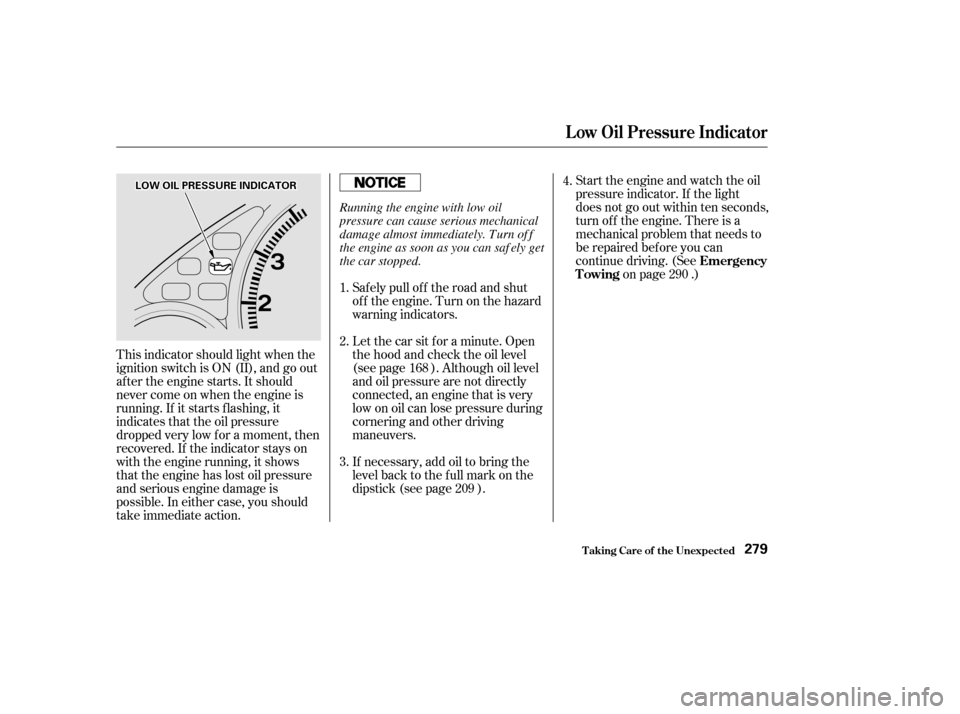
This indicator should light when the
ignition switch is ON (II), and go out
af ter the engine starts. It should
never come on when the engine is
running. If it starts f lashing, it
indicates that the oil pressure
dropped very low f or a moment, then
recovered. If the indicator stays on
with the engine running, it shows
that the engine has lost oil pressure
and serious engine damage is
possible. In either case, you should
take immediate action.Saf ely pull of f the road and shut
of f the engine. Turn on the hazard
warning indicators.
If necessary, add oil to bring the
level back to the full mark on the
dipstick (see page ).
Letthecarsitforaminute.Open
the hood and check the oil level
(see page ). Although oil level
and oil pressure are not directly
connected, an engine that is very
low on oil can lose pressure during
cornering and other driving
maneuvers. Start the engine and watch the oil
pressure indicator. If the light
does not go out within ten seconds,
turn of f the engine. There is a
mechanical problem that needs to
be repaired bef ore you can
continue driving. (See
on page .)
1. 2. 3. 4.
168 209 290
L ow Oil Pressure Indicator
T aking Care of t he Unexpect ed
Emergency
Towing
279
LLOOWWOOIILLPPRREESSSSUURREEIINNDDIICCAATTOORR
Running the engine with low oil
pressure can cause serious mechanical
damage almost immediately. Turn of f
the engine as soon as you can saf ely get
the car stopped.
Page 288 of 321
�µ�µ �µ �µ �µ
�Î
�Î
�Î
No. Amps. Circuits ProtectedNo. Amps. Circuits Protected
: On Canadian models
1 2345 15 A
20 A
10 A
10 A
Ignition Coil
LAF Heater
Daytime running lights
Alternator
Not Used 6789
10111213141516171819202122232425 7.5 A
20 A
7.5 A
7.5 A
7.5 A
7.5 A 10 A
10 A
15 A
15 A
7.5 A 20 A
20 A
20 A
20 A
20 A Power Window Relay
Moonroof
Accessory, Radio
Not Used
Meter
ABS
Daytime running lights
SRS
Remote Control Mirrors
Not Used
Not Used
Fuel Pump
Accessory Power Socket
Turn Signal Lights
Front Wiper
Not Used
Front Right Power Window
Front Left Power Window
Rear Lef t Power Window
Rear Right Power Window
Fuses
T aking Care of t he Unexpect ed289
INTERIOR FUSE BOX
Page 290 of 321
If you decide to tow your car with all
f our wheels on the ground, make
sure you use a properly-designed and
attached tow bar. Prepare the car for
towing as described above, and leave
the ignition switch in Accessory (I)
so the steering wheel does not lock.
Make sure the radio and any items
plugged into the accessory power
socket are turned of f so they do not
rundownthebattery.
With the f ront wheels on the ground,
it is best to tow the car no farther
than 50 miles (80 km), and keep the
speedbelow35mph(55km/h).
If your car is equipped with a f ront
spoiler, remove it bef ore towing so it
is not damaged.
Emergency T owing
T aking Care of t he Unexpect ed291
Trying to lif t or tow your car by the
bumpers will cause serious damage.
The bumpers are not designed to
support the car’s weight.
The steering system can be damaged if
the steering wheel is locked. Leave the
ignition switch in Accessory (I), and
make sure the steering wheel turns
f reely bef ore you begin towing.
Page 295 of 321

�Î�Î�Î �Î �Î �Î
�Î �Î�Î�Î
�Î �Î �Î�Î
�Î�Î
Specif ications
T echnical Inf ormation296
Dimensions
Weights
Engine Capacities
174.6 in (4,435 mm)
67.3 in (1,710 mm)
56.9 in (1,445 mm)
103.1 in (2,620 mm)
57.9 in (1,470 mm)
57.9 in (1,470 mm)
2.95 x 3.72 in (75.0 x 94.4 mm) 13.2 US gal (50
, 11.0 Imp gal)
1.03 US gal (3.9
, 0.86 Imp gal)
102 cu-in (1.668 cm
)
9.5 9.9
Length
Width
Height
Wheelbase
Track
Gross vehicle weight rating See the certification label attached
to the driver’s doorjamb.
Type
BorexStroke
Displacement
Compression ratio
Spark plugs Water cooled 4-stroke
SOHC , SOHC VTEC
4-cylinder gasoline engine Fuel tank
Engine
coolant
Engine oil Automatic
transmission
fluid1.06 US gal (4.0
, 0.88 Imp gal)
1.35 US gal (5.1
, 1.12 Imp gal)
1.32 US gal (5.0, 1.10 Imp gal)
3.4 US qt (3.2
, 2.8 Imp qt)
3.7 US qt (3.5, 3.1 Imp qt)
3.2 US qt (3.0, 2.6 Imp qt)
3.5 US qt (3.3, 2.9 Imp qt)
4.4 US qt (4.2, 3.7 Imp qt)
1.6 US qt (1.5, 1.3 Imp qt)
1.7 US qt (1.6, 1.4 Imp qt)
2.9 US qt (2.7, 2.4 Imp qt)
6.2 US qt (5.9, 5.2 Imp qt)
2.6 US qt (2.5
, 2.2 Imp qt)
4.8 US qt (4.5, 4.0 Imp qt)
Including the coolant in the reserve tank and that remaining in the
engine.
Reserve tank capacity: 0.11 US gal (0.4
, 0.09 Imp gal)
Excluding the oil remaining in the engine.
See spark plug maintenance
section page 229 .
FrontRear
Approx.
1: 2: 3:4:
1 : DX, LX
2:EX
DX, LXEXChange
ManualAutomatic
Total
ManualAutomatic
Change
Without filter
Total
ChangeTotal
ChangeTotal
U.S. Cars
Canada Cars
12
12 1 2
3 434
Manual trans-
mission fluidIncluding filter
Windshield
washer reservoir
Page 296 of 321

�µ�µ�µ
�Î �Î �µ�µ �µ �µ�µ �µ �µ�µ�µ�µ�µ�µ�µ�µ �µ
�Î �Î�Î�Î
�Î �Î
�Î
�Î�Î
�Î�Î
Specif ications
T echnical Inf ormation297
Battery Fuses
Tires
Alignment
Lights
Air Conditioning
HFC-134a (R-134a)
17.6 19.4 oz (500 550 g)
SP-10
12 V
12 V 60/55 W (HB2)
21/5 W
60 psi (420 kPa , 4.2 kgf/cm
)
12 V 5 W
12 V 8 W
12 V 5 W
12 V 5 W
12 V 8 W
12 V 3 CP
12 V 21 W
12 V 3 CP
12 V 21 W
12 V 21/5 W
12 V 21 W
12 V 3 CP
12 V 36 AH/5 HR
Capacity Interior
Under-hood Size
Pressure
Toe-in
Camber
Caster
1°33’0°50’
0°
0.00 in (0.0 mm)
30 psi (210 kPa , 2.1 kgf/cm)
T115/70D14 88M
P185/65R15 86HP185/70R14 87S
Headlights (HI/LO)
Front turn signal/side marker
lights
Front parking light
Rear turn signal lights
Stop/Taillights/Rear side
marker lights
Back-up lights
Taillights
High-mount brake light
License plate lights
Ceiling light
Front ceiling light
Spotlights
Trunk light
Refrigerant type
Charge quantity
Lubricant oil type
0.08 in (2.0 mm)
T125/70D15 95M
See page 289 or the fuse label
attached to the inside of the fuse
box door under the steering
column.
See page 288 or the fuse box
cover.
FrontRear
FrontRear
Front
1: EX
2: LX Front/Rear
Spare
Front/Rear
Spare
1 : US: DX, LX Canada: DX
2: US:EX Canada: LX
3 : US: DX, LX without ABS Canada: DX
4 : US: EX, LX with ABS Canada: LX
12
1
34
12