Page 230 of 319
�µ
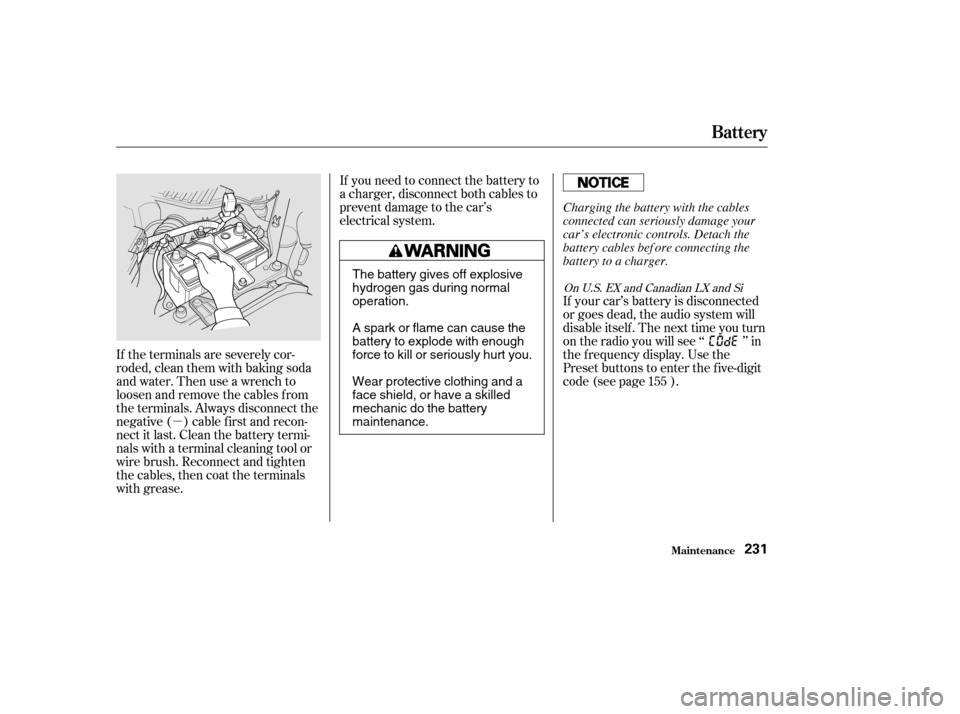
If the terminals are severely cor-
roded, clean them with baking soda
and water. Then use a wrench to
loosen and remove the cables f rom
the terminals. Always disconnect the
negative ( ) cable f irst and recon-
nect it last. Clean the battery termi-
nals with a terminal cleaning tool or
wire brush. Reconnect and tighten
the cables, then coat the terminals
with grease. If you need to connect the battery to
a charger, disconnect both cables to
prevent damage to the car’s
electrical system.
If your car’s battery is disconnected
or goes dead, the audio system will
disableitself.Thenexttimeyouturn
on the radio you will see ‘‘ ’’ in
the f requency display. Use the
Preset buttons to enter the five-digit
code (see page ).155
On U.S. EX and Canadian LX and Si
Battery
Maint enance231
The battery gives off explosive
hydrogen gas during normaloperation.
A spark or flame can cause the
battery to explode with enough
force to kill or seriously hurt you.
Wear protective clothing and a
face shield, or have a skilled
mechanic do the batterymaintenance. Charging the battery with the cables
connected can seriously damage your
car’s electronic controls. Detach the
battery cables bef ore connecting the
battery to a charger.
Page 247 of 319
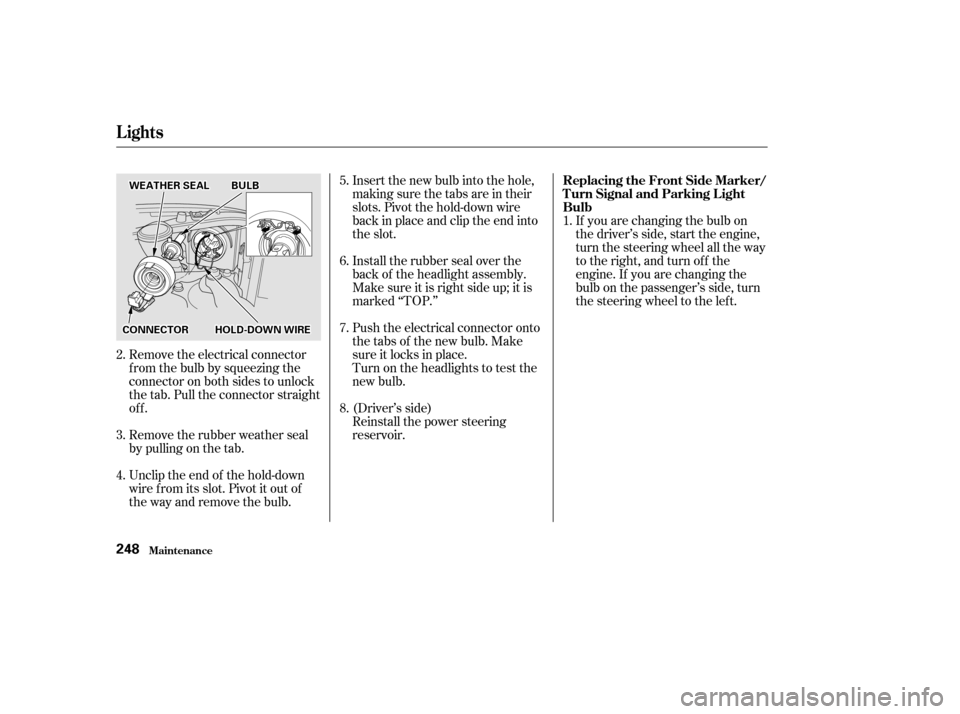
If you are changing the bulb on
the driver’s side, start the engine,
turn the steering wheel all the way
to the right, and turn off the
engine. If you are changing the
bulb on the passenger’s side, turn
the steering wheel to the left.
Reinstall the power steering
reservoir.
(Driver’s side)
Push the electrical connector onto
the tabs of the new bulb. Make
sure it locks in place.
Turn on the headlights to test the
new bulb.
Insert the new bulb into the hole,
making sure the tabs are in their
slots. Pivot the hold-down wire
back in place and clip the end into
the slot.
Install the rubber seal over the
back of the headlight assembly.
Make sure it is right side up; it is
marked ‘‘TOP.’’
Unclip the end of the hold-down
wire f rom its slot. Pivot it out of
the way and remove the bulb.
Remove the rubber weather seal
by pulling on the tab.
Remove the electrical connector
f rom the bulb by squeezing the
connector on both sides to unlock
the tab. Pull the connector straight
off.
3. 4. 5. 6. 7. 8.
1.
2. Replacing the Front Side Marker/
Turn Signal and Parking L ightBulb
Lights
Maint enance248
WWEEAATTHHEERRSSEEAALLBBUULLBB
CCOONNNNEECCTTOORRHHOOLLDD--DDOOWWNNWWIIRREE
Page 270 of 319

Diagnosing why your engine won’t
start f alls into two areas, depending
on what you hear when you turn the
key to START (III):When you turn the ignition switch to
START (III), you do not hear the
normal noise of the engine trying to
start. You may hear a clicking sound
or series of clicks, or nothing at all.
Check these things:
You hear nothing, or almost
nothing. The engine’s starter
motor does not operate at all, or
operates very slowly.
You can hear the starter motor
operating normally, or the starter
motor sounds like it is spinning
f aster than normal, but the engine
does not start up and run. Check the transmission interlock.
If you have a manual transmission,
the clutch pedal must be pushed
all the way to the f loor or the
starter will not operate. With an
automatic transmission, it must be
in Park or Neutral.
Turn the ignition switch to ON (II).
Turn on the headlights and check
their brightness. If the headlights
are very dim or don’t light at all,
the battery is discharged. See
on page . Turn the ignition switch to START
(III). If the headlights do not dim,
check the condition of the f uses. If
the f uses are OK, there is proba-
bly something wrong with the
electrical circuit f or the ignition
switch or starter motor. You will
need a qualif ied technician to
determine the problem. (See
on page .)
If the headlights dim noticeably or
go out when you try to start the
engine, either the battery is dis-
charged or the connections are
corroded. Check the condition of
the battery and terminal connec-
tions (see page ). You can
then try jump starting the car from
a booster battery (see page ).
273 230
273289
Nothing Happens or the Starter
Motor Operates Very Slowly
Jump Starting Emergency T owing
If Your Engine Won’t Start
T aking Care of t he Unexpect ed271
Page 271 of 319

If youfindnothingwrong,youwill
need a qualif ied technician to f ind
the problem. Seeon page .
In this case, the starter motor’s
speed sounds normal, or even f aster
than normal, when you turn the
ignition switch to START (III), but
the engine does not run.
Your car has the Immobilizer
System. You should use a
properly-coded master or valet key
to start the engine (see page ).
A key that is not properly coded
will cause the immobilizer system
indicator in the dash panel to blink
rapidly.
Are you using the proper starting
procedure? Ref er to on page . Do you have f uel? Turn the
ignition switch to ON (II) for a
minute and watch the f uel gauge.
The low f uel level warning light
may not be working, so you were
not reminded to f ill the tank.
There may be an electrical
problem, such as no power to the
f uel pump. Check all the f uses
(see page ).
177 285
289
77 Emergency
Towing
T he Starter Operates Normally
Starting the
Engine
If Your Engine Won’t Start
T aking Care of t he Unexpect ed272
Page 272 of 319

If your car’s battery has run down,
you may be able to start the engine
by using a booster battery. Although
this seems like a simple procedure,
you should take several precautions.
You cannot start a Honda with an
automatic transmission by pushing
or pulling it.To jump start your car, f ollow these
directions closely:
Open the hood and check the
physical condition of the battery
(see page ). In very cold
weather, check the condition of
the electrolyte. If it seems slushy
or like ice, do not try jump starting
until it thaws. Turn of f all the electrical acces-
sories: heater, A/C, stereo system,
lights, etc.
Put the transmission in Neutral or
Park, and set the parking brake.
1.
2.
230
CONT INUED
Jump Starting
T aking Care of t he Unexpect ed273
A battery can explode if you do
not follow the correct procedure,
seriously injuring anyonenearby.
Keep all sparks, open flames,
and smoking materials away
from the battery. If a battery sits in extreme cold, the
electrolyte inside can f reeze.
Attempting to jump start with a f rozen
battery can cause it to rupture.
Page 274 of 319

Once your car is running, discon-
nectthenegativecablefromyour
car, then from the booster battery.
Disconnect the positive cable f rom
your car, then the booster battery.Your car can overheat f or several
reasons, such as lack of coolant or a
mechanical problem. The only
indication may be the temperature
gauge climbing to or above the red
mark. Or you may see steam or
spray coming f rom under the hood.
In either case, you should take
immediate action.
The pointer of your car’s tempera-
ture gauge should stay in the mid-
range under most conditions. It may
go higher if you are driving up a long
steep hill on a very hot day. If it
climbs to the red mark, you should
determine the reason.
Keep the ends of the jumper cables
away from each other and any metal
on the car until all are disconnected.
Otherwise, you may cause an
electrical short.
7.
CONT INUED
If Your Engine Overheats
Jump Starting, If Your Engine Overheats
T aking Care of t he Unexpect ed275
Steam and spray from an
overheated engine can
seriously scald you.
Do not open the hood if steam
is coming out.
Driving with the temperature gauge
pointer at the red mark can cause
serious damage to your engine.
Page 278 of 319
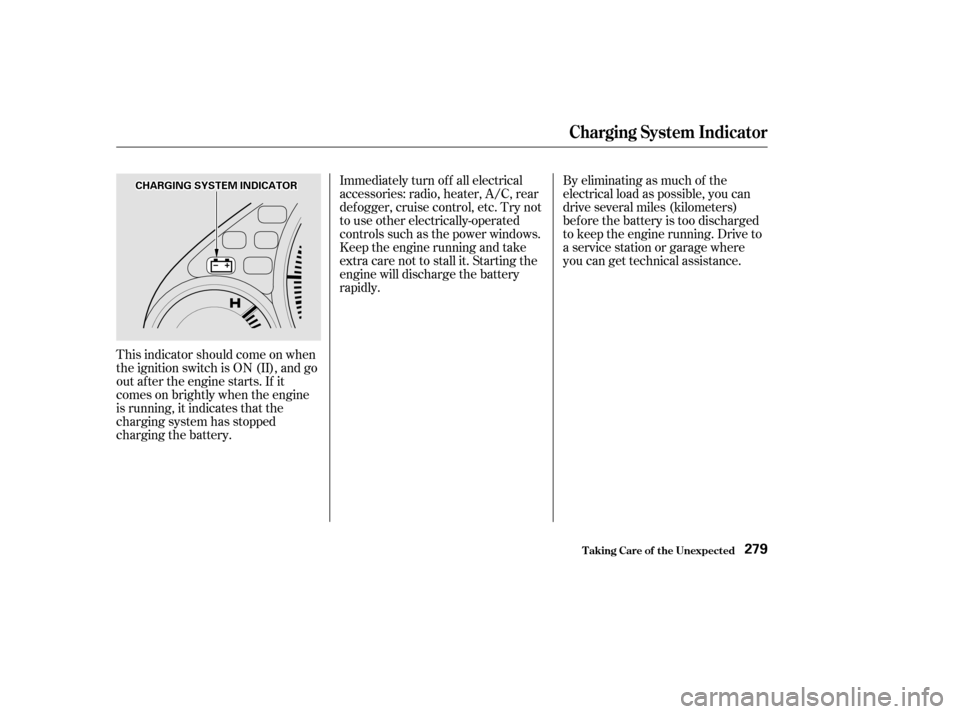
This indicator should come on when
the ignition switch is ON (II), and go
out af ter the engine starts. If it
comes on brightly when the engine
is running, it indicates that the
charging system has stopped
charging the battery.By eliminating as much of the
electrical load as possible, you can
drive several miles (kilometers)
before the battery is too discharged
to keep the engine running. Drive to
a service station or garage where
you can get technical assistance.
Immediately turn of f all electrical
accessories: radio, heater, A/C, rear
def ogger, cruise control, etc. Try not
to use other electrically-operated
controls such as the power windows.
Keep the engine running and take
extra care not to stall it. Starting the
engine will discharge the battery
rapidly.
Charging System Indicator
T aking Care of t he Unexpect ed279
CCHHAARRGGIINNGGSSYYSSTTEEMMIINNDDIICCAATTOORR
Page 283 of 319
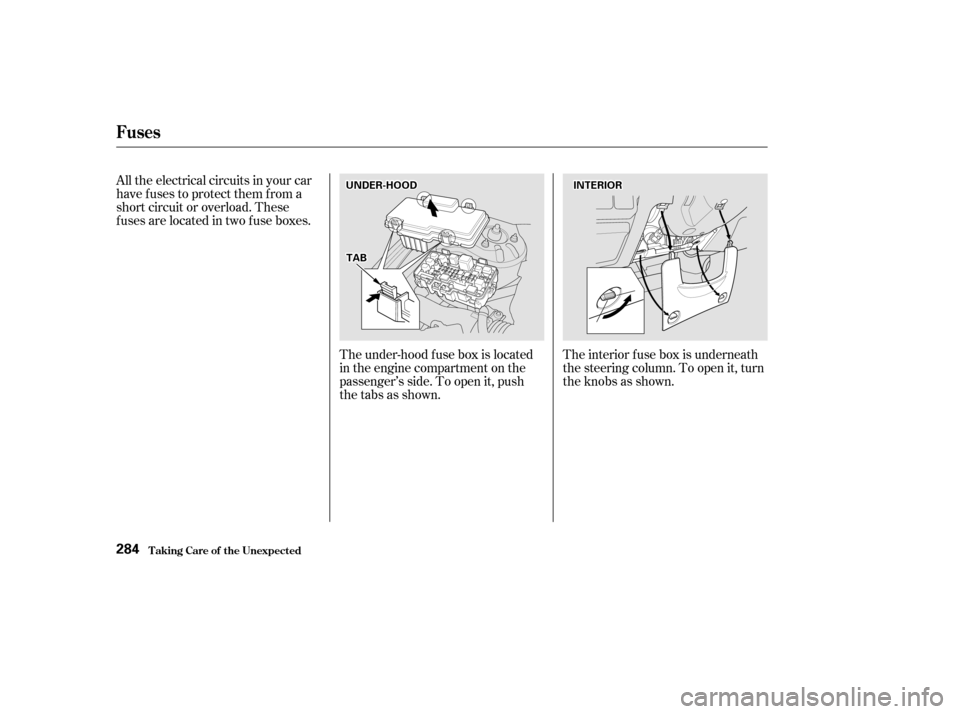
All the electrical circuits in your car
have fuses to protect them from a
short circuit or overload. These
f uses are located in two f use boxes.The interior f use box is underneath
the steering column. To open it, turn
the knobs as shown.
The under-hood f use box is located
in the engine compartment on the
passenger’s side. To open it, push
thetabsasshown.
Fuses
T aking Care of t he Unexpect ed284
TTAABB
UUNNDDEERR--HHOOOODDIINNTTEERRIIOORR