2002 HONDA ACCORD lock
[x] Cancel search: lockPage 171 of 223

Run the air conditioning at least once
a week during the cold weather
months. Run it f or at least ten
minutes while you are driving at a
steady speed with the engine at
normal operating temperature. This
circulates the lubricating oil con-
tained in the ref rigerant.If the air conditioning does not get as
cold as before, have your dealer
check the system. Recharge the
system with Ref rigerant HFC-134a
(R-134a). (See Specif ications on page
.)
Periodically check the engine’s
radiator and air conditioning
condenser f or leaves, insects, and
dirt stuck to the f ront surf ace. These
block the air f low and reduce cooling
ef f iciency. Use a light spray f rom a
hose or a sof t brush to remove them.
Your car’s air conditioning is a sealed
system. Any major maintenance,
such as recharging, should be done
by a qualif ied mechanic. You can do
a couple of things to make sure the
air conditioning works ef f iciently.
342
Optional f or U.S. DX and Value Package
models
A ir Condit ioning Syst em
Maint enance281
AAIIRRCCOONNDDIITTIIOONNIINNGGCCOONNDDEENNSSEERR
Whenever you have the air conditioning
system serviced, make sure the service
f acility uses a ref rigerant recycling
system. This system captures the
ref rigerant f or reuse. Releasing
ref rigerant into the atmosphere can
damage the environment.
The condenser and radiator f ins bend
easily. Only use a low-pressure spray
or sof t-bristle brush to clean them.
Page 180 of 223

Open the hood.Turn on the headlights to test the
new bulb.
Push the electrical connector back
onto the bulb. Make sure it is on
all the way.
Remove the bulb by turning it
approximately one-quarter turn
counterclockwise.
Insert the new bulb into the hole
and turn it one-quarter turn clock-
wise to lock it in place.
If you need to change a bulb on
thepassenger’sside(onthe
driver’s side on 6-cylinder models),
remove the radiator reserve tank.
Remove the electrical connector
f rom the bulb by squeezing the
connector to unlock the tab, then
slide the connector of f the bulb. Reinstall the radiator reserve tank.
Theheadlightswereproperlyaimed
when your car was new. If you
regularly carry heavy items in the
trunk, readjustment may be required.
Adjustment of the headlights should
be perf ormed by a Honda technician
or other qualif ied mechanic.
Your car has two bulbs on each side,
four in total. Make sure you are
replacing the bulb that is burned out.
Your car uses halogen headlight
bulbs. When replacing a bulb, handle
it by its plastic case and protect the
glass from contact with your skin or
hard objects. If you touch the glass,
clean it with denatured alcohol and a
clean cloth.
1. 2.3. 4. 7.
6.
5.
(Passenger’s side on 4-cylinder
models, driver’s side on 6-cylinder
models)
Lights
Maint enance
Headlight A iming
Replacing a Headlight Bulb
292
BBUULLBB
TTAABB
Halogen headlight bulbs get very hot
when lit. Oil, perspiration, or a scratch
on the glass can cause the bulb to
overheat and shatter.
Page 181 of 223

Block the rear wheels.
Fill the f uel tank.
Change the engine oil and f ilter
(see page ).
Wash and dry the exterior
completely.
Cleantheinterior.Makesurethe
carpeting, floor mats, etc. are
completely dry.
Leave the parking brake off. Put
the transmission in Reverse
(5-speed manual) or Park
(automatic).
If you need to park your car f or an
extended period (more than one
month), there are several things you
should do to prepare it f or storage.
Proper preparation helps prevent
deterioration and makes it easier to
get your car back on the road. If
possible, store your car indoors.
If the car is to be stored for a
longer period, it should be
supported on jackstands so the
tires are of f the ground.
Leave one window open slightly (if
the car is being stored indoors).
Disconnect the battery.
Support the f ront wiper blade
arms with a f olded towel or rag so
they do not touch the windshield.
To minimize sticking, apply a
silicone spray lubricant to all door
and trunk seals. Also, apply a
vehiclebodywaxtothepainted
surfaces that mate with the door
and trunk seals.Coverthecarwitha‘‘breathable’’
cover, one made f rom a porous
material such as cotton.
Nonporous materials, such as
plastic sheeting, trap moisture,
which can damage the paint.
If possible, run the engine f or a
while periodically (pref erably once
amonth).
If you store your car f or 12 months
or longer, have your Honda dealer
perf orm the inspections called f or in
the 24 months/30,000 miles (48,000
km) maintenance schedule (Normal
Conditions) as soon as you take it
out of storage (see page ). The
replacements called f or in the
maintenance schedule are not
needed unless the car has actually
reached that time or mileage.
252
240
St oring Your Car
Maint enance301
Page 192 of 223

If you have a f lat tire while driving,
stop in a saf e place to change it.
Stopping in traf f ic or on the shoulder
of a busy road is dangerous. Drive
slowly along the shoulder until you
gettoanexitoranareatostopthat
is far away from the traffic lanes.Open the trunk. Raise the trunk
f loor by lif ting up on the back edge.
Unscrew the wing bolt and take
the spare tire out of its well.
The tools are in the tool box on
the right side of the trunk. Take
the tools out of the tool box.
Park the car on f irm, level and
non-slippery ground away f rom
traffic. Put the transmission in
Park (automatic) or Reverse
(manual). Apply the parking brake.
Turn on the hazard warning lights
and turn the ignition switch to
LOCK (0). Have all the
passengers get out of the car while
you change the tire. 5.
4.
3.
2. 1.
CONT INUED
Changing a Flat T ire
T aking Care of t he Unexpect ed313
JJAACCKKSSPPAARREETTIIRREE
TTOOOOLLBBOOXXTTRRUUNNKKFFLLOOOORR
The car can easily roll off the
jack, seriously injuring anyoneunderneath.
Follow the directions for
changing a tire exactly, and
never get under the car when it
is supported only by the jack.
Page 193 of 223

Store the wheel cover or center
cap in the trunk. Make sure it does
not get scratched or damaged.
Store the jack in its holder. Turn
the jack’s end bracket to lock it in
place. Replace the cover. Store the
tools.
Place the flat tire face down in the
spare tire well.
Remove the spacer cone f rom the
wing bolt, turn it over, and put it
back on the bolt.
Securetheflattirebyscrewing
the wing bolt back into its hole. Diagnosing why your engine won’t
start f alls into two areas, depending
on what you hear when you turn the
key to START (III):
You hear nothing, or almost
nothing. The engine’s starter
motor does not operate at all, or
operates very slowly.
You can hear the starter motor
operating normally, or the starter
motor sounds like it is spinning
f aster than normal, but the engine
does not start up and run.
17.
18.
19. 20.
21.
T aking Care of t he Unexpect ed
Changing a Flat Tire, If Your Engine Won’t Start
If Your Engine Won’t Start
318
WWIINNGGBBOOLLTTSSPPAACCEERRCCOONNEE
Loose items can fly around the
interior in a crash and could
seriously injure the occupants.
Store the wheel, jack, and tools
securely before driving.
Page 194 of 223

When you turn the ignition switch to
START (III), you do not hear the
normal noise of the engine trying to
start. You may hear a clicking sound
or series of clicks, or nothing at all.
Check these things:Check the transmission interlock.
If you have a manual transmission,
the clutch pedal must be pushed
all the way to the f loor or the
starter will not operate. With an
automatic transmission, it must be
in Park or Neutral.
Turn the ignition switch to ON (II).
Turn on the headlights and check
their brightness. If the headlights
are very dim or don’t light at all,
the battery is discharged. See on page . If the headlights dim noticeably or
go out when you try to start the
engine, either the battery is dis-
charged or the connections are
corroded. Check the condition of
the battery and terminal connec-
tions (see page ). You can
then try jump starting the car from
a booster battery (see page ).
Turn the ignition switch to START
(III). If the headlights do not dim,
check the condition of the f uses. If
thefusesareOK,thereisproba-
bly something wrong with the
electrical circuit for the ignition
switch or starter motor. You will
need a qualif ied technician to
determine the problem. (See
on page .)In this case, the starter motor’s
speed sounds normal, or even f aster
than normal, when you turn the
ignition switch to START (III), but
the engine does not run.
Are you using the proper starting
procedure? Ref er to on page .
Your car has the Immobilizer
System. You should use a
properly-coded master or valet key
to start the engine (see page ).
A key that is not properly coded
will cause the immobilizer system
indicator in the dash panel to blink
rapidly. 71
209
320 336
276 320
If Your Engine Won’t Start
T aking Care of t he Unexpect ed
Nothing Happens or the Starter
Motor Operates Very Slowly
Jump Starting Emergency T owing
T he Starter Operates Normally
Starting the
Engine
319
Page 204 of 223
Turn the ignition switch to LOCK
(0). Make sure the headlights and
all other accessories are off.
Remove the cover f rom the f use
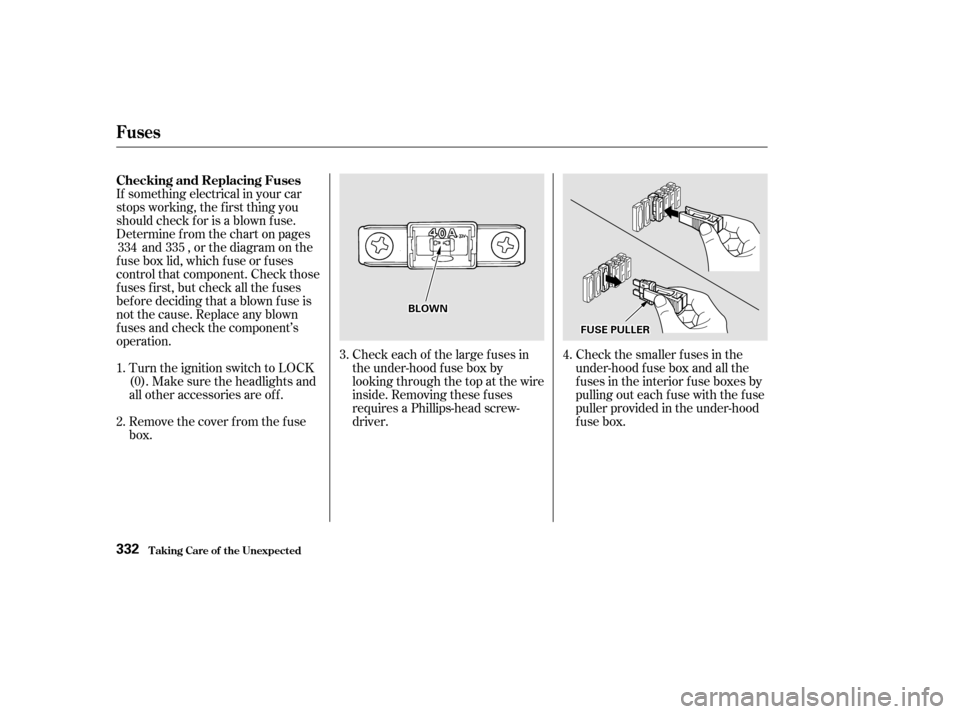
box.Check each of the large f uses in
the under-hood f use box by
looking through the top at the wire
inside. Removing these f uses
requires a Phillips-head screw-
driver.
Check the smaller f uses in the
under-hood f use box and all the
fuses in the interior fuse boxes by
pulling out each f use with the f use
puller provided in the under-hood
fuse box.
If something electrical in your car
stops working, the f irst thing you
should check f or is a blown f use.
Determine f rom the chart on pages
and , or the diagram on the
fuse box lid, which fuse or fuses
control that component. Check those
f uses f irst, but check all the f uses
bef ore deciding that a blown f use is
not the cause. Replace any blown
f uses and check the component’s
operation. 3.
1. 2. 4.
334 335
Checking and Replacing Fuses
Fuses
T aking Care of t he Unexpect ed332
BBLLOOWWNN
FFUUSSEEPPUULLLLEERR
Page 222 of 223

CONT INUED
...
Accessories and Modif ications . 202
................................
Accessories . 202
...
Additional Safety Precaution . 202
............................
Modif ications . 202
ACCESSORY (Ignition Key .......................................
Position) . 73
.............
Accessory Power Socket . 100
....................
Additives, Engine Oil . 252
.....................................
Airbag (SRS) . 9
.....................
Air Cleaner Element . 269
............................
Air Conditioning . 104
..............................
Maintenance . 281
.........................................
Usage . 104
.......................
Air Pressure, Tires . 284
.......................
Alcohol in Gasoline . 347
......................................
Antif reeze . 255
Anti-lock Brakes (ABS)
................................
Description . 220
...............................
Indicator . 57, 221
...................................
Operation . 220
.
Anti-thef t Steering Column Lock . 72
..........................
Appearance Care . 303
........
Audio System . 119, 131, 147, 164
.............
Automatic Speed Control . 185 ..............
Automatic Transmission . 212
..........................
Capacity, Fluid . 342
.......
Checking Fluid Level . 263, 264
.......................................
Shif ting . 212
.
Shif t Lever Position Indicator . 213
................
Shif t Lever Positions . 213
....................
Shif t Lock Release . 216
Battery ......
Charging System Light . 56, 326
............................
Jump Starting . 320
..............................
Maintenance . 276
............................
Specif ications . 343
..............................
Bef ore Driving . 193
..........................................
Belts, Seat . 8
.............................
Beverage Holder . 98
...................................
Body Repair . 310
Brakes
...........
Anti-lock System (ABS) . 220
.............
Break-in, New Linings . 194
....................
Bulb Replacement . 295
...........................................
Fluid . 267
.........................................
Parking . 95
.........................
System Indicator . 57 ........................
Wear Indicators . 219
.............................
Braking System . 219
........................
Break-in, New Car . 194
..
Brightness Control, Instruments . 65
........................
Brights, Headlights . 64
Bulb Replacement
..........................
Back-up Lights . 295
..............................
Brake Lights . 295
..............................
Ceiling Light . 298
..........................
Courtesy Light . 299
................
Front Parking Lights . 294
........
Front Side Marker Lights . 293
.................................
Headlights . 292
.........
High-mount Brake Light . 297
.................
License Plate Lights . 297
............................
Specif ications . 343
.....................................
Spotlight . 299
...............................
Trunk Light . 300
....................
Turn Signal Lights . 293
..............................
Bulbs, Halogen . 292
Index
A
B
I