Page 296 of 443

5-13
The coolant level
should be at or above
the FILL COLD
mark. If it isn't, you
may have a leak at
the pressure cap or
in the radiator hoses,
heater hoses, radiator,
water pump or
somewhere else in
the cooling system.
CAUTION:
Heater and radiator hoses, and other engine
parts, can be very hot. Don't touch them. If you
do, you can be burned.
Don't run the engine if there is a leak. If you run
the engine, it could lose all coolant. That could
cause an engine fire, and you could be burned.
Get any leak fixed before you drive the vehicle.
If there seems to be no leak, start the engine again. The
engine cooling fan speed should increase when idle speed
is doubled by pushing the accelerator pedal down. If it
doesn't, your vehicle needs service. Turn off the engine.
NOTICE:
Engine damage from running your engine
without coolant isn't covered by your warranty.
See ªOverheated Engine Protection Operating
Modeº in the Index.
NOTICE:
When adding coolant, it is important that you use
only DEX
-COOL� (silicate-free) coolant.
If coolant other than DEX-COOL is added to
the system, premature engine, heater core or
radiator corrosion may result. In addition, the
engine coolant will require change sooner
-- at
30,000 miles (50 000 km) or 24 months,
whichever occurs first. Damage caused by the
use of coolant other than DEX
-COOL� is not
covered by your new vehicle warranty.
Page 322 of 443

6-
6-1
Section 6 Service and Appearance Care
Here you will find information about the care of your vehicle. This section begins with service and fuel information,
and then it shows how to check important fluid and lubricant levels. There is also technical information about your
vehicle, and a part devoted to its appearance care.
6
-2 Service
6
-3 Fuel (Gasoline)
6
-5 Fuel E-85 (85% Ethanol)
6
-7 Fuels in Foreign Countries
6
-7 Filling Your Tank
6
-9 Filling a Portable Fuel Container
6
-10 Checking Things Under the Hood
6
-15 Engine Oil
6
-21 Engine Air Cleaner/Filter
6
-23 Passenger Compartment Air Filter
(If Equipped)
6
-24 Automatic Transmission Fluid
6
-27 Rear Axle
6
-28 Four-Wheel Drive
6
-31 Engine Coolant
6
-34 Coolant Surge Tank Pressure Cap6
-35 Power Steering Fluid
6
-36 Windshield Washer Fluid
6
-37 Brakes
6
-41 Battery
6
-42 Bulb Replacement
6
-48 Windshield Wiper Blade Replacement
6
-49 Tires
6
-59 Appearance Care
6
-60 Cleaning the Inside of Your Vehicle
6
-63 Cleaning the Outside of Your Vehicle
6
-67 GM Vehicle Care/Appearance Materials
6
-68 Vehicle Identification Number (VIN)
6
-69 Electrical System
6
-77 Replacement Bulbs
6
-78 Capacities and Specifications
6
-81 Normal Maintenance Replacement Parts
Page 323 of 443
6-2
Service
Your dealer knows your vehicle best and wants you to
be happy with it. We hope you'll go to your dealer for
all your service needs. You'll get genuine GM parts and
GM
-trained and supported service people.
We hope you'll want to keep your GM vehicle all GM.
Genuine GM parts have one of these marks:
Doing Your Own Service Work
If you want to do some of your own service work, you'll
want to use the proper service manual. It tells you much
more about how to service your vehicle than this manual
can. To order the proper service manual, see ªService
and Owner Publicationsº in the Index.
Your vehicle has an air bag system. Before attempting to
do your own service work, see ªServicing Your Air
Bag
-Equipped Vehicleº in the Index.
You should keep a record with all parts receipts and list
the mileage and the date of any service work you
perform. See ªMaintenance Recordº in the Index.
Page 324 of 443

6-3
CAUTION:
You can be injured and your vehicle could be
damaged if you try to do service work on a
vehicle without knowing enough about it.
�Be sure you have sufficient knowledge,
experience, the proper replacement parts
and tools before you attempt any vehicle
maintenance task.
�Be sure to use the proper nuts, bolts and
other fasteners. ªEnglishº and ªmetricº
fasteners can be easily confused. If you use
the wrong fasteners, parts can later break
or fall off. You could be hurt.
Adding Equipment to the Outside of
Your Vehicle
Things you might add to the outside of your vehicle can
affect the airflow around it. This may cause wind noise
and affect windshield washer performance. Check with
your dealer before adding equipment to the outside of
your vehicle.
Fuel (Gasoline)
The 8th digit of your vehicle identification number
(VIN) shows the code letter or number that identifies
your engine. You will find the VIN at the top left of the
instrument panel. See ªVehicle Identification Numberº
in the Index.
If your vehicle has the 5.3L V8 engine (VIN Code Z
only), you may use either regular unleaded gasoline or
ethanol fuel containing up to 85% ethanol (E
-85); also
see ªFuel E
-85 (85% Ethanol)º following. In all other
engines, including the 5.3L V8 (VIN Code T), use only
regular unleaded gasoline.
Gasoline Octane
Use regular unleaded gasoline with a posted octane of
87 or higher. If the octane is less than 87, you may get a
heavy knocking noise when you drive. If it is bad
enough, it can damage your engine. A little pinging
noise when you accelerate or drive uphill is considered
normal. This does not indicate a problem exists or that a
higher
-octane fuel is necessary.
Page 326 of 443
6-5 Additives
Some gasolines that are not reformulated for low
emissions may contain an octane
-enhancing additive
called methylcyclopentadienyl manganese tricarbonyl
(MMT); ask the attendant where you buy gasoline
whether the fuel contains MMT. General Motors does
not recommend the use of such gasolines. Fuels
containing MMT can reduce the life of spark plugs and
the performance of the emission control system may be
affected. The malfunction indicator lamp may turn on.
If this occurs, return to your authorized GM dealer
for service.
To provide cleaner air, all gasolines in the United States
are now required to contain additives that will help
prevent engine and fuel system deposits from forming,
allowing your emission control system to work properly.
You should not have to add anything to your fuel.
Gasolines containing oxygenates, such as ethers and
ethanol, and reformulated gasolines may be available in
your area to contribute to clean air. General Motors
recommends that you use these gasolines, particularly if
they comply with the specifications described earlier.
NOTICE:
Your vehicle was not designed for fuel that
contains methanol. Don't use fuel containing
methanol. It can corrode metal parts in your
fuel system and also damage plastic and rubber
parts. That damage wouldn't be covered under
your warranty.
Fuel E-85 (85% Ethanol)
The 8th digit of your vehicle identification number
(VIN) shows the code letter or number that identifies
your engine. You will find the VIN at the top left of the
instrument panel. See ªVehicle Identification Numberº
in the Index.
If your vehicle has the 5.3L V8 engine (VIN Code Z
only), you may use either regular unleaded gasoline or
ethanol fuel containing up to 85% ethanol (E
-85); also
see ªFuel (Gasoline)º listed previously. In all other
engines, including the 5.3L V8 (Code T), use only
regular unleaded gasoline.
Page 327 of 443

6-6
Only vehicles that have the 5.3L V8 engine
(VIN Code Z) may use 85% ethanol fuel (E
-85).
Many service stations will not have an 85% ethanol
fuel (E
-85) pump available. The U. S. Department
of Energy has an alternative fuels website
(http://afdcmap.nrel.gov/nrel/) that can help you find
E
-85 fuel. Those stations that do have E-85 should
have a label indicating ethanol content. Do not use the
fuel if the ethanol content is greater than 85%.
Your vehicle may not operate properly if the ethanol
content is greater than 85%.
At a minimum, E
-85 should meet ASTM
Specification D 5798.
To insure quick starts in the wintertime, the E
-85 fuel
must be formulated properly for your climate according
to ASTM specification D 5798. If you have trouble
starting on E
-85, it may be because your E-85 fuel is not
properly formulated for your climate. If this happens,
switching to gasoline or adding gasoline to your fuel
tank may improve starting. Your vehicle is designed to
accommodate a mixture of gasoline and E
-85 fuel. For
good starting and heater efficiency below 32�F (0�C),
the fuel mix in the fuel tank should contain no more than
70% ethanol.E
-85 has less energy per gallon than gasoline, so you'll
need to refill your fuel tank more often when using E
-85
than when you're using gasoline. Regular unleaded
gasoline is recommended when pulling a trailer. For
payload capacity with ethanol fuel see ªLoading Your
Vehicleº in the Index.
NOTICE:
Some additives are not compatible with E-85 fuel and
may harm your fuel system. Damage caused by
additives wouldn't be covered by your new vehicle
warranty. Don't use additives with E
-85 fuel.
NOTICE:
Your vehicle was not designed for fuel that contains
methanol. It can corrode metal parts in your fuel
system and also damage plastic and rubber parts.
That damage wouldn't be covered under your
warranty. Don't use fuel containing methanol.
Page 341 of 443

6-20
How to Reset the CHANGE ENGINE OIL Message
The GM Oil Life System� calculates when to
change your engine oil and filter based on vehicle use.
Anytime your oil is changed, reset the system so it can
calculate when the next oil change is required. If a
situation occurs where you change your oil prior to a
CHANGE ENGINE OIL message being turned on,
reset the system.
To reset the CHANGE ENGINE OIL message do
the following:
1. Turn the ignition key to RUN with the engine off.
2. Fully press and release the accelerator pedal
three times within five seconds.
If the CHANGE ENGINE OIL message flashes for
five seconds, the system is reset.What to Do with Used Oil
Used engine oil contains certain elements that may be
unhealthy for your skin and could even cause cancer.
Don't let used oil stay on your skin for very long. Clean
your skin and nails with soap and water, or a good hand
cleaner. Wash or properly throw away clothing or rags
containing used engine oil. See the manufacturer's
warnings about the use and disposal of oil products.
Used oil can be a threat to the environment. If you
change your own oil, be sure to drain all the oil from the
filter before disposal. Never dispose of oil by putting it
in the trash, pouring it on the ground, into sewers, or
into streams or bodies of water. Instead, recycle it by
taking it to a place that collects used oil. If you have a
problem properly disposing of your used oil, ask your
dealer, a service station or a local recycling center
for help.
Page 342 of 443
6-21
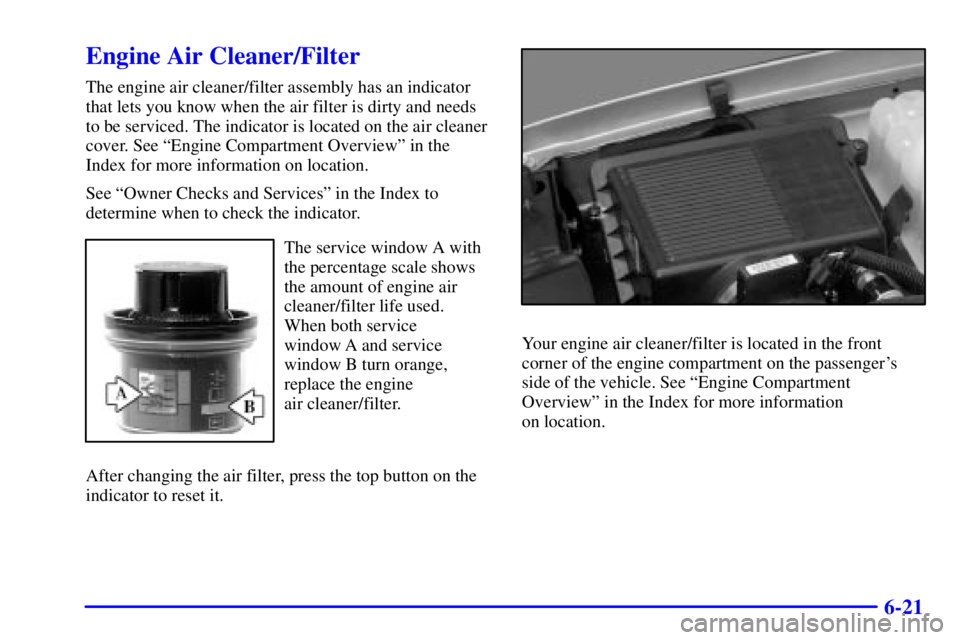
Engine Air Cleaner/Filter
The engine air cleaner/filter assembly has an indicator
that lets you know when the air filter is dirty and needs
to be serviced. The indicator is located on the air cleaner
cover. See ªEngine Compartment Overviewº in the
Index for more information on location.
See ªOwner Checks and Servicesº in the Index to
determine when to check the indicator.
The service window A with
the percentage scale shows
the amount of engine air
cleaner/filter life used.
When both service
window A and service
window B turn orange,
replace the engine
air cleaner/filter.
After changing the air filter, press the top button on the
indicator to reset it.
Your engine air cleaner/filter is located in the front
corner of the engine compartment on the passenger's
side of the vehicle. See ªEngine Compartment
Overviewº in the Index for more information
on location.