Page 308 of 429
5-18
Changing a Flat Tire
If a tire goes flat, avoid further tire and wheel damage
by driving slowly to a level place. Turn on your hazard
warning flashers.
CAUTION:
Changing a tire can cause an injury. The vehicle
can slip off the jack and roll over you or other
people. You and they could be badly injured.
Find a level place to change your tire. To help
prevent the vehicle from moving:
1. Set the parking brake firmly.
2. Put the shift lever in PARK (P).
3. If you have a four
-wheel-drive vehicle,
be sure the transfer case is in a drive
gear
-- not in NEUTRAL.
CAUTION: (Continued)
CAUTION: (Continued)
4. Turn off the engine.
5. Put the wheel blocks at the front and
rear of the tire farthest away from the
one being changed. That would be the
tire on the other side of the vehicle, at
the opposite end.
The following steps will tell you how to use the jack and
change a tire.
Page 310 of 429

5-20
1. To remove the underbody-mounted spare, insert the
socket end of the extension, on an angle, into the
hole in the rear bumper. Be sure the socket end of
the extension connects into the hoist shaft.
2. Turn the wheel wrench counterclockwise to lower
the spare tire. Keep turning the wheel wrench
until the spare tire can be pulled out from under
the vehicle.If the spare tire does not lower to the ground, the
secondary latch is engaged causing the tire not to
lower. See ªSecondary Latch Systemº later in
this section.
When the tire has been completely lowered, tilt
the retainer at the end of the cable and pull it through
the wheel opening. Pull the tire out from under
the vehicle.
NOTICE:
To help avoid vehicle damage, do not drive the
vehicle before the cable is properly stored.
3. Put the spare tire near the flat tire.
4. Use the chisel end of the wheel wrench to pry off the
center cap.
See ªRemoving the Flat Tire and Installing the
Spare Tireº later in this section to continue changing
the flat tire.
Page 318 of 429

5-28
NOTICE:
Improperly tightened wheel nuts can lead to
brake pulsation and rotor damage. To avoid
expensive brake repairs, evenly tighten the wheel
nuts in the proper sequence and to the proper
torque specification.
Storing a Flat or Spare Tire and Tools
CAUTION:
Storing a jack, a tire or other equipment in the
passenger compartment of the vehicle could
cause injury. In a sudden stop or collision, loose
equipment could strike someone. Store all these
in the proper place.
CAUTION:
The underbody-mounted spare tire or flat road
tire needs to be stored with the valve stem
pointing up. If the tire is stored with its valve
stem pointing downward, its secondary latch
won't work properly, and the spare tire or flat
road tire could loosen and suddenly fall from
your vehicle. If this happened when your vehicle
was being driven, the tire might contact a person
or another vehicle, causing injury and, of course,
damage to itself as well. Be sure the
underbody
-mounted spare or flat road tire is
stored with its valve stem pointing up.
Page 323 of 429

5-33
NOTICE:
Spinning your wheels can destroy parts of your
vehicle as well as the tires. If you spin the wheels
too fast while shifting your transmission back
and forth, you can destroy your transmission.
For information about using tire chains on your vehicle,
see ªTire Chainsº in the Index.
Rocking Your Vehicle To Get It Out
First, turn your steering wheel left and right. That will
clear the area around your front wheels. If you have a
four
-wheel-drive vehicle, shift into 4HI. Then shift back
and forth between REVERSE (R) and a forward gear,
spinning the wheels as little as possible. Release the
accelerator pedal while you shift, and press lightly on
the accelerator pedal when the transmission is in gear.
By slowly spinning your wheels in the forward and
reverse directions, you will cause a rocking motion that
may free your vehicle. If that doesn't get you out after
a few tries, you may need to be towed out. If you do
need to be towed out, see ªTowing Your Vehicleº in
the Index.
Page 324 of 429

6-
6-1
Section 6 Service and Appearance Care
Here you will find information about the care of your vehicle. This section begins with service and fuel information,
and then it shows how to check important fluid and lubricant levels. There is also technical information about your
vehicle, and a part devoted to its appearance care.
6
-2 Service
6
-3 Fuel
6
-5 Fuels in Foreign Countries
6
-6 Filling Your Tank
6
-8 Filling a Portable Fuel Container
6
-8 Checking Things Under the Hood
6
-11 Engine Oil
6
-15 Engine Air Cleaner/Filter
6
-17 Automatic Transmission Fluid
6
-20 Rear Axle
6
-21 Four-Wheel Drive
6
-23 Engine Coolant
6
-26 Radiator Pressure Cap
6
-27 Power Steering Fluid
6
-28 Windshield Washer Fluid
6
-29 Brakes6
-33 Battery
6
-33 Bulb Replacement
6
-36 Windshield Wiper Blade Replacement
6
-38 Tires
6
-46 Appearance Care
6
-47 Cleaning the Inside of Your Vehicle
6
-49 Care of Safety Belts
6
-50 Cleaning the Outside of Your Vehicle
6
-54 GM Vehicle Care/Appearance Materials
6
-55 Vehicle Identification Number (VIN)
6
-55 Service Parts Identification Label
6
-56 Electrical System
6
-63 Replacement Bulbs
6
-63 Capacities and Specifications
6
-64 Normal Maintenance Replacement Parts
Page 344 of 429
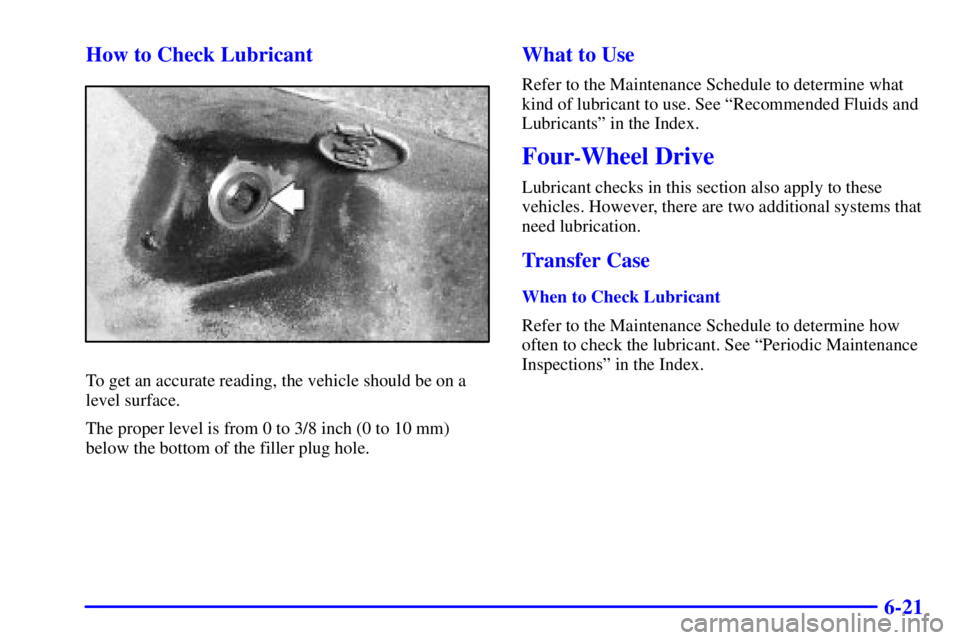
6-21 How to Check Lubricant
To get an accurate reading, the vehicle should be on a
level surface.
The proper level is from 0 to 3/8 inch (0 to 10 mm)
below the bottom of the filler plug hole.
What to Use
Refer to the Maintenance Schedule to determine what
kind of lubricant to use. See ªRecommended Fluids and
Lubricantsº in the Index.
Four-Wheel Drive
Lubricant checks in this section also apply to these
vehicles. However, there are two additional systems that
need lubrication.
Transfer Case
When to Check Lubricant
Refer to the Maintenance Schedule to determine how
often to check the lubricant. See ªPeriodic Maintenance
Inspectionsº in the Index.
Page 354 of 429

6-31
NOTICE:
�Using the wrong fluid can badly damage
brake system parts. For example, just a few
drops of mineral
-based oil, such as engine
oil, in your brake system can damage brake
system parts so badly that they'll have to be
replaced. Don't let someone put in the
wrong kind of fluid.
�If you spill brake fluid on your vehicle's
painted surfaces, the paint finish can be
damaged. Be careful not to spill brake fluid
on your vehicle. If you do, wash it off
immediately. See ªAppearance Careº in
the Index.
Brake Wear
Your vehicle has four-wheel disc brakes.
Disc brake pads have built
-in wear indicators that make a
high
-pitched warning sound when the brake pads are
worn and new pads are needed. The sound may come and
go or be heard all the time your vehicle is moving (except
when you are pushing on the brake pedal firmly).
CAUTION:
The brake wear warning sound means that soon
your brakes won't work well. That could lead to
an accident. When you hear the brake wear
warning sound, have your vehicle serviced.
NOTICE:
Continuing to drive with worn-out brake pads
could result in costly brake repair.
Some driving conditions or climates may cause a brake
squeal when the brakes are first applied or lightly
applied. This does not mean something is wrong with
your brakes.
Page 368 of 429

6-45
Each new wheel should have the same load-carrying
capacity, diameter, width, offset and be mounted the
same way as the one it replaces.
If you need to replace any of your wheels, wheel bolts
or wheel nuts, replace them only with new GM original
equipment parts. This way, you will be sure to have the
right wheel, wheel bolts and wheel nuts for your vehicle.
CAUTION:
Using the wrong replacement wheels, wheel bolts
or wheel nuts on your vehicle can be dangerous.
It could affect the braking and handling of your
vehicle, make your tires lose air and make
you lose control. You could have a collision in
which you or others could be injured. Always
use the correct wheel, wheel bolts and wheel nuts
for replacement.
NOTICE:
The wrong wheel can also cause problems with
bearing life, brake cooling, speedometer or
odometer calibration, headlamp aim, bumper
height, vehicle ground clearance and tire or tire
chain clearance to the body and chassis.
See ªChanging a Flat Tireº in the Index for
more information.
Used Replacement Wheels
CAUTION:
Putting a used wheel on your vehicle is
dangerous. You can't know how it's been used or
how far it's been driven. It could fail suddenly
and cause a crash. If you have to replace a wheel,
use a new GM original equipment wheel.