Page 308 of 429
5-18
Changing a Flat Tire
If a tire goes flat, avoid further tire and wheel damage
by driving slowly to a level place. Turn on your hazard
warning flashers.
CAUTION:
Changing a tire can cause an injury. The vehicle
can slip off the jack and roll over you or other
people. You and they could be badly injured.
Find a level place to change your tire. To help
prevent the vehicle from moving:
1. Set the parking brake firmly.
2. Put the shift lever in PARK (P).
3. If you have a four
-wheel-drive vehicle,
be sure the transfer case is in a drive
gear
-- not in NEUTRAL.
CAUTION: (Continued)
CAUTION: (Continued)
4. Turn off the engine.
5. Put the wheel blocks at the front and
rear of the tire farthest away from the
one being changed. That would be the
tire on the other side of the vehicle, at
the opposite end.
The following steps will tell you how to use the jack and
change a tire.
Page 323 of 429

5-33
NOTICE:
Spinning your wheels can destroy parts of your
vehicle as well as the tires. If you spin the wheels
too fast while shifting your transmission back
and forth, you can destroy your transmission.
For information about using tire chains on your vehicle,
see ªTire Chainsº in the Index.
Rocking Your Vehicle To Get It Out
First, turn your steering wheel left and right. That will
clear the area around your front wheels. If you have a
four
-wheel-drive vehicle, shift into 4HI. Then shift back
and forth between REVERSE (R) and a forward gear,
spinning the wheels as little as possible. Release the
accelerator pedal while you shift, and press lightly on
the accelerator pedal when the transmission is in gear.
By slowly spinning your wheels in the forward and
reverse directions, you will cause a rocking motion that
may free your vehicle. If that doesn't get you out after
a few tries, you may need to be towed out. If you do
need to be towed out, see ªTowing Your Vehicleº in
the Index.
Page 324 of 429

6-
6-1
Section 6 Service and Appearance Care
Here you will find information about the care of your vehicle. This section begins with service and fuel information,
and then it shows how to check important fluid and lubricant levels. There is also technical information about your
vehicle, and a part devoted to its appearance care.
6
-2 Service
6
-3 Fuel
6
-5 Fuels in Foreign Countries
6
-6 Filling Your Tank
6
-8 Filling a Portable Fuel Container
6
-8 Checking Things Under the Hood
6
-11 Engine Oil
6
-15 Engine Air Cleaner/Filter
6
-17 Automatic Transmission Fluid
6
-20 Rear Axle
6
-21 Four-Wheel Drive
6
-23 Engine Coolant
6
-26 Radiator Pressure Cap
6
-27 Power Steering Fluid
6
-28 Windshield Washer Fluid
6
-29 Brakes6
-33 Battery
6
-33 Bulb Replacement
6
-36 Windshield Wiper Blade Replacement
6
-38 Tires
6
-46 Appearance Care
6
-47 Cleaning the Inside of Your Vehicle
6
-49 Care of Safety Belts
6
-50 Cleaning the Outside of Your Vehicle
6
-54 GM Vehicle Care/Appearance Materials
6
-55 Vehicle Identification Number (VIN)
6
-55 Service Parts Identification Label
6
-56 Electrical System
6
-63 Replacement Bulbs
6
-63 Capacities and Specifications
6
-64 Normal Maintenance Replacement Parts
Page 344 of 429
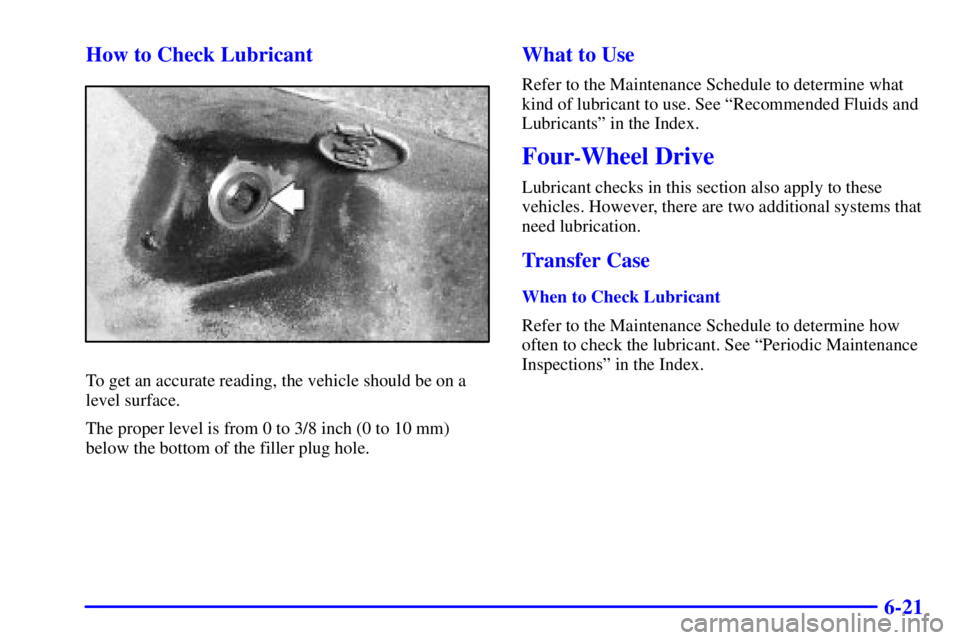
6-21 How to Check Lubricant
To get an accurate reading, the vehicle should be on a
level surface.
The proper level is from 0 to 3/8 inch (0 to 10 mm)
below the bottom of the filler plug hole.
What to Use
Refer to the Maintenance Schedule to determine what
kind of lubricant to use. See ªRecommended Fluids and
Lubricantsº in the Index.
Four-Wheel Drive
Lubricant checks in this section also apply to these
vehicles. However, there are two additional systems that
need lubrication.
Transfer Case
When to Check Lubricant
Refer to the Maintenance Schedule to determine how
often to check the lubricant. See ªPeriodic Maintenance
Inspectionsº in the Index.
Page 354 of 429

6-31
NOTICE:
�Using the wrong fluid can badly damage
brake system parts. For example, just a few
drops of mineral
-based oil, such as engine
oil, in your brake system can damage brake
system parts so badly that they'll have to be
replaced. Don't let someone put in the
wrong kind of fluid.
�If you spill brake fluid on your vehicle's
painted surfaces, the paint finish can be
damaged. Be careful not to spill brake fluid
on your vehicle. If you do, wash it off
immediately. See ªAppearance Careº in
the Index.
Brake Wear
Your vehicle has four-wheel disc brakes.
Disc brake pads have built
-in wear indicators that make a
high
-pitched warning sound when the brake pads are
worn and new pads are needed. The sound may come and
go or be heard all the time your vehicle is moving (except
when you are pushing on the brake pedal firmly).
CAUTION:
The brake wear warning sound means that soon
your brakes won't work well. That could lead to
an accident. When you hear the brake wear
warning sound, have your vehicle serviced.
NOTICE:
Continuing to drive with worn-out brake pads
could result in costly brake repair.
Some driving conditions or climates may cause a brake
squeal when the brakes are first applied or lightly
applied. This does not mean something is wrong with
your brakes.
Page 386 of 429

6-63
Fuse Usage
35 Blank
36 HVAC B
37 Front Parking Lamps
38 Left Turn Signal
39 HVAC 1
40 TBC 4
41 Radio
42 TR PARK
43 Right Turn Signal
44 HVAC
45 Rear Fog Lamps
46 Auxiliary Power 1
47 Ignition 0
48 Four
-Wheel Drive
49 Blank
50 TBC IG
51 Brakes
52 TBC RUN
Replacement Bulbs
Lamps Number
Halogen Headlamps
Low Beam 9006 HB4. . . . . . . . . . . . . . . . . . . . . . . .
High Beam 9005 HB3. . . . . . . . . . . . . . . . . . . . . . .
Front Sidemarker Lamps 194. . . . . . . . . . . . . . . . . . .
Front Turn Signal Lamps 3457. . . . . . . . . . . . . . . . . .
Tail and Stoplamps 3057. . . . . . . . . . . . . . . . . . . . . . .
Rear Turn Signal Lamps 3057. . . . . . . . . . . . . . . . . .
For any bulb not listed here contact your dealer.
Capacities and Specifications
Engine Specifications
Engine Description ªVORTECº 4200. . . . . . . . . . . .
Type L6. . . . . . . . . . . . . . . . . . . . . . . . . . . . . . . . . . . .
VIN Code S. . . . . . . . . . . . . . . . . . . . . . . . . . . . . . . . .
Firing Order 1
-5-3-6-2-4 . . . . . . . . . . . . . . . . . . . . . .
Spark Plug Gap 0.050 inches (1.25 mm). . . . . . . . . .
Page 391 of 429

7-4
Part A: Scheduled
Maintenance Services
Using Your Maintenance Schedule
We at General Motors want to help you keep your
vehicle in good working condition. But we don't know
exactly how you'll drive it. You may drive very short
distances only a few times a week. Or you may drive
long distances all the time in very hot, dusty weather.
You may use your vehicle in making deliveries.
Or you may drive it to work, to do errands or in
many other ways.
Because of all the different ways people use their
vehicles, maintenance needs vary. You may need more
frequent checks and replacements. So please read the
following and note how you drive. If you have any
questions on how to keep your vehicle in good
condition, see your dealer.
This part tells you the maintenance services you should
have done and when you should schedule them. If you
go to your dealer for your service needs, you'll know
that GM
-trained and supported service people will
perform the work using genuine GM parts.The proper fluids and lubricants to use are listed in
Part D. Make sure whoever services your vehicle
uses these. All parts should be replaced and all
necessary repairs done before you or anyone else
drives the vehicle.
This schedule is for vehicles that:
�carry passengers and cargo within recommended
limits. You will find these limits on your vehicle's
Certification/Tire label. See ªLoading Your Vehicleº
in the Index.
�are driven on reasonable road surfaces within legal
driving limits.
�are driven off
-road in the recommended manner. See
ªOff
-Road Driving With Your Four-Wheel-Drive
Vehicleº in the Index.
�use the recommended fuel. See ªFuelº in the Index.
Page 408 of 429
7-21 Transfer Case and Front Axle
(Four-Wheel Drive) Inspection
Every 12 months or at engine oil change intervals, check
front axle and transfer case and add lubricant when
necessary. A fluid loss could indicate a problem; check
and have it repaired, if needed. Check vent hose at
transfer case for kinks and proper installation. More
frequent lubrication may be required on off
-road use.
Brake System Inspection
Inspect the complete system. Inspect brake lines and
hoses for proper hook
-up, binding, leaks, cracks,
chafing, etc. Inspect disc brake pads for wear and rotors
for surface condition. Inspect other brake parts,
including calipers, parking brake, etc. Check parking
brake adjustment. You may need to have your brakes
inspected more often if your driving habits or conditions
result in frequent braking.
Page:
< prev 1-8 9-16 17-24