Page 155 of 248
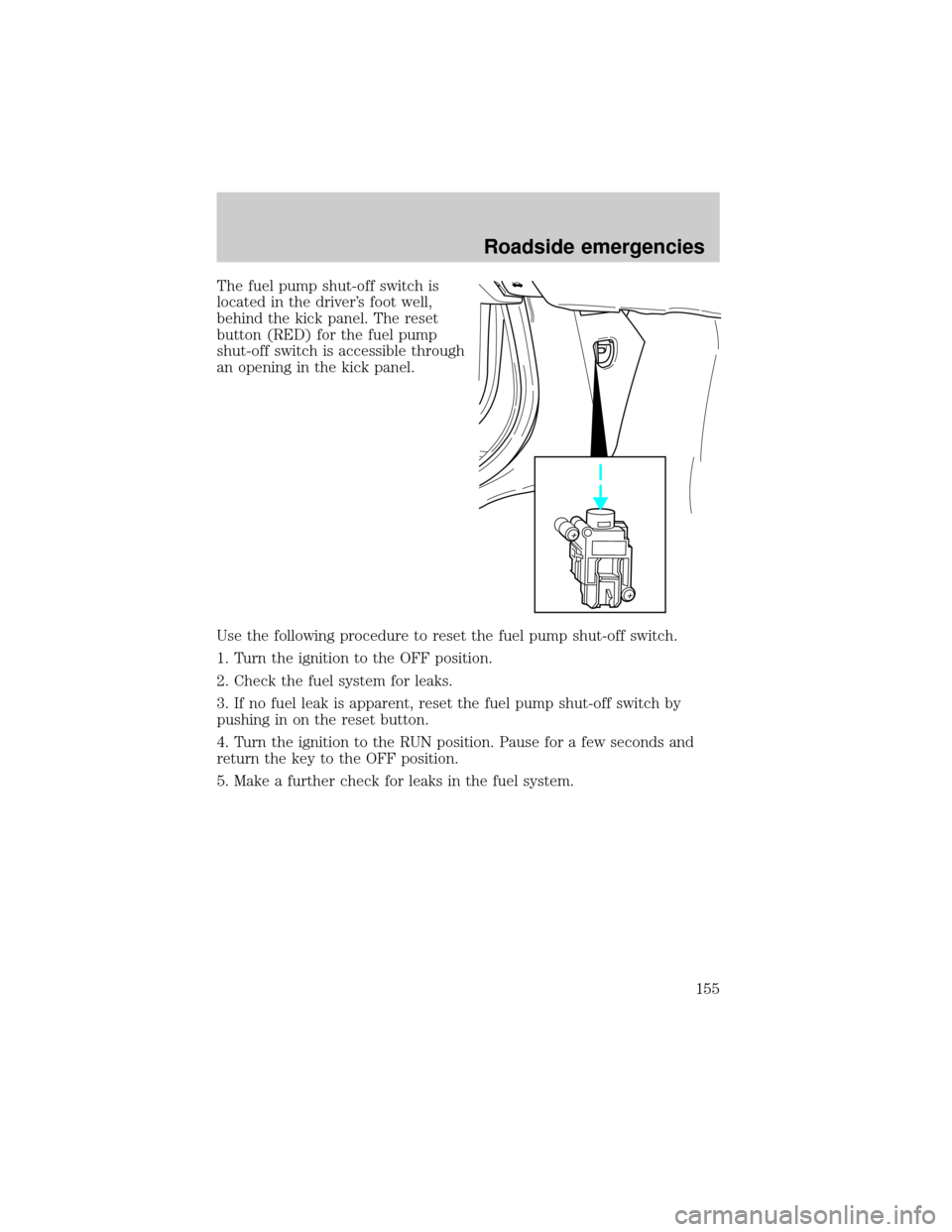
The fuel pump shut-off switch is
located in the driver's foot well,
behind the kick panel. The reset
button (RED) for the fuel pump
shut-off switch is accessible through
an opening in the kick panel.
Use the following procedure to reset the fuel pump shut-off switch.
1. Turn the ignition to the OFF position.
2. Check the fuel system for leaks.
3. If no fuel leak is apparent, reset the fuel pump shut-off switch by
pushing in on the reset button.
4. Turn the ignition to the RUN position. Pause for a few seconds and
return the key to the OFF position.
5. Make a further check for leaks in the fuel system.
Roadside emergencies
155
Page 157 of 248
Passenger compartment fuse panel
The fuse panel is located on the right-hand side kick panel. Remove the
panel cover to access the fuses.
To remove a fuse use the fuse puller tool provided on the fuse panel
cover.
The fuses are coded as follows.
Fuse/Relay
LocationFuse Amp
RatingPassenger Compartment Fuse Panel
Description
1 5A Starter Relay Coil
2 5A Radio Start Signal
3 5A ABS Module
4 5A PCM Coil, Cluster and Fuel Pump Relay
5 5A Autolamp System, FEM, T/A Switch
6 10A OBD II
7 5A PCM, RKE, Sunload sensor
SEE
OWNER'S MANUAL
RELAY 1
REPLACEMENT
FUSES
FUSE 8FUSE 9FUSE 10FUSE 11FUSE 12FUSE 13FUSE 14FUSE 15FUSE 16FUSE 17FUSE 18FUSE 19FUSE 20FUSE 21
FUSE 1FUSE 2FUSE 3FUSE 4FUSE 5FUSE 6FUSE 7
FUSE 22FUSE 23FUSE 24FUSE 25FUSE 26FUSE 27FUSE 28FUSE 29FUSE 30FUSE 31FUSE 32FUSE 33FUSE 34FUSE 35
Roadside emergencies
157
Page 160 of 248
The high-current fuses are coded as follows.
Fuse/Relay
LocationFuse Amp
RatingPower Distribution Box Description
1 10A* A/C Clutch
2 15A* Heated Wiper Park
3 10A* Park Lamp
4 15A* Horn
5 20A* Fuel Injectors
6 15A* Transmission Solenoid
7 Ð Not Used
8 20A Power Point
9 Ð Not Used
10 15A* IAC Solenoid
11 15A* HEGO's
12 10A* Coil On Plug
13 Ð Not used
RELAY
14RELAY
15
RELAY
11RELAY
12
RELAY
1013
1234
5678
9 10111214 15 16 17 18
19 20 21 22 23 24
RELAY
13RELAY 08DIODE
RELAY 04 RELAY 05RELAY 01
RELAY 09
RELAY 06
RELAY 02RELAY 07
RELAY 03
Roadside emergencies
160
Page 163 of 248
The high-current fuses are coded as follows.
Fuse/Relay
LocationFuse Amp
RatingPower Distribution Box Description
1 15A* Decklid Solenoid
2 5A* License plate lamp
3 10A* Left Rear Turn and Stop Lamp
4 10A* Luggage Compartment Lamp
5 Ð Not used
6 10A* Back-up Lamps
7 10A* Right Rear Turn and Stop Lamp
8 5A* Center High Mounted Stop Lamp
9 Ð Not used
10 Ð Not used
11 Ð Not used
12 5A* REM logic (if equipped)
13 Ð Not Used
14 5A* Convertible top relay coil
15 5A* Alternator Sense
16 Ð Not used
17 15A* Fuel Pump
18 20A* Subwoofer Amplifier
19 30A** Driver power seat
20 30A** FEM - Left front window
123456789 19 20 21 22 23 24 25> PBT <
MINI-FUSE
SEE OWNER'S MANUAL CONSULTER LA GUIDECARTRIDGE FUSE
26 27 28 29 30 31 32 10 11
RELAY
001
12 13 14 15 16 17 18
RELAY
002RELAY
003RELAY
004RELAY
005RELAY
006RELAY
007
DIODE 01
DIODE 02
Roadside emergencies
163
Page 164 of 248

Fuse/Relay
LocationFuse Amp
RatingPower Distribution Box Description
21 Ð Not used
22 20A** Ignition Switch
23 30A** SSP4
24 30A** SSP3
25 40A** P-J/B
26 30A** Passenger power seat
27 30A** SSP1
28 30A** REM -Right front window
29 30A** Rear Defroster
30 Ð Not used
31 Ð Not used
32 30A** SSP2
Relay 001 Full ISO SSP1
Relay 002 Full ISO SSP4
Relay 003 Full ISO Rear Defroster
Relay 004 Full ISO SSP3
Relay 005 Full ISO SSP2
Relay 006 Ð Not Used
Relay 007 1/2 ISO Fuel Pump
Diode 01 Ð Not Used
Diode 02 1A Fuel Pump Motor
*Mini fuses **Maxi fuses
CHANGING THE TIRES
If you get a flat tire while driving, do not apply the brake heavily.
Instead, gradually decrease your speed. Hold the steering wheel firmly
and slowly move to a safe place on the side of the road.
Temporary spare tire information
Your vehicle may have a temporary or full-size spare tire. The temporary
spare tire for your vehicle is labeled as such. It is smaller than a regular
tire and is designed for emergency use only. Replace this tire with a
full-size tire as soon as possible.
Roadside emergencies
164
Page 172 of 248
4. Make the final connection of the negative (-) cable to the spare tire
tie-down stud. (Your vehicle may be equipped with a plastic cap on top
of the tire tie-down stud. This cap must be removed prior to attaching
the cable to the stud.)
Do not connect the end of the second cable to the negative (-)
terminal of the battery to be jumped. A spark may cause an
explosion of the gases that surround the battery.
5. Ensure that the cables are clear of fan blades, belts, moving parts of
both engines, or any fuel delivery system parts.
Jump starting
1. Start the engine of the booster vehicle and run the engine at
moderately increased speed.
2. Start the engine of the disabled vehicle.
+–+–
Roadside emergencies
172
Page 183 of 248

UTILIZING THE MEDIATION/ARBITRATION PROGRAM
(CANADA ONLY)
In those cases where you continue to feel that the efforts by Ford and
the dealer to resolve a factory-related vehicle service concern have been
unsatisfactory, Ford of Canada participates in an impartial third party
mediation/arbitration program administered by the Canadian Motor
Vehicle Arbitration Plan (CAMVAP).
The CAMVAP program is a straight-forward and relatively speedy
alternative to resolve a disagreement when all other efforts to produce a
settlement have failed. This procedure is without cost to you and is
designed to eliminate the need for lengthy and expensive legal
proceedings.
In the CAMVAP program, impartial third-party arbitrators conduct
hearings at mutually convenient times and places in an informal
environment. These impartial arbitrators review the positions of the
parties, make decisions and, when appropriate, render awards to resolve
disputes. CAMVAP decisions are fast, fair, and final; the arbitrator's
award is binding both to you and Ford of Canada.
CAMVAP services are available in all territories and provinces. For more
information, without charge or obligation, call your CAMVAP Provincial
Administrator directly at 1-800-207-0685.
GETTING ASSISTANCE OUTSIDE THE U.S. AND CANADA
Before exporting your vehicle to a foreign country, contact the
appropriate foreign embassy or consulate. These officials can inform you
of local vehicle registration regulations and where to find unleaded fuel.
If you cannot find unleaded fuel or can only get fuel with an anti-knock
index lower than is recommended for your vehicle, contact a district or
owner relations/customer relationship office.
The use of leaded fuel in your vehicle without proper conversion may
damage the effectiveness of your emission control system and may cause
engine knocking or serious engine damage. Ford Motor Company/Ford of
Canada is not responsible for any damage caused by use of improper
fuel.
In the United States, using leaded fuel may also result in difficulty
importing your vehicle back into the U.S.
Customer assistance
183
Page 187 of 248

WASHING THE EXTERIOR OF YOUR VEHICLE
Never wash a vehicle that is ªhot to
the touchº or during exposure to
strong, direct sunlight. It is
recommended that you wash your
vehicle regularly with cool or
lukewarm water and a neutral Ph
shampoo, such as Detail Wash
(ZC-3±A), which is available from
your authorized Ford, Lincoln or
Mercury dealer. Always use a clean
sponge or carwash mitt with plenty
of water for best results. Dry the vehicle with a chamois or soft terry
cloth towel in order to eliminate water spotting.
Never use strong household detergents or soap, such as dish
washing or laundry liquid. These products can discolor and spot
painted surfaces.
It is especially important to wash the vehicle regularly during winter
months, as dirt and road salt are difficult to remove and do cause
damage to the vehicle.
Items such as gasoline, diesel fuel, bird droppings and insect deposits
should be washed and sponged off as soon as possible. Deposits not
removed promptly can cause damage to the vehicle's paintwork and trim
over time.
Remove any exterior accessories, such as antennas, before
entering a car wash.
PROTECTING YOUR VEHICLES' PAINT FINISH
Applying a polymer paint sealant to your vehicle on a regular basis will
assist in reducing minor scratches and paint damage.
A typical paint sealant lasts approximately six months to a year,
depending on local weather conditions and the cleaning soap that is used
in washing the vehicle.
Do not use a wax that beads excessively.
Do not allow paint sealant to come in contact with any non-body
(low-gloss black) colored trim, such as grained door handles, roof
racks, bumpers, side moldings, mirror housings or the windshield
cowl area. The paint sealant will ªgrayº or stain the parts over
time.
Cleaning
187