Page 146 of 264
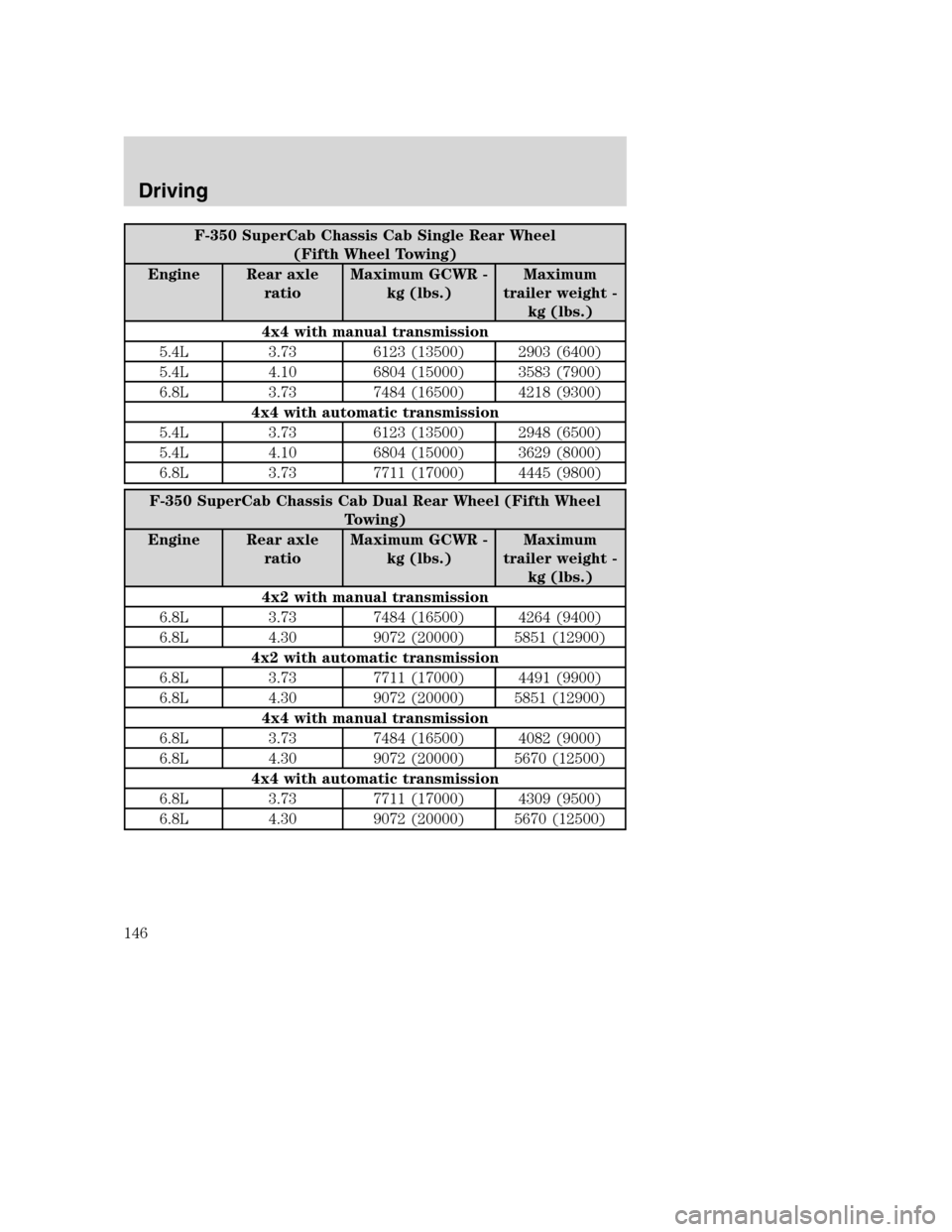
F-350 SuperCab Chassis Cab Single Rear Wheel
(Fifth Wheel Towing)
Engine Rear axle
ratioMaximum GCWR -
kg (lbs.)Maximum
trailer weight -
kg (lbs.)
4x4 with manual transmission
5.4L 3.73 6123 (13500) 2903 (6400)
5.4L 4.10 6804 (15000) 3583 (7900)
6.8L 3.73 7484 (16500) 4218 (9300)
4x4 with automatic transmission
5.4L 3.73 6123 (13500) 2948 (6500)
5.4L 4.10 6804 (15000) 3629 (8000)
6.8L 3.73 7711 (17000) 4445 (9800)
F-350 SuperCab Chassis Cab Dual Rear Wheel (Fifth Wheel
Towing)
Engine Rear axle
ratioMaximum GCWR -
kg (lbs.)Maximum
trailer weight -
kg (lbs.)
4x2 with manual transmission
6.8L 3.73 7484 (16500) 4264 (9400)
6.8L 4.30 9072 (20000) 5851 (12900)
4x2 with automatic transmission
6.8L 3.73 7711 (17000) 4491 (9900)
6.8L 4.30 9072 (20000) 5851 (12900)
4x4 with manual transmission
6.8L 3.73 7484 (16500) 4082 (9000)
6.8L 4.30 9072 (20000) 5670 (12500)
4x4 with automatic transmission
6.8L 3.73 7711 (17000) 4309 (9500)
6.8L 4.30 9072 (20000) 5670 (12500)
Driving
146
Page 147 of 264
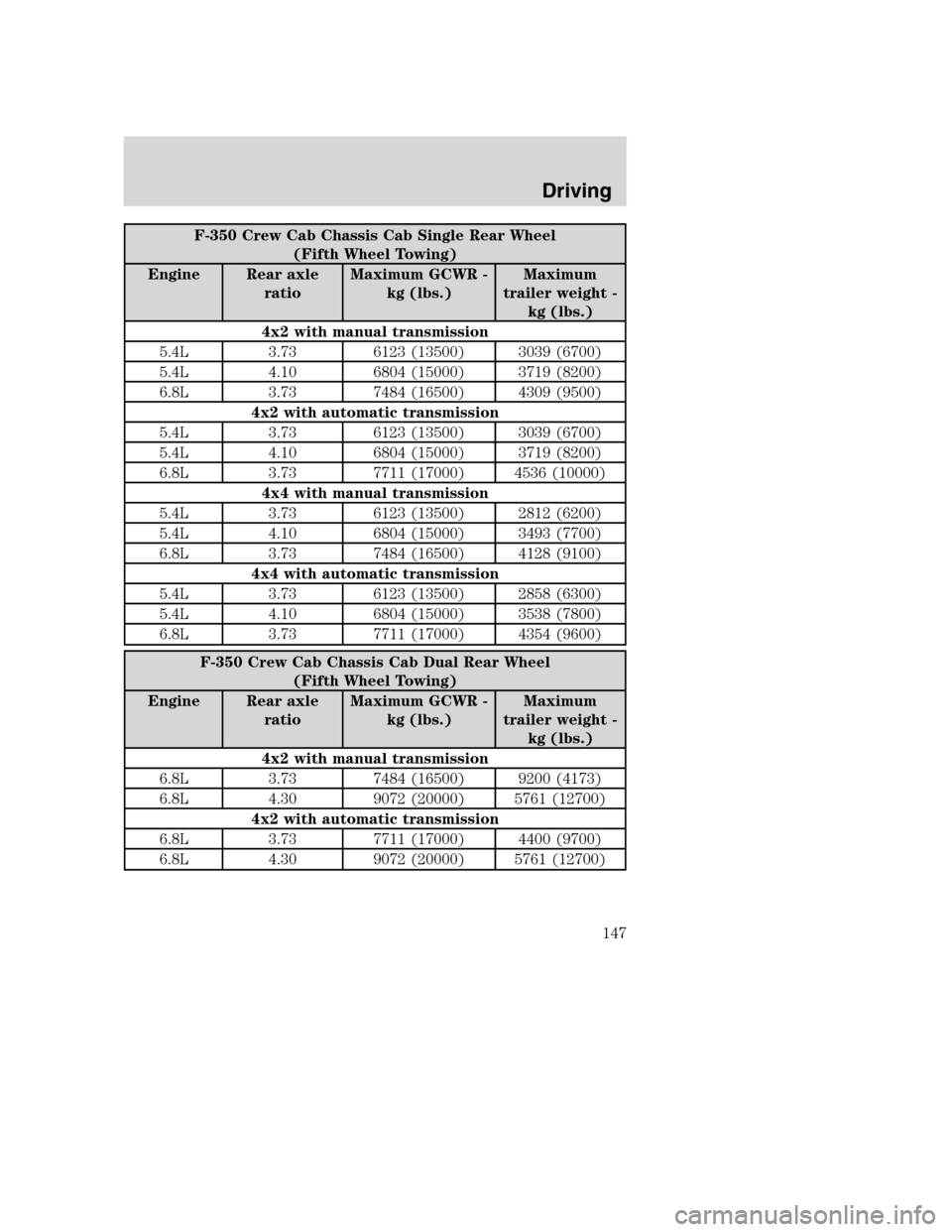
F-350 Crew Cab Chassis Cab Single Rear Wheel
(Fifth Wheel Towing)
Engine Rear axle
ratioMaximum GCWR -
kg (lbs.)Maximum
trailer weight -
kg (lbs.)
4x2 with manual transmission
5.4L 3.73 6123 (13500) 3039 (6700)
5.4L 4.10 6804 (15000) 3719 (8200)
6.8L 3.73 7484 (16500) 4309 (9500)
4x2 with automatic transmission
5.4L 3.73 6123 (13500) 3039 (6700)
5.4L 4.10 6804 (15000) 3719 (8200)
6.8L 3.73 7711 (17000) 4536 (10000)
4x4 with manual transmission
5.4L 3.73 6123 (13500) 2812 (6200)
5.4L 4.10 6804 (15000) 3493 (7700)
6.8L 3.73 7484 (16500) 4128 (9100)
4x4 with automatic transmission
5.4L 3.73 6123 (13500) 2858 (6300)
5.4L 4.10 6804 (15000) 3538 (7800)
6.8L 3.73 7711 (17000) 4354 (9600)
F-350 Crew Cab Chassis Cab Dual Rear Wheel
(Fifth Wheel Towing)
Engine Rear axle
ratioMaximum GCWR -
kg (lbs.)Maximum
trailer weight -
kg (lbs.)
4x2 with manual transmission
6.8L 3.73 7484 (16500) 9200 (4173)
6.8L 4.30 9072 (20000) 5761 (12700)
4x2 with automatic transmission
6.8L 3.73 7711 (17000) 4400 (9700)
6.8L 4.30 9072 (20000) 5761 (12700)
Driving
147
Page 148 of 264
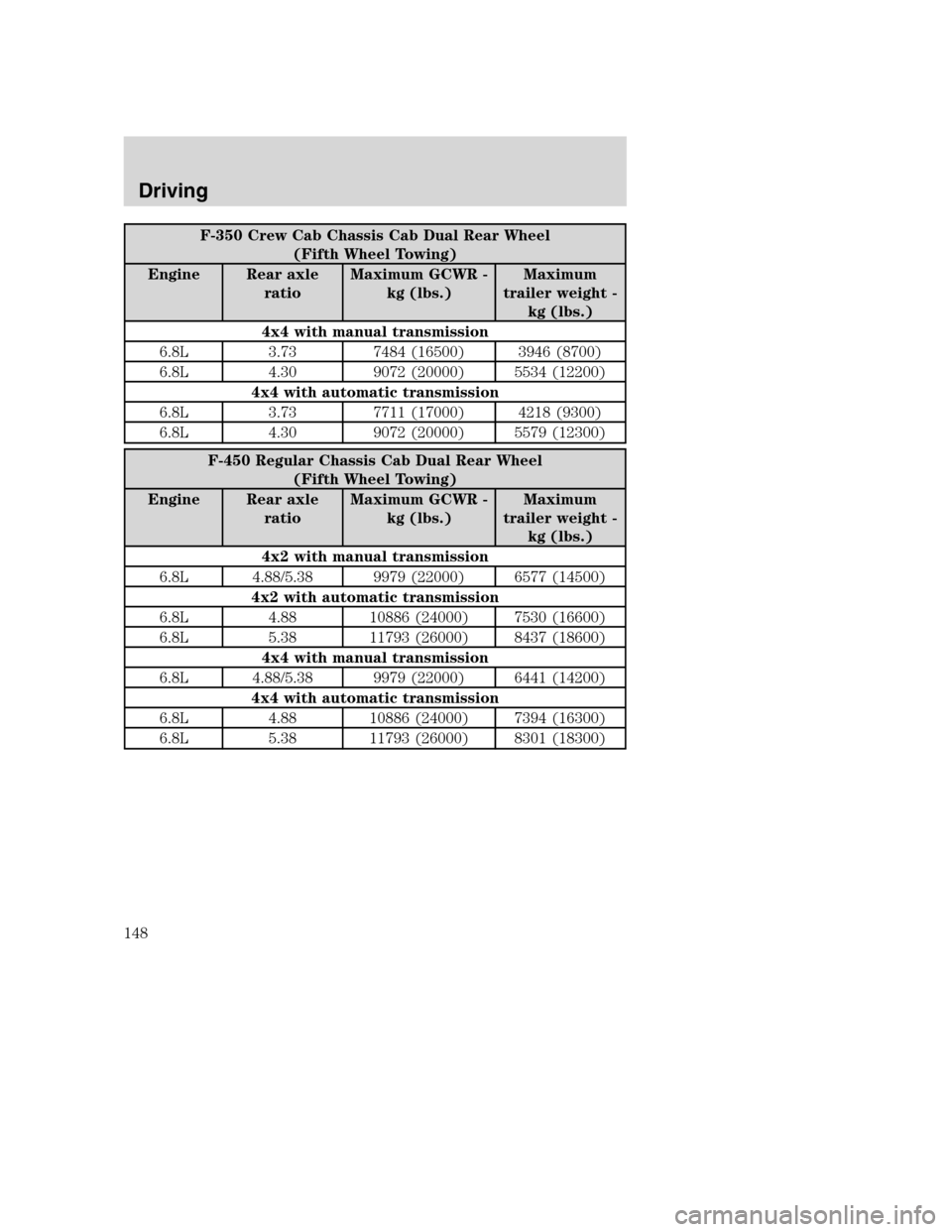
F-350 Crew Cab Chassis Cab Dual Rear Wheel
(Fifth Wheel Towing)
Engine Rear axle
ratioMaximum GCWR -
kg (lbs.)Maximum
trailer weight -
kg (lbs.)
4x4 with manual transmission
6.8L 3.73 7484 (16500) 3946 (8700)
6.8L 4.30 9072 (20000) 5534 (12200)
4x4 with automatic transmission
6.8L 3.73 7711 (17000) 4218 (9300)
6.8L 4.30 9072 (20000) 5579 (12300)
F-450 Regular Chassis Cab Dual Rear Wheel
(Fifth Wheel Towing)
Engine Rear axle
ratioMaximum GCWR -
kg (lbs.)Maximum
trailer weight -
kg (lbs.)
4x2 with manual transmission
6.8L 4.88/5.38 9979 (22000) 6577 (14500)
4x2 with automatic transmission
6.8L 4.88 10886 (24000) 7530 (16600)
6.8L 5.38 11793 (26000) 8437 (18600)
4x4 with manual transmission
6.8L 4.88/5.38 9979 (22000) 6441 (14200)
4x4 with automatic transmission
6.8L 4.88 10886 (24000) 7394 (16300)
6.8L 5.38 11793 (26000) 8301 (18300)
Driving
148
Page 149 of 264
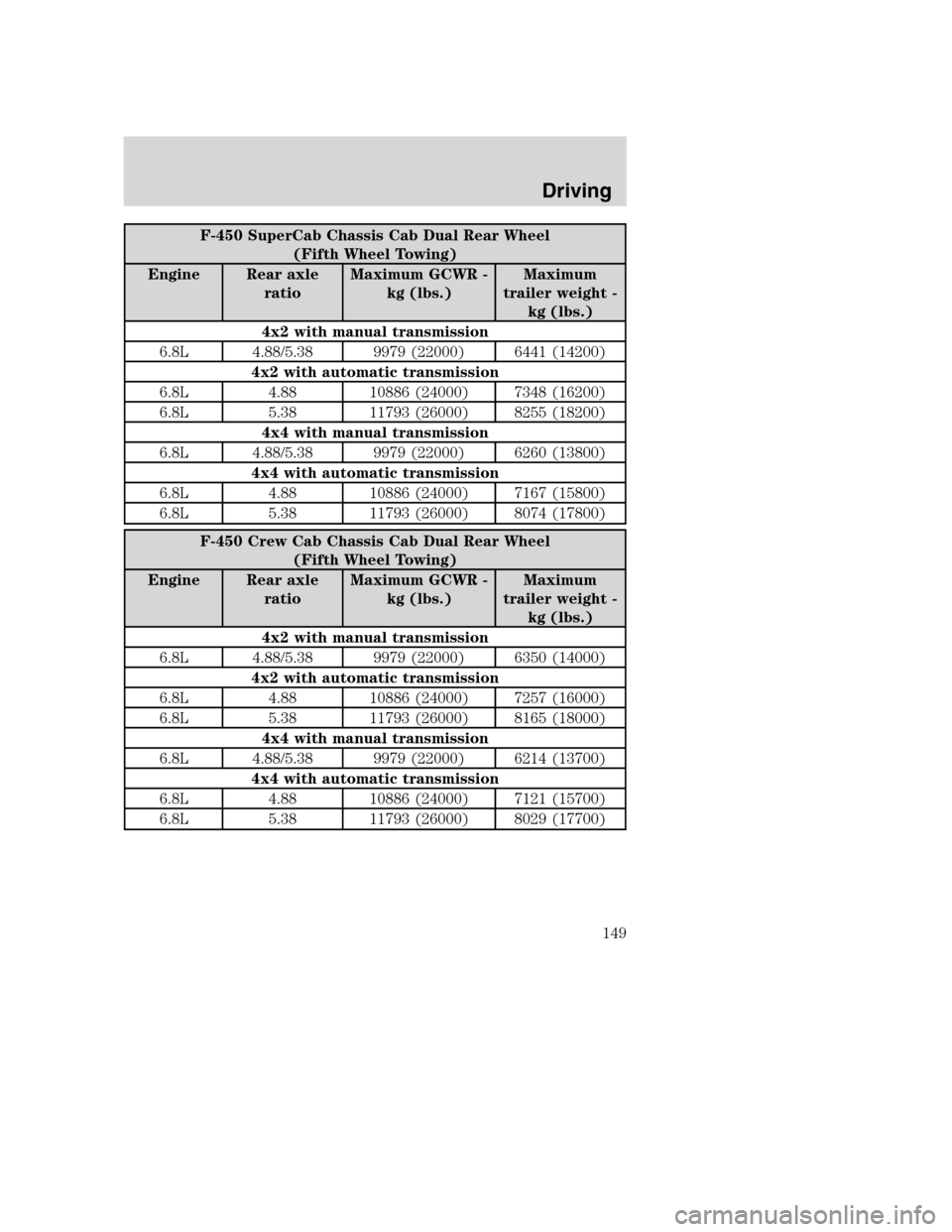
F-450 SuperCab Chassis Cab Dual Rear Wheel
(Fifth Wheel Towing)
Engine Rear axle
ratioMaximum GCWR -
kg (lbs.)Maximum
trailer weight -
kg (lbs.)
4x2 with manual transmission
6.8L 4.88/5.38 9979 (22000) 6441 (14200)
4x2 with automatic transmission
6.8L 4.88 10886 (24000) 7348 (16200)
6.8L 5.38 11793 (26000) 8255 (18200)
4x4 with manual transmission
6.8L 4.88/5.38 9979 (22000) 6260 (13800)
4x4 with automatic transmission
6.8L 4.88 10886 (24000) 7167 (15800)
6.8L 5.38 11793 (26000) 8074 (17800)
F-450 Crew Cab Chassis Cab Dual Rear Wheel
(Fifth Wheel Towing)
Engine Rear axle
ratioMaximum GCWR -
kg (lbs.)Maximum
trailer weight -
kg (lbs.)
4x2 with manual transmission
6.8L 4.88/5.38 9979 (22000) 6350 (14000)
4x2 with automatic transmission
6.8L 4.88 10886 (24000) 7257 (16000)
6.8L 5.38 11793 (26000) 8165 (18000)
4x4 with manual transmission
6.8L 4.88/5.38 9979 (22000) 6214 (13700)
4x4 with automatic transmission
6.8L 4.88 10886 (24000) 7121 (15700)
6.8L 5.38 11793 (26000) 8029 (17700)
Driving
149
Page 153 of 264

•Allow more distance for stopping with a trailer attached.
•The trailer tongue weight should be 10–15% of the loaded trailer
weight.
•After you have traveled 80 km (50 miles), thoroughly check your
hitch, electrical connections and trailer wheel lug nuts.
•To aid in engine/transmission cooling and A/C efficiency during hot
weather while stopped in traffic, place the gearshift lever in P (Park)
(automatic transmission) or N (Neutral) (manual transmissions).
•Vehicles with trailers should not be parked on a grade. If you must
park on a grade, place wheel chocks under the trailer’s wheels.
Launching or retrieving a boat
When backing down a ramp during boat launching or retrieval,
•Do not allow the static water level to rise above the bottom edge of
the rear bumper.
•Do not allow waves to break higher than 15 cm (6 inches) above the
bottom edge of the rear bumper.
•Disconnect the trailer tow electrical connector to prevent blown fuses
caused by water entering into your trailer’s electrical wiring.
Exceeding these limits may allow water to enter critical vehicle
components, adversely affecting driveability, emissions and reliability.
Replace front and rear axle lubricants any time the axles have been
submerged in water. Axle lubricant quantities are not to be checked
unless a leak is suspected.
ALL REAR WHEEL DRIVE (RWD) VEHICLES
This applies to all cars and 4x2 trucks/sport utilities with rear wheel
drive capability.
An example of recreational towing is towing your vehicle behind a
motorhome. The following recreational towing guidelines are designed to
ensure that your transmission is not damaged.
•Place the transmission in N (Neutral).
•Maximum speed is 56 km/h (35 mph).
•Maximum distance is 80 km (50 miles).
If a distance of 80 km (50 miles) or a speed of 56 km/h (35 mph) must
be exceeded, you must disconnect the driveshaft. Ford recommends the
driveshaft be removed/installed only by a qualified technician. See your
local dealer for driveshaft removal/installation.
Driving
153
Page 163 of 264
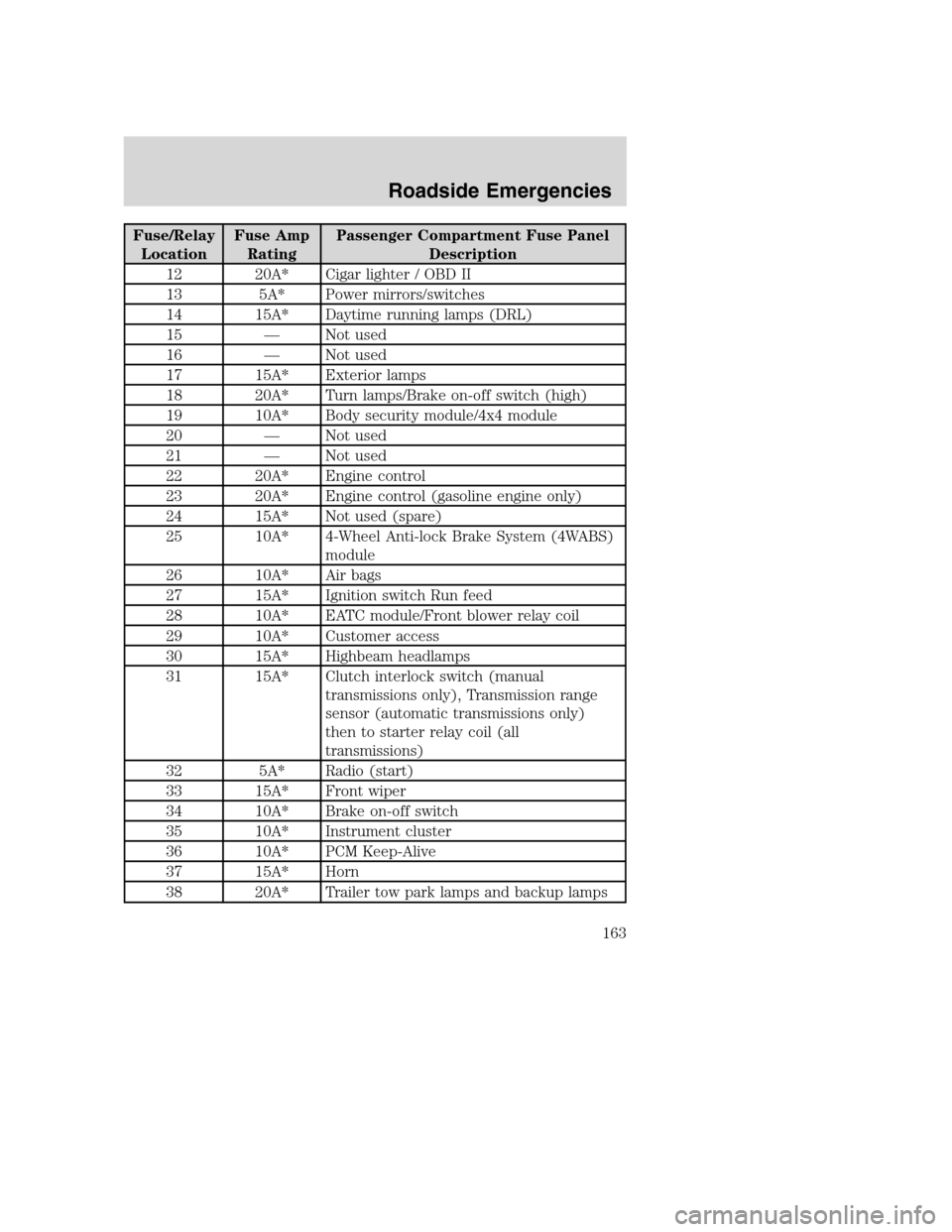
Fuse/Relay
LocationFuse Amp
RatingPassenger Compartment Fuse Panel
Description
12 20A* Cigar lighter / OBD II
13 5A* Power mirrors/switches
14 15A* Daytime running lamps (DRL)
15 — Not used
16 — Not used
17 15A* Exterior lamps
18 20A* Turn lamps/Brake on-off switch (high)
19 10A* Body security module/4x4 module
20 — Not used
21 — Not used
22 20A* Engine control
23 20A* Engine control (gasoline engine only)
24 15A* Not used (spare)
25 10A* 4-Wheel Anti-lock Brake System (4WABS)
module
26 10A* Air bags
27 15A* Ignition switch Run feed
28 10A* EATC module/Front blower relay coil
29 10A* Customer access
30 15A* Highbeam headlamps
31 15A* Clutch interlock switch (manual
transmissions only), Transmission range
sensor (automatic transmissions only)
then to starter relay coil (all
transmissions)
32 5A* Radio (start)
33 15A* Front wiper
34 10A* Brake on-off switch
35 10A* Instrument cluster
36 10A* PCM Keep-Alive
37 15A* Horn
38 20A* Trailer tow park lamps and backup lamps
Roadside Emergencies
163
Page 167 of 264
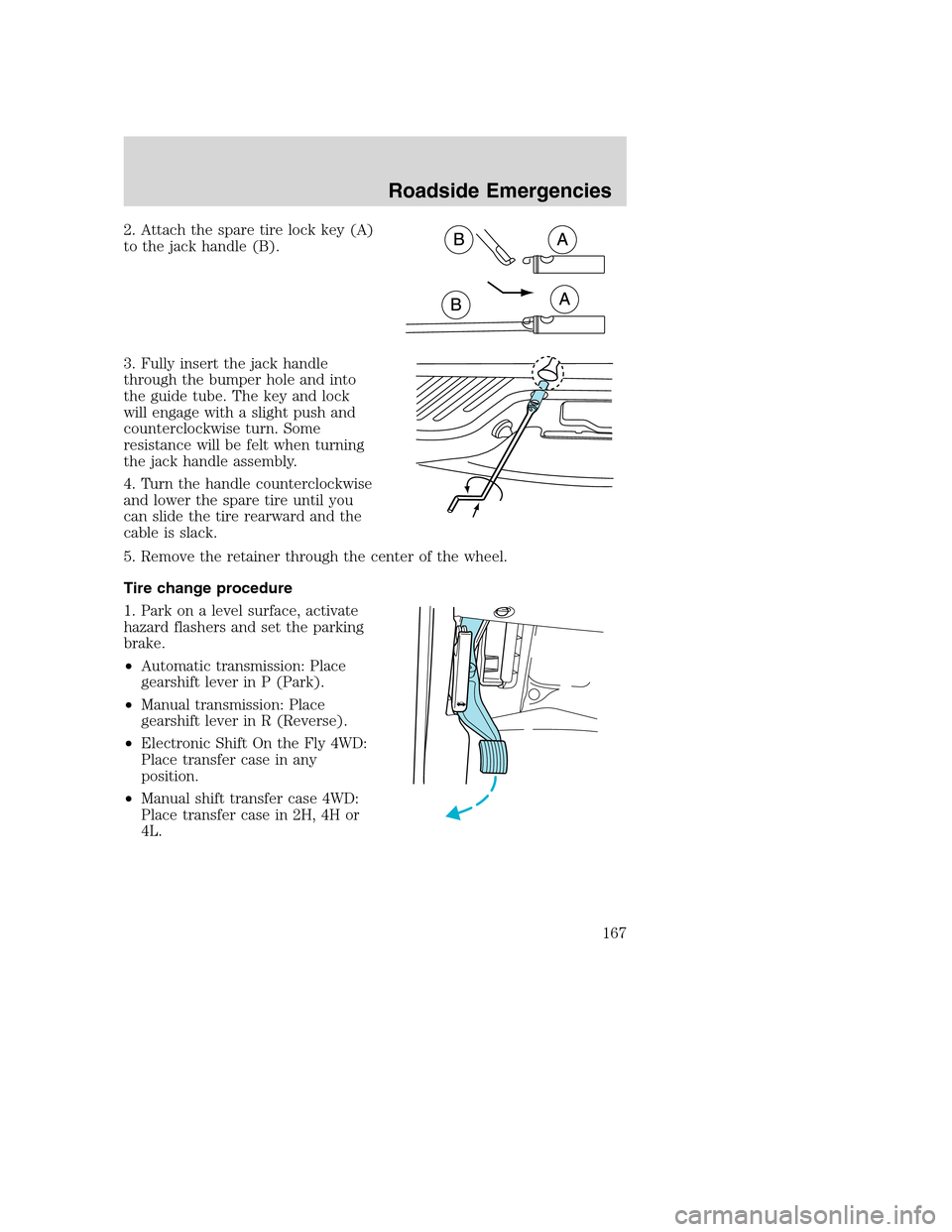
2. Attach the spare tire lock key (A)
to the jack handle (B).
3. Fully insert the jack handle
through the bumper hole and into
the guide tube. The key and lock
will engage with a slight push and
counterclockwise turn. Some
resistance will be felt when turning
the jack handle assembly.
4. Turn the handle counterclockwise
and lower the spare tire until you
can slide the tire rearward and the
cable is slack.
5. Remove the retainer through the center of the wheel.
Tire change procedure
1. Park on a level surface, activate
hazard flashers and set the parking
brake.
•Automatic transmission: Place
gearshift lever in P (Park).
•Manual transmission: Place
gearshift lever in R (Reverse).
•Electronic Shift On the Fly 4WD:
Place transfer case in any
position.
•Manual shift transfer case 4WD:
Place transfer case in 2H, 4H or
4L.
Roadside Emergencies
167
Page 168 of 264
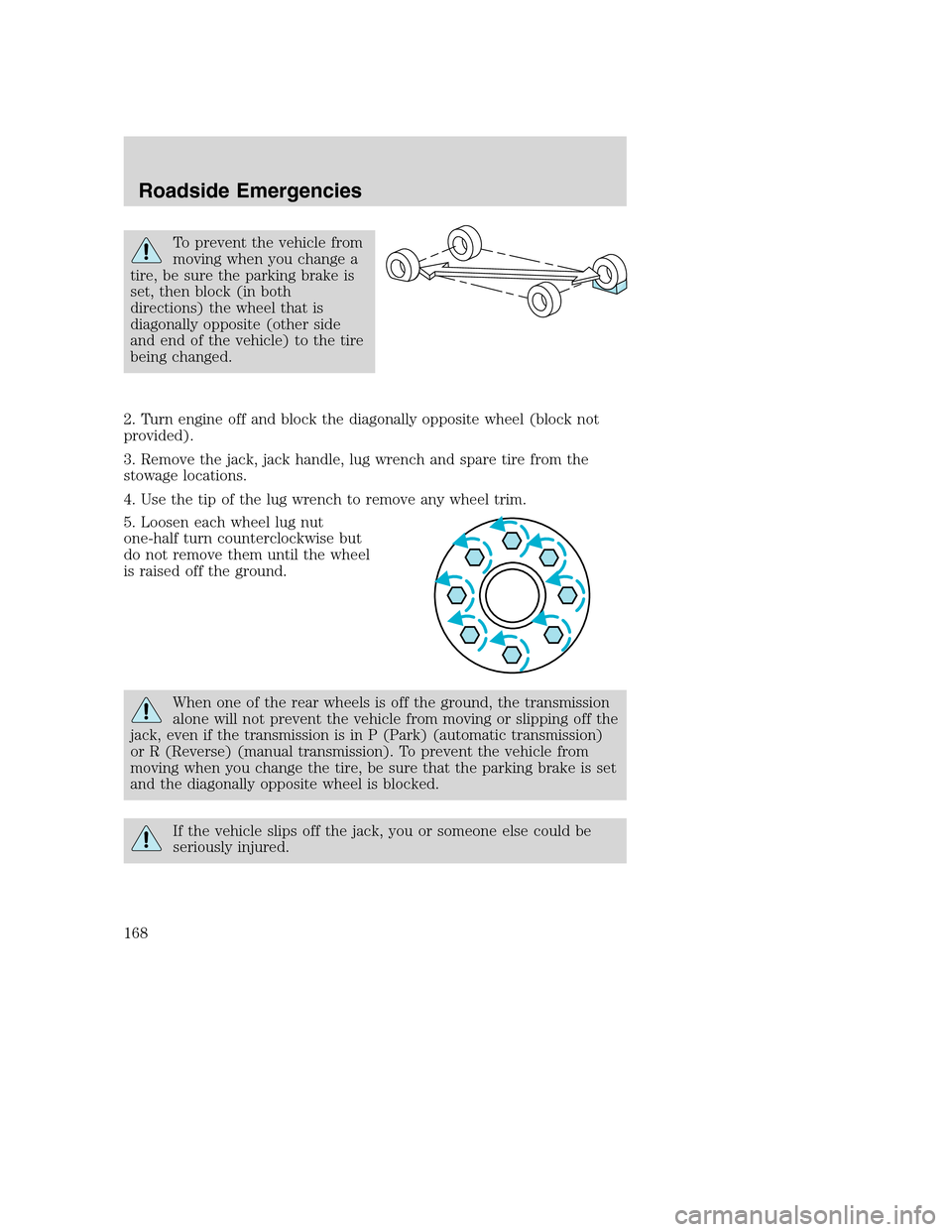
To prevent the vehicle from
moving when you change a
tire, be sure the parking brake is
set, then block (in both
directions) the wheel that is
diagonally opposite (other side
and end of the vehicle) to the tire
being changed.
2. Turn engine off and block the diagonally opposite wheel (block not
provided).
3. Remove the jack, jack handle, lug wrench and spare tire from the
stowage locations.
4. Use the tip of the lug wrench to remove any wheel trim.
5. Loosen each wheel lug nut
one-half turn counterclockwise but
do not remove them until the wheel
is raised off the ground.
When one of the rear wheels is off the ground, the transmission
alone will not prevent the vehicle from moving or slipping off the
jack, even if the transmission is in P (Park) (automatic transmission)
or R (Reverse) (manual transmission). To prevent the vehicle from
moving when you change the tire, be sure that the parking brake is set
and the diagonally opposite wheel is blocked.
If the vehicle slips off the jack, you or someone else could be
seriously injured.
Roadside Emergencies
168