2002 FORD RANGER suspension
[x] Cancel search: suspensionPage 151 of 288

Pull the release lever to release the
brake. Driving with the parking
brake on will cause the brakes to
wear out quickly and reduce fuel
economy.
STEERING
Your vehicle is equipped with power steering. Power steering uses energy
from the engine to help steer the vehicle.
To prevent damage to the power steering pump:
²Never hold the steering wheel to the extreme right or the extreme left
for more than a few seconds when the engine is running.
²Do not operate the vehicle with a low power steering pump fluid level
(below the MIN mark on the reservoir).
If the power steering system breaks down (or if the engine is turned
off), you can steer the vehicle manually, but it takes more effort.
If the steering wanders or pulls, the condition could be caused by any of
the following:
²underinflated tire(s) on any wheel(s)
²uneven vehicle loading
²high crown in center of road
²high crosswinds
²wheels out of alignment
²loose or worn suspension components
TRACTION-LOK AXLE (IF EQUIPPED)
This axle provides added traction on slippery surfaces, particularly when
one wheel is on a poor traction surface. Under normal conditions, the
Traction-Lok axle functions like a standard rear axle.
Extended use of other than the manufacturer's specified size tires on a
Traction-Lok rear axle could result in a permanent reduction in
effectiveness. This loss of effectiveness does not affect normal driving
and should not be noticeable to the driver.BRAKE
RELEASE
Driving
151
Page 171 of 288

Never drive with chains on the front tires of 4WD vehicles without also
putting them on the rear tires. This could cause the rear to slide and
swing around during braking.
Tires, Replacement Requirements
4WD vehicles are equipped with tires designed to provide for safe ride
and handling capability.
Do not use a size and type of tire and wheel other than that originally
provided by Ford because it can affect the safety and performance of
your vehicle, which could lead to loss of vehicle control or roll over and
serious injury. Make sure all tires and wheels on the vehicle are of the
same size, type, tread design, brand and load-carrying capacity. If you
have questions regarding tire replacement, see an authorized Ford or
Lincoln/Mercury dealer.
If you nevertheless decide to equip your 4WD for off-road use with tires
larger than what Ford recommends, you should not use these tires for
highway driving.
If you use any tire/wheel combination not recommended by Ford, it may
adversely affect vehicle handling and could cause steering, suspension,
axle or transfer case failure.
Do not useºaftermarket lift kitsº or other suspension modifications,
whether or not they are used with larger tires and wheels.
These ªaftermarket lift kitsº could adversely affect the vehicle's handling
characteristics, which could lead to loss of vehicle control or roll over
and serious injury.
Tires can be damaged during off-road use. For your safety, tires that are
damaged should not be used for highway driving because they are more
likely to blow out or fail.
You should carefully observe the recommended tire inflation pressure
found on the safety compliance certification label attached to the left
front door lock facing or door latch post pillar. Failure to follow tire
pressure recommendations can adversely affect the way your vehicle
handles. Do not exceed the Ford recommended pressure even if it is less
than the maximum pressure allowed for the tire.
Driving
171
Page 172 of 288

Each day before you drive, check
your tires. If one looks lower than
the others, use a tire gauge to check
pressure of all tires, and adjust if
required. Check tire pressure with a
tire gauge every few weeks
(including spare). Safe operation
requires tires that are neither
underinflated nor overloaded.
Periodically inspect the tire treads and remove stones, nails, glass or
other objects that may be wedged in the tread grooves. Check for holes
or cuts that may permit air leakage from the tire and make necessary
repairs.
Inspect the tire side walls for cuts, bruises and other damage. If internal
damage to the tire is suspected, have the tire demounted and inspected
in case it needs to be repaired or replaced.
Maintenance and Modifications
The suspension and steering systems on your vehicle have been designed
and tested to provide both reasonably safe, predictable performance
whether loaded or empty and durable load carrying capability. For this
reason, Ford strongly recommends that you do not make modifications
such as adding or removing parts (such as lift kits or stabilizer bars) or
by using replacement parts not equivalent to the original factory
equipment.
Any modifications to a vehicle that raise the center of gravity can make
it more likely the vehicle will roll over as a result of a loss of control.
Ford recommends that caution be used with any vehicle equipped with a
high load or device (such as ladder racks or pickup box cover).
Failure to maintain your vehicle properly may void the warranty, increase
your repair cost, reduce vehicle performance and operational capabilities
and adversely affect driver and passenger safety. Frequent inspection of
vehicle chassis components is recommended if the vehicle is subjected to
heavy off-road usage.
Driving
172
Page 175 of 288

Special loading instructions for owners of pickup trucks and
utility-type vehicles
For important information regarding safe operation of this type
of vehicle, see thePreparing to drive your vehiclesection in
this chapter.
Loaded vehicles, with a higher center of gravity, may handle
differently than unloaded vehicles. Extra precautions, such as
slower speeds and increased stopping distance, should be taken when
driving a heavily loaded vehicle.
Your vehicle has the capability to haul more cargo and people than most
passenger cars. Depending upon the type and placement of the load,
hauling cargo and people may raise the center of gravity of the vehicle.
Calculating the load your vehicle can carry/tow
1. Use the appropriate maximum gross combined weight rating (GCWR)
chart to find the maximum GCWR for your type engine and rear axle
ratio.
2. Weigh your vehicle as you customarily operate the vehicle without
cargo. To obtain correct weights, try taking your vehicle to a shipping
company or an inspection station for trucks.
3. Subtract your loaded vehicle weight from the maximum GCWR on the
following charts. This is the maximum trailer weight your vehicle can tow
and must fall below the maximum shown under maximum trailer weight
on the chart.
TRAILER TOWING
Your vehicle may tow a class I, II or III trailer provided the maximum
trailer weight is less than or equal to the maximum trailer weight listed
for your engine and rear axle ratio on the following charts.
Your vehicle's load capacity is designated by weight, not by volume, so
you cannot necessarily use all available space when loading a vehicle.
Towing a trailer places an additional load on your vehicle's engine,
transmission, axle, brakes, tires and suspension. Inspect these
components carefully after any towing operation.
Driving
175
Page 176 of 288

4x2 w/manual transmission
Engine Rear axle
ratioMaximum
GCWR - kg
(lbs.)Maximum
trailer
weight - kg
(lbs.)Maximum
frontal area
of trailer -
m
2(ft2)
Regular Cab w/6' box
2.3L All 2 177 (4 800) 753 (1 660) Equal to
frontal area
of vehicle
3.0L
(non-torsion
bar
suspension)All 2 722 (6 000) 1 207 (2 660) 4.64 (50)
3.0L
(torsion bar
suspension)All 2 722 (6 000) 1 152 (2 540) 4.64 (50)
4.0L
(non-torsion
bar
suspension)All 3 175 (7 000) 1 624 (3 580) 4.64 (50)
4.0L
(torsion bar
suspension)All 3 175 (7 000) 1 569 (3 460) 4.64 (50)
Regular Cab w/7' box
2.3L All 2 177 (4 800) 726 (1 600) Equal to
frontal area
of vehicle
3.0L All 2 722 (6 000) 1 179 (2 600) 4.64 (50)
4.0L All 3 175 (7 000) 1 597 (3 520) 4.64 (50)
SuperCab
2.3L All 2 177 (4 800) 671 (1 480) Equal to
frontal area
of vehicle
Driving
176
Page 177 of 288
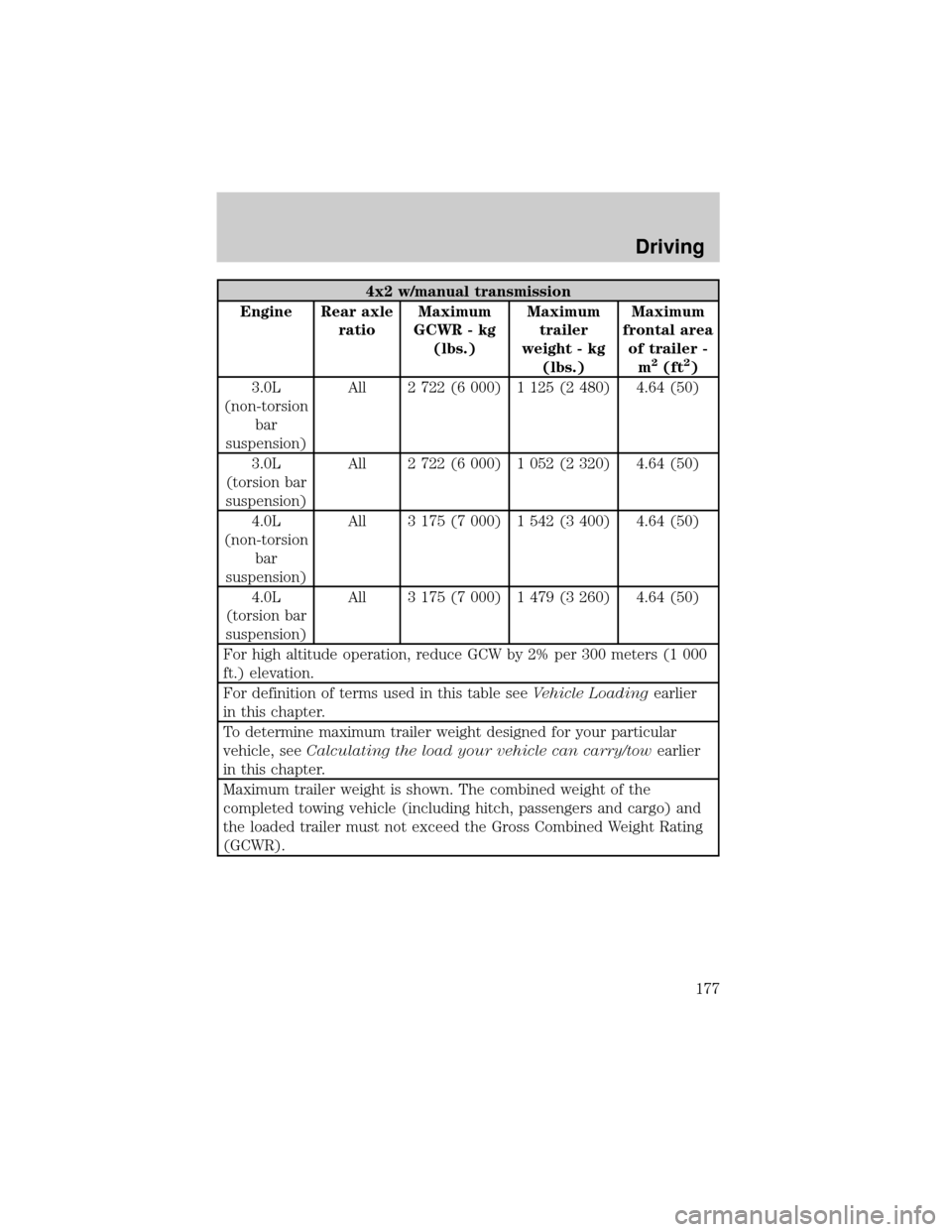
4x2 w/manual transmission
Engine Rear axle
ratioMaximum
GCWR - kg
(lbs.)Maximum
trailer
weight - kg
(lbs.)Maximum
frontal area
of trailer -
m
2(ft2)
3.0L
(non-torsion
bar
suspension)All 2 722 (6 000) 1 125 (2 480) 4.64 (50)
3.0L
(torsion bar
suspension)All 2 722 (6 000) 1 052 (2 320) 4.64 (50)
4.0L
(non-torsion
bar
suspension)All 3 175 (7 000) 1 542 (3 400) 4.64 (50)
4.0L
(torsion bar
suspension)All 3 175 (7 000) 1 479 (3 260) 4.64 (50)
For high altitude operation, reduce GCW by 2% per 300 meters (1 000
ft.) elevation.
For definition of terms used in this table seeVehicle Loadingearlier
in this chapter.
To determine maximum trailer weight designed for your particular
vehicle, seeCalculating the load your vehicle can carry/towearlier
in this chapter.
Maximum trailer weight is shown. The combined weight of the
completed towing vehicle (including hitch, passengers and cargo) and
the loaded trailer must not exceed the Gross Combined Weight Rating
(GCWR).
Driving
177
Page 179 of 288

4x2 w/automatic transmission
Engine Rear axle
ratioMaximum
GCWR - kg
(lbs.)Maximum
trailer
weight - kg
(lbs.)Maximum
frontal area
of trailer -
m
2(ft2)
Regular Cab w/6' box
2.3L All 2 495 (5 500) 1 025 (2 260) Equal to
frontal area
of vehicle
3.0L
(non-torsion
bar
suspensionAll 3 402 (7 500) 1 869 (4 120) 4.64 (50)
3.0L (tosion
bar
suspension)All 3 402 (7 500) 1 814 (4 000) 4.64 (50)
4.0L
(non-torsion
bar
suspension)All 4 309 (9 500) 2 740 (6 040) 4.64 (50)
4.0L
(torsion bar
suspension)All 4 309 (9 500) 2 685 (5 920) 4.64 (50)
Regular Cab w/7' box
2.3L All 2 495 (5 500) 1 007 (2 220) Equal to
frontal area
of vehicle
3.0L All 3 402 (7 500) 1 842 (4 060) 4.64 (50)
4.0L All 4 309 (9 500) 2 712 (5 980) 4.64 (50)
SuperCab
3.0L
(non-torsion
bar
suspension)All 3 402 (7 500) 1 787 (3 940) 4.64 (50)
Driving
179
Page 180 of 288

4x2 w/automatic transmission
Engine Rear axle
ratioMaximum
GCWR - kg
(lbs.)Maximum
trailer
weight - kg
(lbs.)Maximum
frontal area
of trailer -
m
2(ft2)
3.0L
(torsion bar
suspension)All 3 402 (7 500) 1 715 (3 780) 4.64 (50)
4.0L
(non-torsion
bar
suspension)All 4 309 (9 500) 2 667 (5 880) 4.64 (50)
4.0L
(torsion bar
suspension)All 4 309 (9 500) 2 595 (5 720) 4.64 (50)
For high altitude operation, reduce GCW by 2% per 300 meters (1 000
ft.) elevation.
For definition of terms used in this table seeVehicle Loadingearlier
in this chapter.
To determine maximum trailer weight designed for your particular
vehicle, seeCalculating the load your vehicle can carry/towearlier
in this chapter.
Maximum trailer weight is shown. The combined weight of the
completed towing vehicle (including hitch, passengers and cargo) and
the loaded trailer must not exceed the Gross Combined Weight Rating
(GCWR).
Driving
180