Page 176 of 288
4x2 w/manual transmission
Engine Rear axle
ratioMaximum
GCWR - kg
(lbs.)Maximum
trailer
weight - kg
(lbs.)Maximum
frontal area
of trailer -
m
2(ft2)
Regular Cab w/6' box
2.3L All 2 177 (4 800) 753 (1 660) Equal to
frontal area
of vehicle
3.0L
(non-torsion
bar
suspension)All 2 722 (6 000) 1 207 (2 660) 4.64 (50)
3.0L
(torsion bar
suspension)All 2 722 (6 000) 1 152 (2 540) 4.64 (50)
4.0L
(non-torsion
bar
suspension)All 3 175 (7 000) 1 624 (3 580) 4.64 (50)
4.0L
(torsion bar
suspension)All 3 175 (7 000) 1 569 (3 460) 4.64 (50)
Regular Cab w/7' box
2.3L All 2 177 (4 800) 726 (1 600) Equal to
frontal area
of vehicle
3.0L All 2 722 (6 000) 1 179 (2 600) 4.64 (50)
4.0L All 3 175 (7 000) 1 597 (3 520) 4.64 (50)
SuperCab
2.3L All 2 177 (4 800) 671 (1 480) Equal to
frontal area
of vehicle
Driving
176
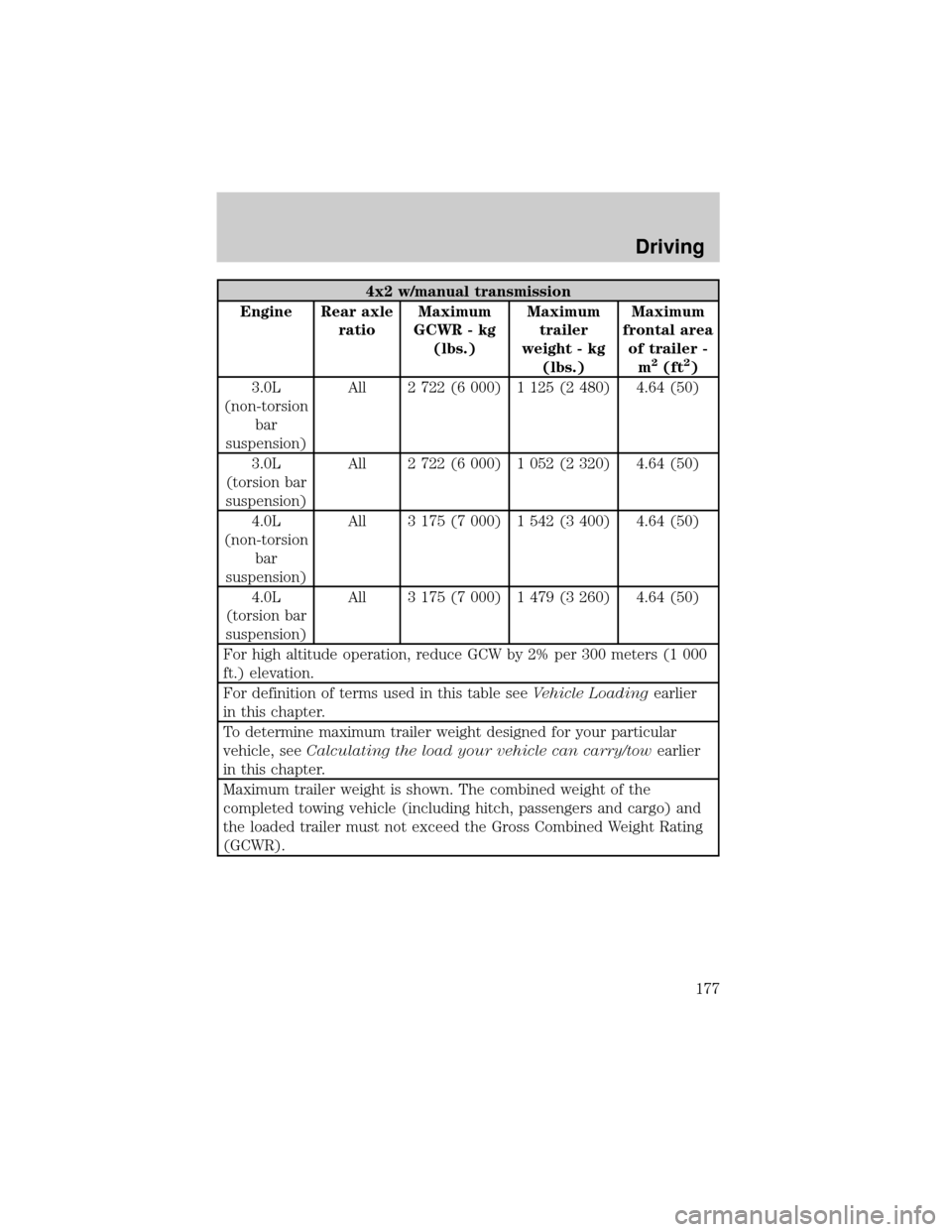
Page 177 of 288
4x2 w/manual transmission
Engine Rear axle
ratioMaximum
GCWR - kg
(lbs.)Maximum
trailer
weight - kg
(lbs.)Maximum
frontal area
of trailer -
m
2(ft2)
3.0L
(non-torsion
bar
suspension)All 2 722 (6 000) 1 125 (2 480) 4.64 (50)
3.0L
(torsion bar
suspension)All 2 722 (6 000) 1 052 (2 320) 4.64 (50)
4.0L
(non-torsion
bar
suspension)All 3 175 (7 000) 1 542 (3 400) 4.64 (50)
4.0L
(torsion bar
suspension)All 3 175 (7 000) 1 479 (3 260) 4.64 (50)
For high altitude operation, reduce GCW by 2% per 300 meters (1 000
ft.) elevation.
For definition of terms used in this table seeVehicle Loadingearlier
in this chapter.
To determine maximum trailer weight designed for your particular
vehicle, seeCalculating the load your vehicle can carry/towearlier
in this chapter.
Maximum trailer weight is shown. The combined weight of the
completed towing vehicle (including hitch, passengers and cargo) and
the loaded trailer must not exceed the Gross Combined Weight Rating
(GCWR).
Driving
177
Page 178 of 288

4x4 w/manual transmission
Engine Rear axle
ratioMaximum
GCWR - kg
(lbs.)Maximum
trailer
weight - kg
(lbs)Maximum
frontal area
of trailer -
m
2(ft2)
Regular Cab w/6' box
3.0L All 2 722 (6 000) 1 180 (2 380) 4.64 (50)
4.0L All 3 175 (7 000) 1 506 (3 320) 4.64 (50)
Regular Cab w/7' box
3.0L All 2 722 (6 000) 1 061 (2 340) 4.64 (50)
4.0L All 3 175 (7 000) 1 479 (3 260) 4.64 (50)
SuperCab
3.0L All 2 722 (6 000) 1 007 (2 220) 4.64 (50)
4.0L All 3 175 (7 000) 1 424 (3 140) 4.64 (50)
4.0L
(FX4
package)All 3 175 (7 000) 1 234 (2 720) 4.64 (50)
For high altitude operation, reduce GCW by 2% per 300 meters (1 000
ft.) of elevation.
For definition of terms used in this table, seeVehicle loadingearlier
in this chapter.
To determine maximum trailer weight designed for your vehicle, see
Calculating the load your vehicle can carry/towearlier in this
chapter.
Maximum trailer weight is shown. The combined weight of the
completed towing vehicle (including hitch, passengers and cargo) and
the loaded trailer must not exceed the Gross Combined Weight Rating
(GCWR).
Driving
178
Page 179 of 288
4x2 w/automatic transmission
Engine Rear axle
ratioMaximum
GCWR - kg
(lbs.)Maximum
trailer
weight - kg
(lbs.)Maximum
frontal area
of trailer -
m
2(ft2)
Regular Cab w/6' box
2.3L All 2 495 (5 500) 1 025 (2 260) Equal to
frontal area
of vehicle
3.0L
(non-torsion
bar
suspensionAll 3 402 (7 500) 1 869 (4 120) 4.64 (50)
3.0L (tosion
bar
suspension)All 3 402 (7 500) 1 814 (4 000) 4.64 (50)
4.0L
(non-torsion
bar
suspension)All 4 309 (9 500) 2 740 (6 040) 4.64 (50)
4.0L
(torsion bar
suspension)All 4 309 (9 500) 2 685 (5 920) 4.64 (50)
Regular Cab w/7' box
2.3L All 2 495 (5 500) 1 007 (2 220) Equal to
frontal area
of vehicle
3.0L All 3 402 (7 500) 1 842 (4 060) 4.64 (50)
4.0L All 4 309 (9 500) 2 712 (5 980) 4.64 (50)
SuperCab
3.0L
(non-torsion
bar
suspension)All 3 402 (7 500) 1 787 (3 940) 4.64 (50)
Driving
179
Page 180 of 288
4x2 w/automatic transmission
Engine Rear axle
ratioMaximum
GCWR - kg
(lbs.)Maximum
trailer
weight - kg
(lbs.)Maximum
frontal area
of trailer -
m
2(ft2)
3.0L
(torsion bar
suspension)All 3 402 (7 500) 1 715 (3 780) 4.64 (50)
4.0L
(non-torsion
bar
suspension)All 4 309 (9 500) 2 667 (5 880) 4.64 (50)
4.0L
(torsion bar
suspension)All 4 309 (9 500) 2 595 (5 720) 4.64 (50)
For high altitude operation, reduce GCW by 2% per 300 meters (1 000
ft.) elevation.
For definition of terms used in this table seeVehicle Loadingearlier
in this chapter.
To determine maximum trailer weight designed for your particular
vehicle, seeCalculating the load your vehicle can carry/towearlier
in this chapter.
Maximum trailer weight is shown. The combined weight of the
completed towing vehicle (including hitch, passengers and cargo) and
the loaded trailer must not exceed the Gross Combined Weight Rating
(GCWR).
Driving
180
Page 181 of 288

4x4 w/automatic transmission
Engine Rear axle
ratioMaximum
GCWR - kg
(lbs.)Maximum
trailer
weight - kg
(lbs.)Maximum
frontal area
of trailer -
m
2(ft2)
Regular Cab w/6' box
3.0L All 3 402 (7 500) 1 751 (3 860) 4.64 (50)
4.0L All 4 309 (9 500) 2 622 (5 780) 4.64 (50)
Regular Cab w/7' box
3.0L All 3 402 (7 500) 1 724 (3 800) 4.64 (50)
4.0L All 4 309 (9 500) 2 595 (5 720) 4.64 (50)
SuperCab
3.0L All 3 402 (7 500) 1 669 (3 680) 4.64 (50)
4.0L All 4 309 (9 500) 2 540 (5 600) 4.64 (50)
4.0L
(FX4
package)All 4 309 (9 500) 2 350 (5 180) 4.64 (50)
For high altitude operation, reduce GCW by 2% per 300 meters (1 000
ft.) of elevation.
For definition of terms used in this table, seeVehicle loadingearlier
in this chapter.
To determine maximum trailer weight designed for your vehicle, see
Calculating the load your vehicle can carry/towearlier in this
chapter.
Maximum trailer weight is shown. The combined weight of the completed
towing vehicle (including hitch, passengers and cargo) and the loaded
trailer must not exceed the Gross Combined Weight Rating (GCWR).
Do not exceed the GVWR or the GAWR specified on the
certification label.
Towing trailers beyond the maximum recommended gross trailer
weight could result in engine damage, transmission/axle damage,
structural damage, loss of control, and personal injury.
Driving
181
Page 185 of 288

Trailer towing tips
²Practice turning, stopping and backing up before starting on a trip to
get the feel of the vehicle trailer combination. When turning, make
wider turns so the trailer wheels will clear curbs and other obstacles.
²Allow more distance for stopping with a trailer attached.
²The trailer tongue weight should be no more than 10±15% of the
loaded trailer weight.
²After you have traveled 80 km (50 miles), thoroughly check your
hitch, electrical connections and trailer wheel lug nuts.
²When stopped in traffic for long periods of time in hot weather, place
the gearshift in P (Park) (automatic transmissions) or N (Neutral)
(manual transmissions). This aids engine cooling and air conditioner
efficiency.
²Vehicles with trailers should not be parked on a grade. If you must
park on a grade, place wheel chocks under the trailer's wheels.
Launching or retrieving a boat
When backing down a ramp during boat launching or retrieval:
²do not allow the static water level to rise above the bottom edge of
the rear bumper.
²do not allow waves to break higher than 15 cm (6 inches) above the
bottom edge of the rear bumper.
Exceeding these limits may allow water to enter critical vehicle
components, adversely affecting driveability, emissions, reliability and
causing internal transmission damage.
Replace the rear axle lubricant any time the axle has been submerged in
water. Rear axle lubricant quantities are not to be checked or changed
unless a leak is suspected or repair required.
Disconnect the wiring to the trailer before backing the trailer into the
water. Reconnect the wiring to the trailer after the trailer is removed
from the water.
RECREATIONAL TOWING
Follow these guidelines if you have a need for recreational towing. An
example of recreational towing would be towing your vehicle behind a
motorhome. These guidelines are designed to ensure that your
transmission is not damaged.
Driving
185
Page 188 of 288

ROADSIDE COVERAGE BEYOND BASIC WARRANTY
In the United States, you may purchase additional roadside assistance
coverage beyond this period through the Ford Auto Club by contacting
your Ford or Lincoln Mercury dealer.
Similarly in Canada, for uninterrupted Roadside Assistance coverage, you
may purchase extended coverage prior to your Basic Warranty's Roadside
Assistance expiring. For more information and enrollment, contact
1±877±294±2582 or visit our website at www.ford.ca.
HAZARD FLASHER
Use only in an emergency to warn traffic of vehicle breakdown,
approaching danger, etc. The hazard flashers can be operated when the
ignition is off.
²The hazard lights control is
located on top of the steering
column.
²Depress hazard lights control to
activate all hazard flashers
simultaneously.
²Depress control again to turn the
flashers off.
FUEL PUMP SHUT-OFF SWITCH
FUEL
RESET
The fuel pump shut-off switch is a device intended to stop the electric
fuel pump when your vehicle has been involved in a substantial jolt.
After a collision, if the engine cranks but does not start, the fuel pump
shut-off switch may have been activated. The ªFuel Resetº indicator light
will illuminate in the instrument cluster.
Roadside Emergencies
188