2002 FORD MUSTANG ESP
[x] Cancel search: ESPPage 145 of 264

stopping distance. Always leave enough room
between your vehicle and the vehicle in front of
you to stop.
²We recommend that you familiarize yourself with
this braking technique. However, avoid taking any
unnecessary risks.
Hydraulic brake booster system (Hydroboost)
The Hydroboost system receives fluid pressure from
the power steering pump to provide power assist
during braking.
The sound of the pump operating may be heard by
the driver, but this is a normal characteristic of the
system.
For Hydroboost-equipped vehicles operating under
normal conditions, the noise of the fluid flowing
through the booster may be heard whenever the
brake is applied. This condition is normal. Vehicle
service is not required.
If braking performance or pedal response becomes
very poor, even when the pedal is strongly
depressed, it may indicate the presence of air in the
hydraulic system or leakage of fluid. Stop the vehicle
safely as soon as possible and seek service
immediately.
TRACTION CONTROLY
Your vehicle may be equipped with the optional
Traction Controlysystem. This system helps you
maintain the stability and steerability of your
vehicle. It is especially useful on slippery road
surfaces. The system operates by detecting and
controlling wheel spin. The system borrows many of
the electronic and mechanical elements already
present in the anti-lock braking system (ABS).
Wheel-speed sensors allow excess rear wheel spin to
be detected by the Traction Controlyportion of the
ABS computer. Any excessive wheel spin is
controlled by automatically applying and releasing
the rear brakes in conjunction with engine torque
Driving
145
Page 158 of 264
DRIVING THROUGH WATER
Do not drive quickly through standing water,
especially if the depth is unknown. Traction or brake
capability may be limited and if the ignition system
gets wet, your engine may stall. Water may also
enter your engine's air intake and severely damage
your engine.
If driving through deep or standing water is
unavoidable, proceed very slowly. Never drive
through water that is higher than the bottom of the
hubs (for trucks) or the bottom of the wheel rims
(for cars).
Once through the water, always try the brakes. Wet
brakes do not stop the vehicle as effectively as dry
brakes. Drying can be improved by moving your
vehicle slowly while applying light pressure on the
brake pedal.
Driving through deep water where the
transmission vent tube is submerged may allow
water into the transmission and cause internal
transmission damage.
VEHICLE LOADING
Before loading a vehicle, familiarize yourself with the
following terms:
²Base Curb Weight:Weight of the vehicle
including any standard equipment, fluids,
lubricants, etc. It does not include occupants or
aftermarket equipment.
²Payload:Combined maximum allowable weight of
cargo, occupants and optional equipment. The
payload equals the gross vehicle weight rating
minus base curb weight.
²GVW (Gross Vehicle Weight):Base curb weight
plus payload weight. The GVW is not a limit or a
specification.
Driving
158
Page 182 of 264
If you still have a complaint involving a warranty
dispute, you may wish to contact the Dispute
Settlement Board (U.S.).
In some states (in the U.S.) you must directly notify
Ford in writing before pursuing remedies under your
state's warranty laws. Ford is also allowed a final
repair attempt in some states.
In the United States, a warranty dispute must be
submitted to the Dispute Settlement Board before
taking action under the Magnuson-Moss Warranty
Act, or to the extent allowed by state law, before
pursuing replacement or repurchase remedies
provided by certain state laws. This dispute handling
procedure is not required prior to enforcing state
created rights or other rights which are independent
of the Magnuson-Moss Warranty Act or state
replacement or repurchase laws.
FORD EXTENDED SERVICE PLAN
You can get more protection for your new car or
light truck by purchasing Ford Extended Service
Plan (Ford ESP) coverage. Ford ESP is an optional
service contract which is backed by Ford Motor
Company or Ford Motor Service Company (in the
U.S.) and Ford of Canada (in Canada). It provides
the following:
²Benefits during the warranty period depending on
the plan you purchase (such as: reimbursement
for rentals; coverage for certain maintenance and
wear items).
²Protection against covered repair costs after your
Bumper-to-Bumper Warranty expires.
You may purchase Ford ESP from any participating
Ford and Lincoln Mercury and Ford of Canada
dealer. There are several plans available in various
time, distance and deductible combinations which
can be tailored to fit your own driving needs. Ford
ESP also offers reimbursement benefits for towing
and rental coverage.
Customer Assistance
182
Page 183 of 264
When you buy Ford ESP, you receive Peace-of-Mind
protection throughout the United States and Canada,
provided by a network of more than 5,000
participating Ford or Lincoln Mercury and Ford of
Canada dealers.
If you did not take advantage of the Ford Extended
Service Plan at the time of purchasing your vehicle,
you may still be eligible. Please contact your dealer
for further information. Since this information is
subject to change, please ask your dealer for
complete details about Ford Extended Service Plan
coverage options, or visit the Ford ESP website at
www.ford-esp.com.
THE DISPUTE SETTLEMENT BOARD
(U.S. ONLY)
The Dispute Settlement Board is:
²an independent, third-party arbitration program
for warranty disputes
²available free to owners and lessees of qualifying
Ford Motor Company vehicles
The Dispute Settlement Board may not be available
in all states. Ford Motor Company reserves the right
to change eligibility limitations, modify procedures
and/or to discontinue this service without notice and
without incurring obligations per applicable state
law.
What kinds of cases does the Board review?
Unresolved warranty repair concerns or vehicle
performance concerns as on Ford and Lincoln
Mercury cars and Ford and Lincoln Mercury light
trucks which are within the terms of any applicable
written new vehicle warranty are eligible for review,
except those involving:
²a non-Ford product
²a non-Ford dealership
Customer Assistance
183
Page 188 of 264
GETTING ASSISTANCE OUTSIDE THE U.S. AND
CANADA
Before exporting your vehicle to a foreign country,
contact the appropriate foreign embassy or
consulate. These officials can inform you of local
vehicle registration regulations and where to find
unleaded fuel.
If you cannot find unleaded fuel or can only get fuel
with an anti-knock index lower than is
recommended for your vehicle, contact a district or
owner relations/customer relationship office.
The use of leaded fuel in your vehicle without
proper conversion may damage the effectiveness of
your emission control system and may cause engine
knocking or serious engine damage. Ford Motor
Company/Ford of Canada is not responsible for any
damage caused by use of improper fuel.
In the United States, using leaded fuel may also
result in difficulty importing your vehicle back into
the U.S.
If your vehicle must be serviced while you are
traveling or living in Central or South America, the
Caribbean, or the Middle East, contact the nearest
Ford dealership. If the dealership cannot help you,
write or call:
FORD MOTOR COMPANY
WORLDWIDE DIRECT MARKET OPERATIONS
1555 Fairlane Drive
Fairlane Business Park #3
Allen Park, Michigan 48101
U.S.A.
Telephone: (313) 594-4857
FAX: (313) 390-0804
If you are in another foreign country, contact the
nearest Ford dealership. If the dealership employees
cannot help you, they can direct you to the nearest
Ford affiliate office.
Customer Assistance
188
Page 192 of 264
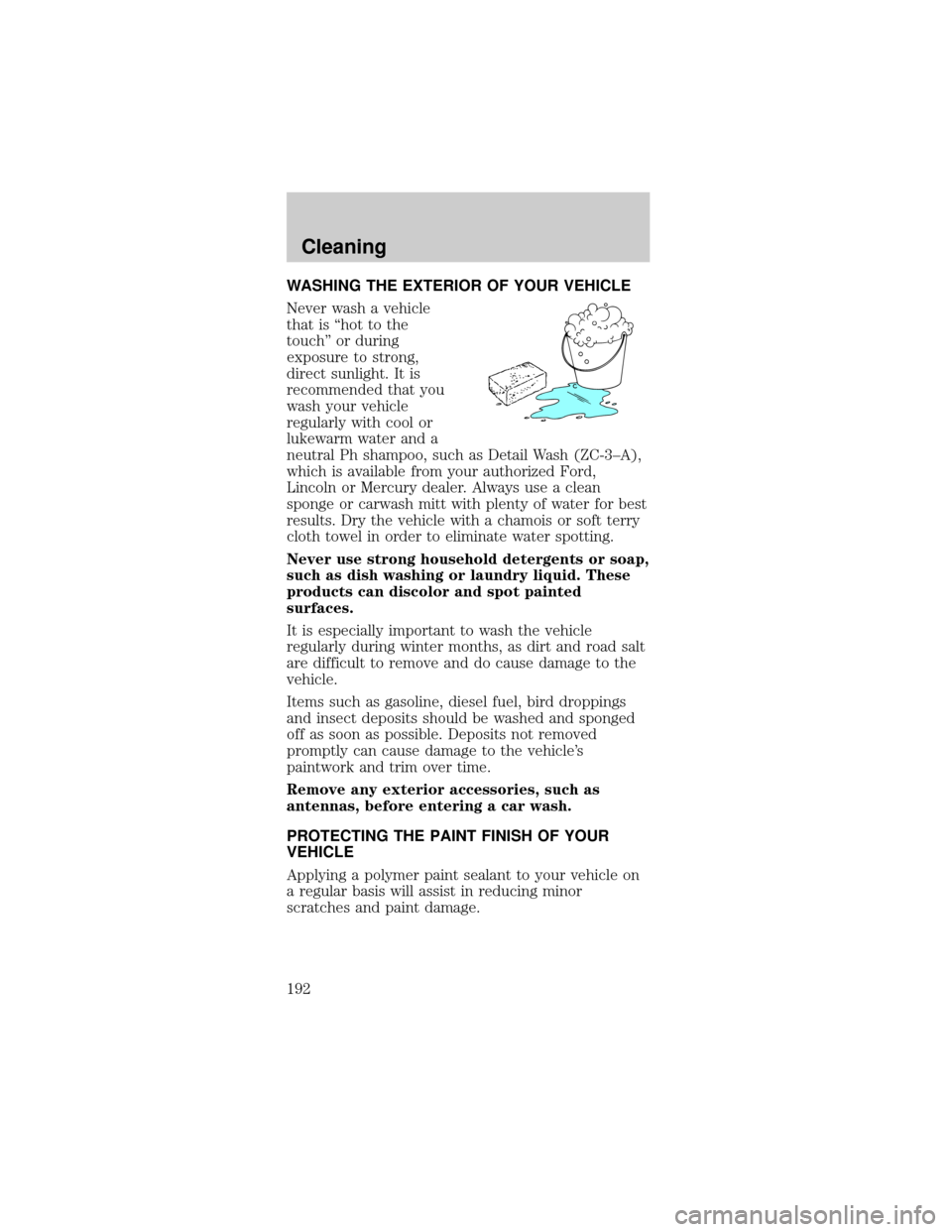
WASHING THE EXTERIOR OF YOUR VEHICLE
Never wash a vehicle
that is ªhot to the
touchº or during
exposure to strong,
direct sunlight. It is
recommended that you
wash your vehicle
regularly with cool or
lukewarm water and a
neutral Ph shampoo, such as Detail Wash (ZC-3±A),
which is available from your authorized Ford,
Lincoln or Mercury dealer. Always use a clean
sponge or carwash mitt with plenty of water for best
results. Dry the vehicle with a chamois or soft terry
cloth towel in order to eliminate water spotting.
Never use strong household detergents or soap,
such as dish washing or laundry liquid. These
products can discolor and spot painted
surfaces.
It is especially important to wash the vehicle
regularly during winter months, as dirt and road salt
are difficult to remove and do cause damage to the
vehicle.
Items such as gasoline, diesel fuel, bird droppings
and insect deposits should be washed and sponged
off as soon as possible. Deposits not removed
promptly can cause damage to the vehicle's
paintwork and trim over time.
Remove any exterior accessories, such as
antennas, before entering a car wash.
PROTECTING THE PAINT FINISH OF YOUR
VEHICLE
Applying a polymer paint sealant to your vehicle on
a regular basis will assist in reducing minor
scratches and paint damage.
Cleaning
192
Page 201 of 264

SERVICE RECOMMENDATIONS
To help you service your vehicle:
²We highlight do-it-yourself items in the engine
compartment for easy location.
²We provide a scheduled maintenance guide which
makes tracking routine service easy.
If your vehicle requires professional service, your
dealership can provide the necessary parts and
service. Check yourWarranty Guideto find out
which parts and services are covered.
Use only recommended fuels, lubricants, fluids and
service parts conforming to specifications. Motorcraft
parts are designed and built to provide the best
performance in your vehicle.
PRECAUTIONS WHEN SERVICING YOUR
VEHICLE
Be especially careful when inspecting or servicing
your vehicle.
²Do not work on a hot engine.
²When the engine is running, keep loose clothing,
jewelry or long hair away from moving parts.
²Do not work on a vehicle with the engine running
in an enclosed space, unless you are sure you
have enough ventilation.
²Keep all lit cigarettes, open flames and other lit
material away from the battery and all fuel related
parts.
If you disconnect the battery, the engine must
ªrelearnº its idle conditions before your vehicle will
drive properly, as explained in theBatterysection in
this chapter.
Working with the engine off
²Automatic transmission:
1. Set the parking brake and ensure the gearshift is
securely latched in P (Park).
Maintenance and Specifications
201
Page 213 of 264

²Always dispose of
automotive batteries
in a responsible
manner. Follow your
local authorized
standards for
disposal. Call your
local authorized
recycling center to find out more about recycling
automotive batteries.
ENGINE COOLANT
Checking engine coolant
The concentration and level of engine coolant should
be checked at the mileage intervals in the scheduled
maintenance guide. The coolant concentration
should be maintained at 50/50 coolant and water,
which equates to a freeze point of -36É C (-34É F).
Coolant concentration testing is possible with a
hydrometer or antifreeze tester (such as the
Rotunda Battery and Antifreeze Tester, 014±R1060).
The level of coolant should be maintained at the
ªcold fullº of ªcold fill rangeº level in the coolant
reservoir. If the level falls below, add coolant per the
instructions in theAdding Engine Coolantsection.
Your vehicle was factory-filled with a 50/50 engine
coolant and water concentration. If the
concentration of coolant falls below 40% or above
60%, the engine parts could become damaged or not
work properly.A 50±50 mixture of coolant and
water provides the following:
²freeze protection down to -36É C (-34É F)
²boiling protection up to 129É C (265É F)
²protection against rust and other forms of
corrosion
²enables calibrated gages to function properly
LEAD
RETURN
RECYCLE
Maintenance and Specifications
213