Page 222 of 264

Brake fluid is toxic. If brake fluid contacts the eyes, flush eyes
with running water for 15 minutes. Seek medical if irritation
persists. If taken internally, drink water and induce vomiting. Seek
medical attention immediately.
During normal operation, the fluid level in the clutch reservoir should
remain constant or rise slightly. If the fluid level drops, refill the fluid
level to the step in the reservoir.
1. Clean the reservoir cap before
removal to prevent dirt and water
from entering the reservoir.
2. Remove cap and rubber
diaphragm from reservoir.
3. Add fluid until the level reaches
the step in the reservoir.
4. Reinstall rubber diaphragm and
cap onto reservoir.
TRANSMISSION FLUID
Checking automatic transmission fluid (if equipped)
Refer to your scheduled maintenance guide for scheduled intervals for
fluid checks and changes. Your transmission does not consume fluid.
However, the fluid level should be checked if the transmission is not
working properly, i.e., if the transmission slips or shifts slowly or if you
notice some sign of fluid leakage.
Automatic transmission fluid expands when warmed. To obtain an
accurate fluid check, drive the vehicle until it is at normal operating
temperature (approximately 30 km [20 miles]). If your vehicle has been
Maintenance and Specifications
222
ProCarManuals.com
Page 223 of 264

operated for an extended period at high speeds, in city traffic during hot
weather or pulling a trailer, the vehicle should be turned off for about 30
minutes to allow fluid to cool before checking.
1. Drive the vehicle 30 km (20 miles) or until it reaches normal operating
temperature.
2. Park the vehicle on a level surface and engage the parking brake.
3. With the parking brake engaged and your foot on the brake pedal,
start the engine and move the gearshift lever through all of the gear
ranges. Allow sufficient time for each gear to engage.
4. Latch the gearshift lever in P (Park) and leave the engine running.
5. Remove the dipstick, wiping it clean with a clean, dry lint free rag. If
necessary, refer toIdentifying components in the engine compartment
in this chapter for the location of the dipstick.
6. Install the dipstick making sure it is fully seated in the filler tube.
7. Remove the dipstick and inspect the fluid level. The fluid should be in
the designated area for normal operating temperature or ambient
temperature.
Low fluid level
Do not drive the vehicle if the fluid
level is at the bottom of the dipstick
and the ambient temperature is
above 10°C (50°F).
Correct fluid level
The transmission fluid should be checked at normal operating
temperature 66°C-77°C (150°F-170°F) on a level surface. The normal
operating temperature can be reached after approximately 30 km (20
miles) of driving.
You can check the fluid without driving if the ambient temperature is
above 10°C (50°F). However, if fluid is added at this time, an overfill
condition could result when the vehicle reaches normal operating
temperature.
ADD COLD HOT DO NOT ADD
DON'T ADD IF IN CROSSHATCHED AREA CHECK WHEN HOT IDLING IN PARK
Maintenance and Specifications
223
ProCarManuals.com
Page 224 of 264
![FORD F250 2002 Owners Manual The transmission fluid should be in
this range if at normal operating
temperature (66°C-77°C
[150°F-170°F]).
The transmission fluid should be in
this range if at ambient temperature
(10°C-35°C [](/manual-img/11/57805/w960_57805-223.png "FORD F250 2002 Owners Manual The transmission fluid should be in
this range if at normal operating
temperature (66°C-77°C
[150°F-170°F]).
The transmission fluid should be in
this range if at ambient temperature
(10°C-35°C [")
The transmission fluid should be in
this range if at normal operating
temperature (66°C-77°C
[150°F-170°F]).
The transmission fluid should be in
this range if at ambient temperature
(10°C-35°C [50°F-95°F]).
High fluid level
Fluid levels above the safe range
may result in transmission failure.
An overfill condition of transmission
fluid may cause shift and/or
engagement concerns and/or
possible damage.
High fluid levels can be caused by
an overheating condition.
Adjusting automatic transmission fluid levels
Before adding any fluid, make sure the correct type is used. The type of
fluid used is normally indicated on the dipstick and also in the
Lubricant specificationssection in this chapter.
Use of a non-approved automatic transmission fluid may cause
internal transmission component damage.
If necessary, add fluid in 250 ml (1/2 pint) increments through the filler
tube until the level is correct.
If an overfill occurs, excess fluid
should be removed by a qualified
technician.
An overfill condition of
transmission fluid may cause
shift and/or engagement
concerns and/or possible
damage.
ADD COLD HOT DO NOT ADD
DON'T ADD IF IN CROSSHATCHED AREA CHECK WHEN HOT IDLING IN PARK
ADD COLD HOT DO NOT ADD
DON'T ADD IF IN CROSSHATCHED AREA CHECK WHEN HOT IDLING IN PARK
ADD COLD HOT DO NOT ADD
DON'T ADD IF IN CROSSHATCHED AREA CHECK WHEN HOT IDLING IN PARK
ADD COLD HOT DO NOT ADD
DON'T ADD IF IN CROSSHATCHED AREA CHECK WHEN HOT IDLING IN PARK
Maintenance and Specifications
224
ProCarManuals.com
Page 225 of 264
Do not use supplemental transmission fluid additives, treatments or
cleaning agents. The use of these materials may affect transmission
operation and result in damage to internal transmission components.
Checking and adding manual transmission fluid (if equipped)
1. Clean the filler plug.
2. Remove the filler plug and
inspect the fluid level.
3. Fluid level should be at the
bottom of the opening.
4. Add enough fluid through the
filler opening so that the fluid level
is at the bottom of the opening.
5. Install and tighten the fill plug
securely.
Use only fluid that meets Ford specifications. Refer toLubricant
Specificationsin this chapter.
Maintenance and Specifications
225
ProCarManuals.com
Page 226 of 264
Checking and adding transfer case fluid (if equipped)
1. Clean the filler plug.
2. Remove the filler plug and
inspect the fluid level.
3. Add only enough fluid through
the filler opening so that the fluid
level is at the bottom of the
opening.
Use only fluid that meets Ford specifications. Refer toLubricant
Specificationsin this chapter.
DRIVELINE UNIVERSAL JOINT AND SLIP YOKE
Your vehicle may be equipped with universal joints that require
lubrication. Refer to the scheduled maintenance guide for maintenance
intervals. If the original universal joints are replaced with universal joints
equipped with grease fittings, lubrication will also be necessary.
AIR FILTER MAINTENANCE
Refer to the scheduled maintenance guide for the appropriate intervals
for changing the air filter element.
When changing the air filter element, use only the Motorcraft air filter
element listed. Refer toMotorcraft Part Numbers.
Maintenance and Specifications
226
ProCarManuals.com
Page 234 of 264
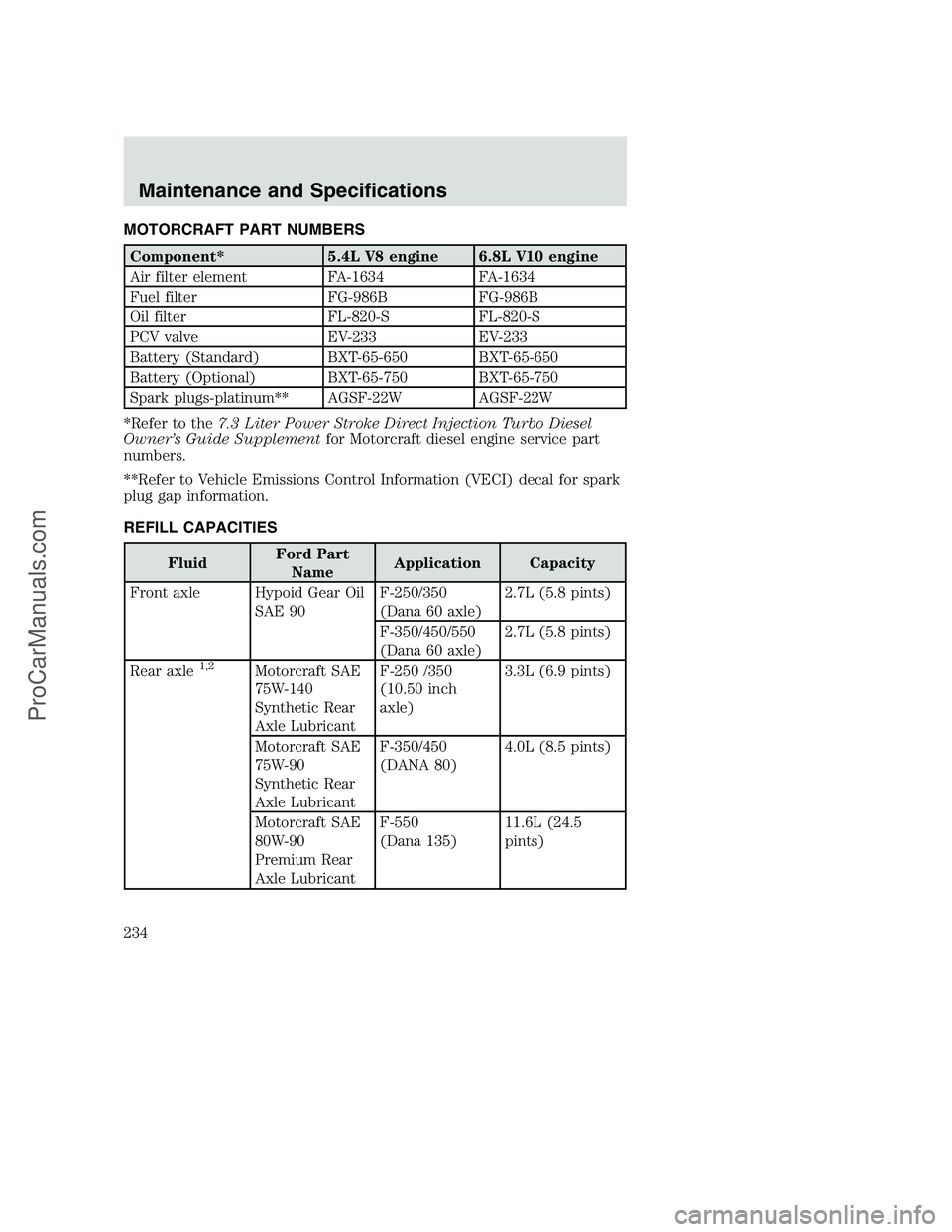
MOTORCRAFT PART NUMBERS
Component* 5.4L V8 engine 6.8L V10 engine
Air filter element FA-1634 FA-1634
Fuel filter FG-986B FG-986B
Oil filter FL-820-S FL-820-S
PCV valve EV-233 EV-233
Battery (Standard) BXT-65-650 BXT-65-650
Battery (Optional) BXT-65-750 BXT-65-750
Spark plugs-platinum** AGSF-22W AGSF-22W
*Refer to the7.3 Liter Power Stroke Direct Injection Turbo Diesel
Owner’s Guide Supplementfor Motorcraft diesel engine service part
numbers.
**Refer to Vehicle Emissions Control Information (VECI) decal for spark
plug gap information.
REFILL CAPACITIES
FluidFord Part
NameApplication Capacity
Front axle Hypoid Gear Oil
SAE 90F-250/350
(Dana 60 axle)2.7L (5.8 pints)
F-350/450/550
(Dana 60 axle)2.7L (5.8 pints)
Rear axle
1,2Motorcraft SAE
75W-140
Synthetic Rear
Axle LubricantF-250 /350
(10.50 inch
axle)3.3L (6.9 pints)
Motorcraft SAE
75W-90
Synthetic Rear
Axle LubricantF-350/450
(DANA 80)4.0L (8.5 pints)
Motorcraft SAE
80W-90
Premium Rear
Axle LubricantF-550
(Dana 135)11.6L (24.5
pints)
Maintenance and Specifications
234
ProCarManuals.com
Page 235 of 264
FluidFord Part
NameApplication Capacity
Brake fluid (and
clutch fluid-if
equipped)Motorcraft High
Performance
DOT 3 Motor
Vehicle Brake
FluidAll Fill to line or
step (for clutch)
on reservoir
Engine coolant
3Motorcraft
Premium Engine
Coolant
(green-colored)
orMotorcraft
Premium Gold
Engine Coolant
(yellow-colored)5.4L V8 engine
with A/C25.0L (26.4
quarts)
6.8L V10 engine 27.0L (28.5
quarts)
Engine oil
(includes filter
change)-Gas
enginesMotorcraft SAE
5W-20 Premium
Synthetic Blend
Motor OilAll 5.7L (6.0
quarts)
Engine oil
(includes filter
change)-Diesel
engineRefer to your 7.3L Diesel Supplement
Maintenance and Specifications
235
ProCarManuals.com
Page 236 of 264

FluidFord Part
NameApplication Capacity
Fuel tank N/A Mid-ship tank
(optional on
Chassis Cab)71.9L (19.0
gallons)
Right side
saddle mounted
tank (optional
on Chassis Cab)87.1L (23.0
gallons)
Short box 109.8L (29.0
gallons)
Long box 143.9L (38.0
gallons)
Aft axle 151.4L (40.0
gallons)
Power steering
fluidMotorcraft
MERCON�AT FAll Fill to line on
reservoir
Transfer case
fluidMotorcraft
MERCON�AT F4x4 vehicles 1.9L (2.0
quarts)
Transmission
fluid
4Motorcraft
MERCON�AT F6-speed manual 5.5L (5.8
quarts)5
Automatic 16.7L (17.7
quarts)6
Windshield
washer fluidMotorcraft
Premium
Windshield
Washer
ConcentrateAll 4.0L (4.25
quarts)
1Your vehicle’s rear axle(s) may be filled with a synthetic lubricant that
may require a lubricant change. Refer to the scheduled maintenance
guide. Axle lubricant quantities should not need to be checked unless a
leak is suspected, service is required or the axle assembly has been
submerged in water. The axle lubricant should be changed any time the
rear axle has been submerged in water.
2Add 236 ml (8 oz.) of Additive Friction Modifier XL-3or equivalent
meeting Ford Specification EST-M2C118-A for complete refill of
Traction-Lok axles.
Maintenance and Specifications
236
ProCarManuals.com


