2002 FORD F150 ignition
[x] Cancel search: ignitionPage 13 of 32
FUEL SELECTOR SWITCH
This booklet supplements your Owner's Guide and is part of the owner's
portfolio. It describes the operation of yourBi-fuelvehicle and how it
differs from a standard gasoline powered vehicle. Therefore it is very
important that you read this guide and thoroughly familiarize yourself
and others operating the vehicle with this information.
The fuel selector switch allows you to select which fuel yourBi-fuel
vehicle will operate on.
The fuel selector switch only operates when the vehicle is at a
stop with the ignition in the OFF position. If the fuel selector
switch is moved while the vehicle is running, the gaseous fuel
injection system will NOT automatically change fuel modes and
no damage to the vehicle will occur. Except for vehicles equipped
with the LPG extended-range fuel tank system, the fuel selector
switch will allow you to switch between the two LPG fuel tanks
while you are driving.
Prior to starting the vehicle (with the ignition in the OFF position),
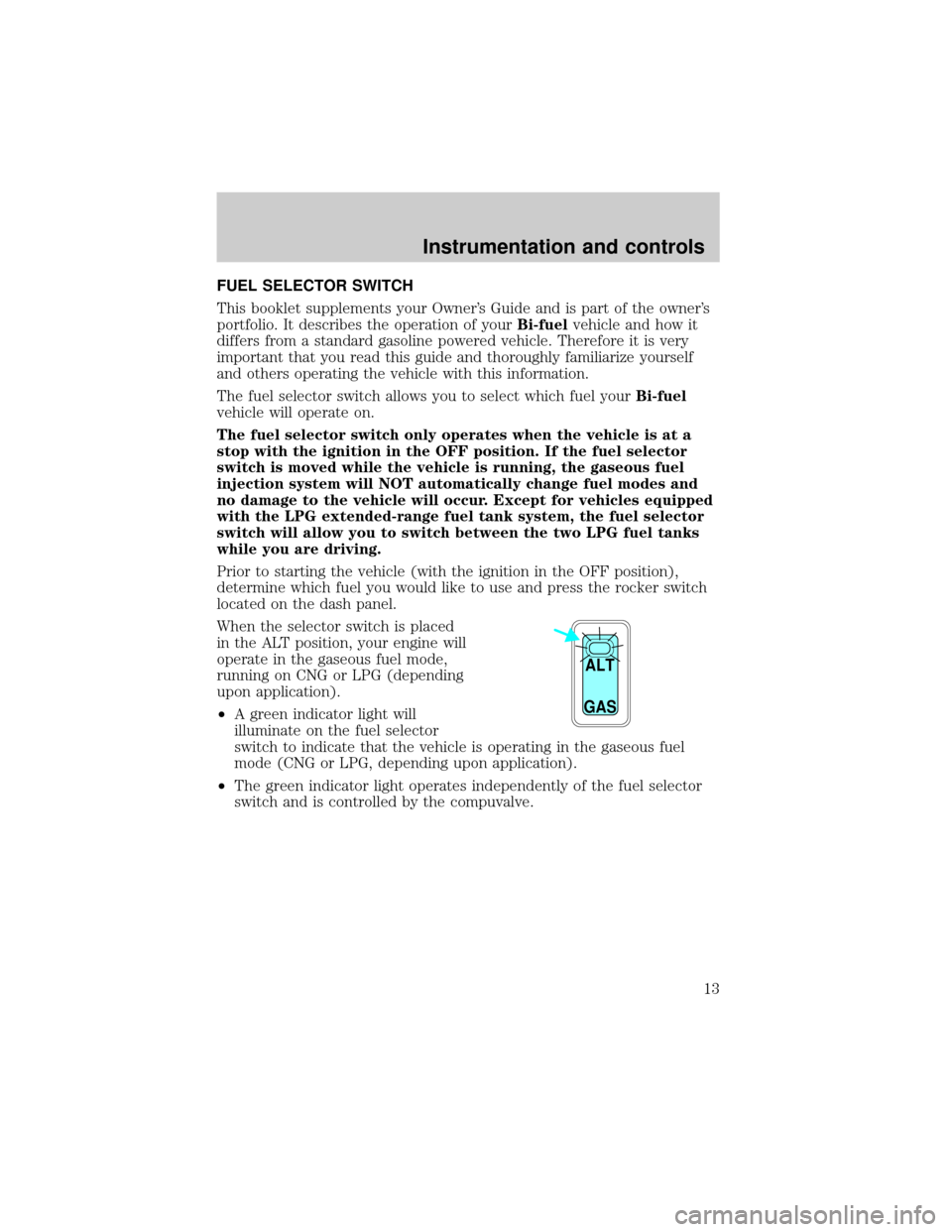
determine which fuel you would like to use and press the rocker switch
located on the dash panel.
When the selector switch is placed
in the ALT position, your engine will
operate in the gaseous fuel mode,
running on CNG or LPG (depending
upon application).
²A green indicator light will
illuminate on the fuel selector
switch to indicate that the vehicle is operating in the gaseous fuel
mode (CNG or LPG, depending upon application).
²The green indicator light operates independently of the fuel selector
switch and is controlled by the compuvalve.
ALT
GAS
Instrumentation and controls
13
Page 16 of 32
STARTING THE ENGINE
Before you start yourBi-fuelvehicle, read and understand all
information found in theStartingchapter of your Owner's Guide and
this supplement.
Use the following procedure to start yourBi-fuelvehicle in the gaseous
fuel mode:
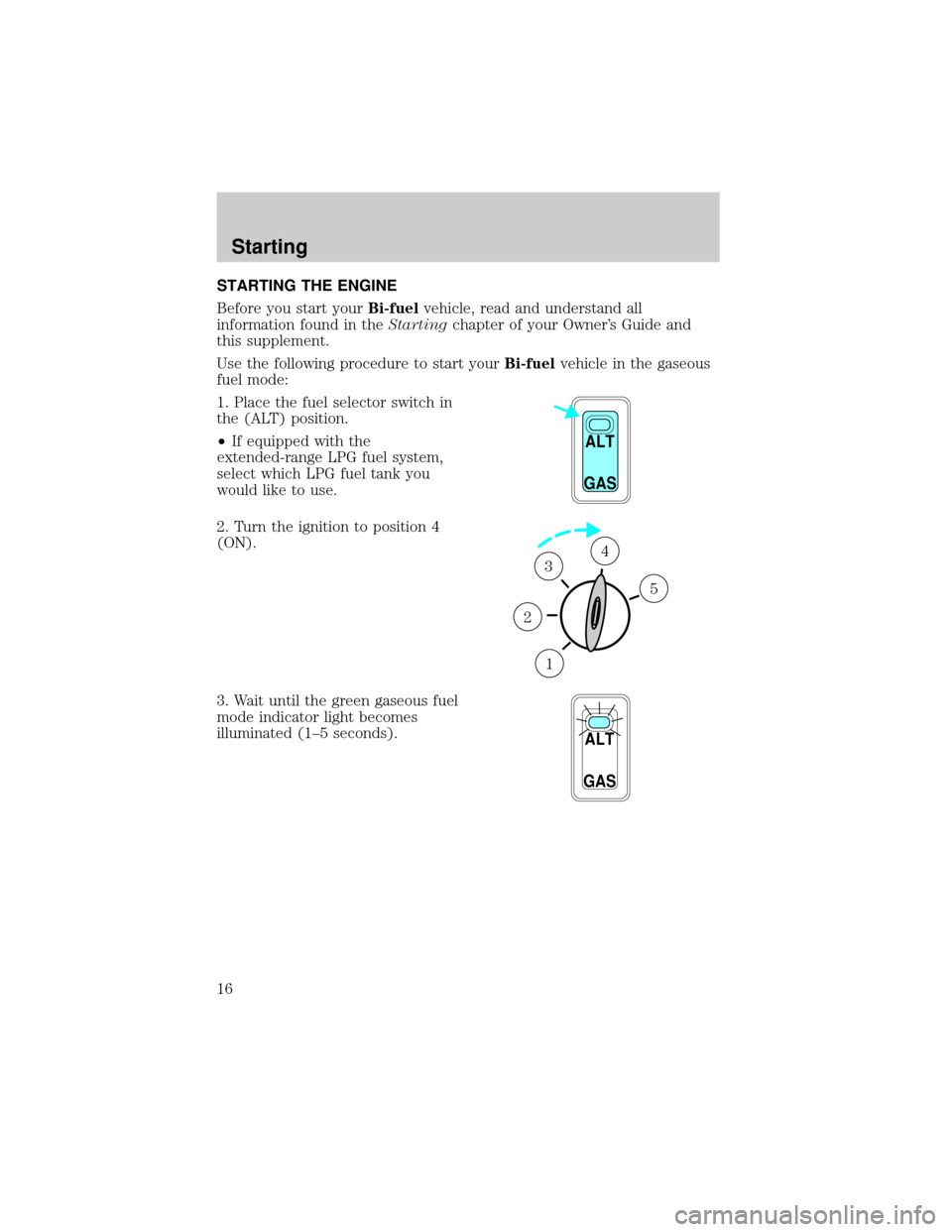
1. Place the fuel selector switch in
the (ALT) position.
²If equipped with the
extended-range LPG fuel system,
select which LPG fuel tank you
would like to use.
2. Turn the ignition to position 4
(ON).
3. Wait until the green gaseous fuel
mode indicator light becomes
illuminated (1±5 seconds).
ALT
GAS
1
2
34
5
GASALT
Starting
16
Page 17 of 32
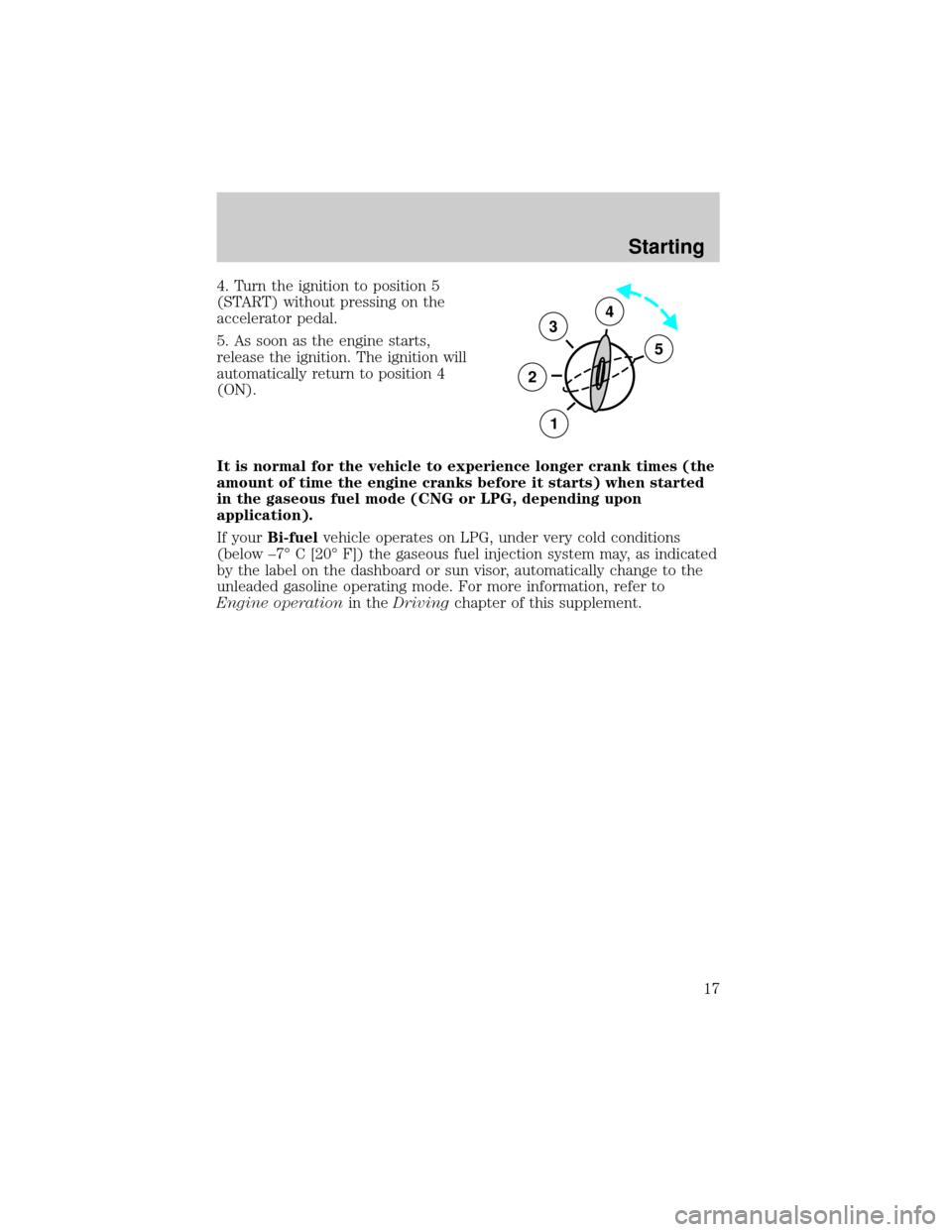
4. Turn the ignition to position 5
(START) without pressing on the
accelerator pedal.
5. As soon as the engine starts,
release the ignition. The ignition will
automatically return to position 4
(ON).
It is normal for the vehicle to experience longer crank times (the
amount of time the engine cranks before it starts) when started
in the gaseous fuel mode (CNG or LPG, depending upon
application).
If yourBi-fuelvehicle operates on LPG, under very cold conditions
(below ±7É C [20É F]) the gaseous fuel injection system may, as indicated
by the label on the dashboard or sun visor, automatically change to the
unleaded gasoline operating mode. For more information, refer to
Engine operationin theDrivingchapter of this supplement.
3
2
1
5
4
Starting
17
Page 18 of 32
ENGINE OPERATION
Before you drive yourBi-fuelvehicle, read and understand all
information found in theDrivingchapter of your Owner's Guide and this
supplement.
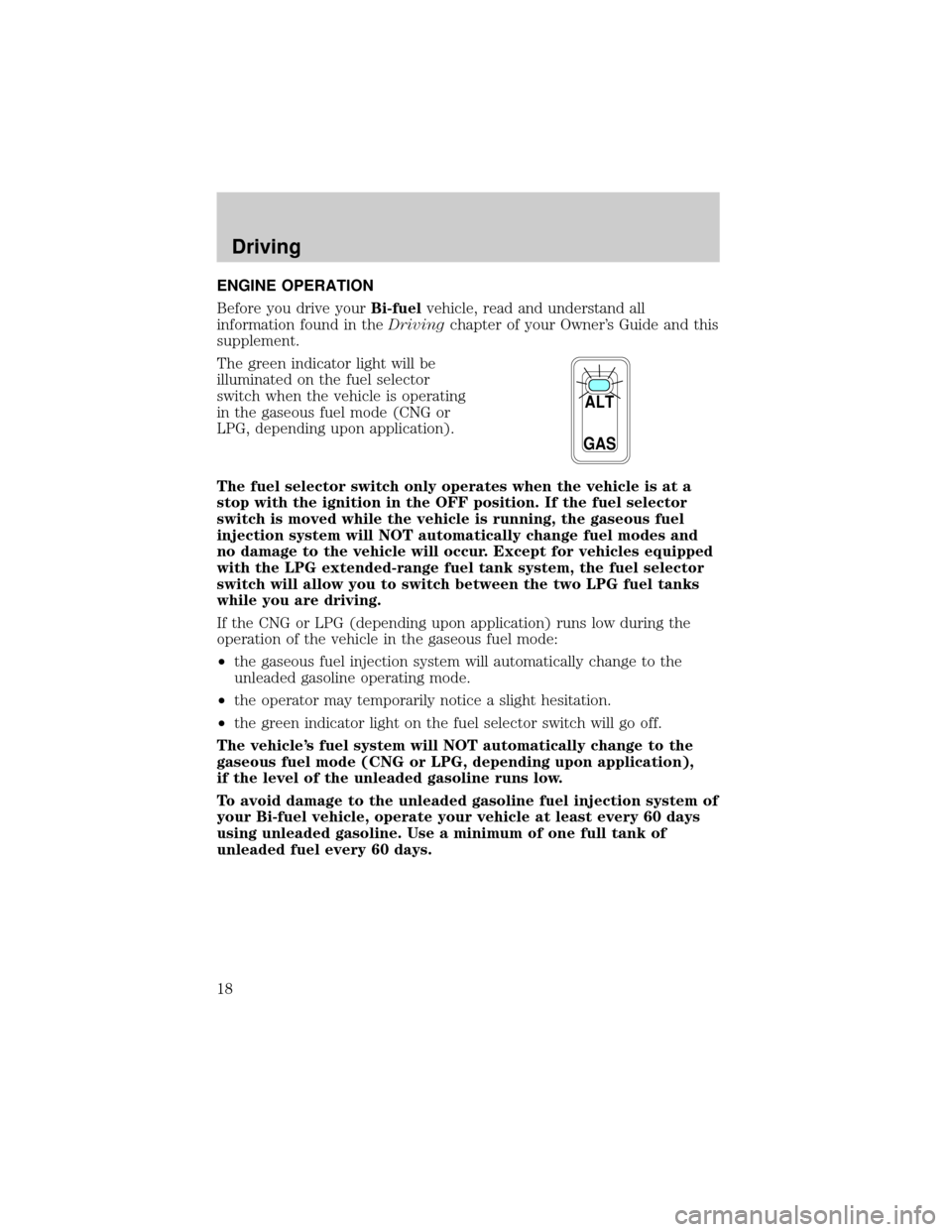
The green indicator light will be
illuminated on the fuel selector
switch when the vehicle is operating
in the gaseous fuel mode (CNG or
LPG, depending upon application).
The fuel selector switch only operates when the vehicle is at a
stop with the ignition in the OFF position. If the fuel selector
switch is moved while the vehicle is running, the gaseous fuel
injection system will NOT automatically change fuel modes and
no damage to the vehicle will occur. Except for vehicles equipped
with the LPG extended-range fuel tank system, the fuel selector
switch will allow you to switch between the two LPG fuel tanks
while you are driving.
If the CNG or LPG (depending upon application) runs low during the
operation of the vehicle in the gaseous fuel mode:
²the gaseous fuel injection system will automatically change to the
unleaded gasoline operating mode.
²the operator may temporarily notice a slight hesitation.
²the green indicator light on the fuel selector switch will go off.
The vehicle's fuel system will NOT automatically change to the
gaseous fuel mode (CNG or LPG, depending upon application),
if the level of the unleaded gasoline runs low.
To avoid damage to the unleaded gasoline fuel injection system of
your Bi-fuel vehicle, operate your vehicle at least every 60 days
using unleaded gasoline. Use a minimum of one full tank of
unleaded fuel every 60 days.
GASALT
Driving
18
Page 20 of 32
EMERGENCY PROCEDURES
Be sure to read and understand all information found in theRoadside
emergencychapter of your Owner's Guide and this supplement.
Do not modify the gaseous fuel injection system configuration or
components. Do not replace the gaseous fuel injection system
components with parts not designed for use with your Bi-fuel vehicle.
Components designed for use in your CNG or LPG Bi-fuel vehicle
consist of special materials and are calibrated especially for your
vehicle. Failure to use the correct components may cause damage to
the engine and fuel system or possible personal injury.
Service to gaseous fuel injection system components must be
conducted only at qualified dealerships by qualified service
technicians. Failure to do so may cause damage to the engine and fuel
system components or possible personal injury.
Any modification to your Gaseous Fuel Injection System voids
the Ford New Vehicle Limited Warranty.
If a CNG fuel leak is suspected or detected, switch operation to
the unleaded gasoline mode and have the complete gaseous fuel
injection system tested by a qualified service technician
immediately.
If the vehicle is involved in an accident or fire that damages any
portion of the gaseous fuel injection system, the damaged
components MUST be replaced and the complete system tested by
a qualified service technician before the vehicle is operated
again.
The fuel selector switch only operates when the vehicle is at a
stop with the ignition in the OFF position. If the fuel selector
switch is moved while the vehicle is running, the gaseous fuel
injection system will NOT automatically change fuel modes and
no damage to the vehicle will occur. Except for vehicles equipped
with the LPG extended-range fuel tank system, which allows you
to switch between the two LPG fuel tanks while you are driving.
Roadside emergencies
20
Page 22 of 32
SERVICE RECOMMENDATIONS
Before you service yourBi-fuelvehicle, read and understand all
information found in theMaintenance and carechapter of your
Owner's Guide and this supplement.
Refer to your scheduled maintenance guide for service requirements and
intervals.
Do not modify the gaseous fuel injection system configuration or
components. Do not replace the gaseous fuel injection system
components with parts not designed for use with your Bi-fuel vehicle.
Components designed for use in your CNG or LPG Bi-fuel vehicle
consist of special materials and are calibrated especially for your
vehicle. Failure to use the correct components may cause damage to
the engine and fuel system or possible personal injury.
Service to gaseous fuel injection system components must be
conducted only at qualified dealerships by qualified service
technicians. Failure to do so may cause damage to the engine and fuel
system components or possible personal injury.
Any modification to your Gaseous Fuel Injection System voids
the Ford New Vehicle Limited Warranty.
GASEOUS FUEL INJECTION SYSTEM SHUTOFF
When in the gaseous fuel mode under normal operating procedures, the
flow of CNG or LPG (depending upon application) is stopped when the
ignition is turned to the OFF position. The electrically operated control
valve(s) only allow the flow of fuel when the ignition is in the ON
position, with the engine running.
Liquefied petroleum gas (LPG)
If equipped with the manually-actuated supply valve(s), the flow of LPG
to the engine can be stopped by closing the supply valve located on the
LPG fuel tank(s).
If equipped, the manually-actuated supply valve(s) must be in the full
OPEN position for the engine to run on LPG.
Maintenance and care
22
Page 24 of 32
Compressed natural gas (CNG)
Use only a CNG fuel that meets the specification of NFPA-52 and SAE
J1616 in yourCNG Bi-fuelvehicle. Specifications NFPA-52 and SAE
J1616 place limits on particulate contamination and moisture content to
ensure a quality CNG fuel.
The use of a CNG fuel that does not meet specifications NFPA-52 and
SAE J1616 isnot recommendedand may cause engine damage.
Liquefied petroleum gas (LPG)
Use only an automotive grade LPG in yourLPG Bi-fuelvehicle.
Automotive grade LPG is typically referred to as HD-5 Propane and
contains at least 90% propane. Strict limits are placed on the amount of
other hydrocarbon gases which can be introduced into automotive grade
propane.
The use of an LPG fuel that does not meet the specification for HD-5
Propane (HD-10 Propane in California) isnot recommendedand may
cause engine damage.
REFUELING YOUR BI-FUEL VEHICLE
Refueling yourCNG or LPG Bi- fuelvehicle, with a few exceptions, is
very similar to refueling a standard unleaded gasoline powered vehicle.
Before refueling yourCNG or LPG Bi- fuelvehicle, be sure to read and
understandImportant safety precautionsin theMaintenance and
carechapter of your Owner's Guide and this supplement.
For safety reasons, use the same care and caution when refueling the
gaseous fuel injection system as you would when refueling the unleaded
gasoline fuel system. In particular, the enginemust always be turned
offwhen refueling.
DO NOT refuel your vehicle with the engine running or with the
ignition in the ON position. Failure to do so can be hazardous to
personal safety and property.
Some localities mandate a sticker be displayed showing the date of the
next required inspection. In localities requiring this sticker, refueling
station technicians arenot allowedto refill your gaseous fuel tank(s) if
the sticker is not visible or if the date has expired. For more information,
refer toTank inspection and replacementin theMaintenance and
carechapter of this supplement.
Maintenance and care
24