Page 26 of 32
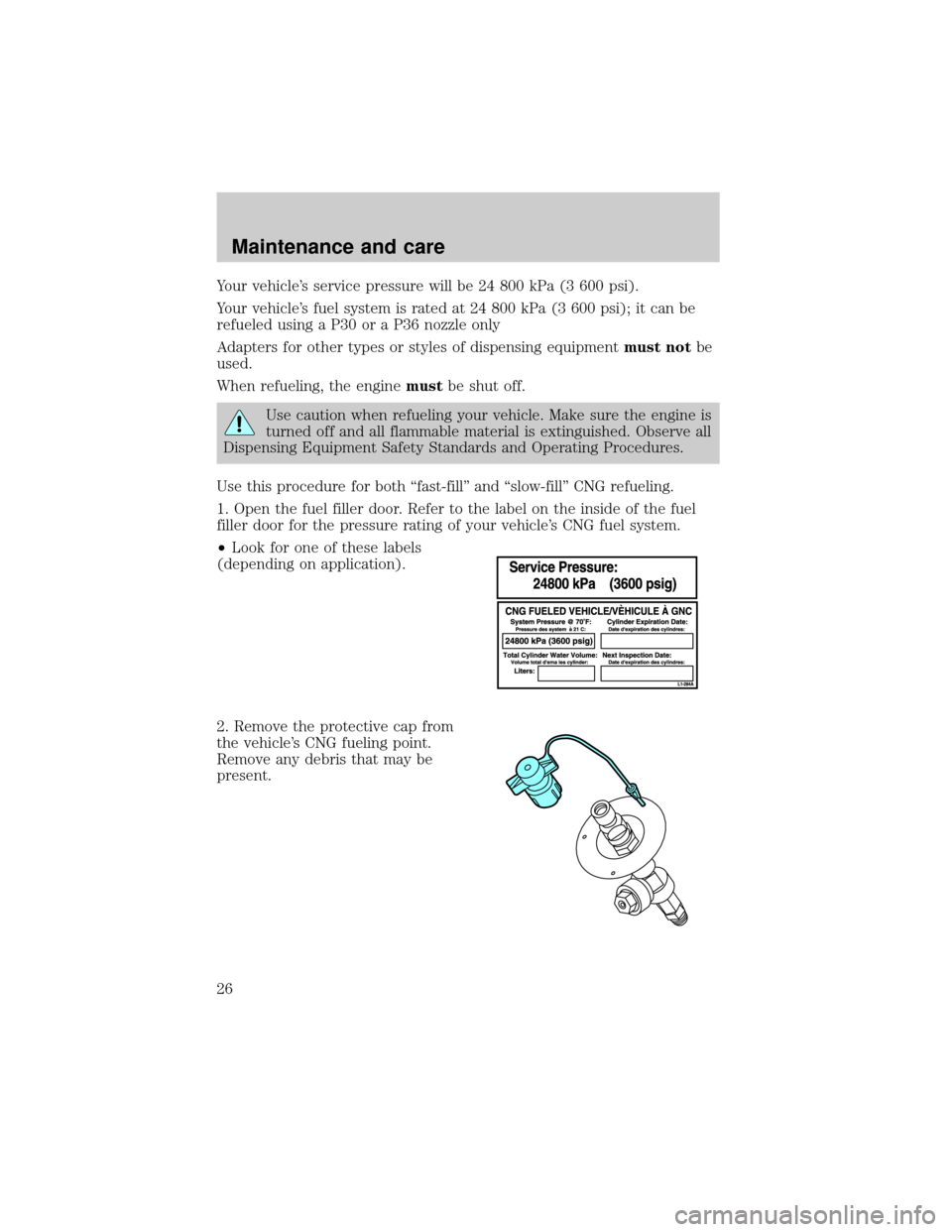
Your vehicle's service pressure will be 24 800 kPa (3 600 psi).
Your vehicle's fuel system is rated at 24 800 kPa (3 600 psi); it can be
refueled using a P30 or a P36 nozzle only
Adapters for other types or styles of dispensing equipmentmust notbe
used.
When refueling, the enginemustbe shut off.
Use caution when refueling your vehicle. Make sure the engine is
turned off and all flammable material is extinguished. Observe all
Dispensing Equipment Safety Standards and Operating Procedures.
Use this procedure for both ªfast-fillº and ªslow-fillº CNG refueling.
1. Open the fuel filler door. Refer to the label on the inside of the fuel
filler door for the pressure rating of your vehicle's CNG fuel system.
²Look for one of these labels
(depending on application).
2. Remove the protective cap from
the vehicle's CNG fueling point.
Remove any debris that may be
present.
Maintenance and care
26
Page 27 of 32
3. Follow the CNG fueling procedures provided by the natural gas dealer
and dispense the CNG until the fuel tank(s) are full or until the flow of
CNG stops.
4. When refueling is complete, follow the natural gas dispensing
equipment's operating procedures to shut the flow of natural gas off.
5. Remove the CNG dispensing connector and put the protective cap on
the vehicle's CNG fueling point. Close the fuel filler door.
CNG refill capacities Ð gasoline equivalent
F-Series
Fueling method Standard
Slow-fill 47.3L (12.5 gallons)
Fast-fill 40.1L (10.6 gallons)
Fuel fill procedure Ð liquefied petroleum gas (LPG)
Refueling aLPG Bi-fuelvehicle involves filling the vehicle's LPG fuel
tank(s) to the maximum limit of 80%. Refueling your LPG gaseous fuel
injection system is similar in terms of time spent refueling your unleaded
gasoline fuel system.
Your LPG Bi-fuel vehicle is equipped with an automatic stop-fill
device to limit the maximum LPG level in the fuel tank(s) to less
than 80%. Use of the 80% outage valve is required to prevent
overfilling of the LPG fuel tank(s).
Do not attempt to fill the LPG fuel tank(s) without opening the
outage valve. Use of the 80% outage valve is required to prevent
overfilling the LPG fuel tank(s). Failure to follow this warning may
cause damage to the engine and fuel system or possible personal
injury.
The LPG fueling point, or fuel receptacle is located on the driver's side of
the vehicle.
When refueling, the enginemustbe shut off.
Use caution when refueling your vehicle. Make sure the engine is
turned off and all flammable material is extinguished. Observe all
Dispensing Equipment Safety Standards and Operating Procedures.
Use the following procedure when refueling yourLPG Bi-fuelvehicle.
Maintenance and care
27
Page 31 of 32
Inspection and testing of the fuel tank(s) must be done by a qualified
Ford service technician, or by the local authority governing the
enforcement of gaseous fuel regulations in the jurisdiction of which you
refuel.
Some localities mandate a sticker be displayed showing the date of the
next required inspection. In localities requiring this sticker, refueling
station technicians arenot allowedto refill your gaseous fuel tank(s) if
the sticker is not visible or if the date has expired.
Refer to the following for more information regarding gaseous fuel tank
inspection and replacement requirements.
Compressed natural gas (CNG)
For your protection, the CNG fuel tanks require visual inspection every
three years or 48 000 kilometers (30 000 miles), whichever comes first.
The purpose of the inspection is to check for damage to the fuel tank(s)
or tank wrap which may shorten the tank(s) usable life span.
CNG fuel tanks that leak or show serious damagemustbe repaired or
replaced.
The expiration date for the tank replacement is stated on each tank
label. See instructions on fuel container for inspection and service life.
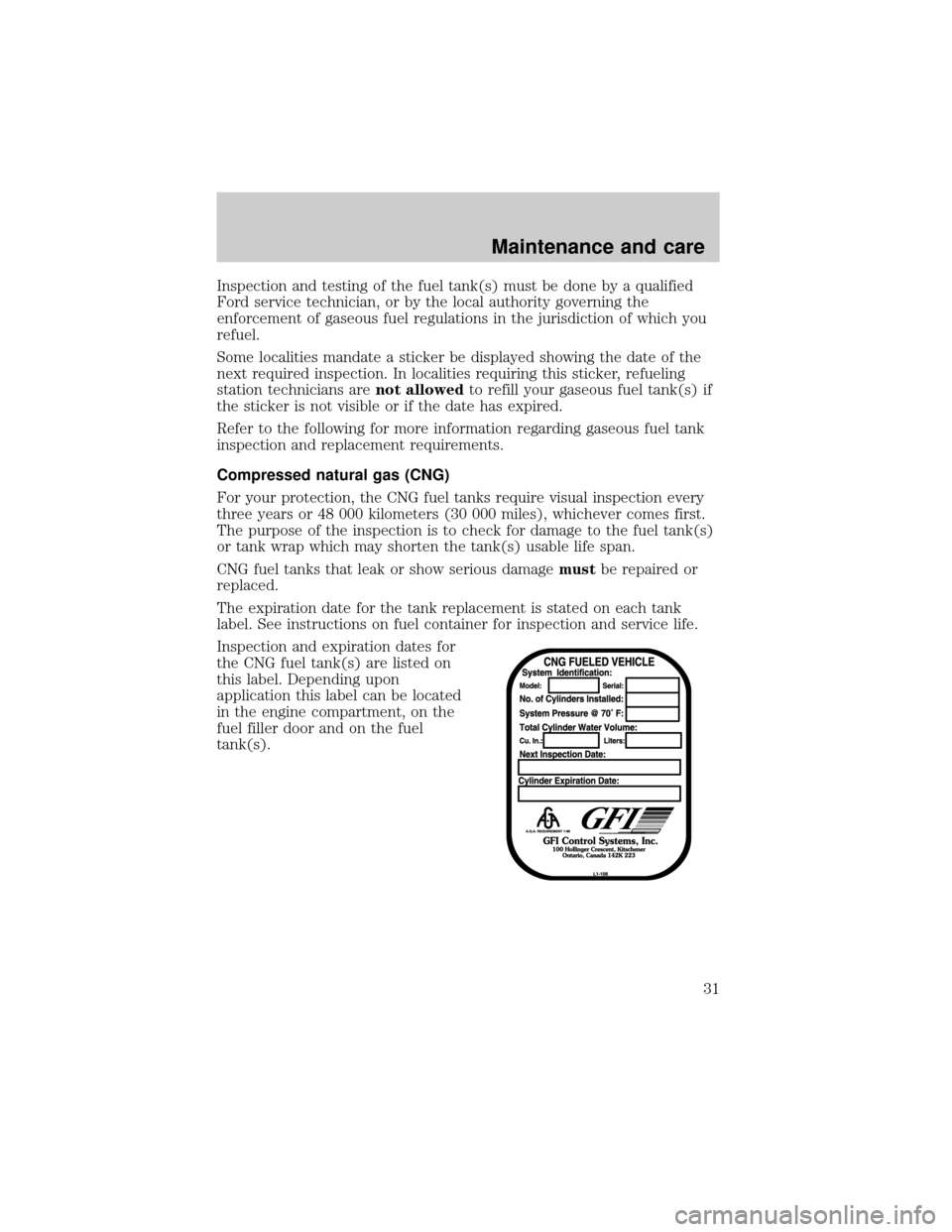
Inspection and expiration dates for
the CNG fuel tank(s) are listed on
this label. Depending upon
application this label can be located
in the engine compartment, on the
fuel filler door and on the fuel
tank(s).
Maintenance and care
31
Page 32 of 32
Liquefied petroleum gas (LPG)
For your protection, the LPG fuel tanksshouldbe visually inspected
every three years or 48 000 kilometers (30 000 miles) whichever comes
first. The purpose of the inspection is to check the tank(s) for damage or
excessive corrosion which may shorten the tank(s) usable life span.
All LPG fuel tank(s) used in Canada may require visual inspection every
five years. Contact the local authority governing the enforcement of
gaseous fuel regulations in the jurisdiction of which you refuel.
LPG fuel tanks that leak, show serious damage or excessive corrosion
mustbe repaired or replaced.
FUEL FILTER
YourBi-fuelvehicle is equipped with a separate fuel filter for the
gaseous fuel injection system. Its primary function is to remove
contaminants from the CNG or LPG fuel and trap it in the filter.
The fuel filter must be drained and/or replaced on a regular basis. Refer
to your scheduled maintenance guide for service requirements and
intervals.
Do not modify the gaseous fuel injection system configuration or
components. Do not replace the gaseous fuel injection system
components with parts not designed for use with your Bi-fuel vehicle.
Components designed for use in your CNG or LPG Bi-fuel vehicle
consist of special materials and are calibrated especially for your
vehicle. Failure to use the correct components may cause damage to
the engine and fuel system or possible personal injury.
Service to the gaseous fuel injection system components must be
conducted only at qualified dealerships by qualified service
technicians. Failure to do so may cause damage to the engine and fuel
system components or possible personal injury.
Maintenance and care
32
Page:
< prev 1-8 9-16 17-24