Page 121 of 184
Spare tire information
The spare tire on your vehicle can be used as a spare tire or a regular
tire. With 15”wheels, the wheel ornaments from the original wheel/tire
can be used on the spare tire.
Your spare tire and tools can be found in the following locations:
Tool Location
Spare Tire under the vehicle, just in front of the rear
bumper
Jack, lug nut wrench in the cargo area on the left rear quarter
panel, behind the interior access cover
Jack handle, jack
handle extensionbehind the rear seat under the carpet in the
cargo area
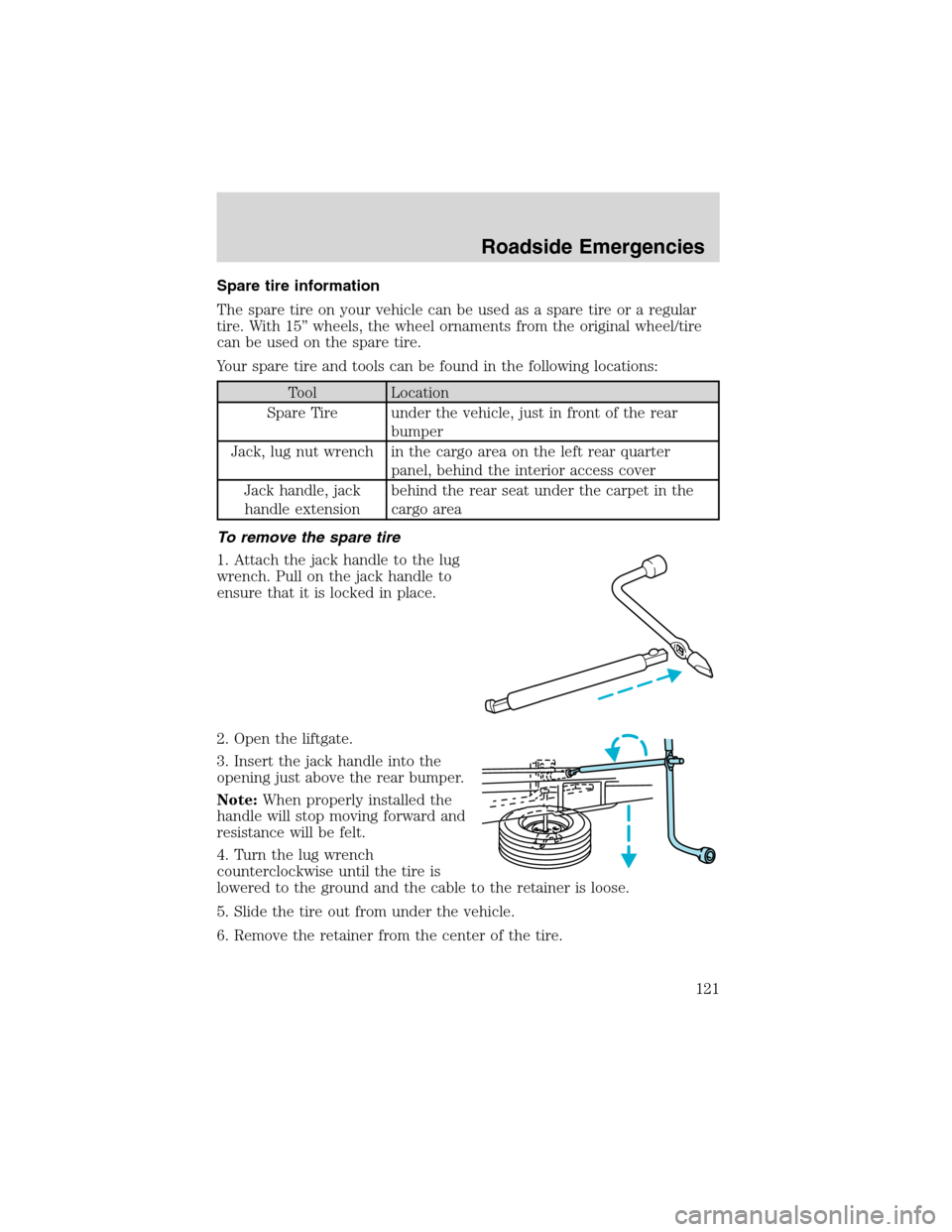
To remove the spare tire
1. Attach the jack handle to the lug
wrench. Pull on the jack handle to
ensure that it is locked in place.
2. Open the liftgate.
3. Insert the jack handle into the
opening just above the rear bumper.
Note:When properly installed the
handle will stop moving forward and
resistance will be felt.
4. Turn the lug wrench
counterclockwise until the tire is
lowered to the ground and the cable to the retainer is loose.
5. Slide the tire out from under the vehicle.
6. Remove the retainer from the center of the tire.
Roadside Emergencies
121
Page 122 of 184
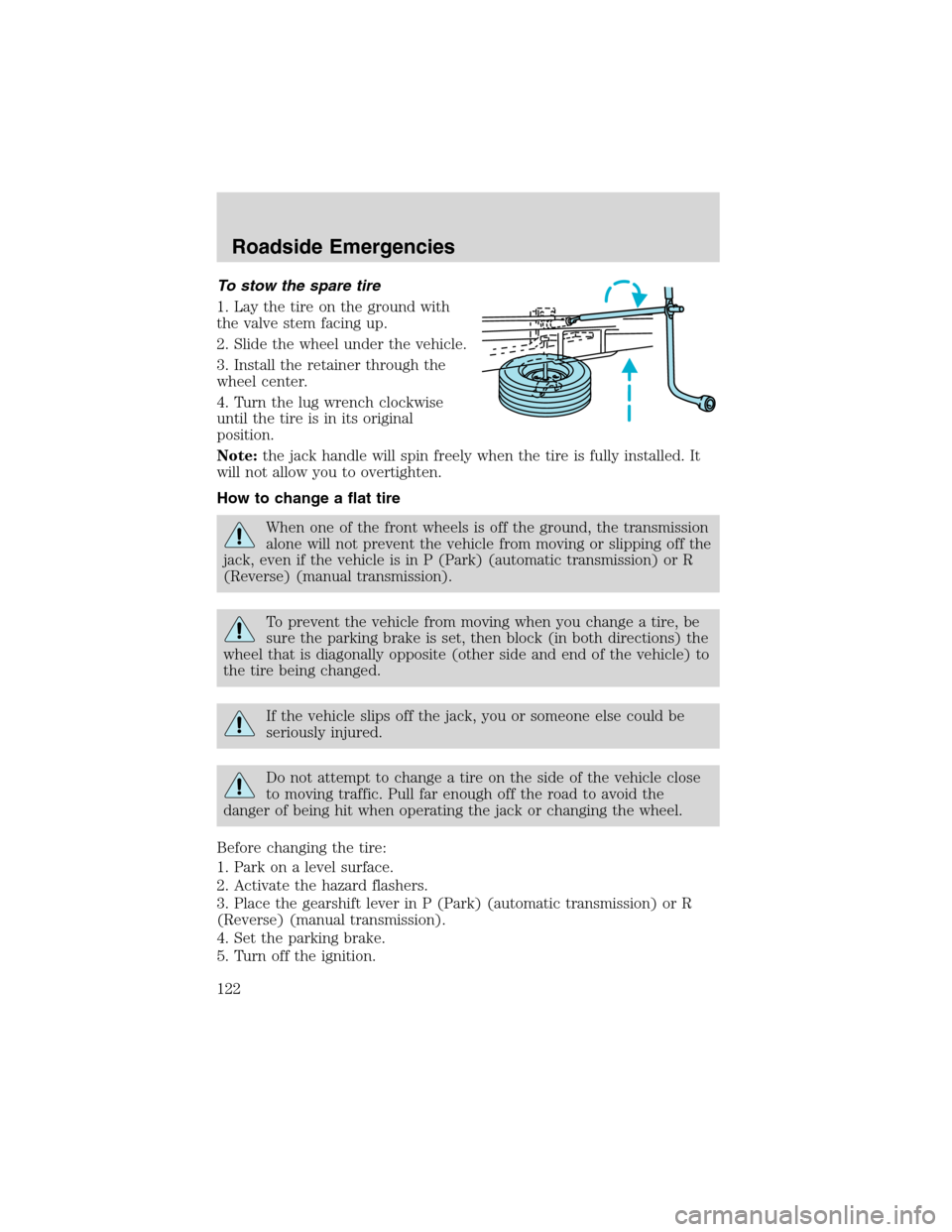
To stow the spare tire
1. Lay the tire on the ground with
the valve stem facing up.
2. Slide the wheel under the vehicle.
3. Install the retainer through the
wheel center.
4. Turn the lug wrench clockwise
until the tire is in its original
position.
Note:the jack handle will spin freely when the tire is fully installed. It
will not allow you to overtighten.
How to change a flat tire
When one of the front wheels is off the ground, the transmission
alone will not prevent the vehicle from moving or slipping off the
jack, even if the vehicle is in P (Park) (automatic transmission) or R
(Reverse) (manual transmission).
To prevent the vehicle from moving when you change a tire, be
sure the parking brake is set, then block (in both directions) the
wheel that is diagonally opposite (other side and end of the vehicle) to
the tire being changed.
If the vehicle slips off the jack, you or someone else could be
seriously injured.
Do not attempt to change a tire on the side of the vehicle close
to moving traffic. Pull far enough off the road to avoid the
danger of being hit when operating the jack or changing the wheel.
Before changing the tire:
1. Park on a level surface.
2. Activate the hazard flashers.
3. Place the gearshift lever in P (Park) (automatic transmission) or R
(Reverse) (manual transmission).
4. Set the parking brake.
5. Turn off the ignition.
Roadside Emergencies
122
Page 125 of 184
To lessen the risk of
personal injury, do not put
any part of your body under the
vehicle while changing a tire. Do
not start the engine when your
vehicle is on the jack. The jack is
only meant for changing the tire.
•Never use the differential as a
jacking point.
5. Remove the wheel lug nuts with the lug nut wrench.
6. Replace the flat tire with the spare tire, making sure the valve stem is
facing outward. Reinstall the lug nuts (cone side in) until the wheel is
snug against the hub. Do not fully tighten the lug nuts until the wheel
has been lowered.
7. Lower the wheel by turning the jack handle counterclockwise.
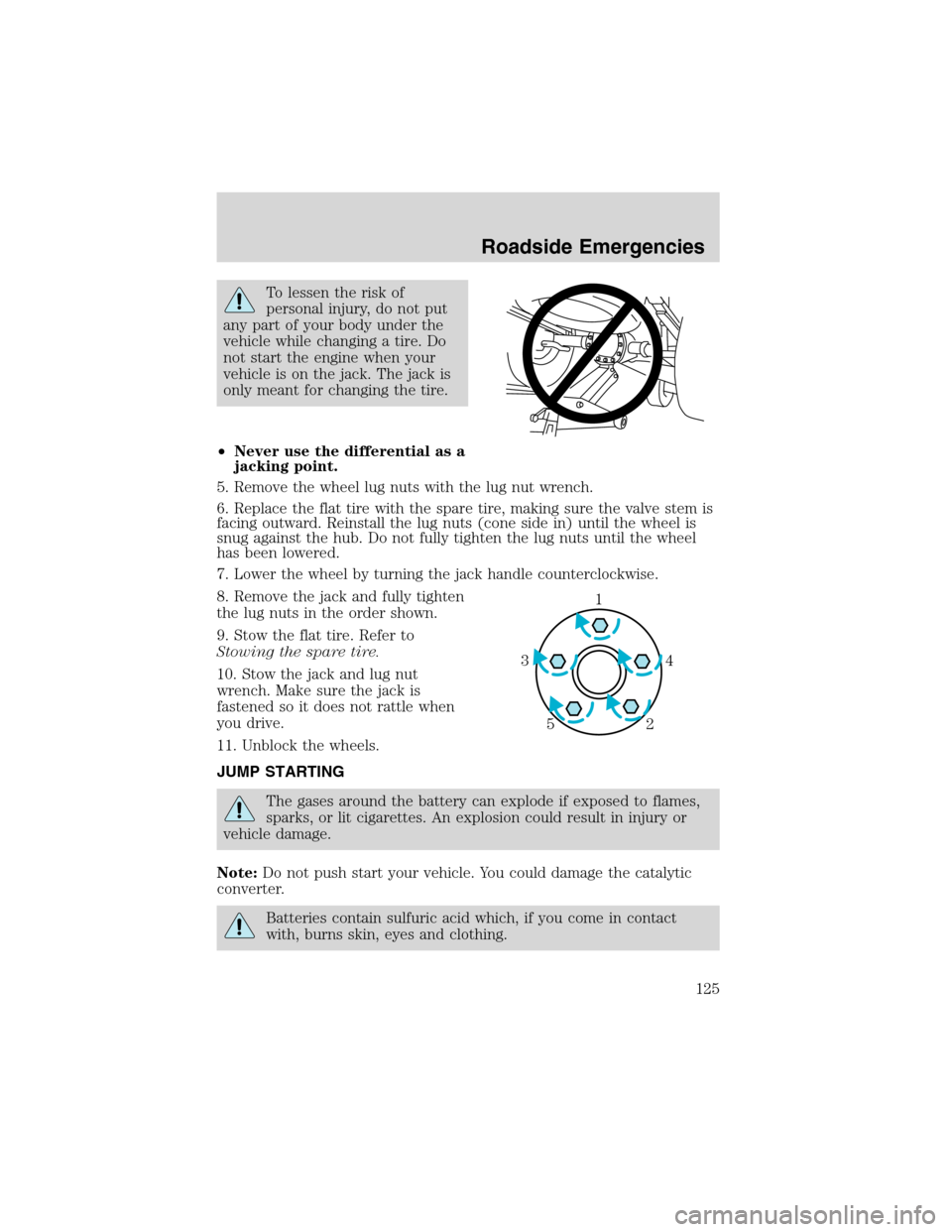
8. Remove the jack and fully tighten
the lug nuts in the order shown.
9. Stow the flat tire. Refer to
Stowing the spare tire.
10. Stow the jack and lug nut
wrench. Make sure the jack is
fastened so it does not rattle when
you drive.
11. Unblock the wheels.
JUMP STARTING
The gases around the battery can explode if exposed to flames,
sparks, or lit cigarettes. An explosion could result in injury or
vehicle damage.
Note:Do not push start your vehicle. You could damage the catalytic
converter.
Batteries contain sulfuric acid which, if you come in contact
with, burns skin, eyes and clothing.
1
4 3
2 5
Roadside Emergencies
125