Page 118 of 184
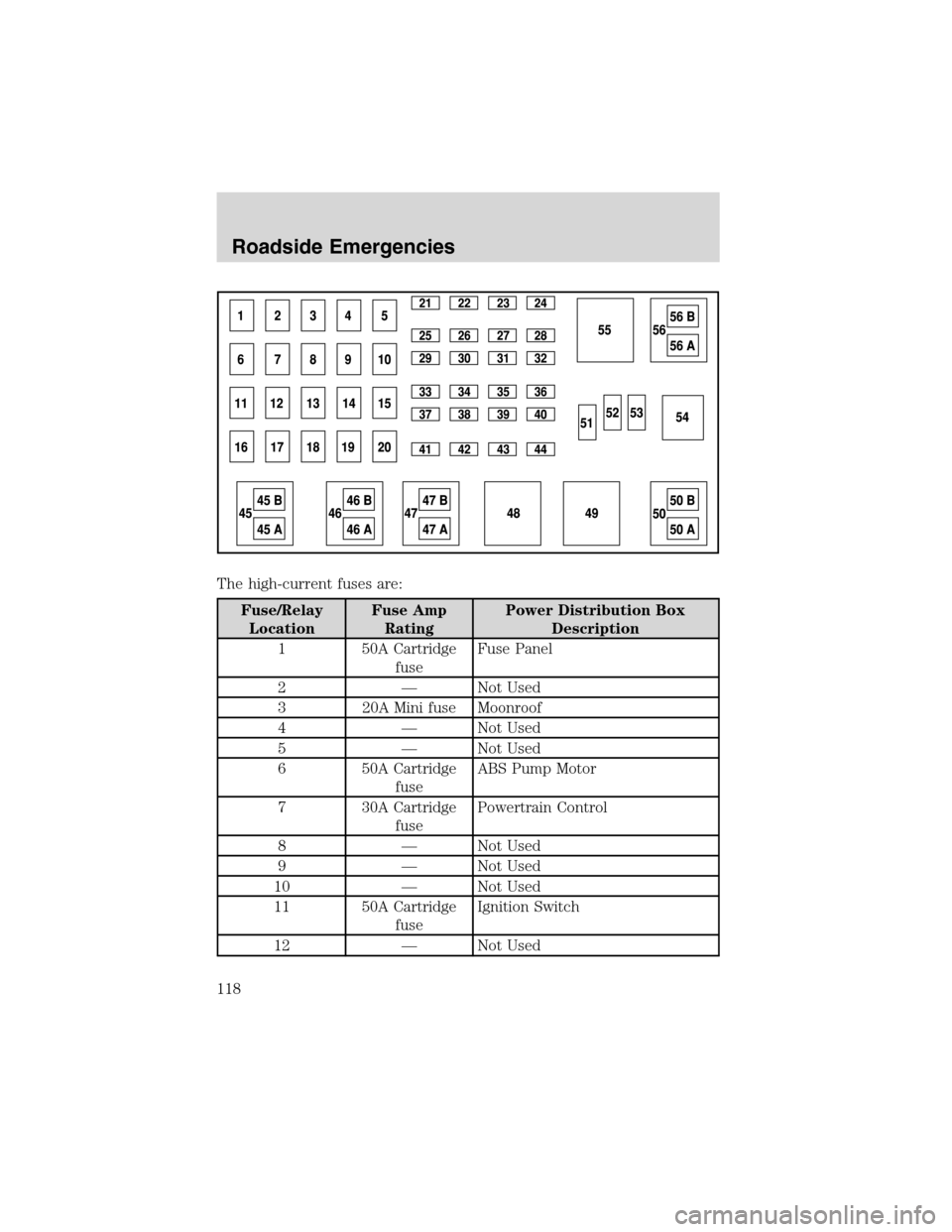
The high-current fuses are:
Fuse/Relay
LocationFuse Amp
RatingPower Distribution Box
Description
1 50A Cartridge
fuseFuse Panel
2—Not Used
3 20A Mini fuse Moonroof
4—Not Used
5—Not Used
6 50A Cartridge
fuseABS Pump Motor
7 30A Cartridge
fusePowertrain Control
8—Not Used
9—Not Used
10—Not Used
11 50A Cartridge
fuseIgnition Switch
12—Not Used
Roadside Emergencies
118
Page 122 of 184
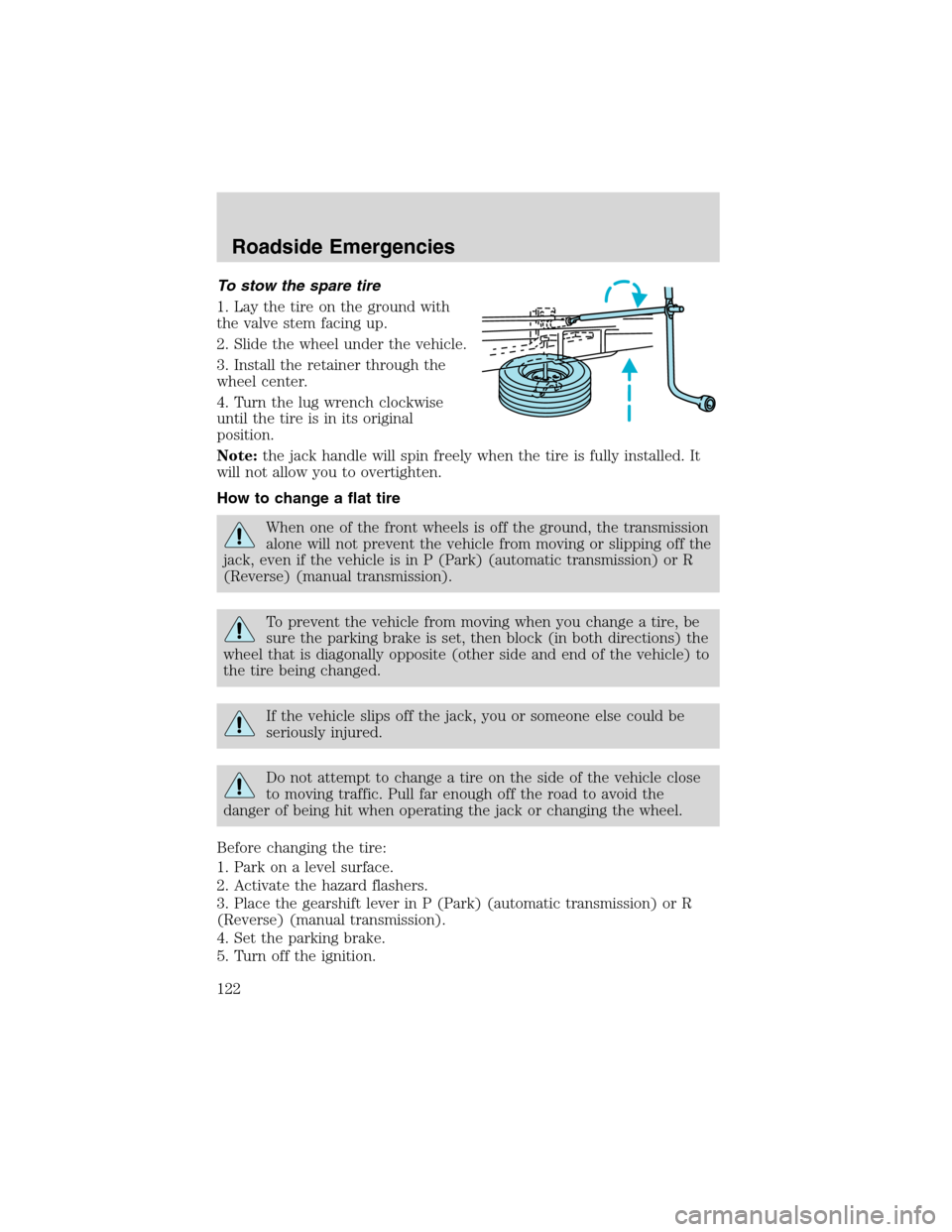
To stow the spare tire
1. Lay the tire on the ground with
the valve stem facing up.
2. Slide the wheel under the vehicle.
3. Install the retainer through the
wheel center.
4. Turn the lug wrench clockwise
until the tire is in its original
position.
Note:the jack handle will spin freely when the tire is fully installed. It
will not allow you to overtighten.
How to change a flat tire
When one of the front wheels is off the ground, the transmission
alone will not prevent the vehicle from moving or slipping off the
jack, even if the vehicle is in P (Park) (automatic transmission) or R
(Reverse) (manual transmission).
To prevent the vehicle from moving when you change a tire, be
sure the parking brake is set, then block (in both directions) the
wheel that is diagonally opposite (other side and end of the vehicle) to
the tire being changed.
If the vehicle slips off the jack, you or someone else could be
seriously injured.
Do not attempt to change a tire on the side of the vehicle close
to moving traffic. Pull far enough off the road to avoid the
danger of being hit when operating the jack or changing the wheel.
Before changing the tire:
1. Park on a level surface.
2. Activate the hazard flashers.
3. Place the gearshift lever in P (Park) (automatic transmission) or R
(Reverse) (manual transmission).
4. Set the parking brake.
5. Turn off the ignition.
Roadside Emergencies
122
Page 154 of 184
Running out of fuel
Running out of fuel may have an adverse affect on powertrain
components.
•You may need to cycle the ignition from off to on several times after
refueling to allow the fuel system to pump the fuel from the tank to
the engine.
•Your“Check Engine”indicator may come on.
Fuel filler cap
When fueling:
1. Turn the engine off.
2. Carefully turn the filler cap counterclockwise 1/8 of a turn until it
stops.
3. Pull to remove the cap.
4. To install the cap, align the tabs on the cap with the notches on the
filler pipe.
5. Turn the filler cap clockwise 1/8 of a turn until it stops.
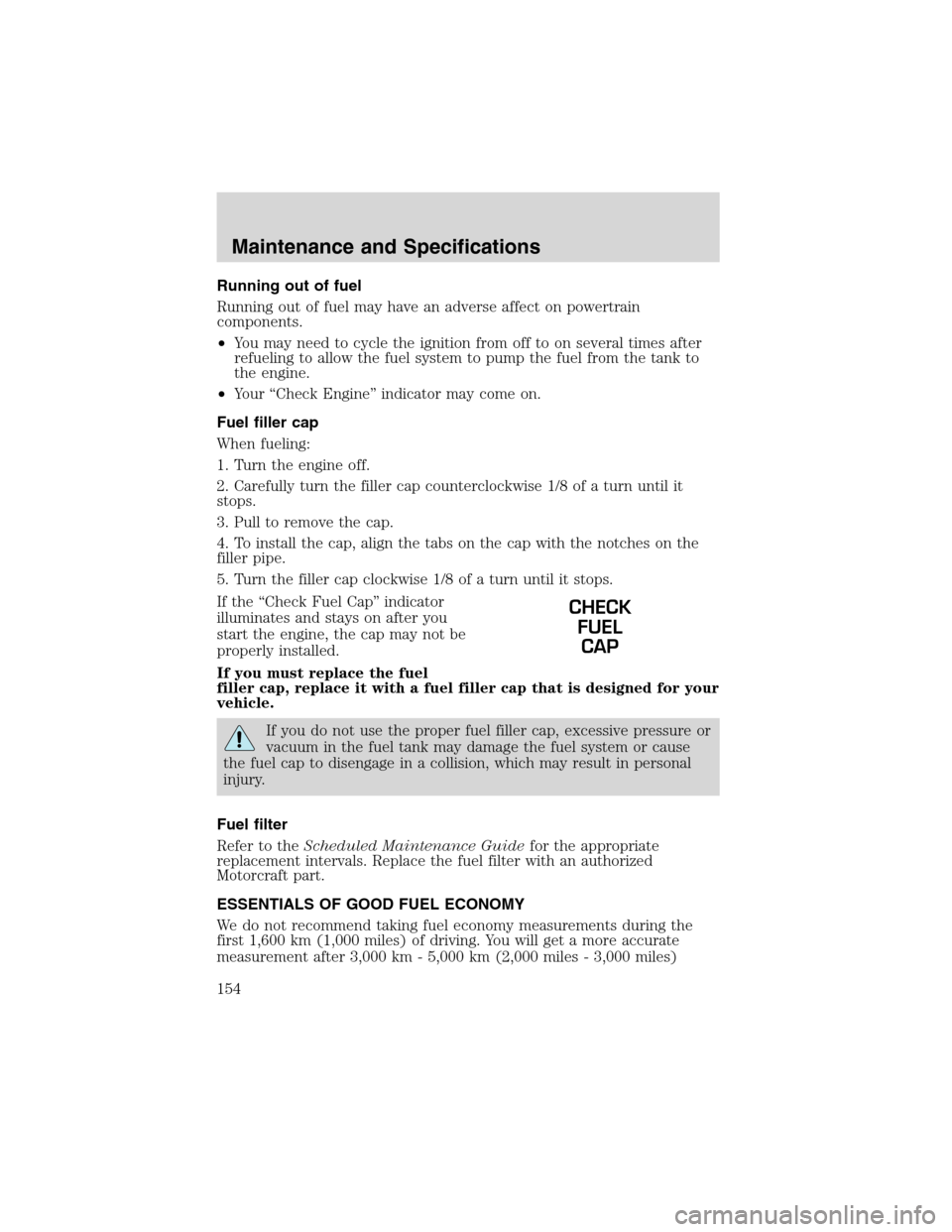
If the“Check Fuel Cap”indicator
illuminates and stays on after you
start the engine, the cap may not be
properly installed.
If you must replace the fuel
filler cap, replace it with a fuel filler cap that is designed for your
vehicle.
If you do not use the proper fuel filler cap, excessive pressure or
vacuum in the fuel tank may damage the fuel system or cause
the fuel cap to disengage in a collision, which may result in personal
injury.
Fuel filter
Refer to theScheduled Maintenance Guidefor the appropriate
replacement intervals. Replace the fuel filter with an authorized
Motorcraft part.
ESSENTIALS OF GOOD FUEL ECONOMY
We do not recommend taking fuel economy measurements during the
first 1,600 km (1,000 miles) of driving. You will get a more accurate
measurement after 3,000 km - 5,000 km (2,000 miles - 3,000 miles)
CHECK
FUEL
CAP
Maintenance and Specifications
154
Page 155 of 184
Filling the tank
The advertised fuel capacity of the fuel tank on your vehicle is equal to
the rated refill capacity of the fuel tank as listed in theRefill capacities
section of this chapter.
The advertised capacity is the amount of the indicated capacity and the
empty reserve combined. Indicated capacity is the difference in the
amount of fuel in a full tank and a tank when the fuel gauge indicates
empty. Empty reserve is the small amount of fuel remaining in the fuel
tank after the fuel gauge indicates empty.
The amount of usable fuel in the empty reserve varies and should
not be relied upon to increase driving range. When refueling your
vehicle after the fuel gauge indicates empty, you might not be
able to refuel the full amount of the advertised capacity of the
fuel tank due to the empty reserve still present in the tank.
For consistent results when filling the fuel tank:
•Turn the engine/ignition switch to the off position prior to refueling,
an error in the reading will result if the engine is left running.
•Use the same filling rate setting (low—medium—high) each time
the tank is filled.
•Allow no more than 2 automatic click-offs when filling.
•Always use fuel with the recommended octane rating.
•Use a known quality gasoline, preferably a national brand.
•Use the same side of the same pump and have the vehicle facing the
same direction each time you fill up.
•Have the vehicle loading and distribution the same every time.
Your results will be most accurate if your filling method is consistent.
Calculating fuel economy
1. Fill the tank and record the odometer reading.
2. Each time you fill up the tank, record the amount of fuel added.
3. After at least 3 fill-ups, fill the fuel tank and record the current
odometer reading.
4. Subtract your initial odometer reading from the current reading.
Use one of the following simple calculations to determine fuel economy:
•Liters x 100�total kilometers
•Miles traveled�gallons used
Maintenance and Specifications
155
Page 156 of 184
Keep a record for at least one month and record the type of driving (city
or highway). You can also keep records in summer and winter to
determine how temperature impacts fuel economy. Note that ethanol
decrease fuel economy.
Improving fuel economy
To improve your fuel economy:
•Do not leave your vehicle idling for long periods of time.
•Drive at a moderate pace, with smooth acceleration and deceleration.
•Turn off speed control in hilly terrain.
•Follow the recommended maintenance schedule in yourScheduled
Maintenance Guide.
•Do not carry unnecessary weight.
EPA window sticker
The EPA window sticker should be your guide for fuel economy
comparisons. If you have any questions about this sticker, contact your
dealer.
EMISSION CONTROL SYSTEM
Your vehicle has emission control components and a catalytic converter
that enable your vehicle to comply with applicable exhaust emission
standards. To make sure that the emission control components work
properly:
•Use only unleaded fuel.
•Avoid running out of fuel.
•Do not turn off your ignition while the vehicle is moving.
•Follow yourScheduled Maintenance Guide.
•Use Ford Motor Company authorized parts for maintenance
replacements or for service.
Consult yourWarranty Guidefor emission warranty information.
Do not park, idle, or drive your vehicle in dry ground cover. The
emission system heats up the engine and exhaust system, which
could cause a fire.
Maintenance and Specifications
156
Page 172 of 184
3Traction-Lok rear axles are filled with Motorcraft SAE 75W-140 High
Performance Synthetic Rear Axle Lubricant, part number F1TZ-19780-B,
Ford specification WSL-M2C192-A.
4Add 118 ml (4 oz) of Additive Friction Modifier C8AZ-19B546-A or
equivalent meeting Ford specification EST-M2C118–A to Traction-Lok
rear axles whenever the axle has been serviced.
ENGINE DATA
Engine 4.0L SOHC V6 engine
Cubic inches 245
Required fuel 87 octane
Firing order 1-4-2-5-3-6
Spark plug gap 1.3-1.4 mm (0.052-0.056 inch)
Ignition system EDIS
Compression ratio 9.7:1
VEHICLE DIMENSIONS
Dimensions 2 Door 4x2 XL model
mm (in.)2 Door 4x4 Sport
model mm (in.)
(1) Overall length 4 608 (181.4) 4 608 (181.4)
(2) Overall width 1 783 (70.2) 1 783 (70.2)
(3) Maximum
height*1 704 (67.1) 1 779 (70.0)*
(4) Wheelbase 2 585 (101.8) 2 585 (101.8)
(5) Front track /
rear1 486 (58.5)/1 486
(58.5)1 486 (58.5)/1 486
(58.5)
Maintenance and Specifications
172
Page 180 of 184
Headlamps
aiming ........................................25
autolamp system .......................24
flash to pass ..............................25
high beam .................................25
Heating
heating and air conditioning
system .......................................22
I
Ignition .................................86, 172
Infant seats (see Safety seats)...80
Instrument panel
cleaning ...................................140
cluster ..........................................8
K
Keyless entry system .................51
Keys
positions of the ignition ...........86
L
Lamps
autolamp system .................24, 37
bulb replacement
specifications chart ..................28
fog lamps ...................................24
high beams ................................25
instrument panel, dimming .....25
interior lamps ...........................27
Liftgate ........................................46
Lights, warning and indicator ......8
anti-lock brakes (ABS) ............90
Load limits .................................103
GAWR ......................................103
GVWR ......................................103
trailer towing ..........................103Loading instructions .................105
Locks
childproof ..................................47
Lubricant specifications ...170, 172
Lumbar support, seats .........57–58
M
Manual transmission ...................96
fluid capacities ........................167
lubricant specifications ..........172
reverse .......................................97
Mirrors
automatic dimming rearview
mirror ........................................38
fold away ...................................38
side view mirrors (power) .......38
Moon roof ....................................41
Motorcraft parts ........................167
P
Parking brake ..............................91
Parts (see Motorcraft parts) ....167
Power steering ............................91
fluid, refill capacity ................167
fluid, specifications .........170, 172
Preparing to drive your
vehicle ..........................................92
R
Radio ......................................14, 18
Remote entry system
locking/unlocking doors ...........47
Roadside assistance ..................111
Index
180