Page 235 of 312
ENGINE OIL
Checking the engine oil
Refer to the scheduled maintenance guide for the appropriate intervals
for checking the engine oil.
1. Make sure the vehicle is on level ground.
2. Turn the engine off and wait a few minutes for the oil to drain into the
oil pan.
3. Set the parking brake and ensure the gearshift is securely latched in P
(Park).
4. Open the hood. Protect yourself from engine heat.
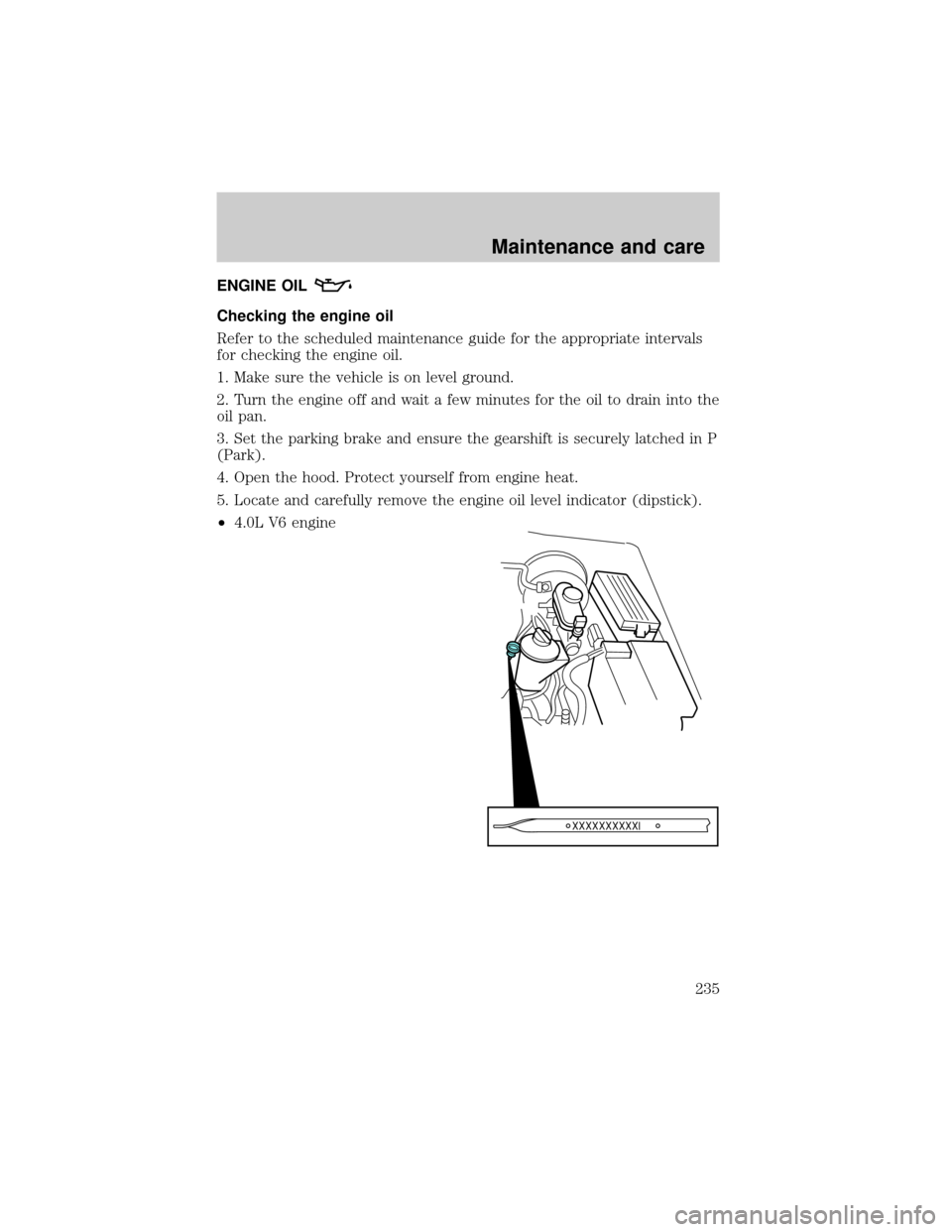
5. Locate and carefully remove the engine oil level indicator (dipstick).
²4.0L V6 engine
Maintenance and care
235
Page 236 of 312
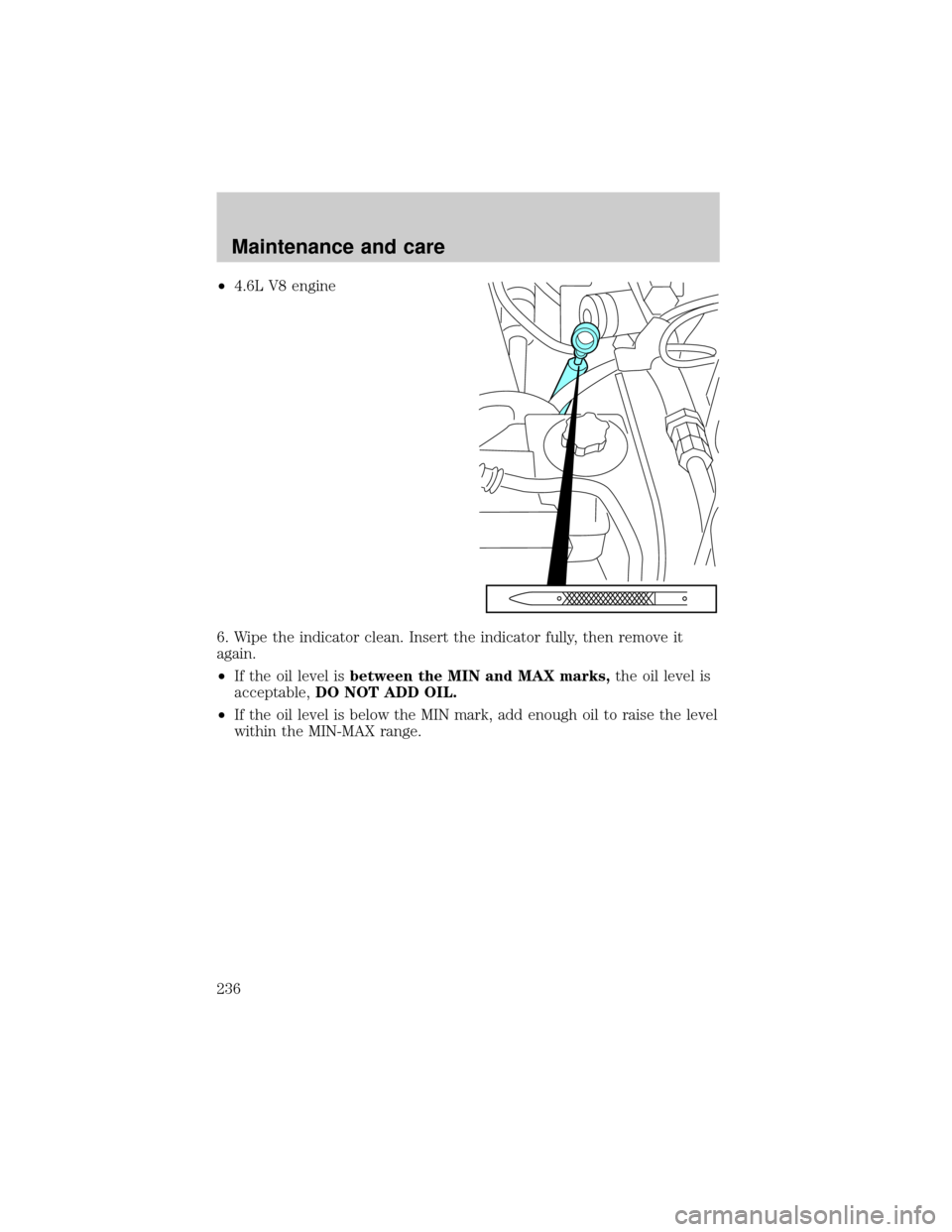
²4.6L V8 engine
6. Wipe the indicator clean. Insert the indicator fully, then remove it
again.
²If the oil level isbetween the MIN and MAX marks,the oil level is
acceptable,DO NOT ADD OIL.
²If the oil level is below the MIN mark, add enough oil to raise the level
within the MIN-MAX range.
Maintenance and care
236
Page 237 of 312
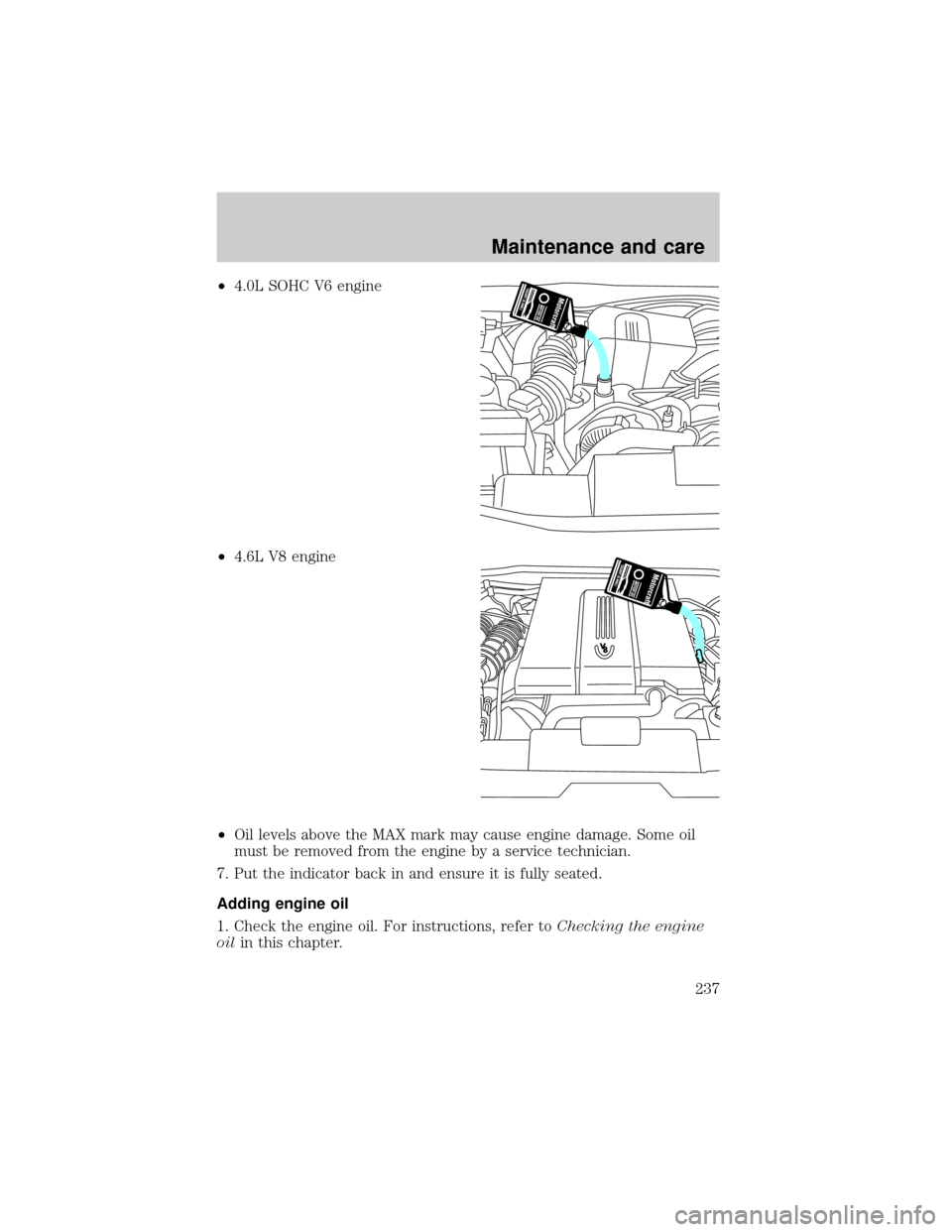
²4.0L SOHC V6 engine
²4.6L V8 engine
²Oil levels above the MAX mark may cause engine damage. Some oil
must be removed from the engine by a service technician.
7. Put the indicator back in and ensure it is fully seated.
Adding engine oil
1. Check the engine oil. For instructions, refer toChecking the engine
oilin this chapter.
Maintenance and care
237
Page 238 of 312
2. If the engine oil level is not within the normal range, add only certified
engine oil of the recommended viscosity. Remove the engine oil filler cap
and use a funnel to pour the engine oil into the opening.
3. Recheck the engine oil level. Make sure the oil level is not above the
MAX hole on the engine oil level indicator (dipstick).
4. Install the indicator and ensure it is fully seated.
5. Fully install the engine oil filler cap by turning the filler cap clockwise
1/4 of a turn or until three clicks can be heard.
To avoid possible oil loss, DO NOT operate the vehicle with the
engine oil level indicator and/or the engine oil filler cap removed.
Engine Oil Recommendations
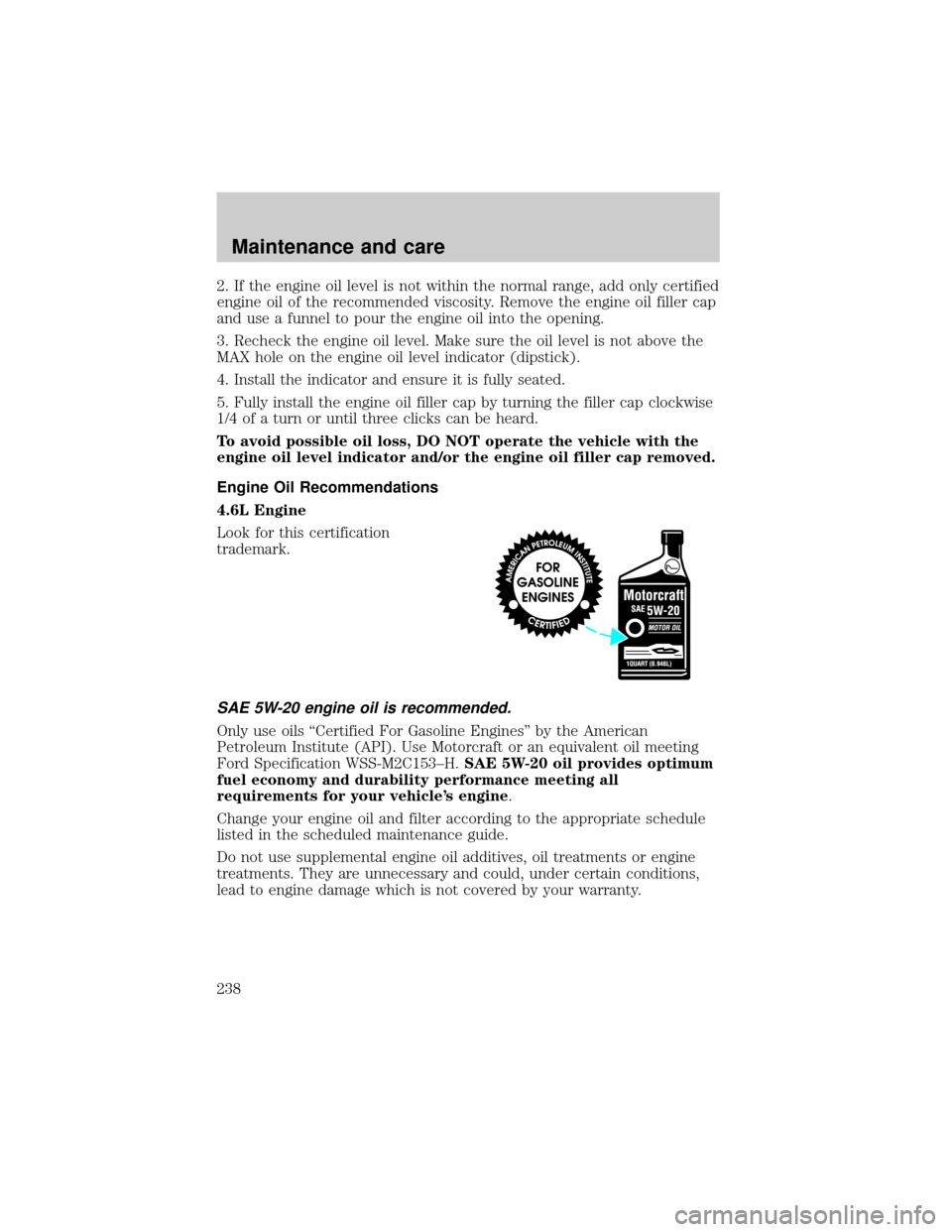
4.6L Engine
Look for this certification
trademark.
SAE 5W-20 engine oil is recommended.
Only use oils ªCertified For Gasoline Enginesº by the American
Petroleum Institute (API). Use Motorcraft or an equivalent oil meeting
Ford Specification WSS-M2C153±H.SAE 5W-20 oil provides optimum
fuel economy and durability performance meeting all
requirements for your vehicle's engine.
Change your engine oil and filter according to the appropriate schedule
listed in the scheduled maintenance guide.
Do not use supplemental engine oil additives, oil treatments or engine
treatments. They are unnecessary and could, under certain conditions,
lead to engine damage which is not covered by your warranty.
Maintenance and care
238
Page 239 of 312
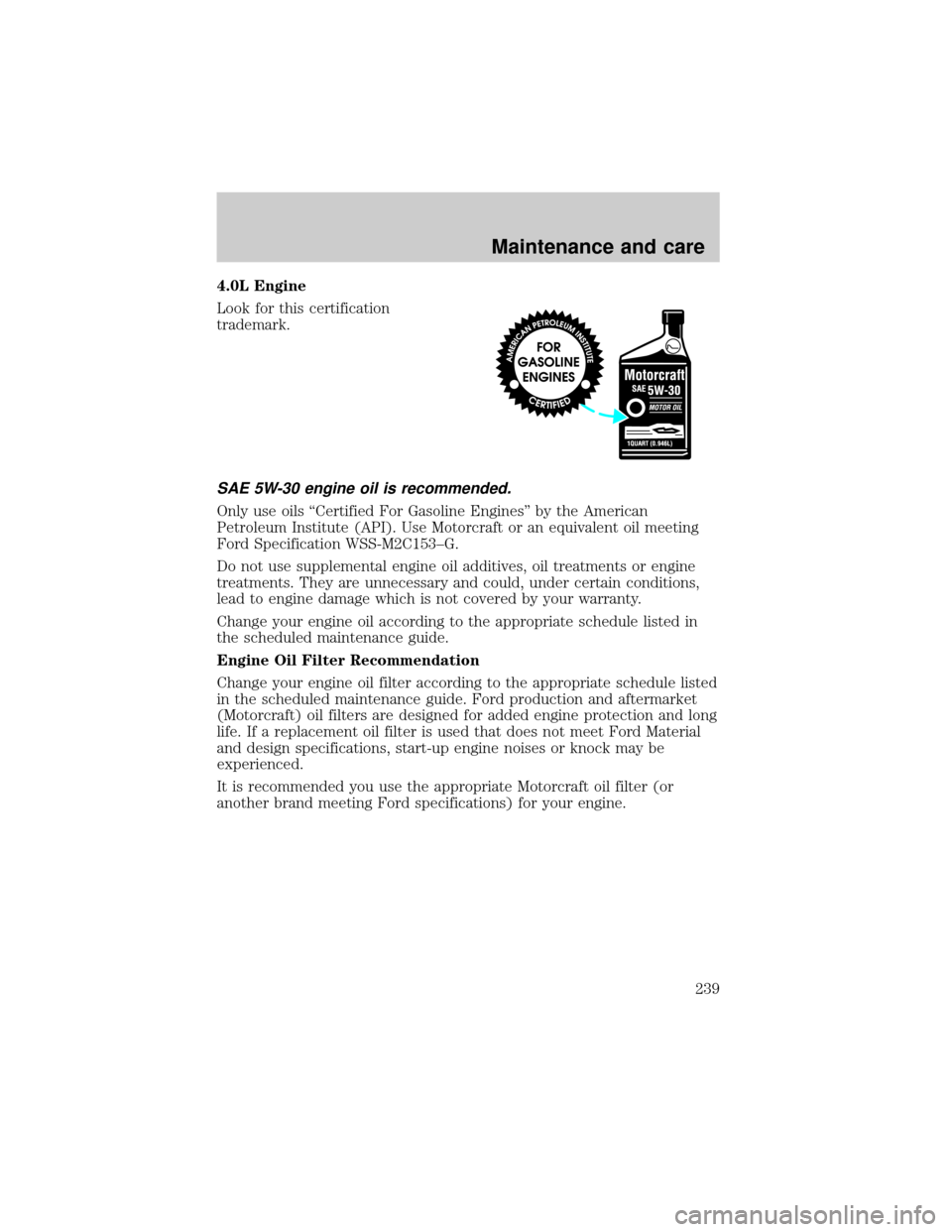
4.0L Engine
Look for this certification
trademark.
SAE 5W-30 engine oil is recommended.
Only use oils ªCertified For Gasoline Enginesº by the American
Petroleum Institute (API). Use Motorcraft or an equivalent oil meeting
Ford Specification WSS-M2C153±G.
Do not use supplemental engine oil additives, oil treatments or engine
treatments. They are unnecessary and could, under certain conditions,
lead to engine damage which is not covered by your warranty.
Change your engine oil according to the appropriate schedule listed in
the scheduled maintenance guide.
Engine Oil Filter Recommendation
Change your engine oil filter according to the appropriate schedule listed
in the scheduled maintenance guide. Ford production and aftermarket
(Motorcraft) oil filters are designed for added engine protection and long
life. If a replacement oil filter is used that does not meet Ford Material
and design specifications, start-up engine noises or knock may be
experienced.
It is recommended you use the appropriate Motorcraft oil filter (or
another brand meeting Ford specifications) for your engine.
Maintenance and care
239
Page 242 of 312
Your vehicle was factory-filled with a 50/50 engine coolant and water
concentration. If the concentration of coolant falls below 40% or above
60%, the engine parts could become damaged or not work properly.A
50±50 mixture of coolant and water provides the following:
²maximum cooling system efficiency.
²freeze protection down to -36É C (-34É F).
²boiling protection up to 129É C (265É F).
²protection against rust and other forms of corrosion.
²enables calibrated gages to function properly.
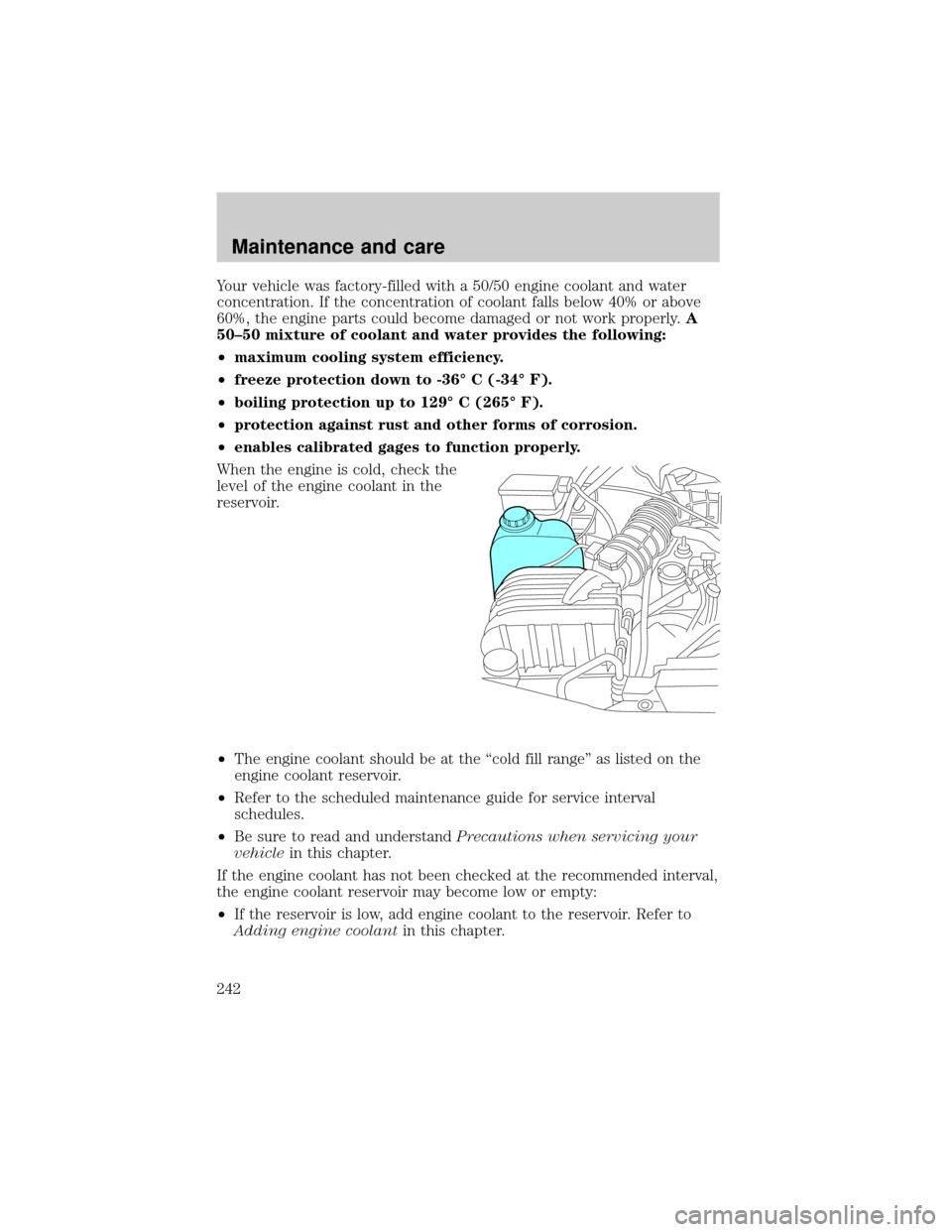
When the engine is cold, check the
level of the engine coolant in the
reservoir.
²The engine coolant should be at the ªcold fill rangeº as listed on the
engine coolant reservoir.
²Refer to the scheduled maintenance guide for service interval
schedules.
²Be sure to read and understandPrecautions when servicing your
vehiclein this chapter.
If the engine coolant has not been checked at the recommended interval,
the engine coolant reservoir may become low or empty:
²If the reservoir is low, add engine coolant to the reservoir. Refer to
Adding engine coolantin this chapter.
Maintenance and care
242
Page 267 of 312
²Idling for long periods of time (greater than one minute) may waste
fuel.
²Anticipate stopping; slowing down may eliminate the need to stop.
²Sudden or hard accelerations may reduce fuel economy.
²Slow down gradually.
²Driving at reasonable speeds (traveling at 88 km/h [55 mph] uses 15%
less fuel than traveling at 105 km/h [65 mph]).
²Revving the engine before turning it off may reduce fuel economy.
²Using the air conditioner or defroster may reduce fuel economy.
²You may want to turn off the speed control in hilly terrain if
unnecessary shifting between third and fourth gear occurs.
Unnecessary shifting of this type could result in reduced fuel
economy.
²Warming up a vehicle on cold mornings is not required and may
reduce fuel economy.
²Resting your foot on the brake pedal while driving may reduce fuel
economy.
²Combine errands and minimize stop-and-go driving.
Maintenance
²Keep tires properly inflated and use only recommended size.
²Operating a vehicle with the wheels out of alignment will reduce fuel
economy.
²Use recommended engine oil. Refer toLubricant Specifications.
²Perform all regularly scheduled maintenance items. Follow the
recommended maintenance schedule and owner maintenance checks
found in your vehicle scheduled maintenance guide.
Conditions
²Heavily loading a vehicle or towing a trailer may reduce fuel economy
at any speed.
²Carrying unnecessary weight may reduce fuel economy (approximately
0.4 km/L [1 mpg] is lost for every 180 kg [400 lb] of weight carried).
²Adding certain accessories to your vehicle (for example bug
deflectors, rollbars/light bars, running boards, ski/luggage racks) may
reduce fuel economy.
Maintenance and care
267
Page 283 of 312

MOTORCRAFT PART NUMBERS
Component 4.0L SOHC V6 engine 4.6L V8 engine
Air filter element FA-1695 FA-1695
Fuel filter FG-986B FG-986B
Battery BXT-65-650 BXT-65-650
Oil filter FL-820S FL-820S
PCV valve EV-243 F6ZE-6C324-CA
Spark plugs* AGSF-22PP ** AWSF-32P
* Refer to Vehicle Emissions Control Information (VECI) decal for spark
plug gap information.
** If a spark plug is removed for inspection, it must be reinstalled in the
same cylinder. If a spark plug needs to be replaced, use only spark plugs
with the service number suffix letter as shown on the engine decal.
REFILL CAPACITIES
Fluid Ford Part Name Application Capacity
Brake fluid and
Clutch fluid (if
equipped)High Performance
DOT 3 Motor
Vehicle Brake
FluidAll Fill to line on
reservoir
Engine oil
(including filter
change)Motorcraft SAE
5W-30 Super
Premium Motor Oil4.0L 4.7L
(5.0 quarts)
Motorcraft SAE
5W-20 Super
Premium Motor Oil4.6L 5.7L
(6.0 quarts)
Fuel tank N/A All 85.2L
(22.5 gallons)
Power steering
fluidMotorcraft
MERCONtAT FAll Fill between
the MIN and
MAX lines on
reservoir
Transmission
fluid
1Motorcraft
MERCONtAT F5-speed manual 2.4L
(5.1 pints)2
Motorcraft
MERCONtVATFAutomatic
transmissions
only.12.0L
(12.7 quarts)3
Capacities and specifications
283