2002 FORD EXPEDITION heating
[x] Cancel search: heatingPage 236 of 280
with the factory-filled coolant.Mixing Motorcraft Speciality Orange
Engine Coolant or any orange-colored extended life product with your
factory filled coolant can result in degraded corrosion protection.
²A large amount of water without engine coolant may be added, in case
of emergency, to reach a vehicle service location. In this instance, the
cooling system must be drained and refilled with a 50/50 mixture of
engine coolant and distilled water as soon as possible. Water alone
(without engine coolant) can cause engine damage from corrosion,
overheating or freezing.
²Do not use alcohol, methanol or brine or any engine coolants
mixed with alcohol or methanol antifreeze (coolant).Alcohol
and other liquids can cause engine damage from overheating or
freezing.
²Do not add extra inhibitors or additives to the coolant.These
can be harmful and compromise the corrosion protection of the engine
coolant.
²Do not mix with recycled coolant unless from a Ford-approved
recycling process (seeUse of Recycled Engine Coolantsection).
For vehicles with overflow coolant systems with a non-pressurized cap
on the coolant recovery system, add coolant to the coolant recovery
reservoir when the engine is cool. Add the proper mixture of coolant and
water to the ªcold fullº level. For all other vehicles, which have a coolant
degas system with a pressurized cap, or if it is necessary to remove the
coolant pressure relief cap on the radiator of a vehicle with an overflow
system, follow these steps to add engine coolant.
To avoid personal injury, make sure the engine is cool before
unscrewing the coolant pressure relief cap. The cooling system is
under pressure; steam and hot liquid can come out forcefully when the
cap is loosened slightly.
1. Before you begin, turn the engine off and let it cool.
2. When the engine is cool, wrap a thick cloth around the coolant
pressure relief cap on the coolant reservoir (an opaque plastic bottle).
Slowly turn cap counterclockwise (left) until pressure begins to release.
3. Step back while the pressure releases.
4. When you are sure that all the pressure has been released, use the
cloth to turn it counterclockwise and remove the cap.
Maintenance and specifications
236
Page 237 of 280
5. Fill the coolant reservoir slowly with the proper coolant mixture (see
above), to within the ªcold fill rangeº or the ªcold fullº level on the
reservoir. If you removed the radiator cap in an overflow system, fill the
radiator until the coolant is visible and radiator is almost full.
6. Replace the cap. Turn until tightly installed. (Cap must be tightly
installed to prevent coolant loss.)
After any coolant has been added, check the coolant concentration see
Checking Engine Coolant section). If the concentration is not 50/50
(protection to ±34É F/±36É C), drain some coolant and adjust the
concentration. It may take several drains and additions to obtain a 50/50
coolant concentration.
Whenever coolant has been added, the coolant level in the coolant
reservoir should be checked the next few times you drive the vehicle. If
necessary, add enough 50/50 concentration of engine coolant and
distilled water to bring the liquid level to the proper level.
If you have to add more than 1.0 liter (1.0 quart) of engine coolant per
month, have your dealer check the engine cooling system. Your cooling
system may have a leak. Operating an engine with a low level of coolant
can result in engine overheating and possible engine damage.
Recycled engine coolant
Ford Motor Company recommends the use of a recycled engine coolant
produced by Ford-approved processes in vehicles originally equipped
with Motorcraft Premium Engine Coolant (green-colored). However, not
all coolant recycling processes produce coolant that meets Ford
specification ESE-M97B44±A. Use of such coolant may harm the engine
and cooling system components.
Ford Motor Company does NOT recommend the use of recycled engine
coolant in vehicles originally equipped with Motorcraft Premium Gold
Engine Coolant since a Ford-approved recycling process is not yet
available.
Used engine coolant should be disposed of in an appropriate
manner. Follow your community's regulations and standards for recycling
and disposing of automotive fluids.
Coolant refill capacity
To find out how much fluid your vehicle's cooling system can hold, refer
toRefill capacitiesin this chapter.
Maintenance and specifications
237
Page 253 of 280
operating temperature can be reached after approximately 30 km (20
miles) of driving.
You can check the fluid without driving if the ambient temperature is
above 10ÉC (50ÉF). However, if fluid is added at this time, an overfill
condition could result when the vehicle reaches normal operating
temperature.
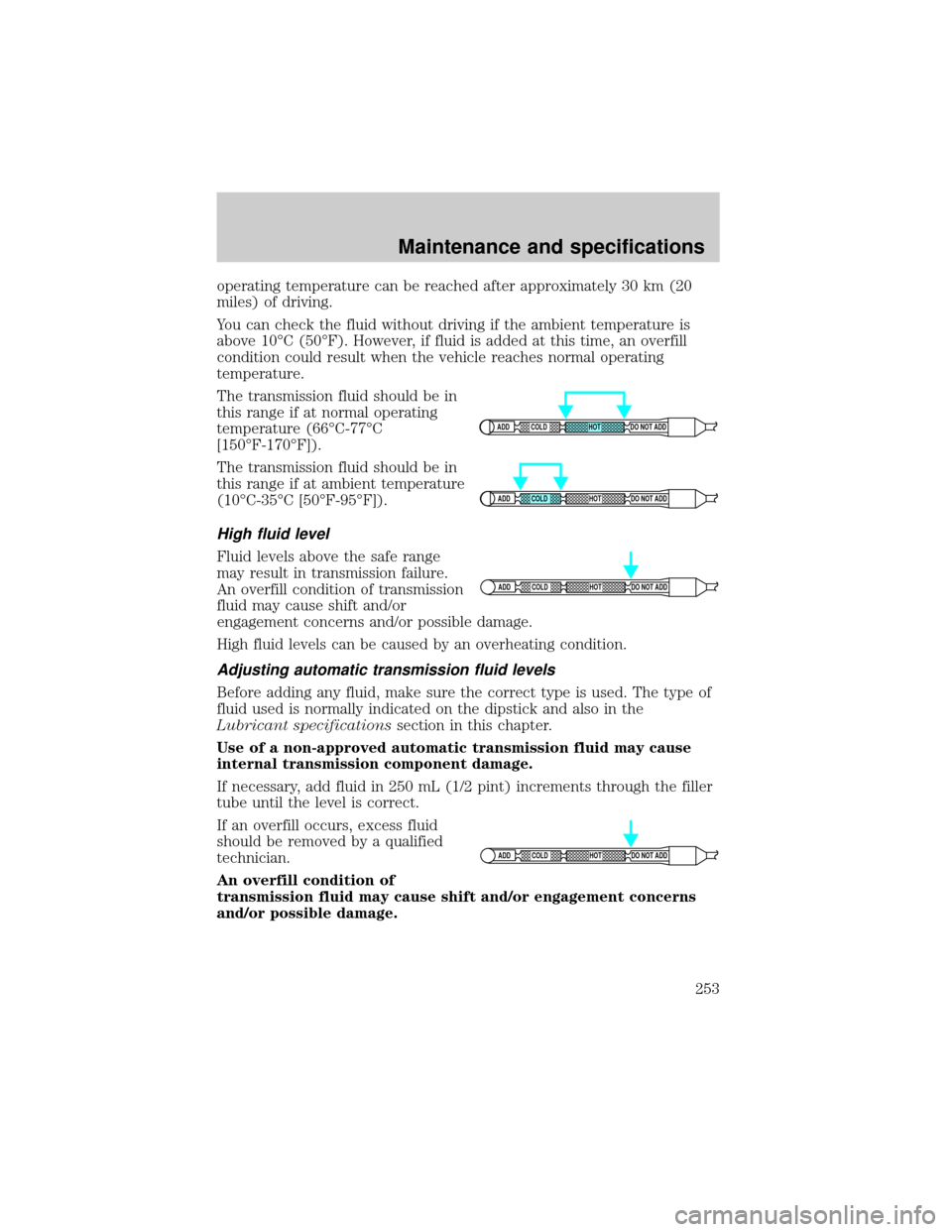
The transmission fluid should be in
this range if at normal operating
temperature (66ÉC-77ÉC
[150ÉF-170ÉF]).
The transmission fluid should be in
this range if at ambient temperature
(10ÉC-35ÉC [50ÉF-95ÉF]).
High fluid level
Fluid levels above the safe range
may result in transmission failure.
An overfill condition of transmission
fluid may cause shift and/or
engagement concerns and/or possible damage.
High fluid levels can be caused by an overheating condition.
Adjusting automatic transmission fluid levels
Before adding any fluid, make sure the correct type is used. The type of
fluid used is normally indicated on the dipstick and also in the
Lubricant specificationssection in this chapter.
Use of a non-approved automatic transmission fluid may cause
internal transmission component damage.
If necessary, add fluid in 250 mL (1/2 pint) increments through the filler
tube until the level is correct.
If an overfill occurs, excess fluid
should be removed by a qualified
technician.
An overfill condition of
transmission fluid may cause shift and/or engagement concerns
and/or possible damage.
ADD COLD HOT DO NOT ADD
ADD COLD HOT DO NOT ADD
ADD COLD HOT DO NOT ADD
ADD COLD HOT DO NOT ADD
Maintenance and specifications
253
Page 273 of 280

A
Accessory delay ..........................80
Air bag supplemental
restraint system ........132±133, 137
and child safety seats ............135
description ......................133, 137
disposal ....................................140
driver air bag ..................135, 138
indicator light ...........12, 137, 139
operation .........................135, 138
passenger air bag ...........135, 138
side air bag ..............................137
Air cleaner filter ...............254, 259
Air conditioning ..........................50
auxiliary heater and air
conditioner ................................55
manual heating and air
conditioning system .................47
Air suspension ...........................158
description ..............................158
warning light .............................12
Ambulance packages ....................7
Antifreeze
(see Engine coolant) ................234
Anti-lock brake system
(see Brakes) ..............................155
Anti-theft system
warning light .............................13
Armrests ....................................110
Automatic transmission
driving an automatic
overdrive .................................162
fluid, adding ............................252
fluid, checking ........................252
fluid, refill capacities ..............260
fluid, specification ..................265Auxiliary power point .................78
Axle
lubricant specifications ..263, 265
refill capacities ........................260
traction lok ..............................159
B
Battery .......................................231
acid, treating emergencies .....231
charging system
warning light .............................12
jumping a disabled battery ....202
maintenance-free ....................231
replacement, specifications ...259
servicing ..................................231
voltage gauge ............................16
Belt minder ...............................128
Brakes ........................................154
anti-lock ...................................155
anti-lock brake system (ABS)
warning light .....................11, 156
brake warning light ..................11
fluid, checking and adding ....251
fluid, refill capacities ..............260
fluid, specifications .........263, 265
lubricant specifications ..263, 265
parking ....................................156
pedals (see Power
adjustable foot pedals) ............82
shift interlock ..........................161
Break-in period .............................5
C
Capacities for refilling fluids ....260
Cassette tape player ...................18
CD changer .................................42
Certification Label ....................268
Index
273
Page 276 of 280

odometer ...................................17
speedometer .............................16
tachometer ................................17
trip odometer ............................17
GAWR
(Gross Axle Weight Rating) .....177
calculating ...............................179
definition .................................177
driving with a heavy load ......177
location ....................................177
GVWR (Gross
Vehicle Weight Rating) .............177
calculating .......................177, 179
definition .................................177
driving with a heavy load ......177
location ....................................177
H
Hazard flashers .........................187
Head restraints .................108, 113
Headlamps ...................................59
aiming ........................................61
autolamp system .......................59
bulb specifications ....................63
daytime running lights .............60
flash to pass ..............................60
high beam ...........................13, 60
replacing bulbs .........................64
turning on and off ....................59
warning chime ..........................14
Heating ........................................50
heating and
air conditioning system ............47
HomeLink universal
transceiver (see
Garage door opener) ............86±89
Hood ..........................................226I
Ignition .......................150, 265±266
Infant seats
(see Safety seats) .....................141
Inspection/
maintenance (I/M) testing .......249
Instrument panel
cleaning ...................................221
cluster ................................10, 222
lighting up
panel and interior .....................60
J
Jack ............................................196
positioning ...............................196
storage .....................................196
Jump-starting your vehicle ......202
K
Keyless entry system
autolock ...................................101
locking and unlocking doors ..103
programming entry code .......102
Keys ...................................104±106
key in ignition chime ...............14
positions of the ignition .........150
L
Lamps
autolamp system .......................59
bulb replacement
specifications chart ..................63
cargo lamps ...............................60
daytime running light ...............60
fog lamps ...................................59
headlamps .................................59
Index
276