2002 FORD ESCORT brakes
[x] Cancel search: brakesPage 113 of 216
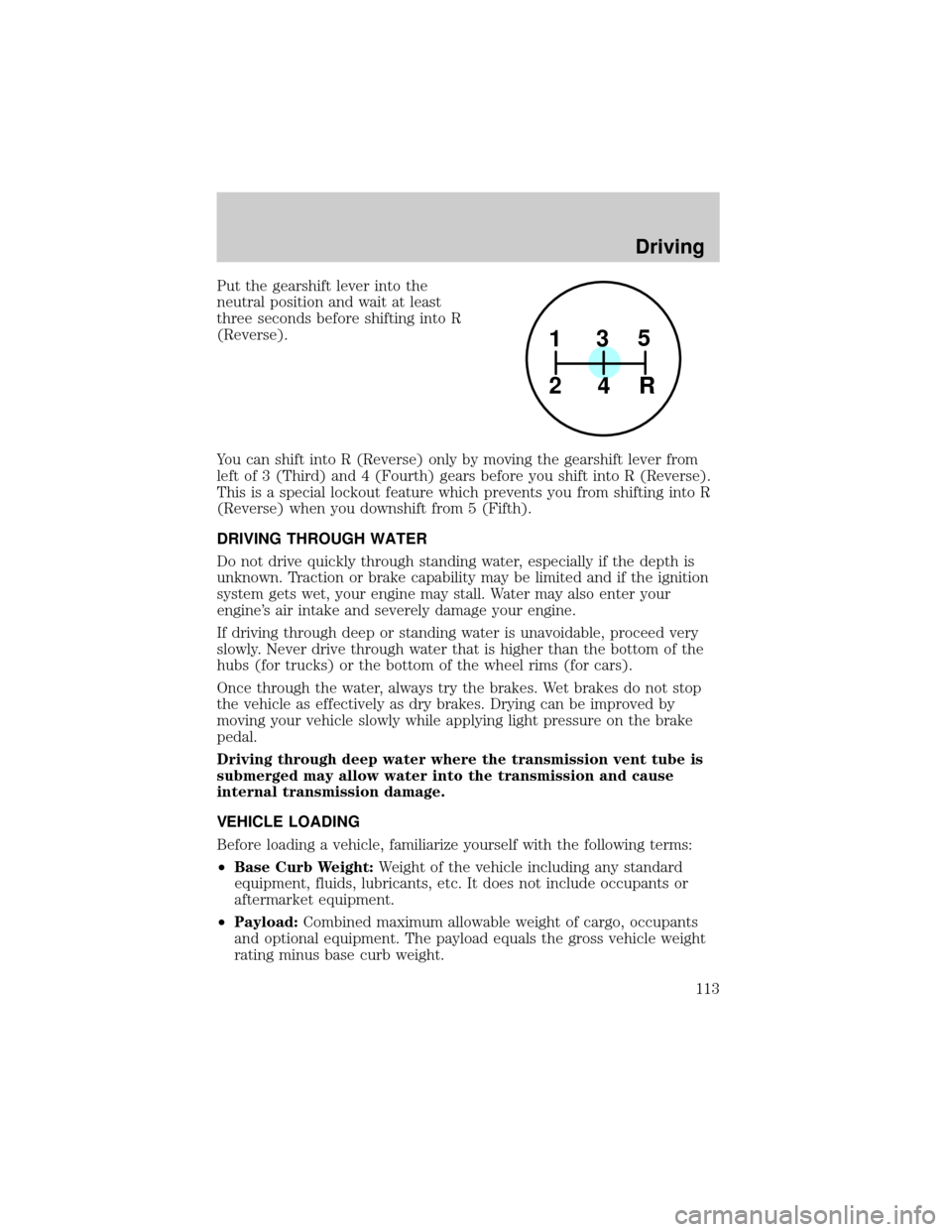
Put the gearshift lever into the
neutral position and wait at least
three seconds before shifting into R
(Reverse).
You can shift into R (Reverse) only by moving the gearshift lever from
left of 3 (Third) and 4 (Fourth) gears before you shift into R (Reverse).
This is a special lockout feature which prevents you from shifting into R
(Reverse) when you downshift from 5 (Fifth).
DRIVING THROUGH WATER
Do not drive quickly through standing water, especially if the depth is
unknown. Traction or brake capability may be limited and if the ignition
system gets wet, your engine may stall. Water may also enter your
engine's air intake and severely damage your engine.
If driving through deep or standing water is unavoidable, proceed very
slowly. Never drive through water that is higher than the bottom of the
hubs (for trucks) or the bottom of the wheel rims (for cars).
Once through the water, always try the brakes. Wet brakes do not stop
the vehicle as effectively as dry brakes. Drying can be improved by
moving your vehicle slowly while applying light pressure on the brake
pedal.
Driving through deep water where the transmission vent tube is
submerged may allow water into the transmission and cause
internal transmission damage.
VEHICLE LOADING
Before loading a vehicle, familiarize yourself with the following terms:
²Base Curb Weight:Weight of the vehicle including any standard
equipment, fluids, lubricants, etc. It does not include occupants or
aftermarket equipment.
²Payload:Combined maximum allowable weight of cargo, occupants
and optional equipment. The payload equals the gross vehicle weight
rating minus base curb weight.
1
24R35
Driving
113
Page 115 of 216
additional equipment, refer to these limitations. If you are adding weight
to the front of your vehicle, (potentially including weight added to the
cab), the weight added should not exceed the front axle reserve capacity
(FARC). Additional frontal weight may be added to the front axle reserve
capacity provided you limit your payload in other ways (i.e. restrict the
number of occupants or amount of cargo carried).
Always ensure that the weight of occupants, cargo and equipment being
carried is within the weight limitations that have been established for
your vehicle including both gross vehicle weight and front and rear gross
axle weight rating limits. Under no circumstance should these limitations
be exceeded.
Exceeding any vehicle weight rating limitation could result in
serious damage to the vehicle and/or personal injury.
TRAILER TOWING
Your vehicle is capable of towing a trailer up to 454 kg (1 000 lbs.) gross
trailer weight with a maximum tongue load of 45 kg (100 lbs.). Do not
tow a trailer until your vehicle has been driven at least 800 km (500
miles).
Towing a trailer places an additional load on your vehicle's engine,
transaxle, brakes, tires and suspension. Inspect these components
carefully after towing.
Do not exceed the GVWR or the GAWR specified on the
certification label.
Towing trailers beyond the maximum recommended gross trailer
weight exceeds the limit of the vehicle and could result in
engine damage, transaxle damage, structural damage, loss of control,
and personal injury.
Preparing to tow
Use the proper equipment for towing a trailer, and make sure it is
properly attached to your vehicle. See your dealer or a reliable trailer
dealer if you require assistance.
Driving
115
Page 116 of 216
Hitches
Do not use hitches that clamp onto the vehicle bumper. Use a load
carrying hitch. You must distribute the load in your trailer so that 10% of
the total weight of the trailer is on the tongue.
Safety chains
Always connect the trailer's safety chains to the frame or hook retainers
of the vehicle hitch. To connect the trailer's safety chains, cross the
chains under the trailer tongue and allow slack for turning corners.
If you use a rental trailer, follow the instructions that the rental agency
gives to you.
Do not attach safety chains to the bumper.
Trailer brakes
Electric brakes and manual, automatic or surge-type trailer brakes are
safe if installed properly and adjusted to the manufacturer's
specifications. The trailer brakes must meet local and Federal
regulations.
Do not connect a trailer's hydraulic brake system directly to your
vehicle's brake system. Your vehicle may not have enough
braking power and your chances of having a collision greatly increase.
The braking system of the tow vehicle is rated for operation at the
GVWR not GCWR.
Trailer lamps
Trailer lamps are required on most towed vehicles. Make sure your
trailer lamps conform to local and Federal regulations. See your dealer or
trailer rental agency for proper instructions and equipment for hooking
up trailer lamps.
Driving while you tow
When towing a trailer:
²Ensure that you turn off your speed control. The speed control may
shut off automatically when you are towing on long, steep grades.
²Consult your local motor vehicle speed regulations for towing a trailer.
Driving
116
Page 117 of 216

²Use a lower gear when towing up or down steep hills. This will
eliminate excessive downshifting and upshifting for optimum fuel
economy and transaxle cooling.
²Anticipate stops and brake gradually.
Exceeding the GCWR rating may cause internal transaxle damage
and void your warranty coverage.
Servicing after towing
If you tow a trailer for long distances, your vehicle will require more
frequent service intervals. Refer to your scheduled maintenance guide for
more information.
Trailer towing tips
²Practice turning, stopping and backing up before starting on a trip to
get the feel of the vehicle trailer combination. When turning, make
wider turns so the trailer wheels will clear curbs and other obstacles.
²Allow more distance for stopping with a trailer attached.
²If you are driving down a long or steep hill, shift to a lower gear. Do
not apply the brakes continuously, as they may overheat and become
less effective.
²The trailer tongue weight should be 10% of the loaded trailer weight.
²After you have traveled 80 km (50 miles), thoroughly check your
hitch, electrical connections and trailer wheel lug nuts.
²When stopped in traffic for long periods of time in hot weather, place
the gearshift in P (Park) and increase idle speed. This aids engine
cooling and air conditioner efficiency.
²Vehicles with trailers should not be parked on a grade. If you must
park on a grade, place wheel chocks under the trailer's wheels.
TOWING BEHIND ANOTHER VEHICLE
If your vehicle has an automatic transaxle, it cannot be flat-towed with
all wheels on the ground; front wheel dollies must be used.
If your vehicle has an manual transaxle, your vehicle can be flat-towed
with all wheels on the ground.
Driving
117
Page 186 of 216
BRAKE FLUID
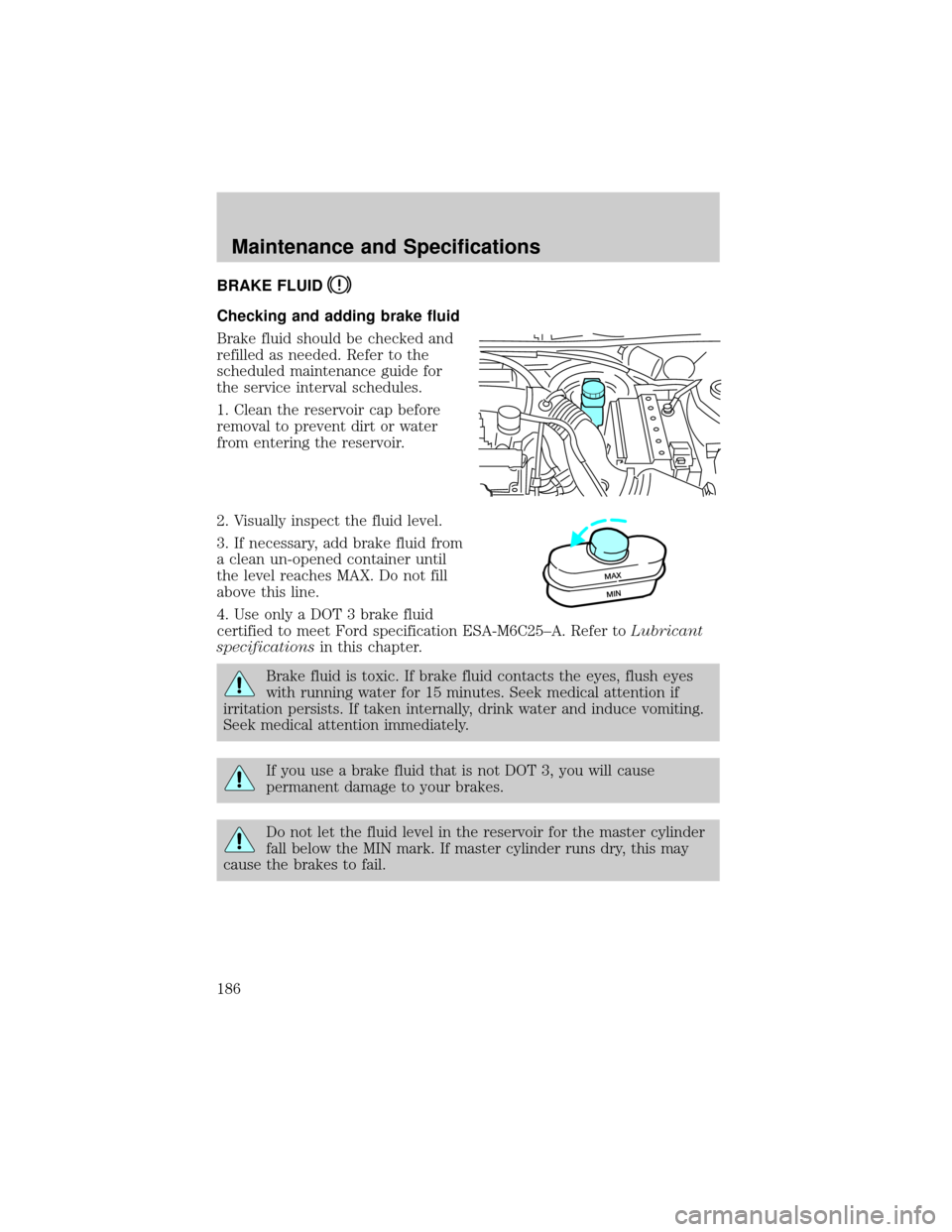
Checking and adding brake fluid
Brake fluid should be checked and
refilled as needed. Refer to the
scheduled maintenance guide for
the service interval schedules.
1. Clean the reservoir cap before
removal to prevent dirt or water
from entering the reservoir.
2. Visually inspect the fluid level.
3. If necessary, add brake fluid from
a clean un-opened container until
the level reaches MAX. Do not fill
above this line.
4. Use only a DOT 3 brake fluid
certified to meet Ford specification ESA-M6C25±A. Refer toLubricant
specificationsin this chapter.
Brake fluid is toxic. If brake fluid contacts the eyes, flush eyes
with running water for 15 minutes. Seek medical attention if
irritation persists. If taken internally, drink water and induce vomiting.
Seek medical attention immediately.
If you use a brake fluid that is not DOT 3, you will cause
permanent damage to your brakes.
Do not let the fluid level in the reservoir for the master cylinder
fall below the MIN mark. If master cylinder runs dry, this may
cause the brakes to fail.
MAX
MIN
Maintenance and Specifications
186
Page 205 of 216

A
Air bag supplemental
restraint system ..........................85
and child safety seats ..............87
description ................................85
disposal ......................................89
driver air bag ............................87
indicator light .....................12, 89
operation ...................................87
passenger air bag .....................87
Air cleaner filter ...............190, 195
Air conditioning
manual heating and air
conditioning system .................38
Antifreeze
(see Engine coolant) ................169
Anti-lock brake system
(see Brakes) ......................102±103
Anti-theft system ..................69±70
arming the system ....................70
disarming a triggered
system .................................70±71
disarming an untriggered
system .......................................70
warning light .............................14
Automatic transaxle .................105
driving with .............................106
fluid, adding ............................187
fluid, checking ........................187
fluid, refill capacities ..............195
fluid, specification ..................198
Axle
lubricant specifications ..........196
B
Battery .......................................167
acid, treating emergencies .....167charging system
warning light .............................12
jumping a disabled battery ....132
maintenance-free ....................167
replacement, specifications ...195
servicing ..................................167
Belt minder .................................81
Brakes ........................................102
anti-lock ...........................102±103
anti-lock brake system
(ABS) warning light .........12, 103
brake warning light ..................12
fluid, checking and adding ....186
fluid, refill capacities ..............195
fluid, specifications .........196, 198
lubricant specifications ..196, 198
parking ....................................104
shift interlock ..........................105
Break-in period .............................6
C
Capacities for refilling fluids ....195
Certification Label ....................200
Child safety restraints ................90
child safety belts ......................90
Child safety seats ........................91
attaching with tether straps ....95
in front seat ..............................92
in rear seat ................................92
Cleaning your vehicle
engine compartment ..............150
exterior ....................................154
instrument cluster lens ..........153
instrument panel ....................152
interior .....................................153
plastic parts ....................151±152
safety belts ..............................154
washing ....................................148
Index
205
Page 208 of 216

J
Jack ............................................128
positioning ...............................128
storage .....................................128
Jump-starting your vehicle ......132
K
Keys
key in ignition chime ...............14
positions of the ignition ...........97
L
Lamps
bulb replacement
specifications chart ..................48
cargo lamps ...............................43
daytime running light ...............42
fog lamps ...................................42
headlamps ...........................42, 49
headlamps, flash to pass ..........43
instrument panel, dimming .....43
interior lamps .....................46±49
replacing bulbs .............47, 50±52
Lane change indicator
(see Turn signal) ........................46
Lights, warning and indicator ....10
air bag ........................................12
anti-lock brakes (ABS) ....12, 103
anti-theft ...................................14
brake ..........................................12
charging system ........................12
fuel cap light .............................13
high beam .................................14
low fuel ......................................13
oil pressure ...............................13
safety belt .................................12
service engine soon ..................11
turn signal indicator .................13
Load limits .................................113GAWR ......................................113
GVWR ......................................113
trailer towing ..........................113
Locks
childproof ..................................63
Lubricant specifications ...196, 198
M
Manual transaxle
fluid capacities ........................195
lubricant specifications ..........198
reverse .....................................112
Mirrors
side view mirrors (power) .......56
Moon roof ....................................61
Motorcraft parts ................179, 195
O
Octane rating ............................178
Odometer .....................................17
Oil (see Engine oil) ..................164
P
Panic alarm feature, remote
entry system ................................67
Parking brake ............................104
Parts (see Motorcraft parts) ....195
Power distribution box
(see Fuses) ...............................125
Power door locks ........................63
Power steering ..........................104
fluid, checking and adding ....185
fluid, refill capacity ................195
fluid,
specifications ..................196, 198
Index
208