2002 FORD ESCAPE fuel
[x] Cancel search: fuelPage 250 of 280

²Fuel economy may decrease with lower temperatures during the first
12±16 km (8±10 miles) of driving.
²Driving on flat terrain offers improved fuel economy as compared to
driving on hilly terrain.
²Transmissions give their best fuel economy when operated in the top
cruise gear and with steady pressure on the gas pedal.
²Close windows for high speed driving.
EPA window sticker
Every new vehicle should have the EPA window sticker. Contact your
dealer if the window sticker is not supplied with your vehicle. The EPA
window sticker should be your guide for the fuel economy comparisons
with other vehicles.
It is important to note the box in the lower left corner of the window
sticker. These numbers represent the Range of L/100 km (MPG)
expected on the vehicle under optimum conditions. Your fuel economy
may vary depending upon the method of operation and conditions.
EMISSION CONTROL SYSTEM
Your vehicle is equipped with various emission control components and a
catalytic converter which will enable your vehicle to comply with
applicable exhaust emission standards. To make sure that the catalytic
converter and other emission control components continue to work
properly:
²Use only the specified fuel listed.
²Avoid running out of fuel.
²Do not turn off the ignition while your vehicle is moving, especially at
high speeds.
²Have the items listed in your scheduled maintenance guide performed
according to the specified schedule.
The scheduled maintenance items listed in the scheduled maintenance
guide are essential to the life and performance of your vehicle and to its
emissions system.
If other than Ford, Motorcraft or Ford-authorized parts are used for
maintenance replacements or for service of components affecting
emission control, such non-Ford parts should be equivalent to genuine
Ford Motor Company parts in performance and durability.
Maintenance and Specifications
250
Page 259 of 280

The traction grade assigned to this tire is based on
straight-ahead braking traction tests, and does not include
acceleration, cornering, hydroplaning or peak traction characteristics.
Temperature A B C
The temperature grades are A (the highest), B, and C, representing the
tire's resistance to the generation of heat and its ability to dissipate heat
when tested under controlled conditions on a specified indoor laboratory
test wheel. Sustained high temperature can cause the material of the tire
to degenerate and reduce tire life, and excessive temperature can lead to
sudden tire failure. The grade C corresponds to a level of performance
which all passenger car tires must meet under the Federal Motor Vehicle
Safety Standard No. 109. Grades B and A represent higher levels of
performance on the laboratory test wheel than the minimum required by
law.
The temperature grade for this tire is established for a tire that
is properly inflated and not overloaded. Excessive speed,
underinflation, or excessive loading, either separately or in
combination, can cause heat buildup and possible tire failure.
SERVICING YOUR TIRES
Checking the tire pressure
²Use an accurate tire pressure gauge.
²Check the tire pressure when tires are cold, after the vehicle has been
parked for at least one hour or has been driven less than 5 km
(3 miles).
²Adjust tire pressure to recommended specifications found on the
Certification Label. Tire pressure information can also be found on the
Tire Information label located on the inside of the fuel filler door.
Improperly inflated tires can affect vehicle handling and can fail
suddenly, possibly resulting in loss of vehicle control.
Maintenance and Specifications
259
Page 261 of 280

Make sure that all replacement tires are of the same size, type,
load-carrying capacity and tread design (e.g., ªAll Terrainº,
ªTouringº, etc.), as originally offered by Ford.
Do not replace your tires with ªhigh performanceº tires or larger
size tires.
Failure to follow these precautions may adversely affect the
handling of the vehicle and make it easier for the driver to lose
control and roll over.
Tires that are larger or smaller than your vehicle's original tires may also
affect the accuracy of your speedometer.
USING SNOW TIRES AND TRACTION DEVICES
Snow tires must be the same size and grade as the tires you
currently have on your vehicle.
The tires on your vehicle have all-weather treads to provide traction in
rain and snow. However, in some climates, using snow tires or traction
devices may be necessary.
Follow these guidelines when using snow tires and traction devices:
²SAE class ªSº cable should be used only on front axle for P235/70R16
tires. With P225/70R15 and P215/70R16 tires, SAE class ªSº cables can
be used on both the front and rear wheels.
²Install cables or chains securely, verifying that the cables or chains do
not touch any wiring, brake lines or fuel lines.
²Drive cautiously. If you hear the cables or chains rub or bang against
the vehicle, stop and retighten them. If this does not work, remove the
cables or chains to prevent vehicle damage.
²Avoid overloading your vehicle.
²Remove the cables or chains when they are no longer needed.
²Do not use cables or chains on dry roads.
²Do not exceed 48 km/h (30 mph) with tire cables or chains on your
vehicle.
Maintenance and Specifications
261
Page 262 of 280

Consult your dealer for information on other Ford approved methods of
traction control.
MOTORCRAFT PART NUMBERS
Component 2.0L DOHC I4
Zetec engine3.0L DOHC V6 Duratec
engine
Air filter element
1FA-1683 FA-1683
Fuel filter FG-800-A FG-800-A
Battery BXT-96R BXT-40R
Oil filter FL-400S FL-820-S
PCV valve EV-224 EV-243
Spark plugs*
2AZFS-32FE3AGSF-32W
1Failure to use the correct air filter element may result in severe engine
damage. The customer warranty may be voided for any damage to the
engine if the correct air filter element is not used.
2Refer to Vehicle Emissions Control Information (VECI) decal for spark
plug gap information.
3If a spark plug is to be removed for inspection, it must be reinstalled in
the same cylinder. If a spark plug needs to be replaced, use only spark
plugs with the service part number suffix letter as shown on the engine
decal.
REFILL CAPACITIES
Fluid Ford Part
NameApplication Capacity
Brake fluid Motorcraft High
Performance
DOT 3 Motor
Vehicle Brake
FluidAll Fill to line on
reservoir
Engine oil
(including filter
change)Motorcraft SAE
5W-20 Super
Premium Motor
Oil2.0L I4 Zetec
engine4.25L
(4.5 quarts)
3.0L V6 Duratec
engine5.2L
(5.5 quarts)
Maintenance and Specifications
262
Page 263 of 280

Fluid Ford Part
NameApplication Capacity
Fuel tank N/A 2.0L I4 Zetec
engine57L (15 gallons)
3.0L V6 Duratec
engine61L (16 gallons)
Power steering
fluidMotorcraft
MERCONtAT FAll Fill to line on
reservoir
Transmission
fluid
1Motorcraft SAE
75W-90
API GL-4 Gear
OilManual transaxle
(2WD)2.7L
(2.85 quarts)2
Manual transaxle
(4X4)2.2L
(2.32 quarts)2
Motorcraft
MERCONtAT F2.0L engine with
Automatic
transaxle and oil
cooler8.5L
(9.0 quarts)
3.0L engine with
Automatic
transaxle and oil
cooler9.6L
(10.2 quarts)
3
Power Take-off
UnitMotorcraft SAE
75W-140 High
Performance
Synthetic Rear
Axle Lubricant4X4 (Automatic) 0.35L
(12 ounces)
Motorcraft SAE
80W-90
Premium Rear
Axle Lubricant4X4 (Manual) 0.35L
(12 ounces)
Maintenance and Specifications
263
Page 265 of 280
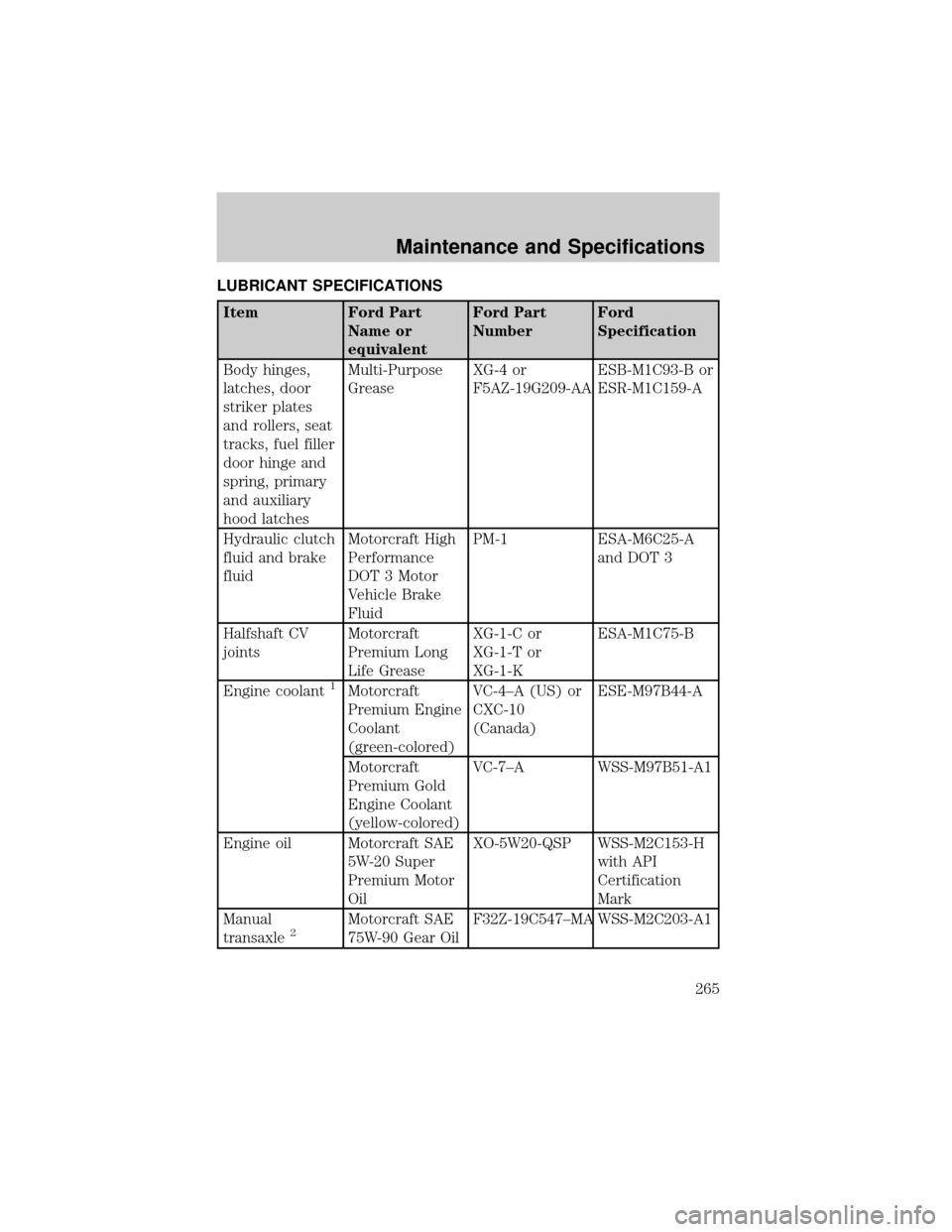
LUBRICANT SPECIFICATIONS
Item Ford Part
Name or
equivalentFord Part
NumberFord
Specification
Body hinges,
latches, door
striker plates
and rollers, seat
tracks, fuel filler
door hinge and
spring, primary
and auxiliary
hood latchesMulti-Purpose
GreaseXG-4 or
F5AZ-19G209-AAESB-M1C93-B or
ESR-M1C159-A
Hydraulic clutch
fluid and brake
fluidMotorcraft High
Performance
DOT 3 Motor
Vehicle Brake
FluidPM-1 ESA-M6C25-A
and DOT 3
Halfshaft CV
jointsMotorcraft
Premium Long
Life GreaseXG-1-C or
XG-1-T or
XG-1-KESA-M1C75-B
Engine coolant
1Motorcraft
Premium Engine
Coolant
(green-colored)VC-4±A (US) or
CXC-10
(Canada)ESE-M97B44-A
Motorcraft
Premium Gold
Engine Coolant
(yellow-colored)VC-7±A WSS-M97B51-A1
Engine oil Motorcraft SAE
5W-20 Super
Premium Motor
OilXO-5W20-QSP WSS-M2C153-H
with API
Certification
Mark
Manual
transaxle
2Motorcraft SAE
75W-90 Gear OilF32Z-19C547±MA WSS-M2C203-A1
Maintenance and Specifications
265
Page 267 of 280

44X4 vehicles exposed for prolonged periods to temperatures less than
±40É C (-40É F) should change out the rear axle fluid to Motorcraft SAE
75W-140 Synthetic Rear Axle Lubricant, Ford part number
XY-75W140±QL meeting Ford specification WSL-M2C192±A.
ENGINE DATA
Engine 2.0L DOHC I4 Zetec
engine3.0L DOHC V6
Duratec engine
Cubic inches 121 181
Required fuel 87 octane 87 octane
Firing order 1-3-4-2 1-4-2-5-3-6
Spark plug gap 1.22-1.32 mm
(0.048-0.052 inch)1.32-1.42 mm
(0.052-00.056 inch)
Ignition system DIS Coil on plug
Compression ratio 9.6:1 10.0:1
VEHICLE DIMENSIONS
Dimensions 4 Door mm (in.)
(1) Vehicle height/ Maximum
height*1 755 (69.1)/1 774 (69.8)*
(2) Front track / rear 1 551 (61.1)/1 530 (60.2)
(3)Overall width (body) 1 780 (70.1)
(4) Wheelbase 2 620 (103.1)
(5)Overall length 4 393 (173.0)
* Denotes a 4x4 vehicle with optional 16º tires
Maintenance and Specifications
267
Page 276 of 280

E
Emergencies, roadside
jump-starting ..........................200
Emission control system ..........250
Engine ........................................267
check engine/service engine
soon light ..................................10
cleaning ...................................219
coolant .....................................237
idle speed control ...................235
lubrication
specifications ..................265, 267
refill capacities ........................262
service points ..................229±230
starting after a collision .........187
Engine block heater .................157
Engine oil ..................................231
checking and adding ..............231
dipstick ....................................231
filter, specifications ........234, 262
recommendations ...................234
refill capacities ........................262
specifications ..................265, 267
Exhaust fumes ..........................158
F
Fluid capacities .........................262
Foglamps .....................................68
Four-Wheel Drive vehicles
description ..............................169
driving off road .......................171
indicator light ...................14, 170
preparing to drive your
vehicle .....................................162
Fuel ............................................242
calculating fuel economy .......247
cap .....................................14, 244capacity ...................................262
choosing the right fuel ...........245
comparisons with EPA fuel
economy estimates .................250
detergent in fuel .....................246
filling your vehicle
with fuel ..................242, 244, 247
filter, specifications ........246, 262
fuel pump shut-off switch .....187
gauge .........................................16
improving fuel economy ........247
low fuel warning light ..............13
octane rating ...................245, 267
quality ......................................245
running out of fuel .................246
safety information relating to
automotive fuels .....................242
Fuses ..................................189±190
G
Garage door opener ....................82
Gas cap (see Fuel cap) ......14, 244
Gas mileage
(see Fuel economy) .................247
Gauges .........................................15
engine coolant temperature
gauge .........................................15
fuel gauge ..................................16
odometer ...................................17
speedometer .............................16
tachometer ................................17
GAWR (Gross Axle
Weight Rating) ..........................178
calculating ...............................180
definition .................................178
driving with a heavy load ......178
location ....................................178
Index
276