2002 FORD ESCAPE lights
[x] Cancel search: lightsPage 154 of 280
STARTING
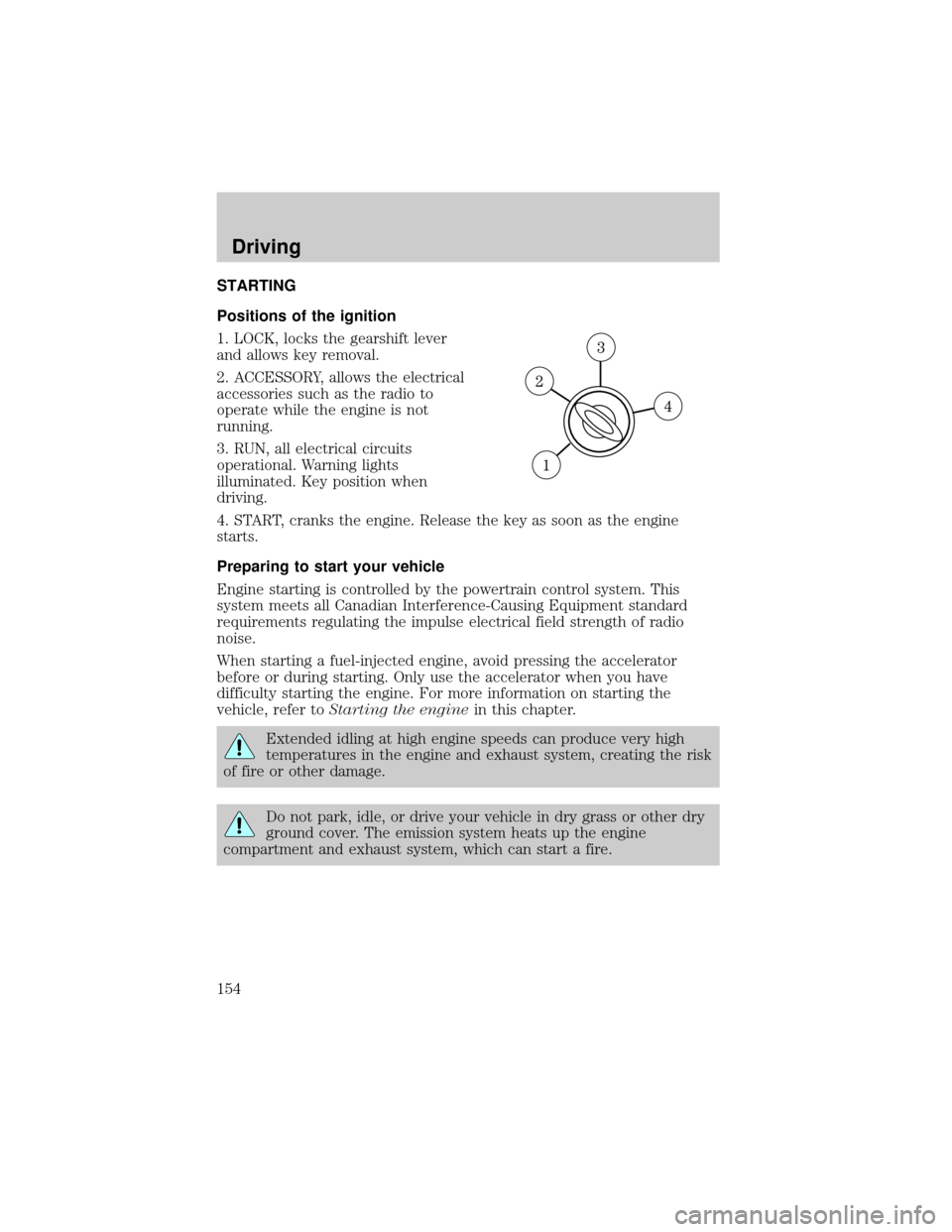
Positions of the ignition
1. LOCK, locks the gearshift lever
and allows key removal.
2. ACCESSORY, allows the electrical
accessories such as the radio to
operate while the engine is not
running.
3. RUN, all electrical circuits
operational. Warning lights
illuminated. Key position when
driving.
4. START, cranks the engine. Release the key as soon as the engine
starts.
Preparing to start your vehicle
Engine starting is controlled by the powertrain control system. This
system meets all Canadian Interference-Causing Equipment standard
requirements regulating the impulse electrical field strength of radio
noise.
When starting a fuel-injected engine, avoid pressing the accelerator
before or during starting. Only use the accelerator when you have
difficulty starting the engine. For more information on starting the
vehicle, refer toStarting the enginein this chapter.
Extended idling at high engine speeds can produce very high
temperatures in the engine and exhaust system, creating the risk
of fire or other damage.
Do not park, idle, or drive your vehicle in dry grass or other dry
ground cover. The emission system heats up the engine
compartment and exhaust system, which can start a fire.
Driving
154
Page 156 of 280

If starting a vehicle with a manual
transmission:
²Make sure the parking brake is
set.
²Push the clutch pedal to the
floor.
3. Turn the key to 3 (RUN) without
turning the key to 4 (START).
If there is difficulty in turning the
key, firmly rotate the steering wheel
left and right until the key turns
freely. This condition may occur
when:
²front wheels are turned
²front wheel is against the curb
²steering wheel is turned when
getting in or out of the vehicle
Make sure the corresponding lights illuminate or illuminate briefly. If a
light fails to illuminate, have the vehicle serviced.
²If the driver's safety belt is fastened, the
light may not illuminate.
Driving
156
Page 170 of 280
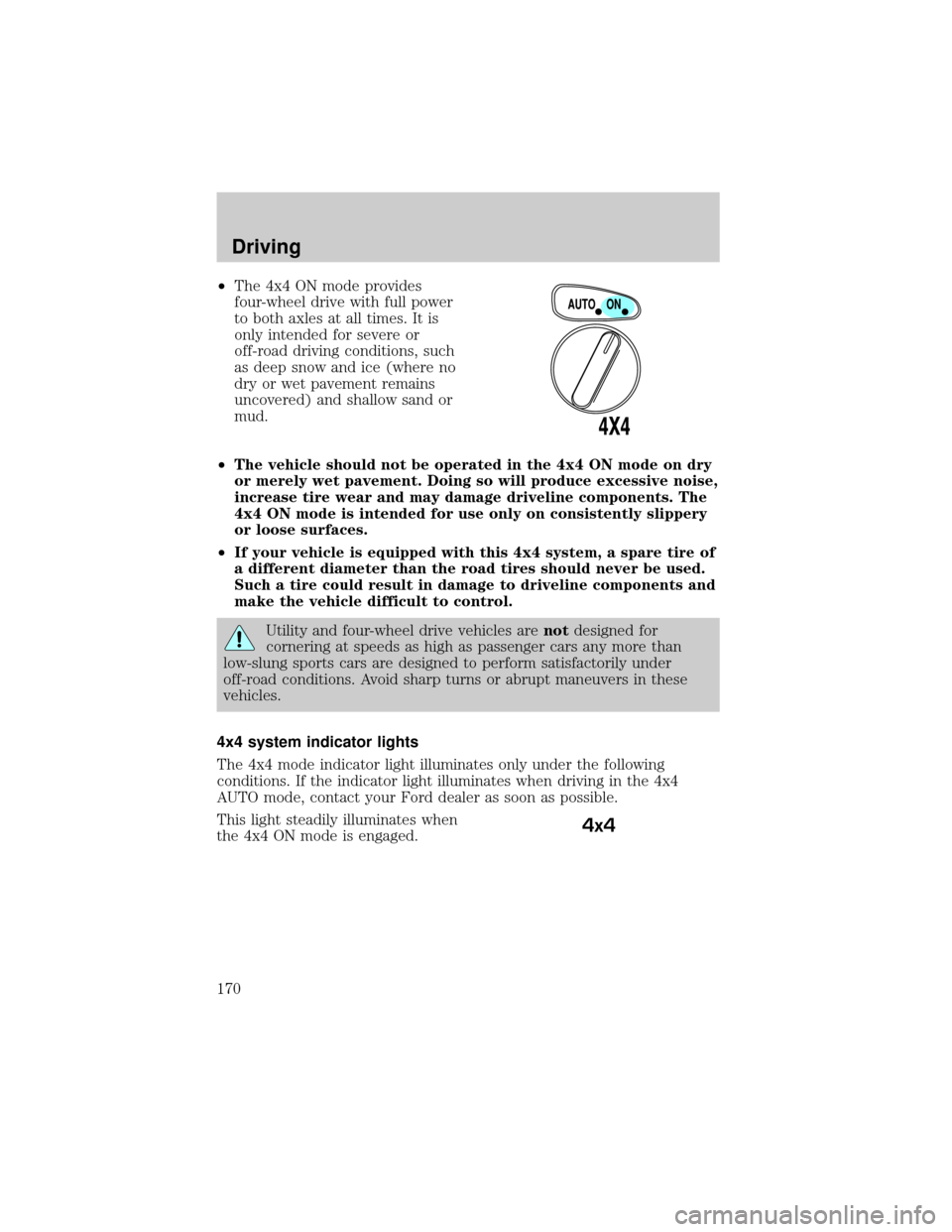
²The 4x4 ON mode provides
four-wheel drive with full power
to both axles at all times. It is
only intended for severe or
off-road driving conditions, such
as deep snow and ice (where no
dry or wet pavement remains
uncovered) and shallow sand or
mud.
²The vehicle should not be operated in the 4x4 ON mode on dry
or merely wet pavement. Doing so will produce excessive noise,
increase tire wear and may damage driveline components. The
4x4 ON mode is intended for use only on consistently slippery
or loose surfaces.
²If your vehicle is equipped with this 4x4 system, a spare tire of
a different diameter than the road tires should never be used.
Such a tire could result in damage to driveline components and
make the vehicle difficult to control.
Utility and four-wheel drive vehicles arenotdesigned for
cornering at speeds as high as passenger cars any more than
low-slung sports cars are designed to perform satisfactorily under
off-road conditions. Avoid sharp turns or abrupt maneuvers in these
vehicles.
4x4 system indicator lights
The 4x4 mode indicator light illuminates only under the following
conditions. If the indicator light illuminates when driving in the 4x4
AUTO mode, contact your Ford dealer as soon as possible.
This light steadily illuminates when
the 4x4 ON mode is engaged.
4x4
Driving
170
Page 187 of 280

ROADSIDE COVERAGE BEYOND BASIC WARRANTY
In the United States, you may purchase additional roadside assistance
coverage beyond this period through the Mazda Auto Club by contacting
your Mazda dealer.
Similarly in Canada, for uninterrupted Roadside Assistance coverage, you
may purchase extended coverage prior to your Basic Warranty's Roadside
Assistance expiring. For more information and enrollment, contact
1±877±294±2582 or visit our website at www.mazda.ca.
HAZARD FLASHER CONTROL
Use only in an emergency to warn traffic of vehicle breakdown,
approaching danger, etc. The hazard flashers can be operated when the
ignition is off.
²The hazard lights control is
located on the instrument panel
by the radio.
²Depress hazard lights control to
activate all hazard flashers
simultaneously.
²Depress control again to turn the
flashers off.
FUEL PUMP SHUT-OFF SWITCH
FUEL
RESET
The fuel pump shut-off switch is a device intended to stop the electric
fuel pump when your vehicle has been involved in a substantial jolt.
After a collision, if the engine cranks but does not start, the fuel pump
shut-off switch may have been activated.
Roadside Emergencies
187
Page 251 of 280

Do not park, idle, or drive your vehicle in dry grass or other dry
ground cover. The emission system heats up the engine
compartment and exhaust system, which can start a fire.
Illumination of the
indicator, charging system warning light or the
temperature warning light, fluid leaks, strange odors, smoke or loss of
engine power, could indicate that the emission control system is not
working properly.
Exhaust leaks may result in entry of harmful and potentially
lethal fumes into the passenger compartment.
Do not make any unauthorized changes to your vehicle or engine. By
law, vehicle owners and anyone who manufactures, repairs, services,
sells, leases, trades vehicles, or supervises a fleet of vehicles are not
permitted to intentionally remove an emission control device or prevent
it from working. Information about your vehicle's emission system is on
the Vehicle Emission Control Information Decal located on or near the
engine. This decal identifies engine displacement and gives some tune up
specifications.
Please consult yourWarranty Guidefor complete emission warranty
information.
Readiness for Inspection/Maintenance (I/M) testing
In some localities, it may be a legal requirement to pass an I/M test of
the on-board diagnostics system. If your
indicator is on, refer to the
description in theWarning lights and chimessection of the
Instrument Clusterchapter. Your vehicle may not pass the I/M test with
the
indicator on.
If the vehicle's powertrain system or its battery has just been serviced,
the on-board diagnostics system is reset to a ªnot ready for I/M testº
condition. To ready the on-board diagnostics system for I/M testing, a
minimum of 30 minutes of city and highway driving is necessary as
described below:
²First, at least 10 minutes of driving on an expressway or highway.
²Next, at least 20 minutes driving in stop-and-go, city-type traffic with
at least four idle periods.
Allow the vehicle to sit for at least eight hours without starting the
engine. Then, start the engine and complete the above driving cycle. The
Maintenance and Specifications
251
Page 272 of 280

Floor cargo net
Tire step
Travel equipment
Auto headlamps with DRL (Daytime Running Lights)
Console
Daytime running lights
Factory luggage rack adaptors
Hitch mounted bike rack
Mirror I/S electrochromic compass with and without temperature display
Pet guard
Removable luggage rack (Track riders)
Removable luggage rack adapters
Running boards and running bars
Soft luggage cover
Trailer hitch (Class II)
Trailer hitch bars and balls
Trailer hitch wiring adaptor
Protection and appearance equipment
Air bag anti-theft locks
Car/truck covers
Cargo liners, interior (soft and rigid)
Carpet floor mats
Door edge guards
Front end covers (full and mini)
Grill guard
Hood deflectors
Molded splash guards
Molded vinyl floor mats
Moonroof deflector
Rear air deflectors
Accessories
272
Page 277 of 280

GVWR (Gross Vehicle
Weight Rating) ..........................178
calculating .......................178, 180
definition .................................178
driving with a heavy load ......178
location ....................................178
H
Hazard flashers .........................187
Head restraints .........................115
Headlamps ...................................68
aiming ........................................70
bulb specifications ....................73
daytime running lights .............68
flash to pass ..............................69
high beam ...........................13, 69
replacing bulbs .........................74
turning on and off ....................68
warning chime ..........................15
Heating
heater only system ...................62
heating and air conditioning
system .......................................63
Hood ..........................................227
I
Ignition ...............................154, 267
Infant seats
(see Safety seats) .............145±146
Inspection/maintenance (I/M)
testing ........................................251
Instrument panel
cleaning ...................................222
cluster ................................10, 223
lighting up panel and
interior .......................................69J
Jack ............................................195
positioning ...............................195
storage .....................................195
Jump-starting your vehicle ......200
K
Keys ...................................107±109
key in ignition chime ...............15
positions of the ignition .........154
L
Lamps
bulb replacement
specifications chart ..................73
cargo lamps ...............................69
daytime running light ...............68
fog lamps ...................................68
headlamps .................................68
headlamps, flash to pass ..........69
instrument panel, dimming .....69
interior lamps ...............71±72, 74
replacing bulbs ...................73±77
Lane change indicator
(see Turn signal) ........................71
Liftgate ........................................90
Lights, warning and indicator ....10
air bag ........................................12
anti-lock brakes (ABS) ....12, 160
anti-theft ...................................14
brake ..........................................11
charging system ........................12
cruise indicator .........................13
door ajar ....................................13
fuel cap light .............................14
high beam .................................13
low coolant ................................14
Index
277
Page 280 of 280

Vehicle loading ..........................178
Ventilating your vehicle ...........158
W
Warning chimes .....................14±15
Warning lights (see Lights) .......10
Washer fluid ..............................231
Water, Driving through .............178
Windows
power .........................................83rear wiper/washer .....................80
Windshield washer fluid and
wipers
checking and adding fluid .....231
checking and cleaning ........79, 81
liftgate reservoir .....................231
operation ...................................78
replacing wiper blades .............80
Wrecker towing .........................206
Index
280