2002 FORD ESCAPE fuel pump
[x] Cancel search: fuel pumpPage 194 of 280

Fuse/Relay
LocationFuse Amp
RatingPower Distribution Box
Description
EEC 5A* EEC (KPWR)
HEGO 15A* HEGO 1,2, CMS 1,2, VMV
FUEL 20A* Fuel Pump, EEC (FPM)
DIODE Ð Ð
DIODE Ð Ð
H/L RELAY
MICROÐ Headlamp (High/Low, Right/Left
Relay)
ÐÐÐ
INJ 30A** EEC (VPWR), EVR, MAF, IAC,
Bulkhead
MAIN 120A Main
ALT 15A* Alternator/ Regulator
(DRL) 15A* DRL Unit (feed), DRL Relay
(DRLZ) (HLEV)15A*(DRLZ)
10A(HLEV)Daytime Running Lamps (DRL)
Module, HLEV
PWR 1 15A* Auxiliary Power Point
FOG 20A* Foglamps RH/LH, Foglamp
Indicator
A/C 15A* A/C Clutch
(ABS) 25A* Anti-Lock Brake System SOL
PWR 2 15A* Auxiliary Power Point
IG MAIN 40A** Starter
HTR 40A** Blower Motor, Blower Motor Relay
BTN 1 40A** JB Ð Acc. Relay, Radio, Clock,
Cigar Lighter, Cluster, Power
Mirror, GEM
(ABS) 60A** Anti-Lock Brake System Motor
BTN 2 40A** JB Ð Radio, CD Changer, Cluster,
Dome Lamps, Map Lamps, Cargo
Lamps
MAIN FAN 40A** (2.0 L)
50A(3.0 L)Main Fan
Roadside Emergencies
194
Page 195 of 280

Fuse/Relay
LocationFuse Amp
RatingPower Distribution Box
Description
R DEF 30A** Rear Defroster
ADD FAN 40A**(2.0 L)
50A(3.0 L)Add Fan
EEC MAIN ISO Ð EEC Relay
FUEL PUMP ISO Ð Fuel Pump Relay
MAIN FAN ISO Ð Low Speed Fan Control Relay
(2.0L Engine)
High Speed Fan Control Relay 1
(3.0L Engine)
ADD FAN ISO Ð High Speed Fan Control Relay 1
(2.0L Engine)
Low Speed Fan Control Relay
(3.0L Engine)
DEF RELAY ISO Ð Rear Defroster Relay
ST RELAY ISO Ð Starter Relay
ADD FAN 2 ISO Ð High Speed Fan Control Relay 2
(3.0L Engine)
Medium Speed Fan Control Relay
(2.0L Engine)
FOG RELAY
MICROÐ Foglamp Relay
A/C RELAY
MICROÐ A/C Clutch Relay
CHANGING THE TIRES
If you get a flat tire while driving, do not apply the brake heavily.
Instead, gradually decrease your speed. Hold the steering wheel firmly
and slowly move to a safe place on the side of the road.
Temporary spare tire information
The temporary spare tire for your vehicle is labeled as such. It is smaller
than a regular tire and is designed for emergency use only.
Roadside Emergencies
195
Page 244 of 280

The flow of fuel through a fuel pump nozzle can produce static
electricity, which can cause a fire if fuel is pumped into an
ungrounded fuel container.
Use the following guidelines to avoid static build-up when filling an
ungrounded fuel container:
²Place approved fuel container on the ground.
²DO NOT fill a fuel container while it is in the vehicle (including the
cargo area).
²Keep the fuel pump nozzle in contact with the fuel container while
filling.
²DO NOT use a device that would hold the fuel pump handle in the fill
position.
Fuel Filler Cap
Your fuel tank filler cap has an indexed design with a 1/8 turn on/off
feature.
When fueling your vehicle:
1. Turn the engine off.
2. Carefully turn the filler cap counterclockwise 1/8 of a turn until it
stops.
3. Pull to remove the cap from the fuel filler pipe.
4. To install the cap, align the tabs on the cap with the notches on the
filler pipe.
5. Turn the filler cap clockwise 1/8 of a turn until it stops.
After refueling, if the ªCHECK FUEL CAPº
indicator comes on and
stays on when you start the engine, the fuel filler cap may not be
properly installed. Turn off the engine, remove the fuel filler cap, align
the cap properly and reinstall it securely. The
indicator should turn
off after three driving cycles with the fuel filler cap properly installed. A
driving cycle consists of a cold engine start-up followed by mixed
city/highway driving.
If you must replace the fuel filler cap, replace it with a fuel filler
cap that is designed for your vehicle. The customer warranty may
be void for any damage to the fuel tank or fuel system if the
correct genuine Ford or Motorcraft fuel filler cap is not used.
Maintenance and Specifications
244
Page 245 of 280
The fuel system may be under pressure. If the fuel filler cap is
venting vapor or if you hear a hissing sound, wait until it stops
before completely removing the fuel filler cap. Otherwise, fuel may
spray out and injure you or others.
If you do not use the proper fuel filler cap, excessive pressure or
vacuum in the fuel tank may damage the fuel system or cause
the fuel cap to disengage in a collision, which may result in possible
personal injury.
Choosing the right fuel
Use only UNLEADED FUEL. The use of leaded fuel is prohibited by law
and could damage your vehicle.
Do not use fuel containing methanol. It can damage critical fuel system
components.
Your vehicle was not designed to use fuel or fuel additives with metallic
compounds, including manganese-based compounds containing MMT.
Repairs to correct the effects of using a fuel for which your vehicle was
not designed may not be covered by your warranty.
Octane recommendations
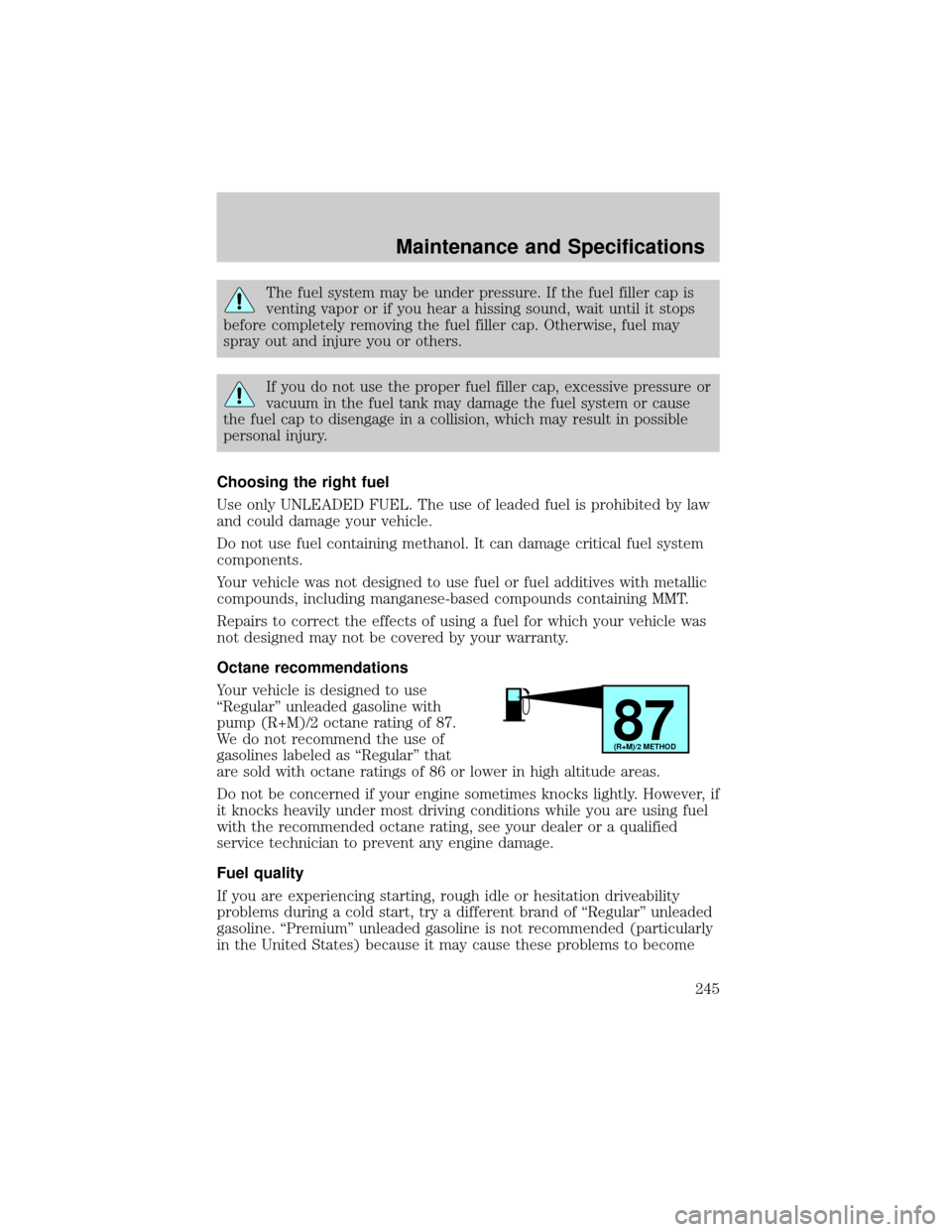
Your vehicle is designed to use
ªRegularº unleaded gasoline with
pump (R+M)/2 octane rating of 87.
We do not recommend the use of
gasolines labeled as ªRegularº that
are sold with octane ratings of 86 or lower in high altitude areas.
Do not be concerned if your engine sometimes knocks lightly. However, if
it knocks heavily under most driving conditions while you are using fuel
with the recommended octane rating, see your dealer or a qualified
service technician to prevent any engine damage.
Fuel quality
If you are experiencing starting, rough idle or hesitation driveability
problems during a cold start, try a different brand of ªRegularº unleaded
gasoline. ªPremiumº unleaded gasoline is not recommended (particularly
in the United States) because it may cause these problems to become
87(R+M)/2 METHOD
Maintenance and Specifications
245
Page 246 of 280

more pronounced. If the problems persist, see your dealer or a qualified
service technician.
It should not be necessary to add any aftermarket products to your fuel
tank if you continue to use high quality fuel of the recommended octane
rating. Aftermarket products could cause damage to the fuel system.
Repairs to correct the effects of using an aftermarket product in your
fuel may not be covered by your warranty.
Many of the world's automakers
issued the World-wide Fuel Charter
that recommends gasoline
specifications to provide improved
performance and emission control
system protection for your vehicle.
Gasolines that meet the World-wide
Fuel Charter should be used when
available. Ask your fuel supplier
about gasolines that meet the
World-wide Fuel Charter. In Canada,
look for fuels that display theAuto Makers' Choiceylogo.
Cleaner air
Ford endorses the use of reformulated ªcleaner-burningº gasolines to
improve air quality.
Running out of fuel
Avoid running out of fuel because this situation may have an adverse
affect on powertrain components.
If you have run out of fuel:
²You may need to cycle the ignition from OFF to ON several times after
refueling, to allow the fuel system to pump the fuel from the tank to
the engine.
²The
indicator may come on. For more information on the ªCheck
Engineº indicator, refer to theInstrument Clusterchapter.
Fuel Filter
For fuel filter replacement, see your dealer or a qualified service
technician. Refer to the scheduled maintenance guide for the appropriate
intervals for changing the fuel filter.
Maintenance and Specifications
246
Page 248 of 280
²Use the same side of the same pump and have the vehicle facing the
same direction each time you fill up.
²Have the vehicle loading and distribution the same every time.
Your results will be most accurate if your filling method is consistent.
Calculating fuel economy
1. Fill the fuel tank completely and record the initial odometer reading
(in kilometers or miles).
2. Each time you fill the tank, record the amount of fuel added (in liters
or gallons).
3. After at least three to five tank fill-ups, fill the fuel tank and record
the current odometer reading.
4. Subtract your initial odometer reading from the current odometer
reading.
5. Follow one of the simple calculations in order to determine fuel
economy:
Multiply liters used by 100, then divide by total kilometers
traveled.
Divide total miles traveled by total gallons used.
Keep a record for at least one month and record the type of driving (city
or highway). This will provide an accurate estimate of the vehicle's fuel
economy under current driving conditions. Additionally, keeping records
during summer and winter will show how temperature impacts fuel
economy. In general, lower temperatures give lower fuel economy.
Driving style Ð good driving and fuel economy habits
Give consideration to the lists that follow and you may be able to change
a number of variables and improve your fuel economy.
Habits
²Smooth, moderate operation can yield up to 10% savings in fuel.
²Steady speeds without stopping will usually give the best fuel
economy.
²Idling for long periods of time (greater than one minute) may waste
fuel.
²Anticipate stopping; slowing down may eliminate the need to stop.
Maintenance and Specifications
248
Page 276 of 280

E
Emergencies, roadside
jump-starting ..........................200
Emission control system ..........250
Engine ........................................267
check engine/service engine
soon light ..................................10
cleaning ...................................219
coolant .....................................237
idle speed control ...................235
lubrication
specifications ..................265, 267
refill capacities ........................262
service points ..................229±230
starting after a collision .........187
Engine block heater .................157
Engine oil ..................................231
checking and adding ..............231
dipstick ....................................231
filter, specifications ........234, 262
recommendations ...................234
refill capacities ........................262
specifications ..................265, 267
Exhaust fumes ..........................158
F
Fluid capacities .........................262
Foglamps .....................................68
Four-Wheel Drive vehicles
description ..............................169
driving off road .......................171
indicator light ...................14, 170
preparing to drive your
vehicle .....................................162
Fuel ............................................242
calculating fuel economy .......247
cap .....................................14, 244capacity ...................................262
choosing the right fuel ...........245
comparisons with EPA fuel
economy estimates .................250
detergent in fuel .....................246
filling your vehicle
with fuel ..................242, 244, 247
filter, specifications ........246, 262
fuel pump shut-off switch .....187
gauge .........................................16
improving fuel economy ........247
low fuel warning light ..............13
octane rating ...................245, 267
quality ......................................245
running out of fuel .................246
safety information relating to
automotive fuels .....................242
Fuses ..................................189±190
G
Garage door opener ....................82
Gas cap (see Fuel cap) ......14, 244
Gas mileage
(see Fuel economy) .................247
Gauges .........................................15
engine coolant temperature
gauge .........................................15
fuel gauge ..................................16
odometer ...................................17
speedometer .............................16
tachometer ................................17
GAWR (Gross Axle
Weight Rating) ..........................178
calculating ...............................180
definition .................................178
driving with a heavy load ......178
location ....................................178
Index
276