Page 248 of 280
²Use the same side of the same pump and have the vehicle facing the
same direction each time you fill up.
²Have the vehicle loading and distribution the same every time.
Your results will be most accurate if your filling method is consistent.
Calculating fuel economy
1. Fill the fuel tank completely and record the initial odometer reading
(in kilometers or miles).
2. Each time you fill the tank, record the amount of fuel added (in liters
or gallons).
3. After at least three to five tank fill-ups, fill the fuel tank and record
the current odometer reading.
4. Subtract your initial odometer reading from the current odometer
reading.
5. Follow one of the simple calculations in order to determine fuel
economy:
Multiply liters used by 100, then divide by total kilometers
traveled.
Divide total miles traveled by total gallons used.
Keep a record for at least one month and record the type of driving (city
or highway). This will provide an accurate estimate of the vehicle's fuel
economy under current driving conditions. Additionally, keeping records
during summer and winter will show how temperature impacts fuel
economy. In general, lower temperatures give lower fuel economy.
Driving style Ð good driving and fuel economy habits
Give consideration to the lists that follow and you may be able to change
a number of variables and improve your fuel economy.
Habits
²Smooth, moderate operation can yield up to 10% savings in fuel.
²Steady speeds without stopping will usually give the best fuel
economy.
²Idling for long periods of time (greater than one minute) may waste
fuel.
²Anticipate stopping; slowing down may eliminate the need to stop.
Maintenance and Specifications
248
Page 254 of 280

TRANSMISSION FLUID
Checking automatic transmission fluid (if equipped)
Refer to your scheduled maintenance guide for scheduled intervals for
fluid checks and changes. Your transaxle does not consume fluid.
However, the fluid level should be checked if the transaxle is not working
properly, i.e., if the transaxle slips or shifts slowly or if you notice some
sign of fluid leakage.
Automatic transmission fluid expands when warmed. To obtain an
accurate fluid check, drive the vehicle until it is warmed up
(approximately 30 km [20 miles]). If your vehicle has been
operated for an extended period at high speeds, in city traffic
during hot weather or pulling a trailer, the vehicle should be
turned off for about 30 minutes to allow fluid to cool before
checking.
1. Drive the vehicle 30 km (20 miles) or until it reaches normal operating
temperature.
2. Park the vehicle on a level surface and engage the parking brake.
3. With the parking brake engaged and your foot on the brake pedal,
start the engine and move the gearshift lever through all of the gear
ranges. Allow sufficient time for each gear to engage.
4. Latch the gearshift lever in P (Park) and leave the engine running.
5. Remove the dipstick, wiping it clean with a clean, dry lint free rag. If
necessary, refer toIdentifying components in the engine compartment
in this chapter for the location of the dipstick.
6. Install the dipstick making sure it is fully seated in the filler tube.
7. Remove the dipstick and inspect the fluid level. The fluid should be in
the crosshatch zone for normal operating temperature.
Low fluid level
Do not drive the vehicle if the fluid
level is at the bottom of the dipstick
and the outside temperatures are
above 10ÉC (50ÉF).
Correct fluid level
The transmission fluid should be checked at normal operating
temperatures 66ÉC-77ÉC (150ÉF-170ÉF) on a level surface. The normal
Maintenance and Specifications
254
Page 266 of 280
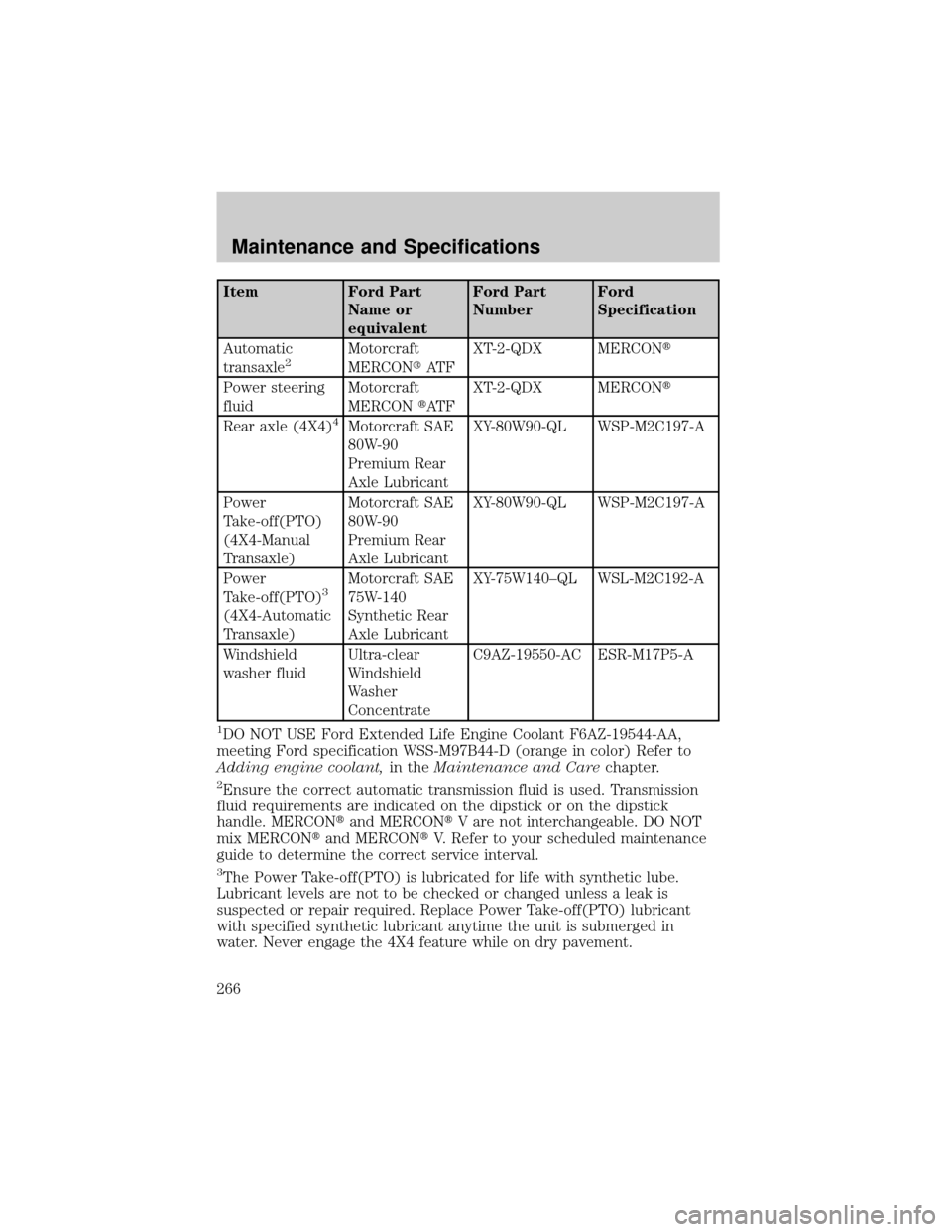
Item Ford Part
Name or
equivalentFord Part
NumberFord
Specification
Automatic
transaxle
2Motorcraft
MERCONtAT FXT-2-QDX MERCONt
Power steering
fluidMotorcraft
MERCONtAT FXT-2-QDX MERCONt
Rear axle (4X4)
4Motorcraft SAE
80W-90
Premium Rear
Axle LubricantXY-80W90-QL WSP-M2C197-A
Power
Take-off(PTO)
(4X4-Manual
Transaxle)Motorcraft SAE
80W-90
Premium Rear
Axle LubricantXY-80W90-QL WSP-M2C197-A
Power
Take-off(PTO)
3
(4X4-Automatic
Transaxle)Motorcraft SAE
75W-140
Synthetic Rear
Axle LubricantXY-75W140±QL WSL-M2C192-A
Windshield
washer fluidUltra-clear
Windshield
Washer
ConcentrateC9AZ-19550-AC ESR-M17P5-A
1DO NOT USE Ford Extended Life Engine Coolant F6AZ-19544-AA,
meeting Ford specification WSS-M97B44-D (orange in color) Refer to
Adding engine coolant,in theMaintenance and Carechapter.
2Ensure the correct automatic transmission fluid is used. Transmission
fluid requirements are indicated on the dipstick or on the dipstick
handle. MERCONtand MERCONtV are not interchangeable. DO NOT
mix MERCONtand MERCONtV. Refer to your scheduled maintenance
guide to determine the correct service interval.
3The Power Take-off(PTO) is lubricated for life with synthetic lube.
Lubricant levels are not to be checked or changed unless a leak is
suspected or repair required. Replace Power Take-off(PTO) lubricant
with specified synthetic lubricant anytime the unit is submerged in
water. Never engage the 4X4 feature while on dry pavement.
Maintenance and Specifications
266
Page 277 of 280

GVWR (Gross Vehicle
Weight Rating) ..........................178
calculating .......................178, 180
definition .................................178
driving with a heavy load ......178
location ....................................178
H
Hazard flashers .........................187
Head restraints .........................115
Headlamps ...................................68
aiming ........................................70
bulb specifications ....................73
daytime running lights .............68
flash to pass ..............................69
high beam ...........................13, 69
replacing bulbs .........................74
turning on and off ....................68
warning chime ..........................15
Heating
heater only system ...................62
heating and air conditioning
system .......................................63
Hood ..........................................227
I
Ignition ...............................154, 267
Infant seats
(see Safety seats) .............145±146
Inspection/maintenance (I/M)
testing ........................................251
Instrument panel
cleaning ...................................222
cluster ................................10, 223
lighting up panel and
interior .......................................69J
Jack ............................................195
positioning ...............................195
storage .....................................195
Jump-starting your vehicle ......200
K
Keys ...................................107±109
key in ignition chime ...............15
positions of the ignition .........154
L
Lamps
bulb replacement
specifications chart ..................73
cargo lamps ...............................69
daytime running light ...............68
fog lamps ...................................68
headlamps .................................68
headlamps, flash to pass ..........69
instrument panel, dimming .....69
interior lamps ...............71±72, 74
replacing bulbs ...................73±77
Lane change indicator
(see Turn signal) ........................71
Liftgate ........................................90
Lights, warning and indicator ....10
air bag ........................................12
anti-lock brakes (ABS) ....12, 160
anti-theft ...................................14
brake ..........................................11
charging system ........................12
cruise indicator .........................13
door ajar ....................................13
fuel cap light .............................14
high beam .................................13
low coolant ................................14
Index
277