2002 FORD E SERIES air condition
[x] Cancel search: air conditionPage 232 of 272

When this occurs the vehicle will still operate. However:
²The engine power will be limited.
²The air conditioning system will be disabled.
Continued operation will increase the engine temperature and the engine
will completely shut down, causing steering and braking effort to
increase.
Once the engine temperature cools, the engine can be re-started. Take
your vehicle to a service facility as soon as possible to minimize engine
damage.
When fail-safe mode is activated
You have limited engine power when in the fail-safe mode, so drive the
vehicle with caution. The vehicle will not be able to maintain high-speed
operation and the engine will run rough. Remember that the engine is
capable of completely shutting down automatically to prevent engine
damage, therefore:
1. Pull off the road as soon as safely possible and turn off the engine.
2. Arrange for the vehicle to be taken to a service facility.
3. If this is not possible, wait a short period for the engine to cool.
4. Check the coolant level and replenish if low.
Never remove the coolant reservoir cap while the engine is
running or hot.
5. Re-start the engine and take your vehicle to a service facility.
Driving the vehicle without repairing the engine problem
increases the chance of engine damage. Take your vehicle to a
service facility as soon as possible.
Maintenance and specifications
232
Page 236 of 272

The fuel system may be under pressure. If the fuel filler cap is
venting vapor or if you hear a hissing sound, wait until it stops
before completely removing the fuel filler cap. Otherwise, fuel may
spray out and injure you or others.
If you do not use the proper fuel filler cap, excessive pressure or
vacuum in the fuel tank may damage the fuel system or cause
the fuel cap to disengage in a collision, which may result in possible
personal injury.
Choosing the right fuel
Use only UNLEADED FUEL. The use of leaded fuel is prohibited by law
and could damage your vehicle.
Do not use fuel containing methanol. It can damage critical fuel system
components.
Your vehicle was not designed to use fuel or fuel additives with metallic
compounds, including manganese-based compounds containing MMT.
Repairs to correct the effects of using a fuel for which your vehicle was
not designed may not be covered by your warranty.
Octane recommendations
Your vehicle is designed to use
ªRegularº unleaded gasoline with
pump (R+M)/2 octane rating of 87.
We do not recommend the use of
gasolines labeled as ªRegularº that
are sold with octane ratings of 86 or lower in high altitude areas.
Do not be concerned if your engine sometimes knocks lightly. However, if
it knocks heavily under most driving conditions while you are using fuel
with the recommended octane rating, see your dealer or a qualified
service technician to prevent any engine damage.
87(R+M)/2 METHOD
Maintenance and specifications
236
Page 240 of 272

²Idling for long periods of time (greater than one minute) may waste
fuel.
²Anticipate stopping; slowing down may eliminate the need to stop.
²Sudden or hard accelerations may reduce fuel economy.
²Slow down gradually.
²Driving at reasonable speeds (traveling at 88 km/h [55 mph] uses 15%
less fuel than traveling at 105 km/h [65 mph]).
²Revving the engine before turning it off may reduce fuel economy.
²Using the air conditioner or defroster may reduce fuel economy.
²You may want to turn off the speed control in hilly terrain if
unnecessary shifting between third and fourth gear occurs.
Unnecessary shifting of this type could result in reduced fuel
economy.
²Warming up a vehicle on cold mornings is not required and may
reduce fuel economy.
²Resting your foot on the brake pedal while driving may reduce fuel
economy.
²Combine errands and minimize stop-and-go driving.
Maintenance
²Keep tires properly inflated and use only recommended size.
²Operating a vehicle with the wheels out of alignment will reduce fuel
economy.
²Use recommended engine oil. Refer toLubricant specificationsin
this chapter.
²Perform all regularly scheduled maintenance items. Follow the
recommended maintenance schedule and owner maintenance checks
found in your vehicle scheduled maintenance guide.
Conditions
²Heavily loading a vehicle or towing a trailer may reduce fuel economy
at any speed.
²Carrying unnecessary weight may reduce fuel economy (approximately
0.4 km/L [1 mpg] is lost for every 180 kg [400 lb] of weight carried).
Maintenance and specifications
240
Page 242 of 272

If other than Ford, Motorcraft or Ford-authorized parts are used for
maintenance replacements or for service of components affecting
emission control, such non-Ford parts should be equivalent to genuine
Ford Motor Company parts in performance and durability.
Do not park, idle, or drive your vehicle in dry grass or other dry
ground cover. The emission system heats up the engine
compartment and exhaust system, which can start a fire.
Illumination of the ªService Engine Soonº light, charging system warning
light or the temperature warning light, fluid leaks, strange odors, smoke
or loss of engine power, could indicate that the emission control system
is not working properly.
Exhaust leaks may result in entry of harmful and potentially
lethal fumes into the passenger compartment.
Do not make any unauthorized changes to your vehicle or engine. By
law, vehicle owners and anyone who manufactures, repairs, services,
sells, leases, trades vehicles, or supervises a fleet of vehicles are not
permitted to intentionally remove an emission control device or prevent
it from working. Information about your vehicle's emission system is on
the Vehicle Emission Control Information Decal located on or near the
engine. This decal identifies engine displacement and gives some tune up
specifications.
Please consult yourWarranty Guidefor complete emission warranty
information.
Readiness for Inspection/Maintenance (I/M) testing
In some localities, it may be a legal requirement to pass an I/M test of
the on-board diagnostics system. If your ªCheck Engine/Service Engine
Soonº light is on, refer to the description in theWarning lights and
chimessection of theInstrument Clusterchapter. Your vehicle may not
pass the I/M test with the ªCheck Engine/Service Engine Soonº light on.
If the vehicle's powertrain system or its battery has just been serviced,
the on-board diagnostics system is reset to a ªnot ready for I/M testº
condition. To ready the on-board diagnostics system for I/M testing, a
minimum of 30 minutes of city and highway driving is necessary as
described below:
²First, at least 10 minutes of driving on an expressway or highway.
Maintenance and specifications
242
Page 247 of 272
Adjusting automatic transmission fluid levels
Before adding any fluid, make sure the correct type is used. The type of
fluid used is normally indicated on the dipstick and also in the
Lubricant specificationssection in this chapter.
Use of a non-approved automatic transmission fluid may cause
internal transmission component damage.
If necessary, add fluid in 250 ml (1/2 pint) increments through the filler
tube until the level is correct.
If an overfill occurs, excess fluid
should be removed by a qualified
technician.
An overfill condition of
transmission fluid may cause shift and/or engagement concerns
and/or possible damage.
AIR FILTER MAINTENANCE
Refer to the scheduled maintenance guide for the appropriate intervals
for changing the air filter element.
When changing the air filter element, use only the Motorcraft air filter
element listed. Refer toMotorcraft Part Numbers.
Note:Do not start your engine with the air cleaner removed and do not
remove it while the engine is running.
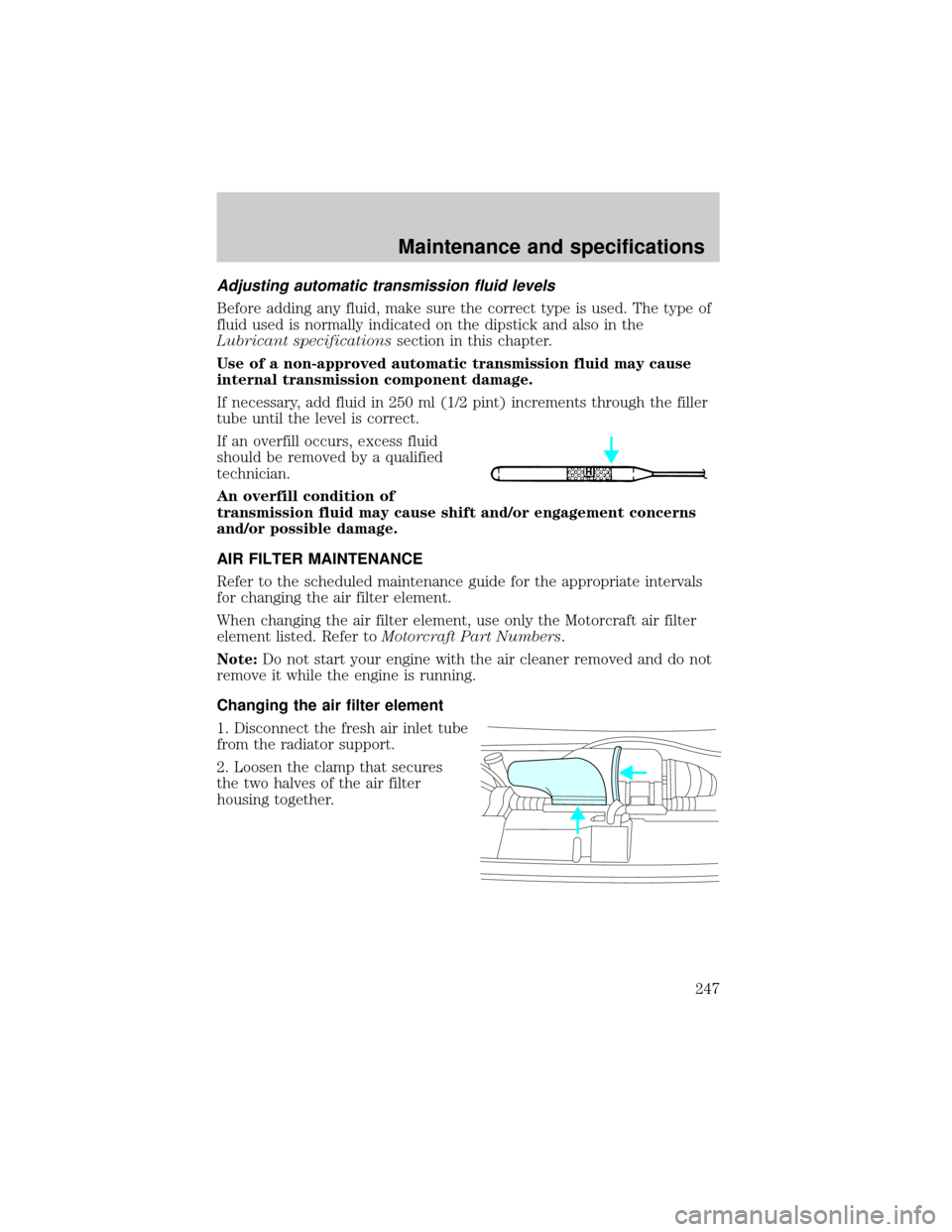
Changing the air filter element
1. Disconnect the fresh air inlet tube
from the radiator support.
2. Loosen the clamp that secures
the two halves of the air filter
housing together.
Maintenance and specifications
247
Page 264 of 272

FORD ACCESSORIES FOR YOUR VEHICLE
A wide selection of genuine Ford accessories are available for your
vehicle through your local authorized Ford, Lincoln, Mercury or Ford of
Canada dealer. These quality accessories have been specifically
engineered to fulfill your automotive needs; they are custom designed to
complement the style and aerodynamic appearance of your vehicle. In
addition, each accessory is made from high quality materials and meets
or exceeds Ford's rigorous engineering and safety specifications. Ford
Motor Company will repair or replace any properly dealer-installed Ford
accessory found to be defective in factory-supplied materials or
workmanship during the warranty period, as well as any component
damaged by the defective accessory. The accessory will be warranted for
whichever provides you the greatest benefit:
²12 months or 20 000 km (12 000 miles) (whichever occurs first), or
²The remainder of your new vehicle limited warranty.
This means that genuine Ford accessories purchased along with your
new vehicle and installed by the dealer are covered for the full length of
your New Vehicle's Limited Warranty Ð 3 years or 60 000 km
(36 000 miles) (whichever occurs first). Contact your dealer for details
and a copy of the warranty.
Not all accessories are available for all models.
Vehicle Security
Styled wheel locks
Vehicle security systems
Comfort and convenience
Air conditioner
Engine block heaters
Remote start
Tire step
Travel equipment
Auto head lamps with DRL
Bicycle rack
Cell phone holder
Accessories
264
Page 267 of 272

A
Air bag supplemental restraint
system ........................................132
and child safety seats ............134
description ..............................132
disposal ....................................137
driver air bag ..........................135
indicator light ...................14, 136
operation .................................135
passenger air bag ...................135
Air cleaner filter ...............247, 253
Air conditioning
manual heating and air
conditioning system .................79
Ambulance packages ....................7
Antifreeze (see Engine
coolant) .....................................226
Anti-lock brake system (see
Brakes) ..............................152±153
Audio system (see Radio) ...20, 41
Automatic transmission
driving an automatic
overdrive .................................157
fluid, adding ............................245
fluid, checking ........................245
fluid, refill capacities ..............254
fluid, specification ..................260
Auxiliary power point .................96
Axle
lubricant specifications ..258, 260
refill capacities ........................254
traction lok ..............................155
B
Battery .......................................220
acid, treating emergencies .....220charging system warning light 14
disconnecting ..........................222
jumping a disabled battery ....191
maintenance-free ....................220
replacement, specifications ...253
servicing ..................................220
voltage gauge ............................18
Belt minder ...............................127
Brakes ........................................152
anti-lock ...........................152±153
anti-lock brake system (ABS)
warning light .....................13, 153
brake warning light ..................13
fluid, checking and adding ....244
fluid, refill capacities ..............254
fluid, specifications .........258, 260
lubricant specifications ..258, 260
shift interlock ..........................156
Break-in period .............................5
C
Capacities for refilling fluids ....254
Child safety restraints ..............138
child safety belts ....................138
Child safety seats ......................139
in front seat ............................140
in rear seat ..............................140
tether anchorage hardware ...143
Cleaning your vehicle
engine compartment ..............209
exterior ....................................212
instrument cluster lens ..........211
instrument panel ....................211
interior .....................................211
plastic parts ............................210
safety belts ..............................212
washing ....................................207
waxing .....................................207
Index
267
Page 269 of 272

Exhaust fumes ..........................151
F
Fail safe cooling ........................231
Fluid capacities .........................254
Four-Wheel Drive vehicles
preparing to drive your
vehicle .....................................156
Fuel ............................................233
calculating fuel economy .......238
cap ...........................................235
capacity ...................................254
choosing the right fuel ...........236
comparisons with EPA fuel
economy estimates .................241
detergent in fuel .....................237
filling your vehicle with
fuel ...........................233, 235, 238
filter, specifications ........238, 253
fuel pump shut-off switch .....175
gauge .........................................18
improving fuel economy ........238
low fuel warning light ..............14
octane rating ...........236, 260±261
quality ......................................237
running out of fuel .................237
safety information relating to
automotive fuels .....................233
Fuses ..................................177±178
G
Garage door opener ..................103
Gas cap (see Fuel cap) ............235
Gas mileage (see Fuel
economy) ...................................238
Gauges .........................................16
battery voltage gauge ...............18engine coolant temperature
gauge .........................................17
engine oil pressure gauge ........17
fuel gauge ..................................18
odometer ...................................19
speedometer .............................18
trip odometer ............................19
GAWR (Gross Axle Weight
Rating) .......................................160
calculating ...............................163
definition .................................160
driving with a heavy load ......160
location ....................................160
GVWR (Gross Vehicle Weight
Rating) .......................................160
calculating .......................160, 163
definition .................................160
driving with a heavy load ......160
location ....................................160
H
Hazard flashers .........................174
Headlamps ...................................85
aiming ........................................86
bulb specifications ....................88
daytime running lights .............85
flash to pass ..............................86
high beam ...........................15, 85
replacing bulbs ...................89±90
turning on and off ....................85
warning chime ..........................16
Heating
auxiliary heater and air
conditioner ................................83
heater only system ...................78
heating and air conditioning
system .......................................79
Hood ..........................................215
Index
269