2002 FORD CROWN VICTORIA spare tire
[x] Cancel search: spare tirePage 102 of 240

Certain items may cause vehicle starting issues:
Certain items may cause vehicle starting issues:
²Large metallic objects
²Electronic devices on the key chain that can be used to purchase
gasoline or similar items
²A second key on the same key ring as thecoded key
If any of these items are present, you need to keep these objects from
touching thecoded keywhile starting the engine. These objects and
devices cannot damage thecoded key,but can cause a momentary ªno
startº condition if they are too close to the key during engine start. If a
problem occurs, turn ignition OFF and restart the engine with all other
objects on the key ring held away from the ignition key. Check to make
sure thecoded keyis an approved Fordcoded key.
If your keys are lost or stolen you will need to do the following:
²Use your spare key to start the vehicle, or
²Have your vehicle towed to a dealership or a locksmith. The key codes
will need to be erased from your vehicle and new key codes will need
to be re-coded.
Replacing coded keys can be very costly and you may want to store an
extra programmed key away from the vehicle in a safe place to prevent
an unforeseen inconvenience.
The correctcoded keymust be used for your vehicle. The use of the
wrong type ofcoded keymay lead to a ªno startº condition.
If an unprogrammed key is used in the ignition it will cause a ªno
startº condition.
Programming spare keys
A maximum of eight keys can be coded to your vehicle. Only
SecuriLockykeys can be used. To program acoded keyyourself, you
will need two previously programmedcoded keys(keys that already
operate your vehicle's engine) and the new unprogrammed key(s) readily
accessible for timely implementation of each step in the procedure.
If two previously programmed coded keys are not available, you must
bring your vehicle to your dealership to have the spare coded key(s)
programmed.
Please read and understand the entire procedure before you begin.
Locks and Security
102
Page 164 of 240

Fuse/Relay
LocationFuse Amp
RatingPower Distribution Box
Description
10 50A** See Fuses 1, 2, 6, 7, 10, 11, 13
and Circuit Breaker 14
11 50A** See Fuses 4, 8, 16 and Circuit
Breaker 12
12 30A** PCM Power Relay, PCM, Natural
Gas Vehicle Module
13 50A** High Speed Cooling Fan Relay
14 40A** Rear Window Defrost Relay, Also
see Fuse 17
15 40A** Anti-Lock Brake Module
16 50A** Police Option Fuse Holder
17 30A CB Cooling Fan Relay
Relay 1 Ð Rear Defrost Relay
Relay 2 Ð Horn Relay
Relay 3 Ð Cooling Fan Relay
Relay 4 Ð Air Suspension Pump Relay,
Police Power Relay
* Mini Fuses ** Maxi Fuses
Relays
Relays are located in the power distribution box and should be replaced
by qualified technicians.
CHANGING THE TIRES
If you get a flat tire while driving, do not apply the brake heavily.
Instead, gradually decrease your speed. Hold the steering wheel firmly
and slowly move to a safe place on the side of the road.
The use of tire sealants is not recommended and may compromise the
integrity of your tires. The use of tire sealants may also affect your tire
pressure monitoring system (if equipped).
Temporary spare tire information
Your vehicle may have a temporary or full-size spare tire. The temporary
spare tire for your vehicle is labeled as such. It is smaller than a regular
tire and is designed for emergency use only. Replace this tire with a
full-size tire as soon as possible.
Roadside Emergencies
164
Page 165 of 240
If you use the temporary spare tire continuously or do not follow
these precautions, the tire could fail, causing you to lose control
of the vehicle, possibly injuring yourself or others.
When driving with the temporary spare tiredo not:
²exceed 80 km/h (50 mph) or drive further than 3 200 km (2 000
miles) total under any circumstances.
²load the vehicle beyond maximum vehicle load rating listed on the
Safety Compliance Label.
²tow a trailer.
²use tire chains.
²drive through an automatic car wash, because of the vehicle's reduced
ground clearance.
²try to repair the temporary spare tire or remove it from its wheel.
²use the wheel for any other type of vehicle.
²use more than one temporary spare tire at a time.
Use of a temporary spare tire at any one wheel location can lead to
impairment of the following:
²Handling, stability and braking performance
²Comfort and noise
²Ground clearance and parking at curbs
²Winter driving capability
Tire change procedure
To prevent the vehicle from moving when you change a tire, be
sure the parking brake is set, then block (in both directions) the
wheel that is diagonally opposite (other side and end of the vehicle) to
the tire being changed.
If the vehicle slips off the jack, you or someone else could be
seriously injured.
Roadside Emergencies
165
Page 166 of 240
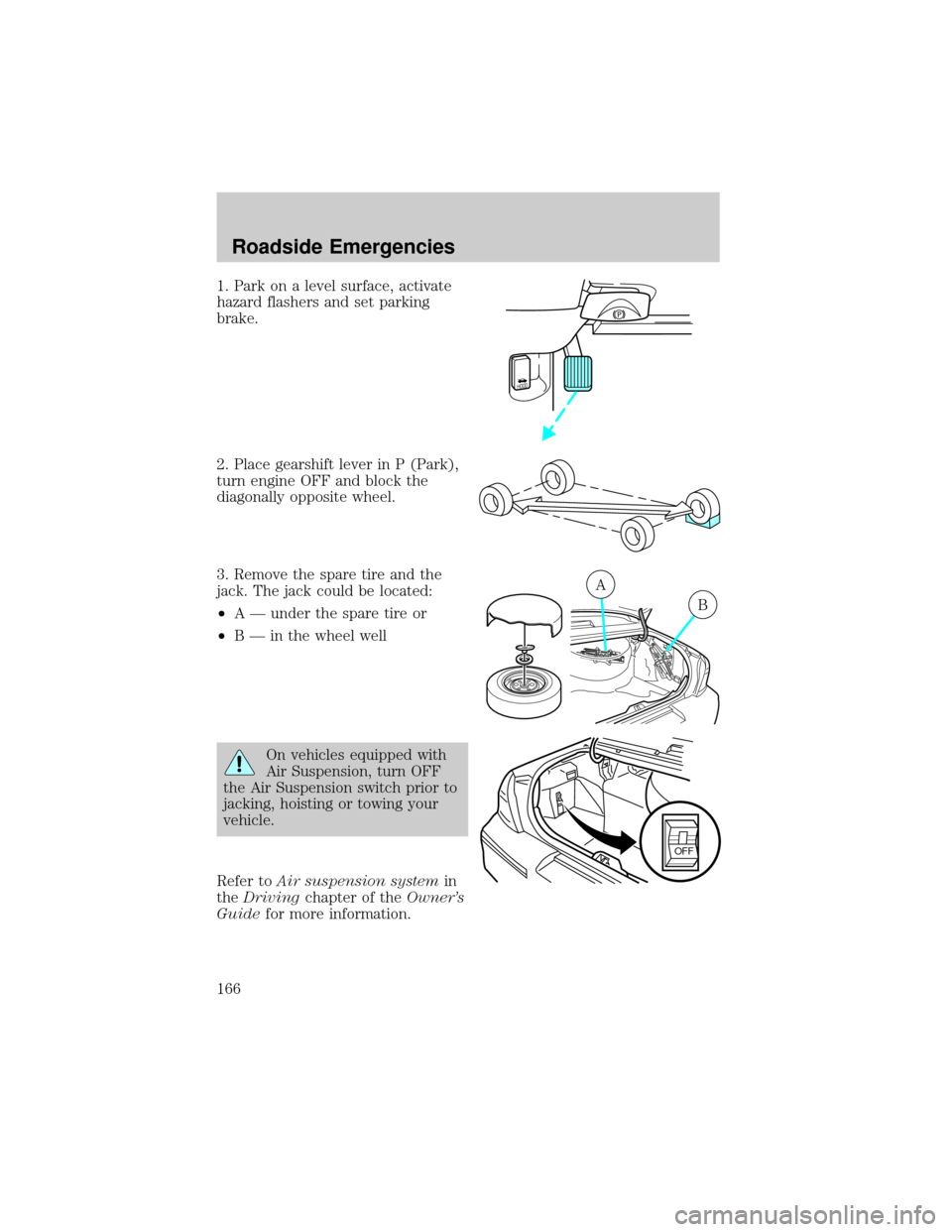
1. Park on a level surface, activate
hazard flashers and set parking
brake.
2. Place gearshift lever in P (Park),
turn engine OFF and block the
diagonally opposite wheel.
3. Remove the spare tire and the
jack. The jack could be located:
²A Ð under the spare tire or
²B Ð in the wheel well
On vehicles equipped with
Air Suspension, turn OFF
the Air Suspension switch prior to
jacking, hoisting or towing your
vehicle.
Refer toAir suspension systemin
theDrivingchapter of theOwner's
Guidefor more information.
HOOD
B
A
OFF
Roadside Emergencies
166
Page 168 of 240
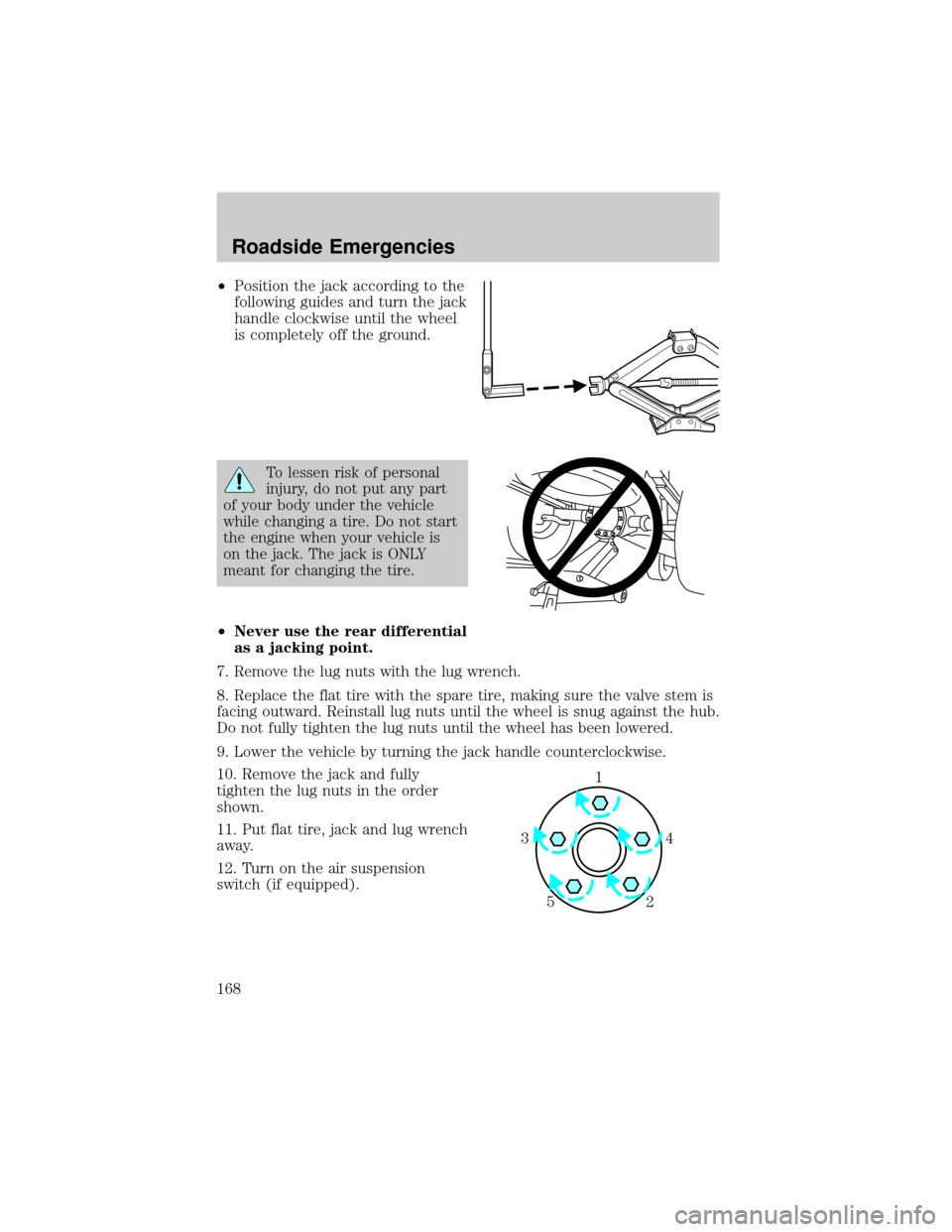
²Position the jack according to the
following guides and turn the jack
handle clockwise until the wheel
is completely off the ground.
To lessen risk of personal
injury, do not put any part
of your body under the vehicle
while changing a tire. Do not start
the engine when your vehicle is
on the jack. The jack is ONLY
meant for changing the tire.
²Never use the rear differential
as a jacking point.
7. Remove the lug nuts with the lug wrench.
8. Replace the flat tire with the spare tire, making sure the valve stem is
facing outward. Reinstall lug nuts until the wheel is snug against the hub.
Do not fully tighten the lug nuts until the wheel has been lowered.
9. Lower the vehicle by turning the jack handle counterclockwise.
10. Remove the jack and fully
tighten the lug nuts in the order
shown.
11. Put flat tire, jack and lug wrench
away.
12. Turn on the air suspension
switch (if equipped).
1
4 3
2 5
Roadside Emergencies
168
Page 220 of 240
8. Replace the air inlet tube and secure the clamp.
Note:Failure to use the correct air filter element may result in severe
engine damage. The customer warranty may be voided for any damage to
the engine if the correct air filter element is not used.
INFORMATION ABOUT UNIFORM TIRE QUALITY GRADING
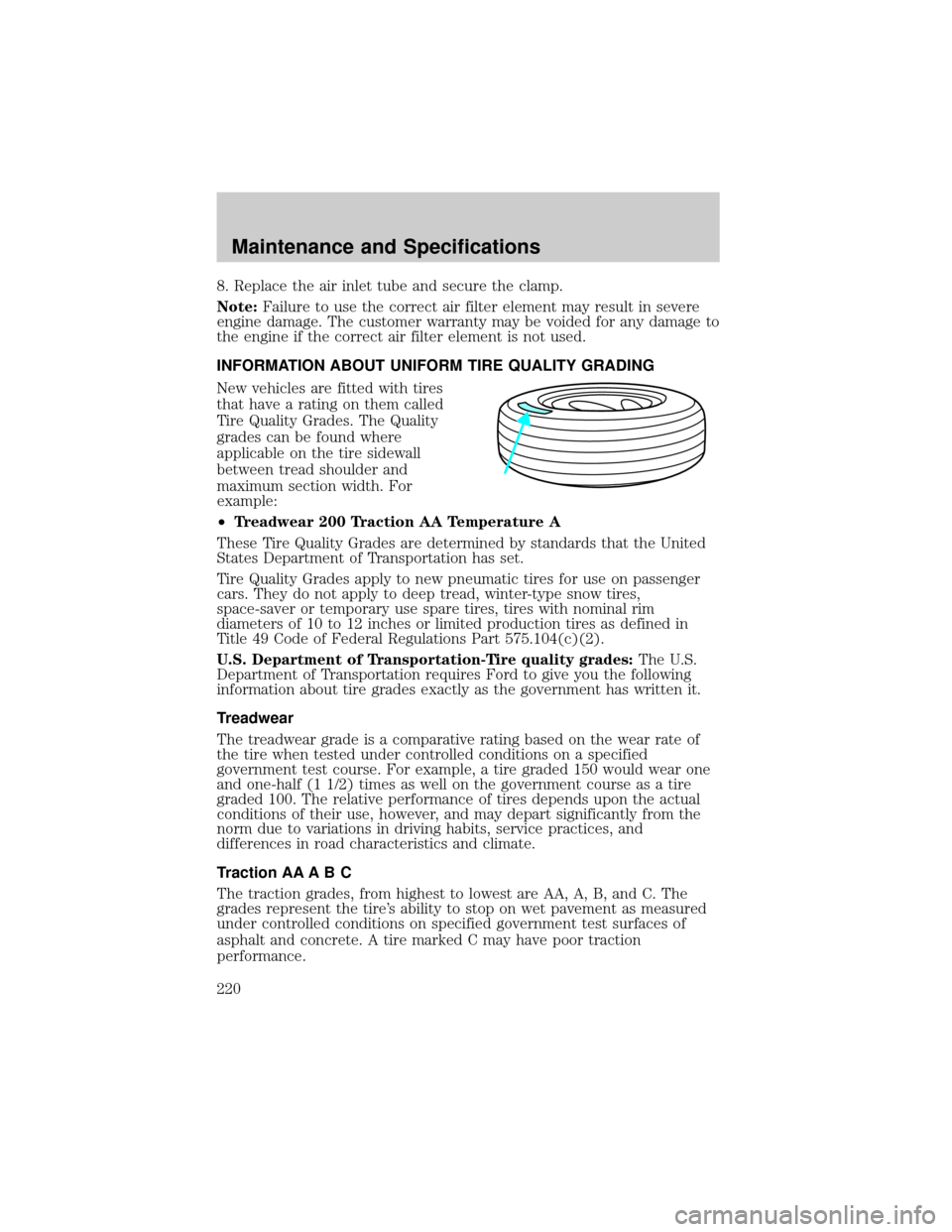
New vehicles are fitted with tires
that have a rating on them called
Tire Quality Grades. The Quality
grades can be found where
applicable on the tire sidewall
between tread shoulder and
maximum section width. For
example:
²Treadwear 200 Traction AA Temperature A
These Tire Quality Grades are determined by standards that the United
States Department of Transportation has set.
Tire Quality Grades apply to new pneumatic tires for use on passenger
cars. They do not apply to deep tread, winter-type snow tires,
space-saver or temporary use spare tires, tires with nominal rim
diameters of 10 to 12 inches or limited production tires as defined in
Title 49 Code of Federal Regulations Part 575.104(c)(2).
U.S. Department of Transportation-Tire quality grades:The U.S.
Department of Transportation requires Ford to give you the following
information about tire grades exactly as the government has written it.
Treadwear
The treadwear grade is a comparative rating based on the wear rate of
the tire when tested under controlled conditions on a specified
government test course. For example, a tire graded 150 would wear one
and one-half (1 1/2) times as well on the government course as a tire
graded 100. The relative performance of tires depends upon the actual
conditions of their use, however, and may depart significantly from the
norm due to variations in driving habits, service practices, and
differences in road characteristics and climate.
Traction AA A B C
The traction grades, from highest to lowest are AA, A, B, and C. The
grades represent the tire's ability to stop on wet pavement as measured
under controlled conditions on specified government test surfaces of
asphalt and concrete. A tire marked C may have poor traction
performance.
Maintenance and Specifications
220
Page 222 of 240
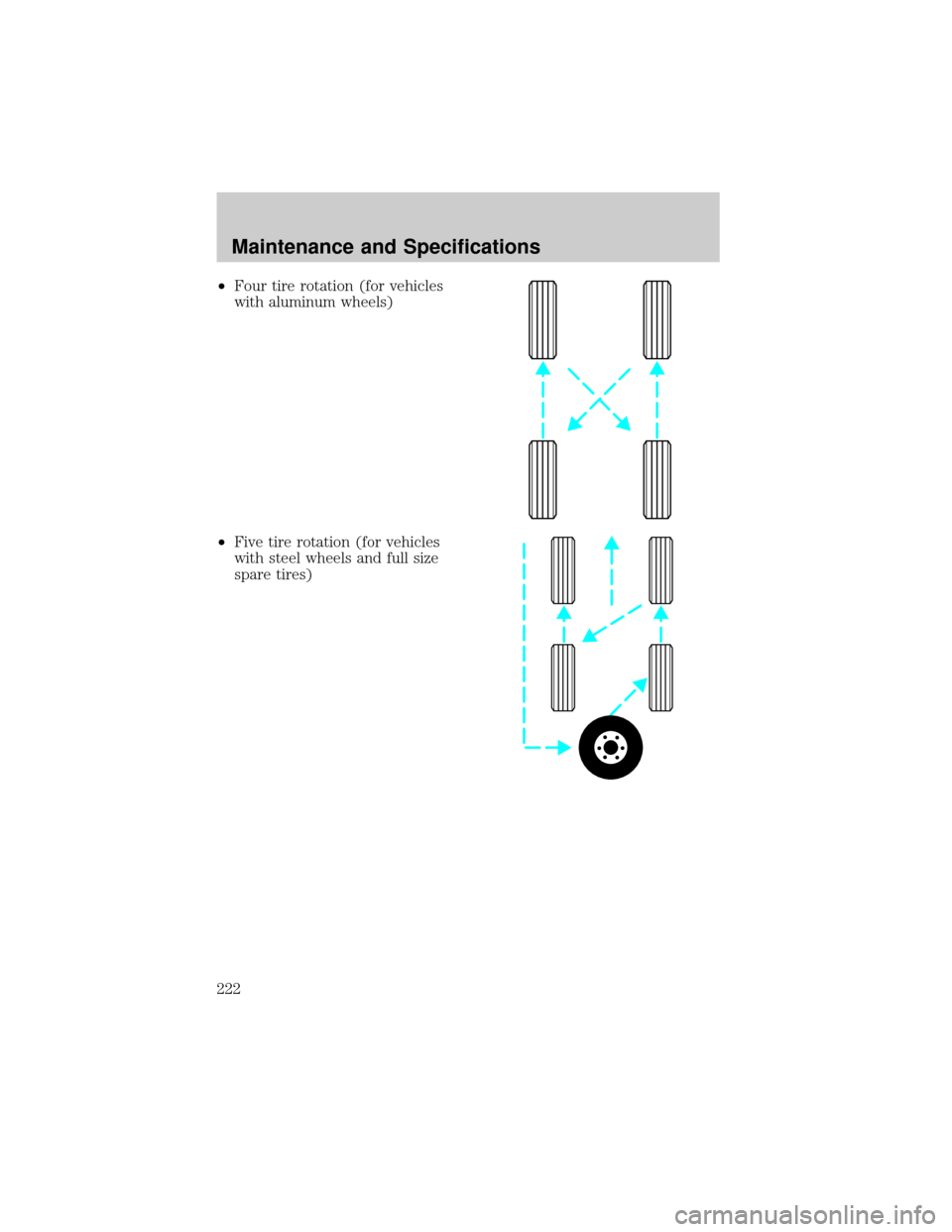
²Four tire rotation (for vehicles
with aluminum wheels)
²Five tire rotation (for vehicles
with steel wheels and full size
spare tires)
Maintenance and Specifications
222
Page 238 of 240

cleaning the safety
belts .................................122, 189
extension assembly ................121
for adults .........................113±115
for children .............................127
lap belt ....................................116
Occupant Classification
Sensor ......................................110
warning light and
chime ...................13, 16, 117±118
Safety seats for children ..........130
Seat belts (see Safety
restraints) ..................................108
Seats ..........................................104
child safety seats ....................130
cleaning ...................................188
SecuriLock passive anti-theft
system ................................100±102
Servicing your vehicle ..............191
Spare tire (see Changing the
Tire) ...........................................164
Spark plugs,
specifications .....................224, 228
Specification chart,
lubricants ...........................226, 228
Speed control ..............................79
Speedometer ...............................20
Starting your vehicle ........137±139
jump starting ..........................169
Steering
speed sensitive .......................146
Steering wheel
controls ..........................73, 79, 83
tilting .........................................73T
Tires ...........................164, 220±221
changing ..........................164±165
checking the pressure ............221
replacing ..................................223
rotating ....................................221
snow tires and chains ............224
tire grades ...............................221
treadwear ................................220
Towing .......................................152
recreational towing .................155
trailer towing ..........................152
wrecker ....................................174
Traction control ........................144
active light ................................14
Traction-lok rear axle ...............150
Transmission .............................146
fluid, checking and adding
(automatic) .............................216
fluid, refill capacities ..............225
lubricant specifications ..226, 228
Trip odometer .............................21
Trunk ...........................................92
remote release ....................89, 95
Turn signal ............................15, 65
V
Vehicle dimensions ...................228
Vehicle Identification Number
(VIN) ..........................................230
Vehicle loading ..........................151
Ventilating your vehicle ...........141
Index
238