Page 327 of 432
6-
6-1
Section 6 Service and Appearance Care
Here you will find information about the care of your vehicle. This section begins with service and fuel information,
and then it shows how to check important fluid and lubricant levels. There is also technical information about your
vehicle, and a part devoted to its appearance care.
6
-2 Service
6
-3 Fuel
6
-5 Fuels in Foreign Countries
6
-6 Filling Your Tank
6
-8 Filling a Portable Fuel Container
6
-8 Checking Things Under the Hood
6
-11 Engine Oil
6
-16 Engine Air Cleaner/Filter
6
-18 Automatic Transmission Fluid
6
-21 Rear Axle
6
-22 Four-Wheel Drive
6
-24 Engine Coolant
6
-27 Radiator Pressure Cap
6
-28 Power Steering Fluid
6
-29 Windshield Washer Fluid
6
-30 Brakes6
-34 Battery
6
-35 Bulb Replacement
6
-36 Windshield Wiper Blade Replacement
6
-38 Tires
6
-46 Appearance Care
6
-47 Cleaning the Inside of Your Vehicle
6
-49 Care of Safety Belts
6
-50 Cleaning the Outside of Your Vehicle
6
-54 GM Vehicle Care/Appearance Materials
6
-55 Vehicle Identification Number (VIN)
6
-55 Service Parts Identification Label
6
-56 Electrical System
6
-63 Replacement Bulbs
6
-63 Capacities and Specifications
6
-63 Normal Maintenance Replacement Parts
Page 334 of 432
6-8
Filling a Portable Fuel Container
CAUTION:
Never fill a portable fuel container while it is in
your vehicle. Static electricity discharge from the
container can ignite the gasoline vapor. You can
be badly burned and your vehicle damaged if this
occurs. To help avoid injury to you and others:
�Dispense gasoline only into
approved containers.
�Do not fill a container while it is inside a
vehicle, in a vehicle's trunk, pickup bed or
on any surface other than the ground.
�Bring the fill nozzle in contact with the
inside of the fill opening before operating
the nozzle. Contact should be maintained
until the filling is complete.
�Don't smoke while pumping gasoline.
Checking Things Under the Hood
CAUTION:
Things that burn can get on hot engine parts and
start a fire. These include liquids like fuel, oil,
coolant, brake fluid, windshield washer and other
fluids, and plastic or rubber. You or others could
be burned. Be careful not to drop or spill things
that will burn onto a hot engine.
Page 337 of 432
6-11
A. Coolant Recovery Tank
B. Engine Air Cleaner/Filter
C. Windshield Washer Fluid Reservoir
D. Engine Air Cleaner/Filter Indicator
E. Power Steering Fluid Reservoir
F. Automatic Transmission Dipstick
G. Engine Oil Dipstick
H. Radiator Pressure Cap
I. Engine Oil Fill Cap
J. Front Engine Lift Bracket Marked ªGNDº
K. Brake Master Cylinder
L. Battery
M. Engine Compartment Fuse Block
Before closing the hood, be sure all filler caps are on
properly. Then lift the hood to relieve pressure on the
hood prop. Remove the hood prop from its slot in the
hood and return the prop to its retainer. Then pull the
hood down firmly to close. It will latch when dropped
from 6 to 8 inches (15 to 20 cm) without pressing on
the hood.Engine Oil
If the CHECK OIL LEVEL message appears on the
instrument cluster, it means you need to check your
engine oil level right away. For more information,
see ªCheck Oil Level Messageº in the Index.
You should check your engine oil level regularly;
this is an added reminder.
Checking Engine Oil
It's a good idea to check your engine oil every time you
get fuel. In order to get an accurate reading, the oil must
be warm and the vehicle must be on level ground.
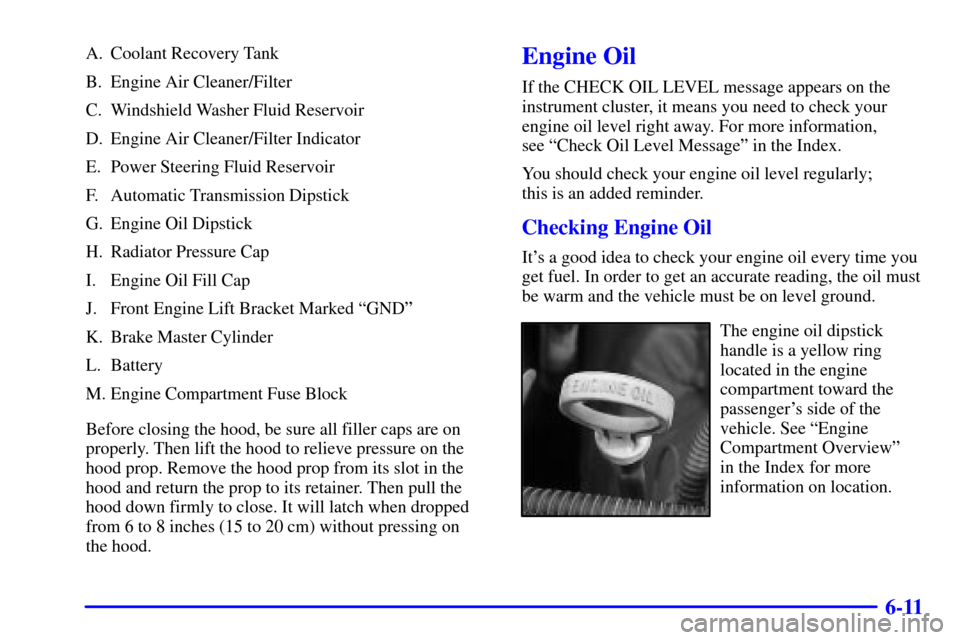
The engine oil dipstick
handle is a yellow ring
located in the engine
compartment toward the
passenger's side of the
vehicle. See ªEngine
Compartment Overviewº
in the Index for more
information on location.
Page 344 of 432
6-18
Automatic Transmission Fluid
When to Check and Change
A good time to check your automatic transmission fluid
level is when the engine oil is changed.
Change both the fluid and filter every 50,000 miles
(83 000 km) if the vehicle is mainly driven under one
or more of these conditions:
�In heavy city traffic where the outside temperature
regularly reaches 90�F (32�C) or higher.
�In hilly or mountainous terrain.
�When doing frequent trailer towing.
�Uses such as found in taxi, police or delivery service.
If you do not use your vehicle under any of
these conditions, change the fluid and filter
every 100,000 miles (166 000 km).
See ªScheduled Maintenance Servicesº in the Index.
How to Check
Because this operation can be a little difficult, you may
choose to have this done at the dealership service department.
If you do it yourself, be sure to follow all the instructions
here, or you could get a false reading on the dipstick.
NOTICE:
Too much or too little fluid can damage your
transmission. Too much can mean that some of
the fluid could come out and fall on hot engine
parts or exhaust system parts, starting a fire.
Too little fluid could cause the transmission to
overheat. Be sure to get an accurate reading if
you check your transmission fluid.
Wait at least 30 minutes before checking the
transmission fluid level if you have been driving:
�When outside temperatures are above 90�F (32�C).
�At high speed for quite a while.
�In heavy traffic
-- especially in hot weather.
�While pulling a trailer.