Page 314 of 432
5-22
Secondary Latch System
The spare tire hoist assembly is equipped with a
secondary latch system. It's designed to stop the spare
tire from suddenly falling off your vehicle. For the
secondary latch to work, the spare tire must be stored
with the valve stem pointing up. See ªStoring a Flat or
Spare Tire and Toolsº in the Index for instructions on
storing the spare tire correctly.
CAUTION:
Before beginning this procedure, read all the
instructions. Failure to read and follow the
instructions could damage the hoist assembly
and you and others could get hurt. Read and
follow the instructions listed below.
To release the spare tire from the secondary latch
do the following:
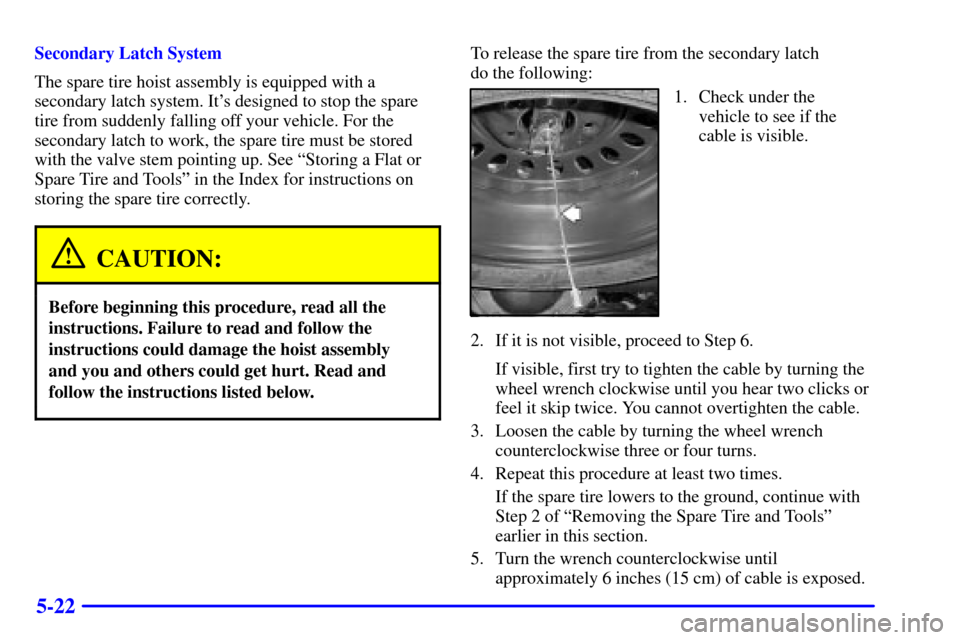
1. Check under the
vehicle to see if the
cable is visible.
2. If it is not visible, proceed to Step 6.
If visible, first try to tighten the cable by turning the
wheel wrench clockwise until you hear two clicks or
feel it skip twice. You cannot overtighten the cable.
3. Loosen the cable by turning the wheel wrench
counterclockwise three or four turns.
4. Repeat this procedure at least two times.
If the spare tire lowers to the ground, continue with
Step 2 of ªRemoving the Spare Tire and Toolsº
earlier in this section.
5. Turn the wrench counterclockwise until
approximately 6 inches (15 cm) of cable is exposed.
Page 315 of 432
5-23
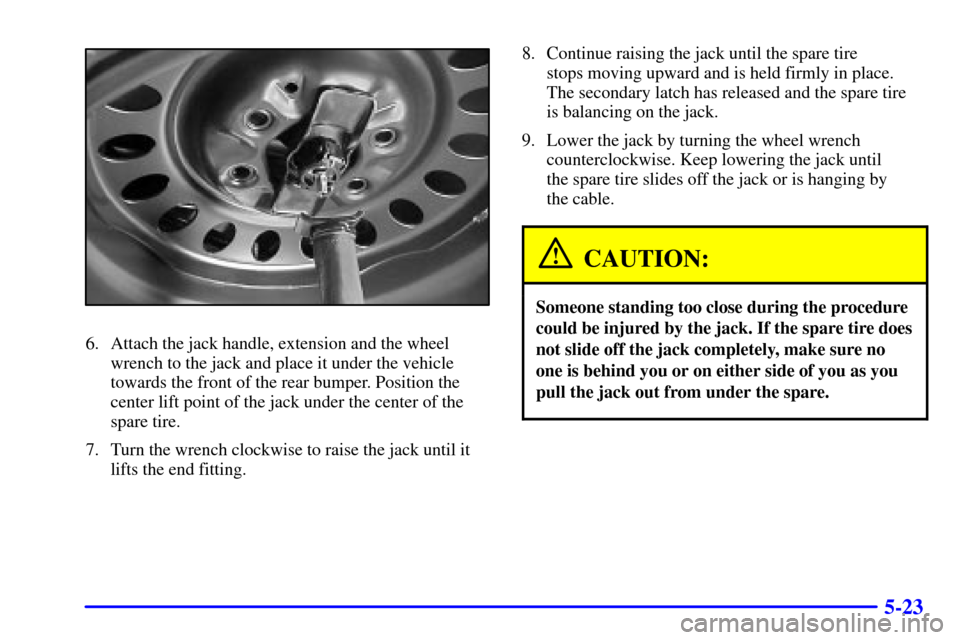
6. Attach the jack handle, extension and the wheel
wrench to the jack and place it under the vehicle
towards the front of the rear bumper. Position the
center lift point of the jack under the center of the
spare tire.
7. Turn the wrench clockwise to raise the jack until it
lifts the end fitting.8. Continue raising the jack until the spare tire
stops moving upward and is held firmly in place.
The secondary latch has released and the spare tire
is balancing on the jack.
9. Lower the jack by turning the wheel wrench
counterclockwise. Keep lowering the jack until
the spare tire slides off the jack or is hanging by
the cable.
CAUTION:
Someone standing too close during the procedure
could be injured by the jack. If the spare tire does
not slide off the jack completely, make sure no
one is behind you or on either side of you as you
pull the jack out from under the spare.
Page 316 of 432
5-24
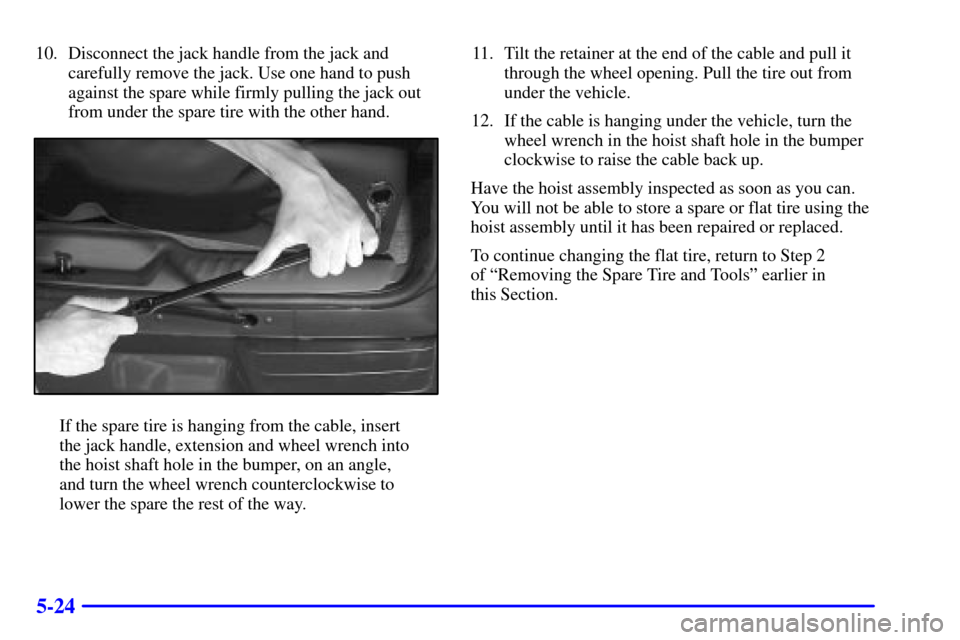
10. Disconnect the jack handle from the jack and
carefully remove the jack. Use one hand to push
against the spare while firmly pulling the jack out
from under the spare tire with the other hand.
If the spare tire is hanging from the cable, insert
the jack handle, extension and wheel wrench into
the hoist shaft hole in the bumper, on an angle,
and turn the wheel wrench counterclockwise to
lower the spare the rest of the way.11. Tilt the retainer at the end of the cable and pull it
through the wheel opening. Pull the tire out from
under the vehicle.
12. If the cable is hanging under the vehicle, turn the
wheel wrench in the hoist shaft hole in the bumper
clockwise to raise the cable back up.
Have the hoist assembly inspected as soon as you can.
You will not be able to store a spare or flat tire using the
hoist assembly until it has been repaired or replaced.
To continue changing the flat tire, return to Step 2
of ªRemoving the Spare Tire and Toolsº earlier in
this Section.
Page 317 of 432
5-25 Removing the Flat Tire and Installing
the Spare Tire
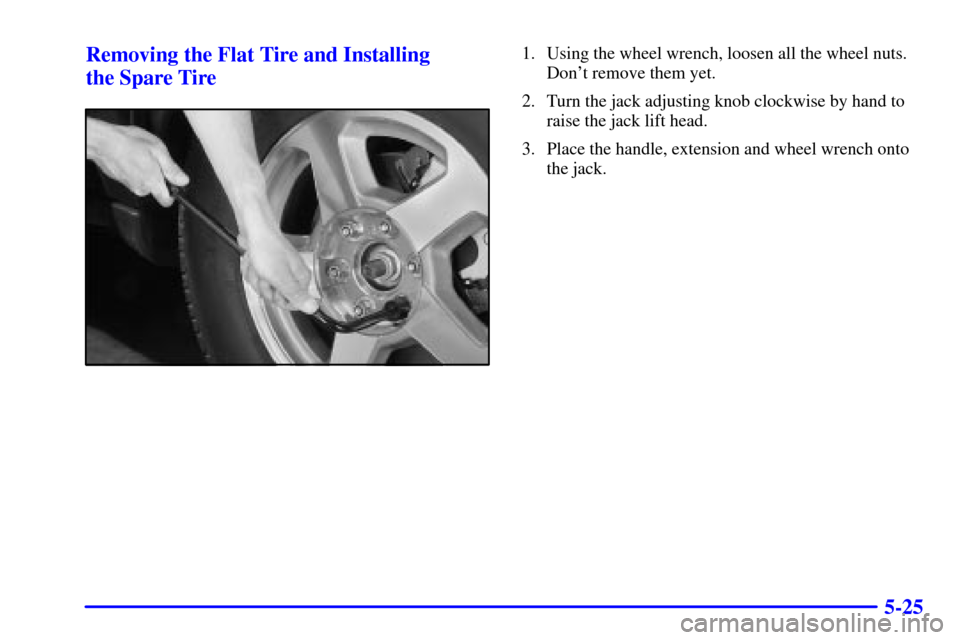
1. Using the wheel wrench, loosen all the wheel nuts.
Don't remove them yet.
2. Turn the jack adjusting knob clockwise by hand to
raise the jack lift head.
3. Place the handle, extension and wheel wrench onto
the jack.
Page 319 of 432
5-27
4. Place the jack in the appropriate position nearest the
flat tire.
CAUTION:
Getting under a vehicle when it is jacked up is
dangerous. If the vehicle slips off the jack, you
could be badly injured or killed. Never get under
a vehicle when it is supported only by a jack.
CAUTION:
Raising your vehicle with the jack improperly
positioned can damage the vehicle and even make
the vehicle fall. To help avoid personal injury and
vehicle damage, be sure to fit the jack lift head into
the proper location before raising the vehicle.
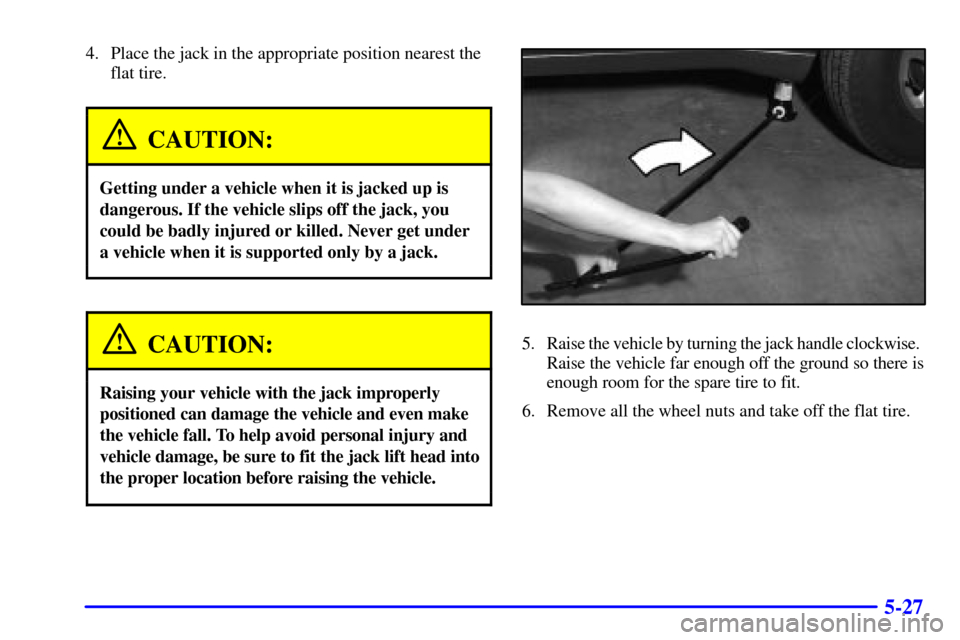
5. Raise the vehicle by turning the jack handle clockwise.
Raise the vehicle far enough off the ground so there is
enough room for the spare tire to fit.
6. Remove all the wheel nuts and take off the flat tire.
Page 321 of 432
5-29
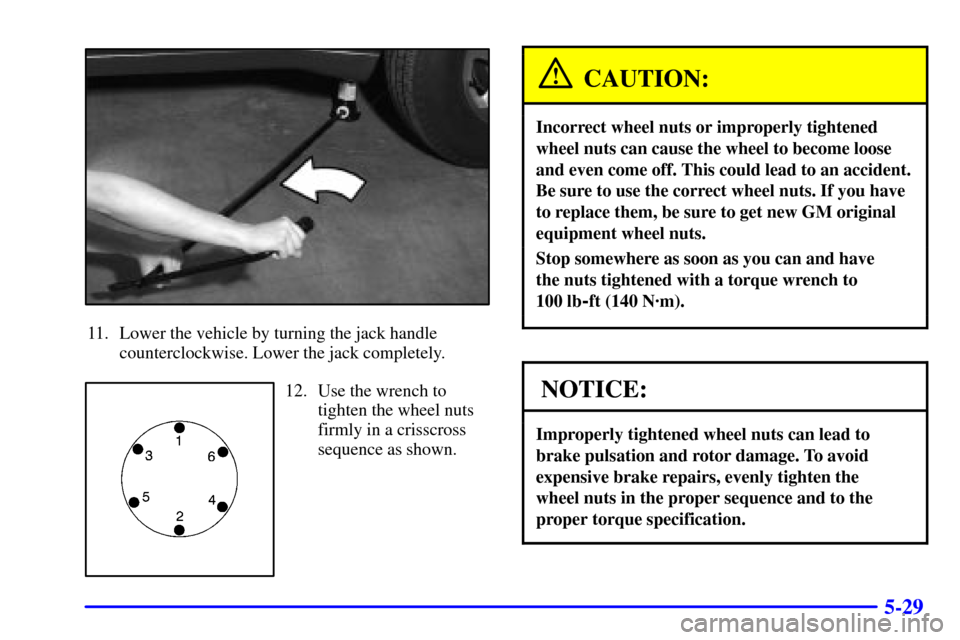
11. Lower the vehicle by turning the jack handle
counterclockwise. Lower the jack completely.
12. Use the wrench to
tighten the wheel nuts
firmly in a crisscross
sequence as shown.
CAUTION:
Incorrect wheel nuts or improperly tightened
wheel nuts can cause the wheel to become loose
and even come off. This could lead to an accident.
Be sure to use the correct wheel nuts. If you have
to replace them, be sure to get new GM original
equipment wheel nuts.
Stop somewhere as soon as you can and have
the nuts tightened with a torque wrench to
100 lb
-ft (140 N´m).
NOTICE:
Improperly tightened wheel nuts can lead to
brake pulsation and rotor damage. To avoid
expensive brake repairs, evenly tighten the
wheel nuts in the proper sequence and to the
proper torque specification.
Page 332 of 432
6-6
Filling Your Tank
CAUTION:
Gasoline vapor is highly flammable. It burns
violently, and that can cause very bad injuries.
Don't smoke if you're near gasoline or refueling
your vehicle. Keep sparks, flames and smoking
materials away from gasoline.
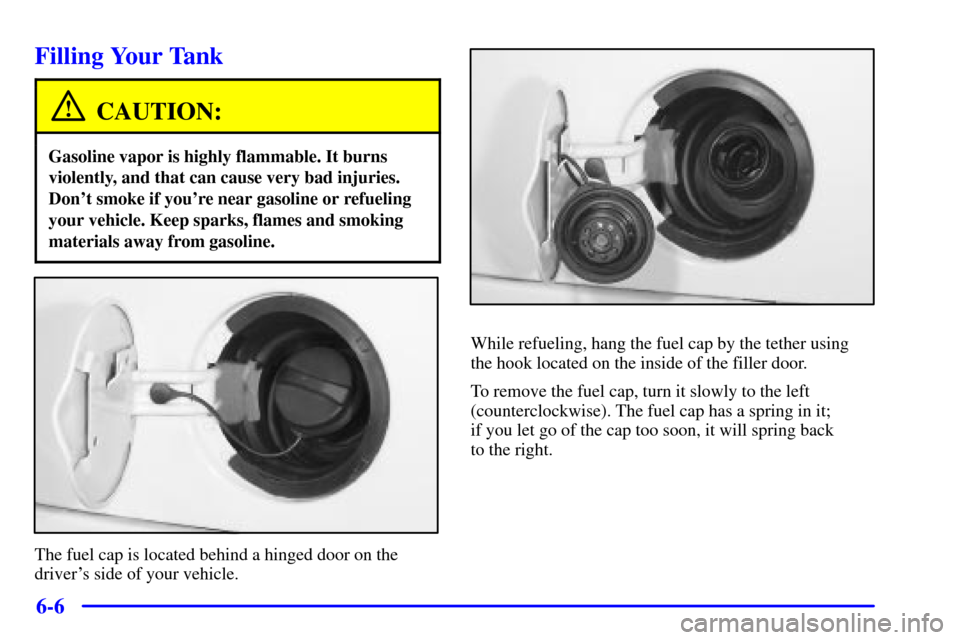
The fuel cap is located behind a hinged door on the
driver's side of your vehicle.
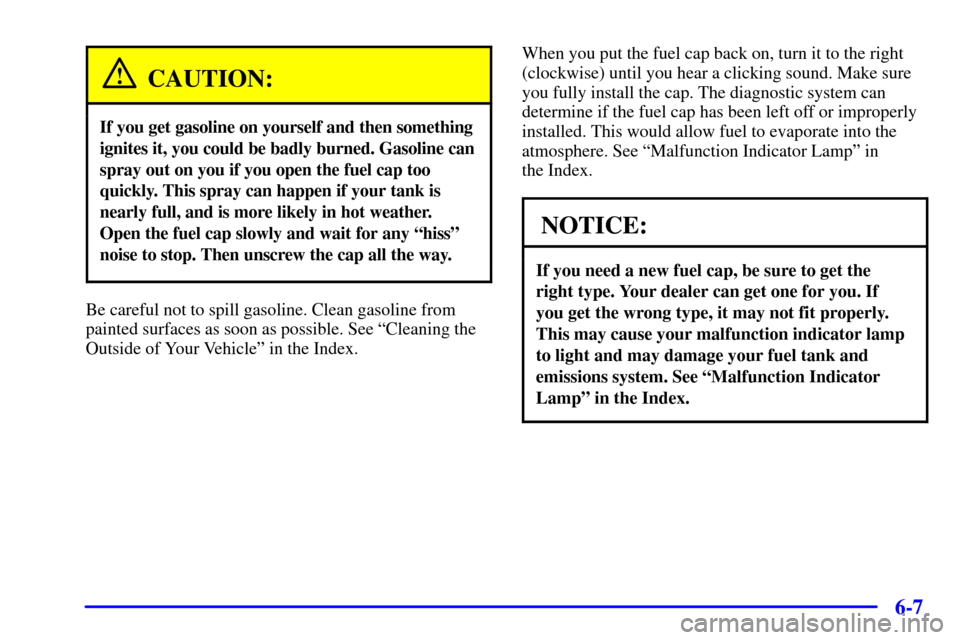
While refueling, hang the fuel cap by the tether using
the hook located on the inside of the filler door.
To remove the fuel cap, turn it slowly to the left
(counterclockwise). The fuel cap has a spring in it;
if you let go of the cap too soon, it will spring back
to the right.
Page 333 of 432
6-7
CAUTION:
If you get gasoline on yourself and then something
ignites it, you could be badly burned. Gasoline can
spray out on you if you open the fuel cap too
quickly. This spray can happen if your tank is
nearly full, and is more likely in hot weather.
Open the fuel cap slowly and wait for any ªhissº
noise to stop. Then unscrew the cap all the way.
Be careful not to spill gasoline. Clean gasoline from
painted surfaces as soon as possible. See ªCleaning the
Outside of Your Vehicleº in the Index.When you put the fuel cap back on, turn it to the right
(clockwise) until you hear a clicking sound. Make sure
you fully install the cap. The diagnostic system can
determine if the fuel cap has been left off or improperly
installed. This would allow fuel to evaporate into the
atmosphere. See ªMalfunction Indicator Lampº in
the Index.
NOTICE:
If you need a new fuel cap, be sure to get the
right type. Your dealer can get one for you. If
you get the wrong type, it may not fit properly.
This may cause your malfunction indicator lamp
to light and may damage your fuel tank and
emissions system. See ªMalfunction Indicator
Lampº in the Index.