Page 130 of 390
2-65
The main components of your instrument panel are the following:
A. Side Defroster Vent
B. Air Vents
C. Turn Signal/Multifunction Lever
D. Instrument Panel Cluster
E. Windshield Wiper/Washer Lever
F. Hazard Button
G. Rear Window Defogger Button (If Equipped)
H. Cruise Control Button (If Equipped)
I. Comfort Controls
J. Rear Window Wiper/Washer Button (If Equipped)
K. CoinholderL. Power Remote Control Mirrors (If Equipped)
M. Instrument Panel Brightness Thumbwheel
N. Hood Release
O. Instrument Panel Fuse Block
P. Ignition Switch
Q. Cigarette Lighter/Accessory Power Outlet
R. Power Mode Selector Switch (If Equipped)
S. Shift Lever
T. Ashtray
U. Audio System
V. Vent Shut
-off Thumbwheel
Page 225 of 390
5-11
Cooling System
When you decide it's safe to lift the hood, here's what
you'll see:
A. Coolant Recovery Tank
B. Engine Cooling Fan
C. Radiator Pressure Cap
D. Auxiliary Cooling Fan (If Equipped)
CAUTION:
An electric engine cooling fan under the hood
can start up even when the engine is not running
and can injure you. Keep hands, clothing and
tools away from any underhood electric fan.
Don't reach through the grille to release the
underhood lever.
If the coolant inside the coolant recovery tank is boiling,
don't do anything else until it cools down. The vehicle
should be parked on a level surface.
Page 256 of 390
6-9
Checking Things Under the Hood
CAUTION:
An electric fan under the hood can start up and
injure you even when the engine is not running.
Keep hands, clothing and tools away from any
underhood electric fan. Don't reach through the
grille to release the underhood lever.
CAUTION:
Things that burn can get on hot engine parts
and start a fire. These include liquids like fuel,
oil, coolant, brake fluid, windshield washer and
other fluids, and plastic or rubber. You or others
could be burned. Be careful not to drop or spill
things that will burn onto a hot engine.
Hood Release
To open the hood, do the following:
1. Pull the release handle
located on the driver's
side of the vehicle on
the lower portion of
the instrument panel.
Page 257 of 390
6-10
2. Then go to the front of the vehicle, pull up on the
hood, and push the hood release lever to your right.
3. Lift the hood, release
the hood prop from
its retainer and put the
hood prop into the slot
in the hood.
Before closing the hood, be sure all the filler caps
are on.
Then lift the hood to relieve pressure on the hood prop.
Remove the hood prop from the slot in the hood and
return the prop to its retainer. Then let the hood down
and close it firmly.
Page 292 of 390
6-45
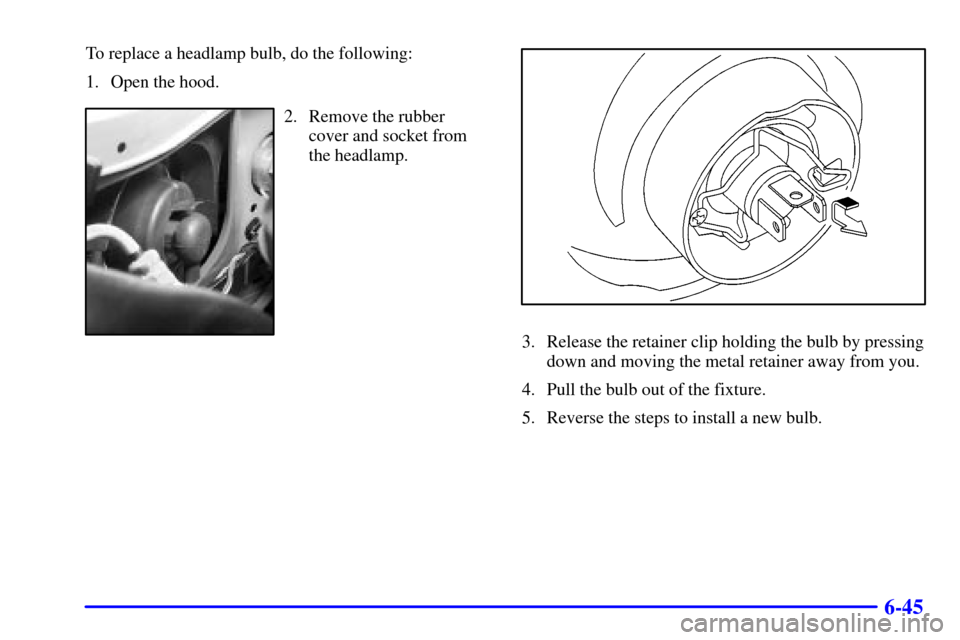
To replace a headlamp bulb, do the following:
1. Open the hood.
2. Remove the rubber
cover and socket from
the headlamp.
3. Release the retainer clip holding the bulb by pressing
down and moving the metal retainer away from you.
4. Pull the bulb out of the fixture.
5. Reverse the steps to install a new bulb.
Page 367 of 390

7-47
Part B: Owner Checks and Services
Listed in this part are owner checks and services which
should be performed at the intervals specified to help
ensure the safety, dependability and emission control
performance of your vehicle.
Be sure any necessary repairs are completed at once.
Whenever any fluids or lubricants are added to your
vehicle, make sure they are the proper ones, as shown
in Part D.
At Each Fuel Fill
It is important for you or a service station attendant to
perform these underhood checks at each fuel fill.
Engine Oil Level Check
Check the engine oil level and add the proper oil
if necessary. See ªEngine Oilº in the Index for
further details.
Engine Coolant Level Check
Check the engine coolant level and add the proper
coolant mixture if necessary. See ªEngine Coolantº
in the Index for further details.Windshield Washer Fluid Level Check
Check the windshield washer fluid level in the
windshield washer tank and add the proper fluid if
necessary. See ªWindshield Washer Fluidº in the
Index for further details.
Hood Latch Operation Check
Pull the primary hood latch release handle inside the
vehicle. The secondary latch should keep the hood from
opening all the way when the primary latch is released.
Make sure the hood closes firmly. See ªHood Releaseº
in the Index for further details.
At Least Once a Month
Tire Inflation Check
Make sure tires are inflated to the correct pressures.
Don't forget to check your spare tire. See ªTiresº in
the Index for further details.
Page 376 of 390

7-56
USAGEFLUID/LUBRICANT
Floor Shift LinkageLubriplate� Lubricant Aerosol
(GM Part No. 12346293 or
equivalent) or lubricant meeting
requirements of NLGI # 2
Category LB or GC
-LB.
Chassis LubricationChassis Lubricant (GM Part
No. 12377985 or equivalent)
or lubricant meeting
requirements of NLGI # 2,
Category LB or GC
-LB.
Front Wheel
BearingsWheel bearing lubricant
meeting requirements of NLGI
# 2, Category GC or GC
-LB
(GM Part No. 1051344
or equivalent).
USAGEFLUID/LUBRICANT
Rear Axle (All)
and Front Axle
(Four
-Wheel Drive)
Axle Lubricant (GM Part
No. 12345977) or SAE 80W
-90
GL
-5 gear lubricant.
Hood Latch
Assembly,
Secondary Latch,
Pivots, Spring
Anchor and
Release PawlLubriplate� Lubricant Aerosol
(GM Part No. 12346293 or
equivalent) or lubricant meeting
requirements of NLGI # 2,
Category LB or GC
-LB.
Hood and
Door HingesMulti-Purpose Lubricant,
Superlube� (GM Part
No. 12346241 or equivalent).
Weatherstrip
ConditioningDielectric Silicone Grease
(GM Part No. 12345579
or equivalent).