Page 100 of 390

2-35
Running Your Engine While You're
Parked (Automatic Transmission)
It's better not to park with the engine running. But if you
ever have to, here are some things to know.
CAUTION:
Idling the engine with the climate control
system off could allow dangerous exhaust into
your vehicle. See the earlier Caution under
ªEngine Exhaust.º
Also, idling in a closed-in place can let deadly
carbon monoxide (CO) into your vehicle even
if the fan is at the highest setting. One place
this can happen is a garage. Exhaust
-- with
CO
-- can come in easily. NEVER park in a
garage with the engine running.
Another closed-in place can be a blizzard.
See ªBlizzardº in the Index.
CAUTION:
It can be dangerous to get out of your vehicle if
the shift lever is not fully in PARK (P) with the
parking brake firmly set. Your vehicle can roll.
Don't leave your vehicle when the engine is
running unless you have to. If you've left the
engine running, the vehicle can move suddenly.
You or others could be injured. To be sure your
vehicle won't move, even when you're on fairly
level ground, always set your parking brake and
move the shift lever to PARK (P).
Four-wheel drive vehicles with the transfer case
in NEUTRAL will allow the vehicle to roll,
even if your shift lever is in PARK (P). So, be
sure the transfer case is in a drive gear
-- not in
NEUTRAL. Always set your parking brake.
Follow the proper steps to be sure your vehicle won't
move. See ªShifting Into PARK (P)º in the Index.
If you're pulling a trailer, see ªTowing a Trailerº in
the Index.
Page 105 of 390
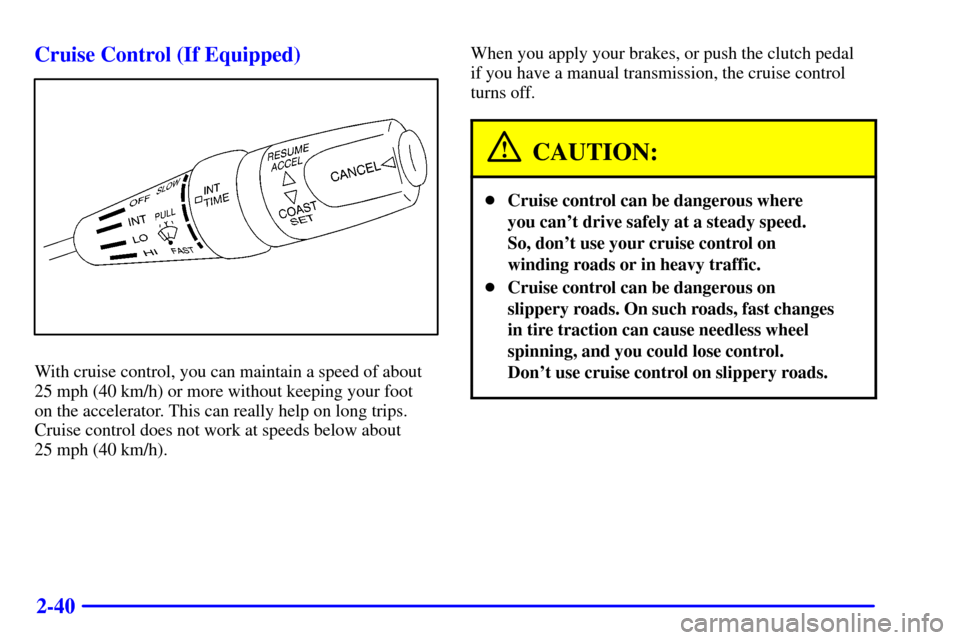
2-40 Cruise Control (If Equipped)
With cruise control, you can maintain a speed of about
25 mph (40 km/h) or more without keeping your foot
on the accelerator. This can really help on long trips.
Cruise control does not work at speeds below about
25 mph (40 km/h).When you apply your brakes, or push the clutch pedal
if you have a manual transmission, the cruise control
turns off.
CAUTION:
�Cruise control can be dangerous where
you can't drive safely at a steady speed.
So, don't use your cruise control on
winding roads or in heavy traffic.
�Cruise control can be dangerous on
slippery roads. On such roads, fast changes
in tire traction can cause needless wheel
spinning, and you could lose control.
Don't use cruise control on slippery roads.
Page 107 of 390

2-42
Increasing Speed While Using Cruise Control
There are two ways to go to a higher speed.
�Use the accelerator pedal to go to a higher speed.
Turn the switch on the lever down to COAST SET
and release it. Take your foot off the accelerator
pedal. You'll now cruise at the higher speed.
�Turn the switch on the lever up to RESUME
ACCEL. Hold the switch at RESUME ACCEL
until you get up to the speed you want, then release
the switch.
Reducing Speed While Using Cruise Control
To reduce your speed, turn the switch and hold it down
in the COAST SET position until you reach the lower
speed you want, then release the switch.
Passing Another Vehicle While Using Cruise Control
Use the accelerator pedal to increase your speed. When
you take your foot off the pedal, your vehicle will slow
down to the cruise control speed you set earlier.Using Cruise Control on Hills
How well your cruise control will work on hills depends
upon your speed, load and the steepness of the hills.
When going up steep hills, you may have to step on the
accelerator pedal to maintain your speed. When going
downhill, you may have to brake or shift to a lower gear
to keep your speed down. Of course, applying the brake
takes you out of cruise control. Many drivers find this
to be too much trouble and don't use cruise control on
steep hills.
Getting Out of Cruise Control
There are three ways to turn off cruise control:
�Step lightly on the brake pedal, or push the clutch
pedal if you have a manual transmission.
�Push in the CANCEL button on the end of the cruise
control lever.
�Press CRUISE ON/OFF on the instrument panel.
Erasing Speed Memory
When you turn off the cruise control or the ignition,
your cruise control set speed memory is erased. It is also
lost if the vehicle speed drops below 25 mph (40 km/h).
You must reset your speed.
Page 139 of 390

2-74
NOTICE:
If you keep driving your vehicle with this light
on, after a while, your emission controls may not
work as well, your fuel economy may not be as
good and your engine may not run as smoothly.
This could lead to costly repairs that may not be
covered by your warranty.
NOTICE:
Modifications made to the engine, transmission,
exhaust, intake or fuel system of your vehicle or
the replacement of the original tires with other
than those of the same Tire Performance Criteria
(TPC) can affect your vehicle's emission controls
and may cause the SERVICE ENGINE SOON
light to come on. Modifications to these systems
could lead to costly repairs not covered by your
warranty. This may also result in a failure to pass
a required Emission Inspection/Maintenance test.
This light should come on, as a check to show you it is
working, when the ignition is on and the engine is not
running. If the light doesn't come on, have it repaired.
This light will also come on during a malfunction in one
of two ways:
�Light Flashing
-- A misfire condition has been
detected. A misfire increases vehicle emissions and
may damage the emission control system on your
vehicle. Dealer or qualified service center diagnosis
and service may be required.
�Light On Steady
-- An emission control system
malfunction has been detected on your vehicle.
Dealer or qualified service center diagnosis and
service may be required.
Page 143 of 390
2-78 Four-Wheel-Drive Light (If Equipped)
This light comes on when
the ignition switch is on
and the transfer case lever
is in one of the four
-wheel
drive positions.
See ªFour
-Wheel Driveº in the Index.
Power Indicator Light (If Equipped)
This light comes on
when the power mode
selector switch is turned
to P (power) with the
ignition switch in the
ON position.
This light comes on as a check for approximately
five seconds when the ignition key is turned to ON
or START.
Overdrive Off Light (If Equipped)
This light comes on when
the automatic four
-speed
transmission has been
converted to the three
-speed
mode and the overdrive
is turned off.
This light also comes on as a check for approximately
five seconds when the ignition key is turned to ON
or START.
Page 179 of 390

4-22
Q:What should I do if my vehicle stalls, or is
about to stall, and I can't make it up the hill?
A:If this happens, there are some things you should
do, and there are some things you must not do.
First, here's what you should do:
�Push the brake pedal to stop the vehicle and
keep it from rolling backwards. Also, apply the
parking brake.
�If your engine is still running, shift the transmission
to REVERSE (R), release the parking brake, and
slowly back down the hill in REVERSE (R).
�If your engine has stopped running, you'll need
to restart it. With the brake pedal pressed and the
parking brake still applied, shift the transmission to
PARK (P) (or, shift to neutral if your vehicle has a
manual transmission) and restart the engine. Then,
shift to REVERSE (R), release the parking brake,
and slowly back down the hill as straight as possible
in REVERSE (R).�As you are backing down the hill, put your left hand
on the steering wheel at the 12 o'clock position.
This way, you'll be able to tell if your wheels are
straight and maneuver as you back down. It's best
that you back down the hill with your wheels straight
rather than in the left or right direction. Turning the
wheel too far to the left or right will increase the
possibility of a rollover.
Here are some things you must not do if you stall, or are
about to stall, when going up a hill.
�Never attempt to prevent a stall by shifting into
NEUTRAL (N) (or pressing the clutch, if you have
a manual transmission) to ªrev
-upº the engine
and regain forward momentum. This won't work.
Your vehicle will roll backwards very quickly and
you could go out of control.
Instead, apply the regular brake to stop the
vehicle. Then apply the parking brake. Shift to
REVERSE (R), release the parking brake, and
slowly back straight down.
�Never attempt to turn around if you are about to
stall when going up a hill. If the hill is steep enough
to stall your vehicle, it's steep enough to cause you
to roll over if you turn around. If you can't make it
up the hill, you must back straight down the hill.
Page 180 of 390

4-23
Q:Suppose, after stalling, I try to back down
the hill and decide I just can't do it.
What should I do?
A:Set the parking brake, put your transmission
in PARK (P) (or the manual transmission in
FIRST (1)) and turn off the engine. Leave the
vehicle and go get some help. Exit on the uphill
side and stay clear of the path the vehicle would
take if it rolled downhill. Do not shift the transfer
case to NEUTRAL when you leave the vehicle.
Leave it in some gear.
CAUTION:
Shifting the transfer case to NEUTRAL can
cause your vehicle to roll even if the transmission
is in PARK (P) (or, if you have the manual
transmission, even if you're in gear). This is
because the NEUTRAL position on the transfer
case overrides the transmission. You or someone
else could be injured. If you are going to leave
your vehicle, set the parking brake and shift the
transmission to PARK (P) (or, put your manual
transmission in FIRST (1)). But do not shift the
transfer case to NEUTRAL. Leave the transfer
case in the 2H, 4H or 4L position.
Page 182 of 390

4-25
Q:Are there some things I should not do when
driving down a hill?
A:Yes! These are important because if you
ignore them you could lose control and have
a serious accident.
�When driving downhill, avoid turns that take you
across the incline of the hill. A hill that's not too
steep to drive down may be too steep to drive across.
You could roll over if you don't drive straight down.
�Never go downhill with the transmission in
NEUTRAL (N), or with the clutch pedal pressed
down in a manual shift. This is called ªfree
-wheeling.º
Your brakes will have to do all the work and could
overheat and fade.
�Unless you have anti
-lock: Avoid braking so hard
that you lock the wheels when going downhill.
If your wheels are locked, you can't steer your
vehicle. If your wheels lock up during downhill
braking, you may feel the vehicle starting to slide
sideways. To regain your direction, just ease off
the brakes and steer to keep the front of the vehicle
pointing straight downhill.
Q:Am I likely to stall when going downhill?
A:It's much more likely to happen going uphill.
But if it happens going downhill, here's what to do.
�Stop your vehicle by applying the regular brakes.
Apply the parking brake.
�Shift to PARK (P) (or to neutral with the
manual transmission) and, while still braking,
restart the engine.
�Shift back to a low gear, release the parking brake,
and drive straight down.
�If the engine won't start, get out and get help.