Page 203 of 390
4-46
CAUTION:
Shifting a four-wheel-drive vehicle's transfer
case into NEUTRAL can cause your vehicle to
roll even if the transmission is in Park (P), for an
automatic transmission, or if your vehicle is in
gear, for a manual transmission. You or others
could be injured. Make sure the parking brake
is firmly set before you shift the transfer case
to NEUTRAL.
Dolly Towing
To tow your vehicle from the rear, do the following:
Page 204 of 390

4-47
The best way to tow your vehicle is from the rear.
Follow these steps:
1. Put the rear wheels on a dolly.
NOTICE:
Do not tow your vehicle with the rear wheels
in contact with the ground, or the transmission
could be damaged.
2. If your vehicle is a four-wheel-drive vehicle,
turn the ignition key to ON, move the transfer
case lever into NEUTRAL and make sure the 4WD
light on the instrument panel cluster is turned off.
See ªFour
-Wheel Driveº in the Index.
3. Turn the ignition key to ACC to unlock the
steering wheel.
4. Make sure the front wheels are facing straight
forward and secure the steering wheel with a
steering wheel clamping device designed for towing.
NOTICE:
Make sure that the towing speed does not
exceed 55 mph (90 km/h), or your vehicle could
be badly damaged.
CAUTION:
Shifting a four-wheel-drive vehicle's transfer
case into NEUTRAL can cause your vehicle to
roll even if the transmission is in PARK (P), for
an automatic transmission, or if your vehicle is
in gear, for a manual transmission. You or others
could be injured. Make sure the parking brake
is firmly set before you shift the transfer case
into NEUTRAL.
Page 205 of 390
4-48
Loading Your Vehicle
Two labels on your vehicle show how much weight it
may properly carry. The tire
-loading information label
found on the driver's door lock pillar tells you the
proper size and recommended inflation pressures for
the tires on your vehicle.
The other label is the certification label, also found on
the driver's door lock pillar. It tells you the gross weight
capacity of your vehicle, called the Gross Vehicle Weight
Rating (GVWR). The GVWR includes the weight of the
vehicle, all occupants, fuel and cargo. Never exceed the
GVWR for your vehicle, or the Gross Axle Weight
Rating (GAWR) for either the front or rear axle.
And, if you do have a heavy load, you should spread it
out. Don't carry more than 400 lbs. (181 kg) in your
rear area when four people are in your two
-wheel-drive
vehicle. If you have a four
-wheel-drive vehicle, don't
carry more than 200 lbs. (91 kg) in your rear area when
four people are in your vehicle.
Page 212 of 390
4-55 Passing
You'll need more passing distance up ahead when
you're towing a trailer. And, because you're a good
deal longer, you'll need to go much farther beyond
the passed vehicle before you can return to your lane.
Backing Up
Hold the bottom of the steering wheel with one hand.
Then, to move the trailer to the left, just move that hand
to the left. To move the trailer to the right, move your
hand to the right. Always back up slowly and, if possible,
have someone guide you.
Making Turns
NOTICE:
Making very sharp turns while trailering could
cause the trailer to come in contact with the
vehicle. Your vehicle could be damaged.
Avoid making very sharp turns while trailering.
When you're turning with a trailer, make wider turns than
normal. Do this so your trailer won't strike soft shoulders,
curbs, road signs, trees or other objects. Avoid jerky or
sudden maneuvers. Signal well in advance.
Turn Signals When Towing a Trailer
When you tow a trailer, your vehicle has to have extra
wiring (included in the optional trailering package).
The arrows on your instrument panel will flash whenever
you signal a turn or lane change. Properly hooked up,
the trailer lamps will also flash, telling other drivers
you're about to turn, change lanes or stop.
When towing a trailer, the arrows on your instrument
panel will flash for turns even if the bulbs on the trailer
are burned out. Thus, you may think drivers behind you
are seeing your signal when they are not. It's important
to check occasionally to be sure the trailer bulbs are
still working.
Driving On Grades
Reduce speed and shift to a lower gear before you start
down a long or steep downgrade. If you don't shift
down, you might have to use your brakes so much
that they would get hot and no longer work well.
If you are towing a trailer and you have a manual
transmission with FIFTH (5) gear, you may prefer
not to use FIFTH (5). Just drive in FOURTH (4)
(or, as you need to, a lower gear).
Page 213 of 390
4-56 Parking on Hills
CAUTION:
You really should not park your vehicle, with
a trailer attached, on a hill. If something goes
wrong, your rig could start to move. People can
be injured, and both your vehicle and the trailer
can be damaged.
But if you ever have to park your rig on a hill,
here's how to do it:
1. Apply your regular brakes, but don't shift into
PARK (P) yet, or into gear for a manual transmission.
2. Have someone place chocks under the trailer wheels.
3. When the wheel chocks are in place, release the
regular brakes until the chocks absorb the load.
4. Reapply the regular brakes. Then apply your parking
brake, and then shift to PARK (P), or REVERSE (R)
for a manual transmission.5. If you have a four
-wheel-drive vehicle, be sure the
transfer case is in a drive gear
-- not in NEUTRAL.
6. Release the regular brakes.
CAUTION:
It can be dangerous to get out of your vehicle if
the shift lever is not fully in PARK (P) with the
parking brake firmly set. Your vehicle can roll.
If you have left the engine running, the vehicle
can move suddenly. You or others could be
injured. To be sure your vehicle won't move,
even when you're on fairly level ground, use the
steps that follow.
Always put the shift lever fully in PARK (P) with
the parking brake firmly set.
If the transfer case on four-wheel drive vehicles
is in NEUTRAL, your vehicle will be free to
roll, even if your shift lever is in PARK (P). So,
be sure the transfer case is in a drive gear
-- not
in NEUTRAL.
Page 233 of 390
5-19
CAUTION: (Continued)
3. If you have a four-wheel-drive vehicle,
be sure the transfer case is in a drive
gear
-- not in NEUTRAL.
4. Turn off the engine.
To be even more certain the vehicle won't move,
you can put blocks at the front and rear of the
tire farthest away from the one being changed.
That would be the tire on the other side of the
vehicle, at the opposite end.
The following steps will tell you how to use the jack and
change a tire.
Page 246 of 390

5-32 Rocking Your Vehicle To Get It Out
First, turn your steering wheel left and right. That will
clear the area around your front wheels. If you have
the four
-speed automatic, see ªPower Mode Selector
Switchº in the Index for information on traction.
If you have a four
-wheel-drive vehicle, shift into 4HI.
Then shift back and forth between REVERSE (R) and
a forward gear (or with a manual transmission, between
FIRST (1) or SECOND (2) and REVERSE (R)),
spinning the wheels as little as possible. Release the
accelerator pedal while you shift, and press lightly on
the accelerator pedal when the transmission is in gear.
By slowly spinning your wheels in the forward and
reverse directions, you will cause a rocking motion that
may free your vehicle. If that doesn't get you out after
a few tries, you may need to be towed out. Or, you can
use your recovery hooks if your vehicle has them. If you
do need to be towed out, see ªTowing Your Vehicleº in
the Index.
Using the Recovery Hooks
Your vehicle is equipped with recovery hooks.
The hooks are provided at the front and rear of your
vehicle. You may need to use them if you're stuck
off
-road and need to be pulled to some place where
you can continue driving.
Page 278 of 390
6-31
Four-Wheel Drive
Most lubricant checks in this section also apply to
four
-wheel-drive vehicles. However, they have two
additional systems that need lubrication.
Transfer Case
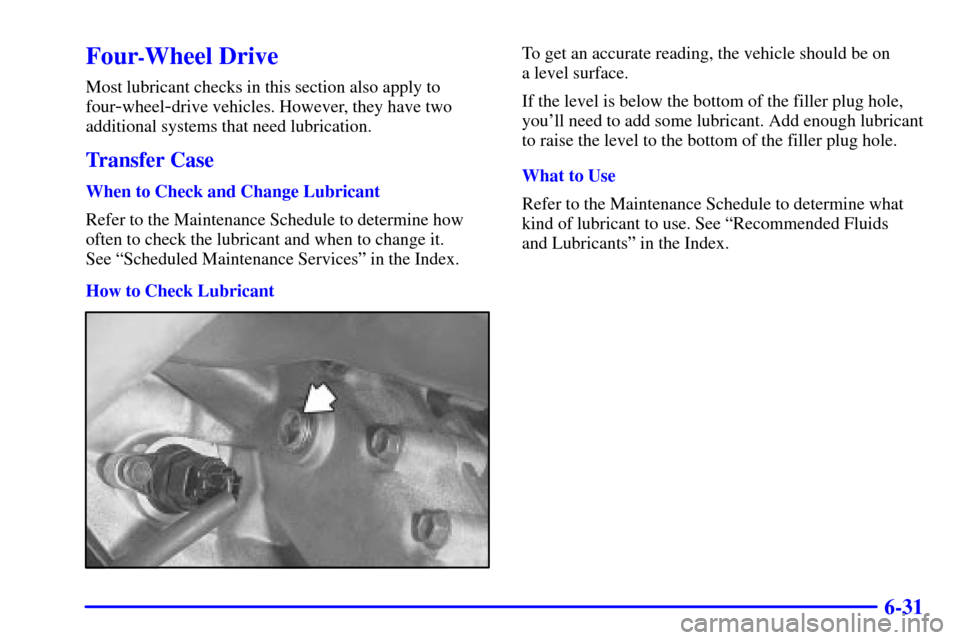
When to Check and Change Lubricant
Refer to the Maintenance Schedule to determine how
often to check the lubricant and when to change it.
See ªScheduled Maintenance Servicesº in the Index.
How to Check Lubricant
To get an accurate reading, the vehicle should be on
a level surface.
If the level is below the bottom of the filler plug hole,
you'll need to add some lubricant. Add enough lubricant
to raise the level to the bottom of the filler plug hole.
What to Use
Refer to the Maintenance Schedule to determine what
kind of lubricant to use. See ªRecommended Fluids
and Lubricantsº in the Index.