Page 35 of 497

1-28
When should an air bag inflate?
An air bag is designed to inflate in a moderate to severe
frontal or near
-frontal crash. The air bag will inflate
only if the impact speed is above the system's designed
ªthreshold level.º If your vehicle goes straight into a
wall that doesn't move or deform, the threshold level is
about 9 to 16 mph (14 to 26 km/h). The threshold level
can vary, however, with specific vehicle design, so that
it can be somewhat above or below this range. If your
vehicle strikes something that will move or deform, such
as a parked car, the threshold level will be higher. The
air bag is not designed to inflate in rollovers, rear
impacts, or in many side impacts because inflation
would not help the occupant.
In any particular crash, no one can say whether an air
bag should have inflated simply because of the damage
to a vehicle or because of what the repair costs were.
Inflation is determined by the angle of the impact and
how quickly the vehicle slows down in frontal or
near
-frontal impacts.
The air bag system is designed to work properly under a
wide range of conditions, including off
-road usage.
Observe safe driving speeds, especially on rough terrain.
As always, wear your safety belt. See ªOff
-Road
Drivingº in the Index for more tips on off
-road driving.What makes an air bag inflate?
In an impact of sufficient severity, the air bag sensing
system detects that the vehicle is in a crash. The sensing
system triggers a release of gas from the inflator, which
inflates the air bag. The inflator, air bag and related
hardware are all part of the air bag modules inside the
steering wheel and in the instrument panel in front of the
right front passenger.
How does an air bag restrain?
In moderate to severe frontal or near
-frontal collisions,
even belted occupants can contact the steering wheel or
the instrument panel. Air bags supplement the protection
provided by safety belts. Air bags distribute the force of
the impact more evenly over the occupant's upper body,
stopping the occupant more gradually. But air bags
would not help you in many types of collisions,
including rollovers, rear impacts and many side impacts,
primarily because an occupant's motion is not toward
those air bags. Air bags should never be regarded as
anything more than a supplement to safety belts,
and then only in moderate to severe frontal or
near
-frontal collisions.
Page 38 of 497

1-31
This switch should only be turned to AIR BAG OFF if
the person in the right front passenger's position is a
member of a passenger risk group identified by the
national government as follows:
Infant. An infant (less than 1 year old) must ride in the
front seat because:
�my vehicle has no rear seat;
�my vehicle has a rear seat too small to accommodate
a rear
-facing infant seat; or
�the infant has a medical condition which, according
to the infant's physician, makes it necessary for the
infant to ride in the front seat so that the driver can
constantly monitor the child's condition.Child age 1 to 12.A child age 1 to 12 must ride in the
front seat because:
�my vehicle has no rear seat;
�although children ages 1 to 12 ride in the rear
seat(s) whenever possible, children ages 1 to 12
sometimes must ride in the front because no space is
available in the rear seat(s) of my vehicle; or
�the child has a medical condition which, according
to the child's physician, makes it necessary for the
child to ride in the front seat so that the driver can
constantly monitor the child's condition.
Page 39 of 497
1-32
Medical Condition.A passenger has a medical
condition which, according to his or her physician:
�causes the passenger air bag to pose a special risk
for the passenger; and
�makes the potential harm from the passenger air bag
in a crash greater than the potential harm from
turning off the air bag and allowing the passenger,
even if belted, to hit the dashboard or windshield
in a crash.
CAUTION:
If the right front passenger's air bag is turned off
for a person who isn't in a risk group identified
by the national government, that person won't
have the extra protection of an air bag. In a
crash, the air bag wouldn't be able to inflate and
help protect the person sitting there. Don't turn
off the passenger's air bag unless the person
sitting there is in a risk group.
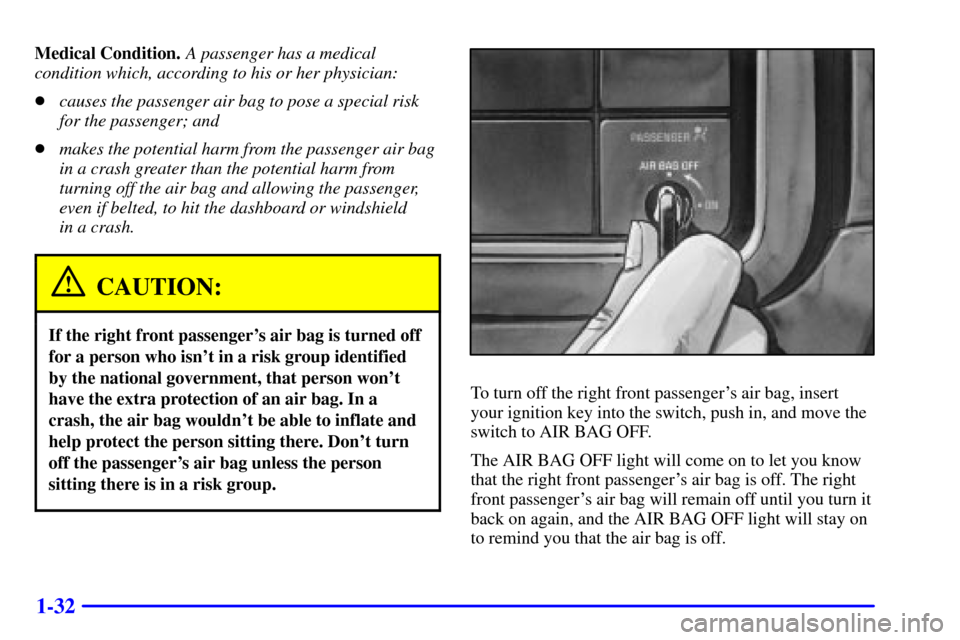
To turn off the right front passenger's air bag, insert
your ignition key into the switch, push in, and move the
switch to AIR BAG OFF.
The AIR BAG OFF light will come on to let you know
that the right front passenger's air bag is off. The right
front passenger's air bag will remain off until you turn it
back on again, and the AIR BAG OFF light will stay on
to remind you that the air bag is off.
Page 42 of 497
1-35
Q:What if I add a snow plow? Will it keep the air
bags from working properly?
A:We've designed our air bag systems to work
properly under a wide range of conditions,
including snow plowing with vehicles
equipped with the optional Snow Plow Prep
Package (RPO VYU). But don't change or defeat
the snow plow's ªtripping mechanism.º If you do,
it can damage your snow plow and your vehicle,
and it may cause an air bag inflation.
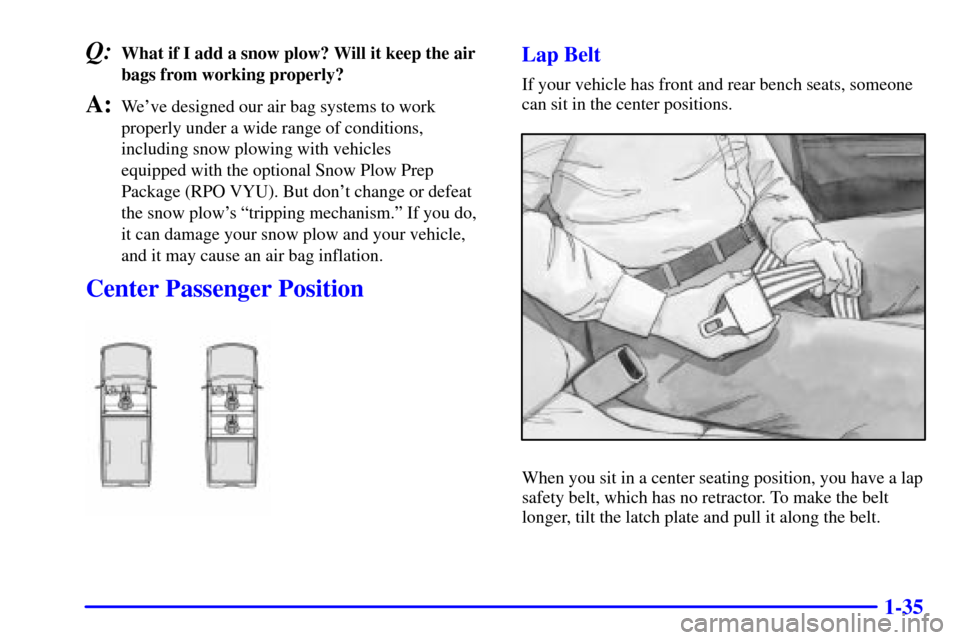
Center Passenger Position
Lap Belt
If your vehicle has front and rear bench seats, someone
can sit in the center positions.
When you sit in a center seating position, you have a lap
safety belt, which has no retractor. To make the belt
longer, tilt the latch plate and pull it along the belt.
Page 181 of 497
2-101
CAUTION:
If the air bag readiness light ever comes on when
you have turned off the air bag, it means that
something may be wrong with the air bag system.
The right front passenger's air bag could inflate
even though the switch is off.
If your vehicle is a regular cab pickup and this
ever happens, don't let anyone whom the
national government has identified as a member
of a passenger air bag risk group sit in the right
front passenger's position (for example, don't
secure a rear
-facing child restraint in your
vehicle) until you have your vehicle serviced.
If your vehicle is an extended cab pickup and this
ever happens, don't let anyone whom the
national government has identified as a member
of a passenger air bag risk group sit in the right
front passenger's position (for example, don't
secure a rear
-facing child restraint in the right
front passenger's seat) until you have your
vehicle serviced.
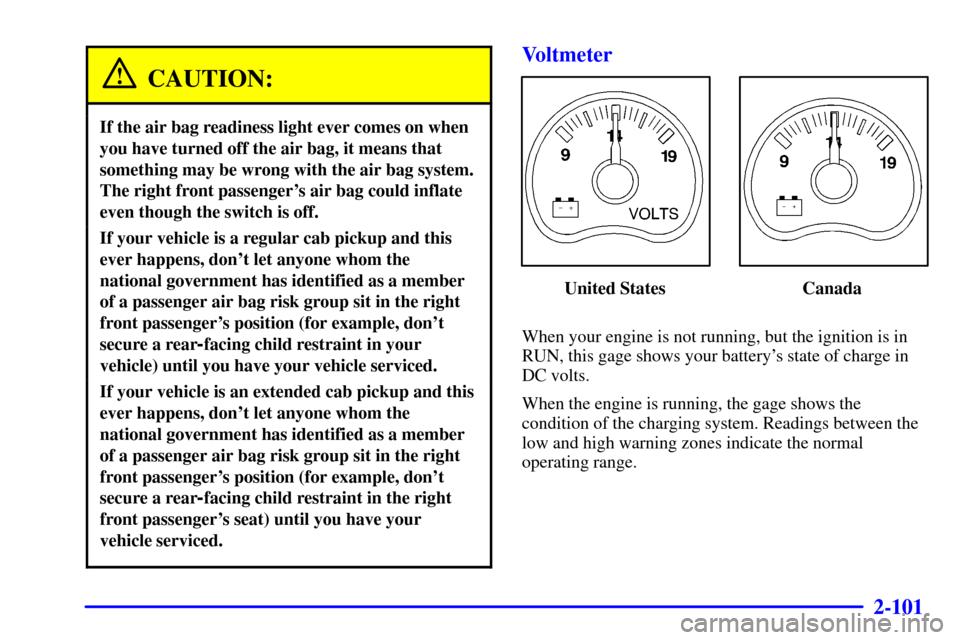
Voltmeter
United States Canada
When your engine is not running, but the ignition is in
RUN, this gage shows your battery's state of charge in
DC volts.
When the engine is running, the gage shows the
condition of the charging system. Readings between the
low and high warning zones indicate the normal
operating range.
Page 189 of 497

2-109
NOTICE:
Modifications made to the engine, transmission,
exhaust, intake or fuel system of your vehicle or
the replacement of the original tires with other
than those of the same Tire Performance Criteria
(TPC) can affect your vehicle's emission controls
and may cause the SERVICE ENGINE SOON or
CHECK ENGINE light to come on.
Modifications to these systems could lead to
costly repairs not covered by your warranty. This
may also result in a failure to pass a required
Emission Inspection/Maintenance test.
This light should come on, as a check to show you it is
working, when the ignition is on and the engine is not
running. If the light doesn't come on, have it repaired.
This light will also come on during a malfunction in one
of two ways:
�Light Flashing
-- A misfire condition has been
detected. A misfire increases vehicle emissions and
may damage the emission control system on your
vehicle. Dealer or qualified service center diagnosis
and service may be required.
�Light On Steady
-- An emission control system
malfunction has been detected on your vehicle.
Dealer or qualified service center diagnosis and
service may be required.
Page 195 of 497
2-115
Message Center
The message center is located on the left side of the
instrument panel cluster. It gives you important safety
and maintenance facts. When you turn the ignition on,
the entire center lights up for just a few seconds. As
needed, the message center will display one of the
following messages. The message center is capable of
alternating among different messages if needed.
Battery
If this message is displayed
when the engine is running,
you may have a problem
with your charging system.The battery display will also stay on while the key is in
RUN until the engine is started.
If the message stays on after starting the engine it could
indicate a problem with the generator drive belt, or some
other charging system problem. Have it checked right
away. Driving with this message displayed could drain
your battery.
If you must drive a short distance with this message
displayed, it helps to turn off all your accessories, such
as the radio and the air conditioner.
Page 198 of 497
2-118
Low Coolant
This message is displayed
when the cooling system is
low on coolant.
The engine may overheat. See ªEngine Coolantº in the
Index and have your vehicle serviced as soon as you can.
Check Coolant Temp
This message is displayed
when the cooling system
temperature gets hot.
Check the coolant temperature gage and the coolant
level. See ªEngine Coolantº and ªEngine Coolant
Temperature Gageº in the Index. See ªEngine
Overheatingº in the Index for further information.
Engine Overheated
This message is displayed
when the cooling system
temperature gets too hot.
This message will be displayed after the air conditioning
system has automatically turned off for the engine
coolant protection mode. See ªEngine Overheatingº in
the Index for further information.